I'm a retired engineer as well and with a post-retirement plan in mind, took over the multiple Raise3D (FDM) printers at work, since the young engineers couldn't be bothered with taking care of their hardware. One of them had been idle for a year (these were $6k each) so after fixing that one, (capable of 36" tall prints) calibrated the others, before modifying them to increase reliability as well as writing maintenance procedures that got the company's (Raise3D) attention. The Raise3D US rep in LA contacted me after I posted them online and asked if they could use them. He even offered me a great deal when I told him I planned to print as a full-time hobby when I retired. A year before I pulled the plug, I got into resin printing, and lost interest in FDM printers.
Logs: First off, if you haven't done so already, I highly recommend starting a logbook for each printer. I record each print, the time it took, (for monitoring the LED life) how it turned out, and add post-print notes, and when applicable, any maintenance performed. This was invaluable in teaching me to become a better maker.
IPA: Are you using a wash station? These do a decent job of cleaning but use a lot of IPA (91 only for me) which gets expensive over time. You can get comparable results and save a small fortune on IPA by cleaning your parts with an IPA-filled spray bottle. I use less than two liters a year now.
Cleaning: I always hang the build plate diagonally to let the excess resin drip back into the vat for at least an hour. Once removed, I wipe the build plate with a paper towel sprayed with IPA to remove the low hanging fruit on the non-printing side. This means less resin gets into the water later.
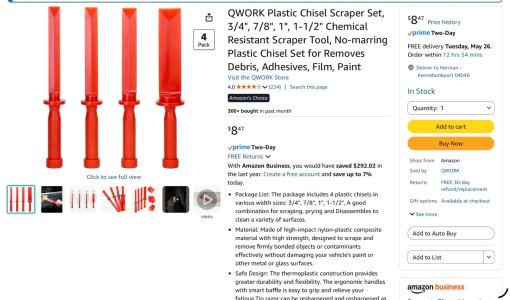
I place two Tupperware containers slightly larger than the build plate side by side. In one I spray the parts with IPA over the trash can initially, which reduces the contamination of the "clean" Tupperware container later. The clean water container contains hot water. I place the build plate into the water which is just deep enough to cover the rafts. Once the build plate heats up, the rafts are easily removed with the before-mentioned metal scraper. (A plastic scraper would not be able to dislodge the rafts, such is their adhesion to the plate.) I only use the angles rafts for small parts, the rest of my parts use a honeycomb pattern for a raft. (I'm using Chitubox Pro after checking out the other mainstream slicers.) My 3D design software has a function that tests the part for watertight integrity so I don't need to use the slicer's repair function which can add unneeded geometry.
Once the parts are in the water, I thoroughly wipe down the build plate removing even more resin that clung to it in the water with another paper towel, before cleaning it with IPA for the next print session.
At this point, I have a few paper towels in the trash, and pour the first container with a few tablespoons of IPA over the paper towels, where it quickly evaporates. For those times when the IPA can become overpowering, I put the trash can outside for a few minutes rather than stink up the garage. Living in Phoenix, I'm lucky this house has a dedicated heat pump for the garage so I'm able to print year-round in a thermally stable environment.
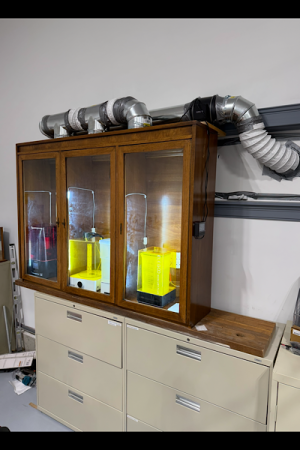
By the time the build plate is re-installed, it's time to pull the parts out of the water. I usually give them another quick spray of IPA, wait a minute, and submerge them in the water, which tells me if they're clean or not. With that done, I use compressed air to blow-dry the parts over the trash can with paper towels in it, and (another benefit of living in AZ) place them outside where they cure quickly. I haven't used my cure station in a couple of years. I'm about to get a larger printer (Phrozen Sonic Mega MK S with an 11.8" Z-height) which will speed up production considerably with fewer hull joints to fill.
I have a Phrozen Cure Beam (small, wand-type UV source) for curing seams and any divots -if showing. I fill the (hull) seams with resin, using a jeweler's oiler, hit them with the wand for a few seconds and continue to the next section needing coverage. I highly recommend these if you have multiple parts with butt joints as I do. Some of my submarines are close to five feet in length so there are plenty of joints to smooth over.
I pour the used water into a clear container, and place it in the sun for a day to let the resin cure and settle, then pour the container into another using multiple paper filters. The original container goes in the trash and the cleaned water is poured out and it becomes the next container for printing. We always have clear containers around the house that held juice, etc. and I grab each when their original purpose is done. Both Tupperware containers are cleaned with IPA-soaked paper towels and are ready for the next cleaning cycle. A large portion of the IPA that settles in the Tupperware container sticks to the food-grade plastic (PE?) and is removed with an IPA-soaked paper towel, making less of a hassle when cleaning the water later.
Because I spend a lot of time researching and designing my models, there can be two or three-month gaps between printing cycles. A typical submarine class takes me about four to six months to research, design, print the first revision, then revise where necessary before the 3D file is locked down. After that, the fun part begins-assembly and painting.
The big takeaway here, is you can save a lot of money spraying your parts with IPA rather than submerging them in it - like I used to do when I was a beginner. I was easily going through a couple of liters a month compared to the same amount lasting a year or more once someone educated me to using a spray bottle.
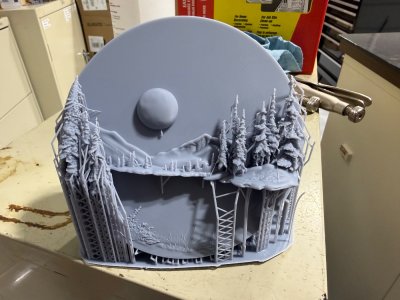
Along the way, I've been investing in all sorts of niche tools to improve the detail of the parts, like 90-degree edge scrappers and micro drills for cleaning out any holes that need it. I just found a pricey set of scribes, which I've added to my acquisition list. Most of my large parts are designed with press-fit tolerances and indexing features to ensure tight alignment -especially when bonding adjacent hull sections. The Parche model at 53" has twenty-four hull sections (top and bottom halves). The larger printer will allow for large diameter 1/72 hulls to be printed in one piece. For the 1/144 hulls, one build plate should be able to handle an entire hull. All of my work is done with ABS-like resin. It's not brittle, and doesn't deform -even under AZ summer sun.
Hope this gives you food for thought. If you have any questions, fire away and I'll help if I can.
CC