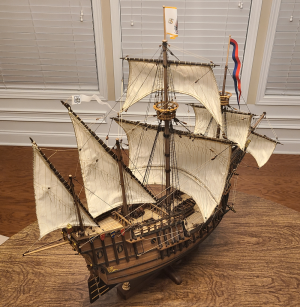
Thanks everyone. Yes my mother was a master machinist - she did this at home when my brother and I were young - with an old treadle machine to help with the family finances. In later years she had a fully computerised machine and doing stitched tablecloths etc was her hobby while my dad worked in his "shed" making wooden things for the family. Luckily my younger sister is good with the sewing machine so after your advice I am going to outsource the sail making. She lives on the other side of our country but on my next trip over I am going to take the raw sails over and bribe her with a bottle of good red wine to run them up for me. In the meantime I'll plod on with rigging my Occre SS Essex model. Cheers.

-

SUBSCRIBE TO SHIPS IN SCALE TODAY!
The beloved Ships in Scale Magazine is back and charting a new course for 2026!
Discover new skills, new techniques, and new inspirations in every issue.
NOTE THAT OUR NEXT ISSUE WILL BE MARCH/APRIL 2026 -

Win a Free Custom Engraved Brass Coin!!!
As a way to introduce our brass coins to the community, we will raffle off a free coin during the month of August. Follow link ABOVE for instructions for entering.
You are using an out of date browser. It may not display this or other websites correctly.
You should upgrade or use an alternative browser.
You should upgrade or use an alternative browser.


Hi, BigBad. It is important to mention that my sail fabric was painted with water diluted (50 - 50) acrylic medium to keep it flat when constructing the sail. This helps the sail to keep its new shape after wetting and fan drying. I am sure acrylic medium can be even more successfully replaced by water diluted PVA glue also at 50-50 rate. Sail wetting is done from spray bottle.
- Joined
- Sep 20, 2024
- Messages
- 6
- Points
- 43

Please give me some advice on thread for sewing canvases. I'm new to the hobby (I've been doing it for about 3 years), but I'm quite passionate and want to sew my own canvases. My question is, which thread would you choose between Gutermann sew all thread, Mara 120 and Skala 200? I've settled on sew all thread, but I'd like to hear your opinion too.
My suggestion is do not sew the sails. This will look awfully out of scale even with thinnest threads and minimal stitch lengths. Construct the sail using acrylic medium as a glue. Vertical seams between canvass strips are imitated by drawing lines with very hard lead pencil.Please give me some advice on thread for sewing canvases. I'm new to the hobby (I've been doing it for about 3 years), but I'm quite passionate and want to sew my own canvases. My question is, which thread would you choose between Gutermann sew all thread, Mara 120 and Skala 200? I've settled on sew all thread, but I'd like to hear your opinion too.
- Joined
- Aug 26, 2023
- Messages
- 106
- Points
- 88

I always wanted to make my sails look "heavy" and found I just couldn't get there with fabric. So I turned to silkspan. It works really well. You can re-wet it any number of times. It also takes acrylic paint very well so I could easily add weathering and fading. I use pencils in different shades to simulate stitching.My suggestion is do not sew the sails. This will look awfully out of scale even with thinnest threads and minimal stitch lengths. Construct the sail using acrylic medium as a glue. Vertical seams between canvass strips are imitated by drawing lines with very hard lead pencil.

- Joined
- Apr 3, 2023
- Messages
- 265
- Points
- 138

Sadly, what I've seen is that the machines have been tossed and the buyers repurpose the tables they were mounted in. Kind of a shame...Thanks Darivs. My ex-wife and I were just reminiscing about the old Singers our grandmothers used- they had foot pedals instead of electric to operate the machine, so you didn’t need electricity to run them. They had rocker pedals and a pulley system to turn the device and bob the needle up and down. I guess it was Singer’s original design. Boy, they probably cost a lot of money nowadays as antiques lol. Amazing to see the technology that developed. Like shipbuilding!
My mother (now long deceased) used one of those treadle powered sewing machines (yes, a Singer), right up until the 1990's. I bought her an electric machine with all sorts of fancy stitches and other features, and she absolutely hated it. I ended up having to return it a few weeks later and she went back to her beloved foot powered machine. Still... foot powered seems better than the ones I've seen out of Asian markets that are hand cranked (right hand cranking while the left hand somehow manages all the material handling). I have neither the dexterity or skill for either scenario.



- Joined
- Oct 13, 2021
- Messages
- 32
- Points
- 48

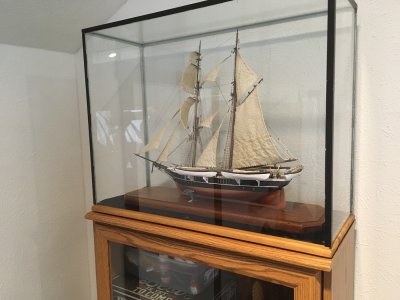
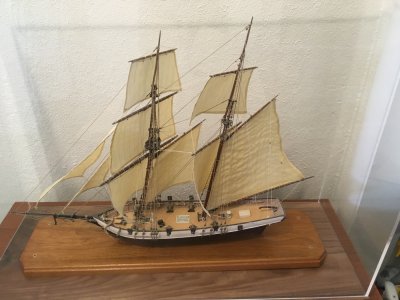
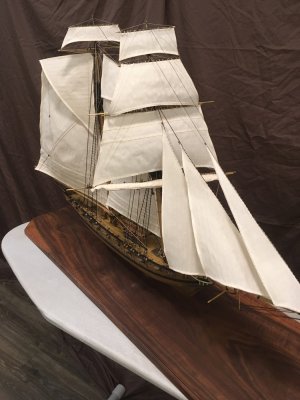
I have made three boats with full sails. On the first two I shaped the sails over wine bottles. I used a clear shellac to get them to hold their shape. They are still holding their shape since 1983. On my most recent build, the Prince de Neufchatel, the sails were too big for wine bottles. So I used large balloons of various sizes. I used a water based clear polyurethane to get them to hold their shape.Hi guys and gals!
I’m a relative novice and I’m learning to make sails. My problem is that I’m trying to get a slight “bowing” of my sails to simulate wind-filled sails on my schooner. I used a roll of a plastic “foam” as a base (as a form then covering it with wax paper and the airbrushing a light application of white acrylic paint on them and let them dry hoping they would stiffen up and achieve the proper curve but after they dried they were still limp and it didn’t work.
I was thinking of applying dilute white PVA glue with a paint brush and letting it dry on the form but I don’t want to mess it up.
Can anyone advice me of a good technique?
Also, I sewed in a thin wire on the bottom of the sails to help shape them. I used a stiff wire instead of thread as sheets to hold them away from the ship so they appear to be in a strong wind. The thin stiff wire on the bottom of the sails was necessary for attaching the stiff "sheet" to them. Otherwise the sail would have eventually bent at the corner where the sheet is attached.
Thanks again YT. I’ll try both the dilute acrylic and dilute PVA glue. I’m gonna experiment with both techniques. I have a good amount of white cotton so I’m thinking maybe the dilute PVA might be good because if I use the tan one it might slightly color the material a little beige or I can use a beige or cream colored acrylic.
John, thanks for your contribution. Interestingly, I also bought several large balloons to use to shape my sails although I haven’t used them yet. I just made a couple of sails for my Herreshoff 12 1/2 using two “helping hands” to hold the sail corners with dilute PVA glue to stiffen them and it worked very well. I didn’t use a weight like Batcherov, I just brought the corners together a little and it worked fine because the glue weighted down the material.
I’m going to try the balloons with clear water-based polyurethane for the sails on my Bluenose schooner which has a larger mainsail.
Interesting idea about using the wire. Looks great!
I’m going to try the balloons with clear water-based polyurethane for the sails on my Bluenose schooner which has a larger mainsail.
Interesting idea about using the wire. Looks great!
Guys,
I’ve tried a couple of methods to try to get a curve to my schooner sails (like wind-filled) but I noticed something: when I applied diluted PVA glue or fabric stiffener (I bought it in Michael’s) the sails “crinkled” and look awful. (I see that on a lot of photos of builds.) I noticed that it happened when I sewed “seams” in the sails but didn’t when I did not sew the seams. I think the sewed seams somehow contract as the glue dries.
Is there a way to prevent the wrinkling? I haven’t tried diluted acrylic glue yet.
I read in Mastini’s book that he sprays a light coat of white acrylic paint on the sails after placing them on a form (I used a rig with weighted plastic bags, balloons and a roll of plastic foam).
Any suggestions? Maybe I should just use a pencil to mark the seams?
I’ve tried a couple of methods to try to get a curve to my schooner sails (like wind-filled) but I noticed something: when I applied diluted PVA glue or fabric stiffener (I bought it in Michael’s) the sails “crinkled” and look awful. (I see that on a lot of photos of builds.) I noticed that it happened when I sewed “seams” in the sails but didn’t when I did not sew the seams. I think the sewed seams somehow contract as the glue dries.
Is there a way to prevent the wrinkling? I haven’t tried diluted acrylic glue yet.
I read in Mastini’s book that he sprays a light coat of white acrylic paint on the sails after placing them on a form (I used a rig with weighted plastic bags, balloons and a roll of plastic foam).
Any suggestions? Maybe I should just use a pencil to mark the seams?

Are you referring to the panel seams or outer seams? If your scale is smaller than 1:12 sewn seams will look out of scale penciling in the panel seams is a classic solution.when I sewed “seams” in the sails but didn’t
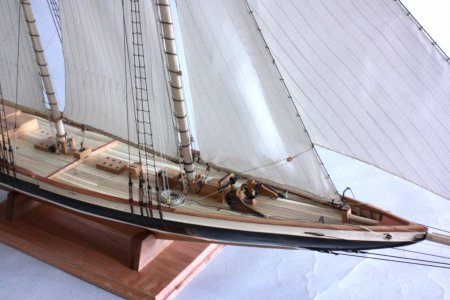
The below are not billowing sails, but you can see the results using pencil on the first photo and marker on the other photo
Cloth sails with penciled panel seams
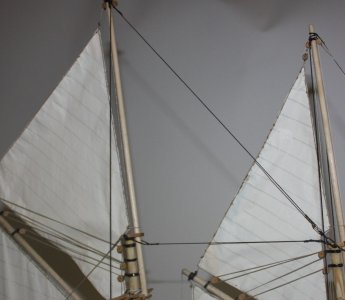
Another alternative is to make the sails with silkspan. The seams can be painted on using a marker pen. The nib can be trimmed to the width you want and it will look a lot like the actual overlap of the panels.

I think using fine pencil marks would be the way to go. Oft times sewing seams in the sail material is out of scale,Guys,
I’ve tried a couple of methods to try to get a curve to my schooner sails (like wind-filled) but I noticed something: when I applied diluted PVA glue or fabric stiffener (I bought it in Michael’s) the sails “crinkled” and look awful. (I see that on a lot of photos of builds.) I noticed that it happened when I sewed “seams” in the sails but didn’t when I did not sew the seams. I think the sewed seams somehow contract as the glue dries.
Is there a way to prevent the wrinkling? I haven’t tried diluted acrylic glue yet.
I read in Mastini’s book that he sprays a light coat of white acrylic paint on the sails after placing them on a form (I used a rig with weighted plastic bags, balloons and a roll of plastic foam).
Any suggestions? Maybe I should just use a pencil to mark the seams?
Rob
Absolutely. It is going to be out of scale unless the model is about 1:6 scale or larger. From what I have been able to find, the panel stiches in the 18th century were about 3 stiches per inch. At 1:64 that is a stitch every 0.13 mm. (0.08mm at 1:98) Sewing machines are hard pressed to have stitches spaced less than 0.5mm.Oft times sewing seams in the sail material is out of scale,
Allan
Just out of curiosity, as I am thinking in the future of adding sails to my Bluenose build (whenever that is finished) and am thinking of using silkspan. Can silkspan be sewn?Absolutely. It is going to be out of scale unless the model is about 1:6 scale or larger. From what I have been able to find, the panel stiches in the 18th century were about 3 stiches per inch. At 1:64 that is a stitch every 0.13 mm. (0.08mm at 1:98) Sewing machines are hard pressed to have stitches spaced less than 0.5mm.
Allan
Rob
Not that I have ever seen, but who knows. It can be painted and parts like the reinforcing pieces, ,edge seams and bolt rope can glued by brushing on matte medium. A great book by David Antscherl on making these is available for $5 at SeaWatch Books. https://seawatchbooks.com/products/...vised-and-expanded-edition-by-david-antscherlCan silkspan be sewn?
Allan
Thank you I will certainly be purchasing it. I also know there are several you tube videos on using silkspan by Tom Lauria.Not that I have ever seen, but who knows. It can be painted and parts like the reinforcing pieces, ,edge seams and bolt rope can glued by brushing on matte medium. A great book by David Antscherl on making these is available for $5 at SeaWatch Books. https://seawatchbooks.com/products/...vised-and-expanded-edition-by-david-antscherl
Allan
Rob
That is all 100% true, but I think we add a lot of detail to our models that would not really be visible on the original, seen from the same real world distance. Stitched sails is one. Treenails is another - we clearly see them on models from a foot away, yet from a distance of 50 to 75 feet, you'd never see them on a real ship. Yet they are a real indicator of outstanding craftsmanship and attention to detail. Something I've never been able to do, but still have hope. I /have/ stitched sails, even after trying the pencil technique, and just like the look, unrealistically large and noticeable or not.Absolutely. It is going to be out of scale unless the model is about 1:6 scale or larger. From what I have been able to find, the panel stiches in the 18th century were about 3 stiches per inch. At 1:64 that is a stitch every 0.13 mm. (0.08mm at 1:98) Sewing machines are hard pressed to have stitches spaced less than 0.5mm.
Allan
You are right about that but should we have them jumping out and staring us in the face like a bad case of measles?. Subtlety is sometimes a good thing, but I get that everyone has their own likes and dislikes in our hobby. It can be difficult to make and insert 10,000 treenails in a hull without wanting viewers to notice them right away.we clearly see them on models from a foot away,
For some, not all, builders, the same goes for sails or paint schemes, and a host of other things. We all get to choose and that is a good thing in a hobby.
Allan
Last edited: