• Win a Free Custom Engraved Brass Coin!!!
    As a way to introduce our brass coins to the community, we will raffle off a free coin during the month of August. Follow link ABOVE for instructions for entering.
  • SUBSCRIBE TO SHIPS IN SCALE TODAY!

    The beloved Ships in Scale Magazine is back and charting a new course for 2026!
    Discover new skills, new techniques, and new inspirations in every issue.

    NOTE THAT OUR NEXT ISSUE WILL BE MARCH/APRIL 2026

Scale and Actual Length

@AllanKP69 Example: I've placed the numbers randomly. I don't know the scale, but I want to make it at a 1:72 scale. Can I find the scale of the piece using the measurements? (excuse for my basic english sometimes use to translate)
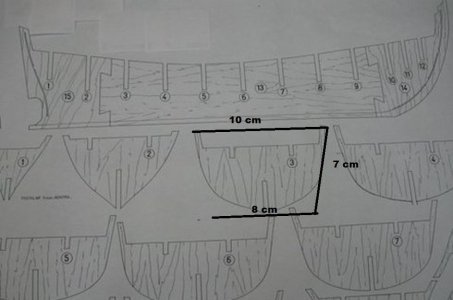

örnek.jpg
 
Whatever translator you are using seems to be really good! Without knowing some actual length of the actual ship, it may be a problem. What ship/year/nation are you interested in building?

Thanks

Allan
 
@AllanKP69 again and again thanks. there isn't a specific model for the problem I'm asking about. However, I'm currently working on a model with a build log. I just wanted to ask what I could do if I ever reach the stage of building from scratch and encounter such a problem.
 
@AllanKP69 This has been bothering me for a long time. Let's say I find a plan, either online or by hand, and I don't know its scale. Can we derive a scale based on the length of any part of the plan? Perhaps I'm confusing things too much, and if so, please forgive me.
Yes, if it's possible to find any data on the ship. Not if it's a made-up model and the plan is fictitious.
 
what I could do if I ever reach the stage of building from scratch and encounter such a problem
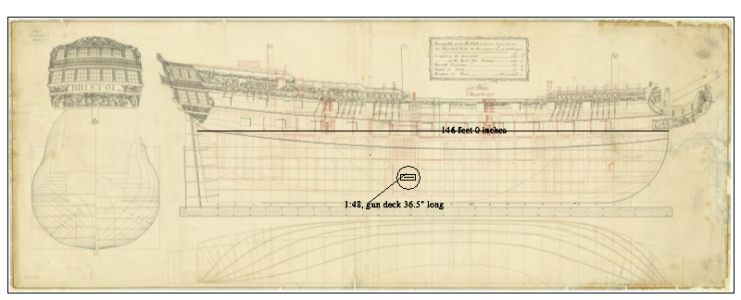
Here is one example of how it can be done, in this case HMS Bristol (50) 1775. There are basic dimensions at the top of the drawing and a scale under the keel in feet and inches. Below I download the drawing and scaled to full size with a gundeck length of 146 feet. In the circle is the same drawing reduced to 1:48 with a gun deck 36.5" long. Once done, delete the full size plan from the drawing and you have a 1:48 scale version that you can print in pieces or take to a printer that can do the scaled drawing. It will be about 56 inches long, For smaller scales it is the same principal. Even a simple CAD program can do this and I think there are still some free ones on line.
Allan

1765909700228.png
 
I don’t use computers so here’s how to do it by hand. First A-4 is the size of the drawing paper and has no relation to the scale of the model drawn on it.

You will need some information about the dimensions of the real vessel that you’re modeling. Length can be iffy as there are several different definitions. The most reliable is maximum beam. Measure your chosen dimension on your drawing. Divide by the corresponding dimension of the actual vessel. The result is the scale. If this is a fictional vessel often favored by kit manufacturers you don’t have the information needed.

Roger
 
The question was answered already about five times in details with examples. If it is still not clear to someone then it is a fundamental problem.
 
@AllanKP69 This has been bothering me for a long time. Let's say I find a plan, either online or by hand, and I don't know its scale. Can we derive a scale based on the length of any part of the plan? Perhaps I'm confusing things too much, and if so, please forgive me.
You have been given the correct answer again and again, but are ignoring it. Imagine photos taken of different sheets of ship plans from different distances - there would be no consistent conversion factor.

Given a similar problem, suppose I have a photo of you standing. How do I simply determine how tall you are? Without more information, that is not possible. Now, if the photo had you standing in front of your '57 Chevy, I could look up the length of the car, determine the scale of the drawing, and from that determine how tall you are.

The only way to scale one set of plans or drawings to another is to 1) Know the scale of the plans you have, and multiply that by the scale you want. Or 2) Know the size of some portion or part on the plan, like the length of the main deck, determine it's scale, and go through step 1.
 
There's a question I've been wondering about for a long time. I've searched online but haven't found much. I'd like to explain my question with an example. For instance, I have a plan the size of an A4 sheet of paper. I want to use this plan to create a 1:72 scale model from scratch. How can I convert the A4 plan to a 1:72 scale?
How can I scale and cut out a model piece on paper, for example, a fake spine?
Hi Kaya
I posted this method a while back and it may suit your needs. If you apply this method below to the exapmle picture you sent you'll see you can calculate all of the dimensions from its overall leght of your picture.

I often ignore the original scale of plans I’ve bought because I build models to suit a space sometimes. I use the ratio and proportion method to translate from the plan actual measurement to measurement I desire. For example if models length on the plan is say 500mm long and I want to make the model only 300mm long you can calculate the dimensions of all measured parts knowing these two numbers.

The layout of the maths is 500mm (Plan measured length) : (is to) 300mm (desired model finished length) AS (measured part from the plan in mm) : (is to) (answer for part you have to make in mm).

In this case say the width of the model is
135mm wide at the midship as measured on the plan. the formula then reads
500 : 300 as 135: x. x being the desire finished length

So...

you multiply the 300x135=40500.

You then divide this number 40500/500=81mm. So the width of the midship of your model will be 81mm.

Another example for clarity,
the bore of the cannon on my plan is 5.25mm diameter.
I want to make my cannon accurately so the bore of my actually cannon would be

500:300 as 5.25: x
(300 x 5.25) / 500= 3.15mm diameter

I usually put this into a spread sheet and just have a cell where I put the measured value from the plan and it spits out the desired length into another cell and I dont have to fluff about with a calculator.

All that’s needed is measuring instruments such as rules, Vernier callipers, dividers etc. ,basic measurement tools really.
The only thing you need to be careful of is sometimes on a plan it will have enlargements of an area, but these are usually highlight with the warning, Not to scale

Hope this helps.
Cheers Rick
 
Here's an example. How can I adapt and crop the fake spine and posts here to a 1:72 scale?

View attachment 564041
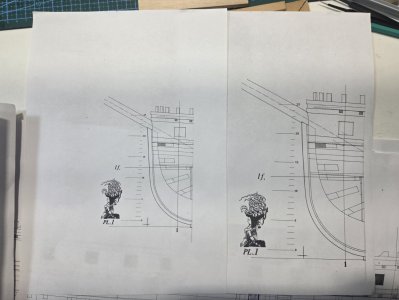
Take the plans you have to a blueprint place and tell them what scale you want. You have to give them one measurement of your plans to apply to the new plan and boom, there's a new plan in the scale you want. Good idea to do this too. Saves a lot of figuring and messing things up when you build from a actual sized plan. That's what I did with the Great Republic. Worked well for me too.
 
5 minutes without leaving home.
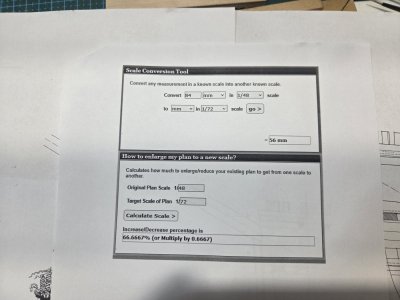
From 1/48 to 1/72, with a ready printout.
Program i recommended even has a percentage conversion rate showing how much you need to increase or decrease your plan.
You don't even have to use brain...
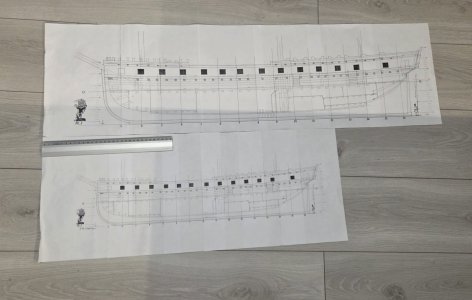
20251220_210458.jpg20251220_210506.jpg
 
That is a great tool to use with ship models but if you need bigger, as I did ,then I think you may need to go to a blueprint shop. My side view of the GR was 18" wide and 8 feet long. Can't tell what size your plans are so you'll have to make that decision.
 
5 minutes without leaving home.
From 1/48 to 1/72, with a ready printout.
Program i recommended even has a percentage conversion rate showing how much you need to increase or decrease your plan.
You don't even have to use brain...
View attachment 565100View attachment 565101
That is all correct, of course, but the Original Poster had no size reference on the original plan, so it is impossible to tell what ratio to multiply by. Nor did he know the scale of the original plan. Yet he expected that known it was on A4 size paper, we should know. As others have said, given any known dimension on the original plan, like ship length or the foot scale shown on your example, it is simple to know the multiplier.

 
That is all correct, of course, but the Original Poster had no size reference on the original plan, so it is impossible to tell what ratio to multiply by. Yet he expected that known it was on A4 size paper, we should know. As others have said, given any known dimension on the original plan, like ship length or the foot scale shown on your example, it is simple to know the multiplier.

He gave an example, but didn't mention anything about ship. I found this plan without any information and gave him correct scale.
That's how it works. Everything is defined.


Let's say I find a plan, either online or by hand, and I don't know its scale. Can we derive a scale based on the length of any part of the plan? Perhaps I'm confusing things too much, and if so, please forgive me.

Yes, you are confusing things a bit. if you have a photo of a person, how can you derive the height of the person?
Your problem is the same.
If you know the person’s actual height, you can work out the scale of the photo. If you know the scale, you have to measure the dimension of the image to work out actual height.
In each case you need to know the actual length of something.

If your ‘photo’ is of a wood, then you need to know its actual length to work out the scale. If you know the scale of your ‘photo’ then you can work out its length.

Maybe you need to research the actual ship to find out its actual length, then you can rescale you ‘photo’ to fit your paper or your desired size.


Jim
 
Back
Top