-
SUBSCRIBE TO SHIPS IN SCALE TODAY!
The beloved Ships in Scale Magazine is back and charting a new course for 2026!
Discover new skills, new techniques, and new inspirations in every issue.
NOTE THAT OUR NEXT ISSUE WILL BE July/August 2026 -
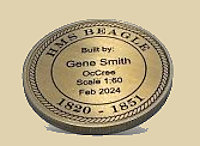
Win a Free Custom Engraved Brass Coin!!!
As a way to introduce our brass coins to the community, we will raffle off a free coin during the month of August. Follow link ABOVE for instructions for entering.


You are using an out of date browser. It may not display this or other websites correctly.
You should upgrade or use an alternative browser.
You should upgrade or use an alternative browser.

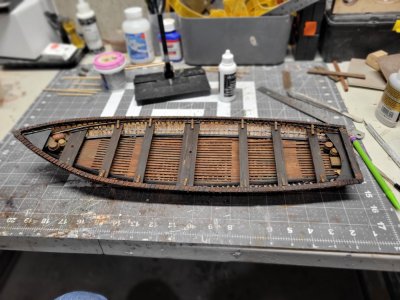


Great job! Looks like a new one!


To the best of my understanding, the leather covering of early currachs was attached to the wooden lattice-like frame only by lacing at the gunwale. This lacing pulls the skin covering tight against the frame, making the hull strong but still flexible. Tim Severin’s Brendan replica and the replica of Columba’s currach from the same era were built this way. This could be simulated by silkspan, although it might tear if the lacing were pulled too tight.Was the leather shrunk/tightened on these boats? If they were, silk span may be worth a try as it will shrink tight on the framing just like on a model plane.
Allan
Seamus
- Joined
- Jun 29, 2024
- Messages
- 2,173
- Points
- 488

25 years ago I became involved in restoring antique wood canvas canoes. A wood canvas canoe is a cedar planked hull over steam bent cedar ribs. The cedar planking is very thin; 5/32” so is not caulked. Instead, the planked hull is covered with #10 cotton duck canvas. After canvassing the hull is then coated with a homemade silica filled goo that cures to a rock hard finish.
Like your currahs the canvas is not bonded to the hull. It is stretched tight; I used a boat trailer winch, and fastened wth tacks along the gunwales, and stem and stern only.
These canoes are manufactured adaptations of the birch bark vessels made by Native American canoe builders. Like your currahs they sewed birch bark panels with spruce roots, waterproofed the seams with pitch and then laced the bark to the frame only at the gunwales, stem and stern.
Roger
Last edited:
I’ve been enjoying the autumn these last couple of weeks and so no work in the shipyard. I’ve been thinking about the project, though, specifically the leather used to make the hull of the curragh, and here are some rambling thoughts about cows. (I’m a life-long celt-ophile and these are some of the miscellanea I’ve picked up over the years.)
Cows were absolutely central to life in ancient Ireland. Because the Celts had no coinage, cows were the unit of value by which payments were made for such things as brides, fines, buying land, etc. Those who owned cattle were the elite of society and that was what distinguished princes and kings from the common man. The Irish used cattle primarily to produce dairy products like milk and cheese and butter—when they ate meat, it was usually boar or pork. The size of one’s herd determined one’s place in society.
In order to keep milk cows fresh, the Irish would slaughter the calves. Perhaps this is the reason that they early became adept at making vellum and writing books as early as the 5th century. Of course, those books were written on vellum in monasteries which meant that Abbeys had their own herds of cattle. Only a few bulls are required to maintain a herd and so the males were often slaughtered as calves or castrated so the oxen could be used in the fields. Calves provided the vellum a monastery needed to make books along with sheep and goats. The oxen produced the “ox skins” that Brendan used to create the hull of his boat.
The difference between leather and vellum is in the tanning—leather is, vellum isn’t. And so it is not surprising that Irish monks would have been experts in cow hides—producing “paper” as well as high-quality leather.