

• Ships of Scale has incorportated an extra level of security when you log In. Please follow on-screen prompts to acknowledge that you are not a robot via a "Check Box" or a "Pictorial Check Box Puzzle". This is needed due to higher level of AI Activity Security.
  • SUBSCRIBE TO SHIPS IN SCALE TODAY!

    The beloved Ships in Scale Magazine is back and charting a new course for 2026!
    Discover new skills, new techniques, and new inspirations in every issue.

    NOTE THAT OUR NEXT ISSUE WILL BE July/August 2026
  • Win a Free Custom Engraved Brass Coin!!!
    As a way to introduce our brass coins to the community, we will raffle off a free coin during the month of August. Follow link ABOVE for instructions for entering.

Soleil Royal by Heller - an Extensive Modification and Partial Scratch-Build by Hubac’s Historian

Thank you, Paul! I hope you are enjoying your travels!

Johann, in my estimation you stand at the very top of the art and craft of ship modeling. To receive such a compliment from you is very rewarding. Thank you!

Among the many losses at MSW was my connection to modelers and their builds, like your incomparable La Creole.

Just yesterday, I learned that Chuck Passaro and Jim Hatch started a new forum, DryDockModeler. I see a number of friends, there, and am considering creating a profile.
 
Hello everyone! I hope all are well.

If I’m being completely honest, at this point, it is very tempting for me to ultimately display the model as laid up, in ordinary, with only the lower mast sections and tops rigged with stays and shrouds. This project began in 2017, and I would LOVE to do something different, at this point.

The reason I am considering this, at this particular time, is that I have to run lengths of line for the sprit sheets, the fore and main sheets and tacks to their main deck kevels, before I can continue building upwards. If I weren’t doing a full rig, I wouldn’t bother with those lines.

HOWEVER, my original intent with this project remains a grand image in my mind. I still think it will be fun to try and create these wildly billowing/unfurling shapes for the fore and main topsails. And, so, I will proceed as though I am doing a full rig.

In anticipation of my surgery early next year, I figured I would try to make the yards and upper masts, so that I could use that time to attach all of the accompanying blocks. My mobility, for a while, will be severely limited, and I don’t see myself moving the hull around the apartment as I maneuver around on a knee scooter. Finishing spars, attaching blocks, and maybe finishing the Africa carving are much more manageable tasks for the first six weeks of recovery.

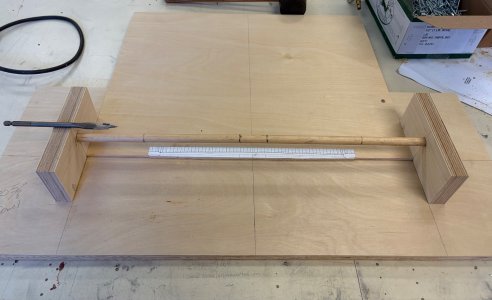
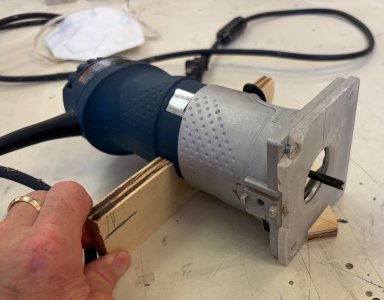
My friend, Dan Pariser, has offered me his mini-lathe, but I have yet to rent a car to go pick it up. I had some downtime at work, so I devised a hand-drill driven router lathe to see whether I could rough-in the various spar tapers. Included among the SP monograph is a sail and spar plan in 1:96. I am using this as the basis of my spar dimensions.

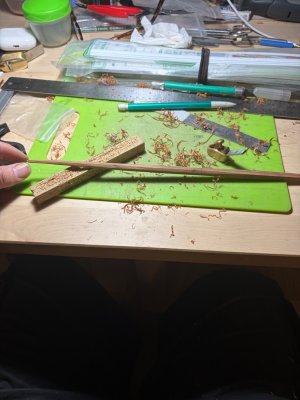
I figured I’d start with the largest, the main yard, and work at making better and better smaller spars. Here is the set-up I devised:

IMG_1372.jpeg
IMG_1374.jpeg

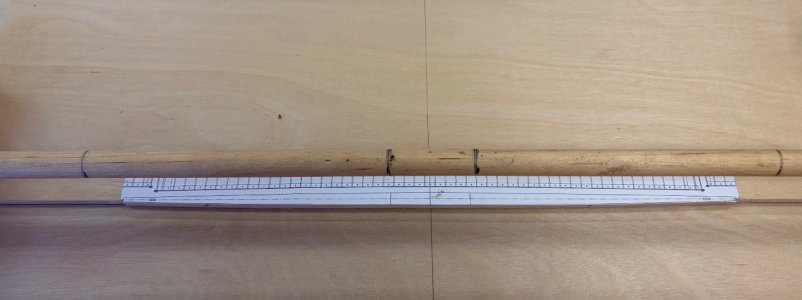
I wanted to include the octagonal flats at the center of the yard, which are proportionally 1/8th the length of the spar:

IMG_1373.jpeg

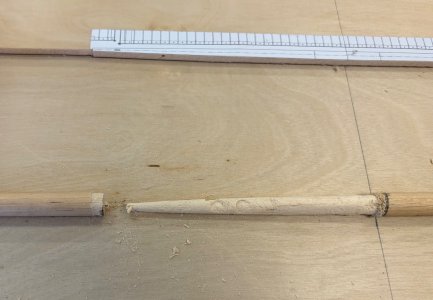
The bottom cutting bit is centered on the turning axis of the lathe. Despite taking as much care as I could manage with one hand guiding the router set-up, and the other powering the drill, I could not really control depth and angle of cut. As the dowel began to thin at the extremes of the spar, a pronounced wobble resulted in the end of this little experiment:

IMG_1375.jpeg

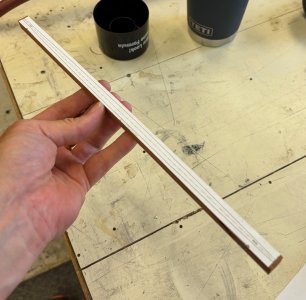
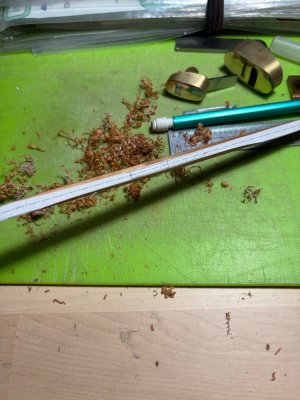
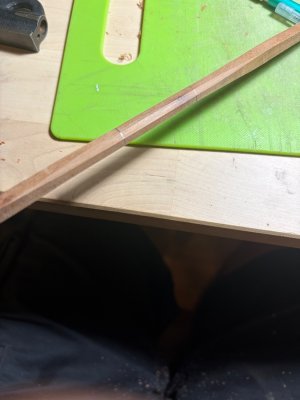
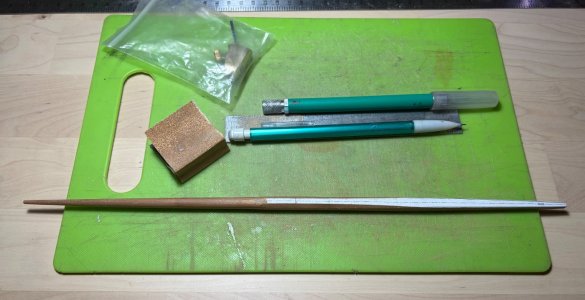
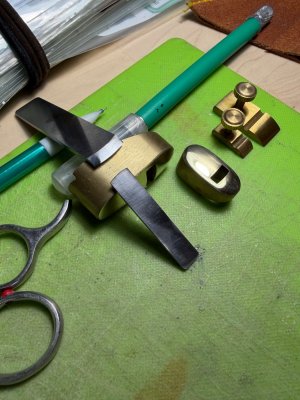
So, next I decided I would take the more traditional approach of bandsawing in two planes, and then using finger planes to micro-bevel into the round:

IMG_1376.jpeg

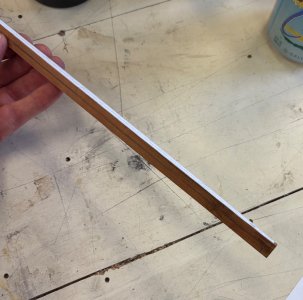
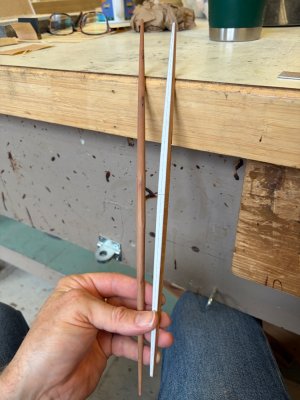
I had found some nice quarter-sawn cherry laying around, and cherry’s natural color has the added advantage, for this application, of appearing to be coated with some kind of preservative pine-tar. This, IMO, is more realistic than the brightness of maple, for example.

IMG_1378.jpeg

I’ve only gotten so far as profiling in one plane, before I was sent out of the shop for a few days. I will be interested to see how my little finger planes perform after a good tune-up.

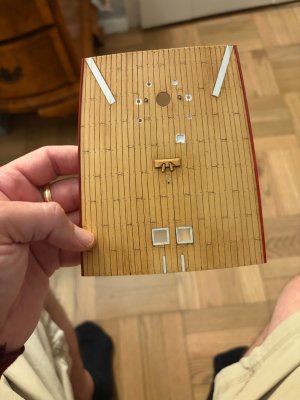
So, in addition to that project, I have drilled for the f’ocsle bitts and painted the f’ocsle deck. While I was careful to mask for the galley chimney bases, and the belfry knees, I neglected to mask for the gun carriage mounts. That’s okay, though, I can trace their footings and scrape paint as I did for the bitts:

IMG_1390.jpeg

I’m also making a bunch of eye-bolts for the gun-carriage rigging. Basically, almost everything I need to assemble the f’ocsle deck is ready and waiting.

Separately, I’ve spent some time playing around with Google Gemini. In a separate thread, member Naima was using Gemini to bring Van de Velde drawings to “life.” All he did was ask Gemini to make the images more photo realistic. I decided to try the same with several of my trove of French VdV portraits.

La Royal Therese:

IMG_1336.jpeg

Le Monarque:

IMG_1334.jpeg

Generally, the better detailed the drawing, the less AI makes non-sensical additions and substitutions.

The Dauphin Royal, 1680:

IMG_1335.jpeg

John Ott’s adaptation of La Reyne;

IMG_1333.jpeg

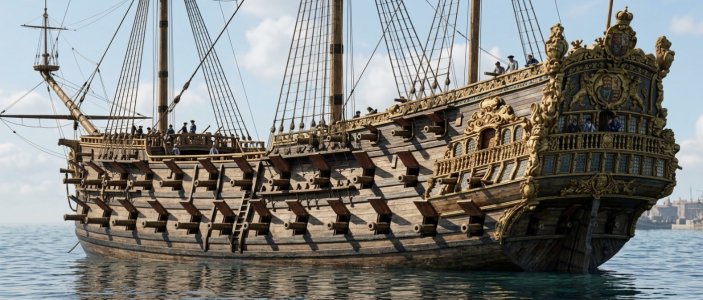
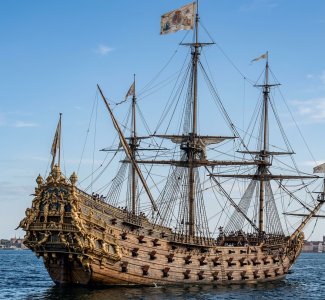
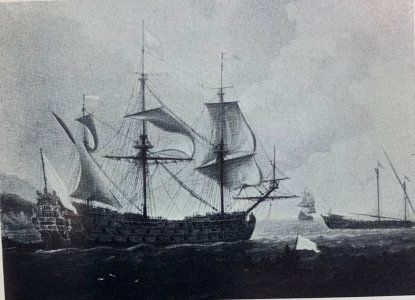
Then, it occurred to me that Gemini could probably improve upon the pixelation of the “Gilded Ghost” photo:

IMG_2022-9-5-084031.jpeg

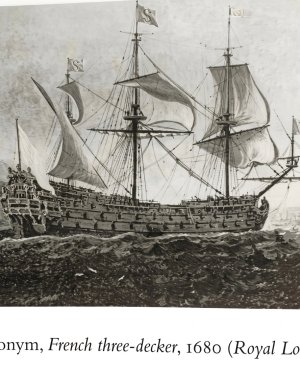
It certainly did!

IMG_1380.jpeg

Interestingly - like the DR portrait above, Gemini included a parenthetical suggestion in the caption that this is the “Royal Lo..”

I think Gemini is correct, in this instance. I think the Gilded Ghost is the Royal Louis. I would still love to find the original portrait, if it still exists, so that I could see the coloration of the ship.

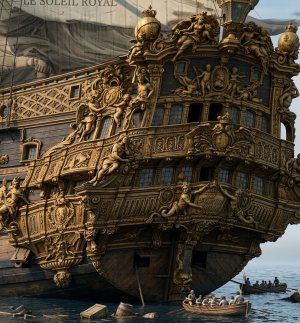
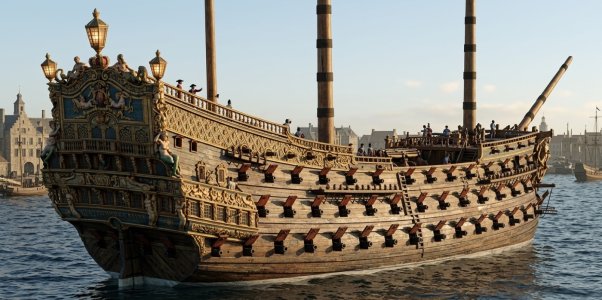
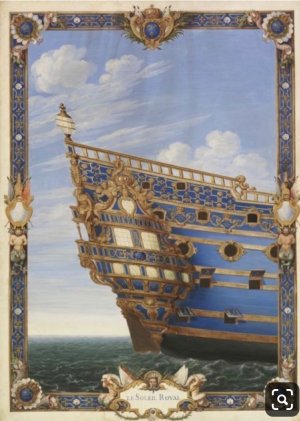
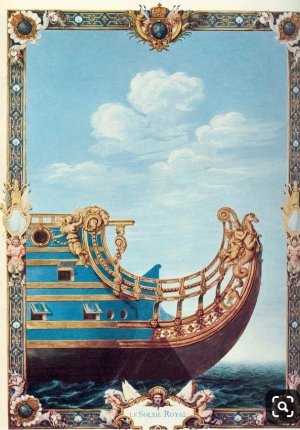
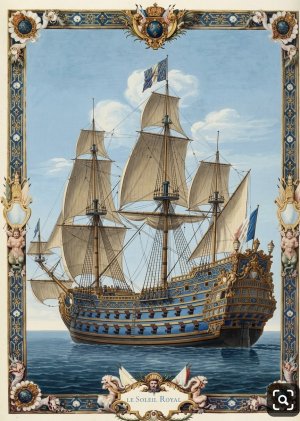
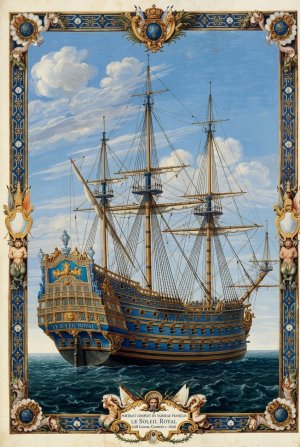
Now thoroughly intrigued by the capability of this tech, I then decided to see whether it could create a fully coherent portrait of the gouache bow and stern portraits:

IMG_2330.jpeg
IMG_2331.jpeg

Within mere seconds, here is what Gemini came up with:

IMG_1381.jpeg

I mean - pretty incredible! Gemini decided on a 5-window transom, and also transposed the QG upper finishing to the stern, which I kind of like, if I’m being honest.

Next, I asked Gemini to incorporate Berain’s gouache stern drawing:

IMG_1383.jpeg

AI is still highly imperfect, and the outputs are entirely dependent upon the quality of inputs, but the capability is, nevertheless, astounding.

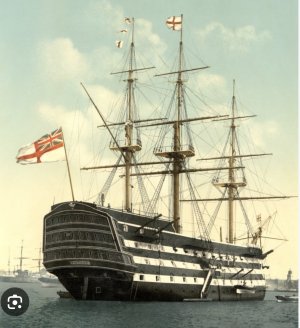
Looking at this portrait brought to mind an old colorized photograph of Victory:

IMG_1394.jpeg

The positioning of Soleil Royal’s name on the stern counter seems a direct crib from this photo, as well as the perspective and general bearing of the ship. Notice, also, the similarity of the tops! I have no way of knowing exactly where and what Gemini pulls from, but this is a plausible illustration of how Gemini pulls from a broad range of related media.

Anyway, SR 1689 is forging ahead on her diorama sea. Thank you for stopping by.

All the best,

M
 
Last edited:
Hello WojtasS, and thank you for the kind words!

I'm not entirely sure what my next project would be, but I think I would like to do a small, fully framed model from a kit, just to get my feet wet on that side of the hobby. La Belle is, of course, a popular subject.

Alternatively, I'm intrigued by the idea of card modeling. Several people are doing the Provincien, in card, and that would make a lovely hull model. Granted, in 1:96, it is not "small."

The other avenue are the resin printed hulls that can be planked over and built up with interior structure. This has really opened up a variety of interesting new subjects.
 
La Belle seems like a good place to start. 7P is also a natural consequence, as recreating the Solei Royal of 1669 or the Reyne of 1671 sounds very difficult, if not impossible. So, going with something Dutch that has been well documented is an interesting alternative. The 7P in Seahorse's 1/96 is 65 cm long only slightly shorter than the Heller SR. Whatever you choose, I'm sure you'll handle it
 
Hello everyone! I hope all are well.

If I’m being completely honest, at this point, it is very tempting for me to ultimately display the model as laid up, in ordinary, with only the lower mast sections and tops rigged with stays and shrouds. This project began in 2017, and I would LOVE to do something different, at this point.

The reason I am considering this, at this particular time, is that I have to run lengths of line for the sprit sheets, the fore and main sheets and tacks to their main deck kevels, before I can continue building upwards. If I weren’t doing a full rig, I wouldn’t bother with those lines.

HOWEVER, my original intent with this project remains a grand image in my mind. I still think it will be fun to try and create these wildly billowing/unfurling shapes for the fore and main topsails. And, so, I will proceed as though I am doing a full rig.

In anticipation of my surgery early next year, I figured I would try to make the yards and upper masts, so that I could use that time to attach all of the accompanying blocks. My mobility, for a while, will be severely limited, and I don’t see myself moving the hull around the apartment as I maneuver around on a knee scooter. Finishing spars, attaching blocks, and maybe finishing the Africa carving are much more manageable tasks for the first six weeks of recovery.

My friend, Dan Pariser, has offered me his mini-lathe, but I have yet to rent a car to go pick it up. I had some downtime at work, so I devised a hand-drill driven router lathe to see whether I could rough-in the various spar tapers. Included among the SP monograph is a sail and spar plan in 1:96. I am using this as the basis of my spar dimensions.

I figured I’d start with the largest, the main yard, and work at making better and better smaller spars. Here is the set-up I devised:

View attachment 637185
View attachment 637183

I wanted to include the octagonal flats at the center of the yard, which are proportionally 1/8th the length of the spar:

View attachment 637186

The bottom cutting bit is centered on the turning axis of the lathe. Despite taking as much care as I could manage with one hand guiding the router set-up, and the other powering the drill, I could not really control depth and angle of cut. As the dowel began to thin at the extremes of the spar, a pronounced wobble resulted in the end of this little experiment:

View attachment 637182

So, next I decided I would take the more traditional approach of bandsawing in two planes, and then using finger planes to micro-bevel into the round:

View attachment 637181

I had found some nice quarter-sawn cherry laying around, and cherry’s natural color has the added advantage, for this application, of appearing to be coated with some kind of preservative pine-tar. This, IMO, is more realistic than the brightness of maple, for example.

View attachment 637184

I’ve only gotten so far as profiling in one plane, before I was sent out of the shop for a few days. I will be interested to see how my little finger planes perform after a good tune-up.

So, in addition to that project, I have drilled for the f’ocsle bitts and painted the f’ocsle deck. While I was careful to mask for the galley chimney bases, and the belfry knees, I neglected to mask for the gun carriage mounts. That’s okay, though, I can trace their footings and scrape paint as I did for the bitts:

View attachment 637176

I’m also making a bunch of eye-bolts for the gun-carriage rigging. Basically, almost everything I need to assemble the f’ocsle deck is ready and waiting.

Separately, I’ve spent some time playing around with Google Gemini. In a separate thread, member Naima was using Gemini to bring Van de Velde drawings to “life.” All he did was ask Gemini to make the images more photo realistic. I decided to try the same with several of my trove of French VdV portraits.

La Royal Therese:

View attachment 637188

Le Monarque:

View attachment 637190

Generally, the better detailed the drawing, the less AI makes non-sensical additions and substitutions.

The Dauphin Royal, 1680:

View attachment 637189

John Ott’s adaptation of La Reyne;

View attachment 637191

Then, it occurred to me that Gemini could probably improve upon the pixelation of the “Gilded Ghost” photo:

View attachment 637194

It certainly did!

View attachment 637180

Interestingly - like the DR portrait above, Gemini included a parenthetical suggestion in the caption that this is the “Royal Lo..”

I think Gemini is correct, in this instance. I think the Gilded Ghost is the Royal Louis. I would still love to find the original portrait, if it still exists, so that I could see the coloration of the ship.

Now thoroughly intrigued by the capability of this tech, I then decided to see whether it could create a fully coherent portrait of the gouache bow and stern portraits:

View attachment 637192
View attachment 637193

Within mere seconds, here is what Gemini came up with:

View attachment 637177

I mean - pretty incredible! Gemini decided on a 5-window transom, and also transposed the QG upper finishing to the stern, which I kind of like, if I’m being honest.

Next, I asked Gemini to incorporate Berain’s gouache stern drawing:

View attachment 637178

AI is still highly imperfect, and the outputs are entirely dependent upon the quality of inputs, but the capability is, nevertheless, astounding.

Looking at this portrait brought to mind an old colorized photograph of Victory:

View attachment 637175

The positioning of Soleil Royal’s name on the stern counter seems a direct crib from this photo, as well as the perspective and general bearing of the ship. Notice, also, the similarity of the tops! I have no way of knowing exactly where and what Gemini pulls from, but this is a plausible illustration of how Gemini pulls from a broad range of related media.

Anyway, SR 1689 is forging ahead on her diorama sea. Thank you for stopping by.

All the best,

M

Glad I was of inspiration :D ...

Great Thread.
 
Thank you, Naima! Yes, that little Gemini trick you showed us is astounding! In just a few short years, it will be so much better. In fact, every couple of years, I'll try and remember to do a current de-pixelation photo of the Gilded Ghost picture, just to see what else it can pull from the ether.
 
Thank you, Naima! Yes, that little Gemini trick you showed us is astounding! In just a few short years, it will be so much better. In fact, every couple of years, I'll try and remember to do a current de-pixelation photo of the Gilded Ghost picture, just to see what else it can pull from the ether.
You can improve it greatly and make it almoust perfect if you give several source pictures and ask to operate exactly on certain areas or constrains, if you want to go the next level you can also use the Chat Gpt imagegen2 image generation , providing a precise blueprint of what you want and the features you want in , for example if you want a specific shape hull , then add other images for details like sail rigging, or a certain kind of stern or even going into more detailing like what statue to put here or there and so on , you can iterate on that and if you build a precise harness with dos and don't you can pretty much obtain whatever you want. I am not an expert on ships so I just went the easy route by asking Gemini , hey make it realistic, but you can go much deeper than that and more precisely.
 
Back
Top