• Win a Free Custom Engraved Brass Coin!!!
    As a way to introduce our brass coins to the community, we will raffle off a free coin during the month of August. Follow link ABOVE for instructions for entering.

Starter kit?

I don't like Model Shipways dorys. I think the wood is far too brittle and too easily sanded, it's almost like balsa wood.
Then you have to remember that it's quite difficult to build a dory. You build a bit blindly.
When you build a regular boat, you can adjust quite easily if a board is a few mm too wide. My attempts to build dories haven't been good and then I've planked the Vasa ship (Billing boats) with decent results.

So don't give up if the dory builds don't turn out well.

For me, Sherbourne or Polaris would have worked much better as a first build than a dory.
I guess it depends on who you are.

One thing I like about Model Shipways 3 starter kits is the tips in the building instructions.
It is noticeable that the instructions are written by someone who has experience in building models.
But why are the pictures so bad?
It wouldn't have cost that much to raise the picture quality.
So instead check out the pictures in the build logs on this forum.
The instructions can be found as PDFs on the model expo site. You can download them to your computer and can enlarge the pictures. This makes them much easier to see.

Rob
 
It is noticeable that the instructions are written by someone who has experience in building models.

The MS three-model starter set was written by David Antscherl, one of the foremost ship modelers alive in the world today. He designed the models and wrote the instructional manuals for the specific purpose of creating a series of models to progressively teach beginning modelers basic ship modeling skills. The instructional content of the instruction manuals is an important part of the series' learning curriculum. These aren't just three "easy to build" models that happen to be within a novice's presumed skill set. They are three models specifically designed as teaching examples through which the written "lessons" in the instruction manuals are illustrated and learned.
 
Sensible advice from Bob, the kind of thoughtful information that is all too lacking in the world today.

If we were all able to physically get together in a room with tools and benches, we’d be having this conversation withe starting point being an understanding of whereabouts on the range of beginner you may be.
I was involved with a build a few years back with a group which included a Naval Architect and a fisherman in the team. We’re talking 1:1 scale here.
The two used to fall out regularly, both having professional knowledge o& the subject so to speak - a 24 foot skiff, built over moulds.
One day I realised what was happening. The architect was working to the design. Nil tolerances. Parts had to fit to optimum glue lines (which means a fit of something like twenty thou for the glue, to give maximum strength, and over the full area.
The fisherman was working too ‘good enough to be ready for the next tide’ which meant just that - good enough. He would build to be good enough to stake his life on it, but he had a living to earn. His skill set with the tools he had produced adequate work. Given a tool intended for more precise work he was a bit lost. The architect wasn’t good with tools, but he knew what he expected them to produce, and that was where the friction emerged,
Desire outran capability in his case, and he was frustrated as a result. The fisherman was happy enough with the result, as his expectation was low from the start.

The point is that it comes down to your own aims. Are you aiming for museum quality, where by dtail is true to full size original? Or are you aiming for presentation quality - a neat looking item of interior decoration. Or maybe just a creative way to pass some time, and the end result, in itself, doesn’t have much value?
If we were chatting about it we’d also be talking about what knowledge and skill you have at the moment. And whether you need a bit of learning in a non risk situation.
Even today, if I’m undertaking a joint or an assembly I’ve not used, I may make a test piece, or a maquette to to find out how to do something or get the result in fact that I have seen in my head.

I just wish that run of training kits was based over more attractive models, but I see their value.

To the extent that it is all just shaping wood and fixing the bits together, all we need is the ability to shape small bits of wood - saw, drill, chisel, plane, gouges, scalpel, clamps. And a plan, and knowledge.
Back in my mythical meeting, we’d pull out some wood, hand across some tool or other and say “here, make the shape on this plan” and with a few hints about how wood behaves and why that bit split and how to persuade that bend we’d have an enjoyable day of it, and the newest apprentice goes away with a huge pocketful of knowledge and confidence, and a feeling that a gang of white haired old bearded blokes have his back.

Well, this forum is the nearest we’ve got. As I believe they say in Oz “don’t be a stranger “

We’ll all be looking at your logs and offering different advice,

Enjoy!


Jim

.

 
¨The instructions can be found as PDFs on the model expo site. You can download them to your computer and can enlarge the pictures. This makes them much easier to see.¨

Have you tried it yourself?
The problem is the quality of the photos, if you enlarge them they just get blurrier.
 
@Daaveyboy I know I'm late to the party,but if it's not too late, and you are a stickler for quality or any but of a perfectionist like me, go for the Sherbourne.

As someone with recent experience on the three kit from model expo and also someone who read through so many build logs I lost count, they've lost something in the latter years.

It seems they've made revisions to the kits and cheapened materials, but have not updated instructions. For that matter you're likely to have many frustrations with discrepancies. I've followed more than one build log that outright quit from frustration and moved on to finish a vanguard kit before coming back.

Someone earlier said you MIGHT get frustrated with the Sherbourne. You WILL get frustrated with these. There are also many quality control issues that will likely cause either further frustration, or outright needing to ask for replacement parts or sheets. Also their 'rigging' thread is beyond atrocious to use. You'll incur extra expense wanted to replace that as well.

Whichever way you go, good luck!
 
I agree wholeheartedly with Bob Cleek. I’m a newbie as well, on my third wooden ship build- Bluenose by Model Shipways, my first build was the Krabbencutter by Billing Boats and my second was a Felucca from a Chinese company. The Krabbencutter was pretty straightforward and the narrative instructions were great but the plans for the rigging were atrocious: most of the lines on the plans intersected so closely, even using a straight edge and trying to follow them was impossible. I had to figure out which lines went where but it came out nice.

The felucca was easy with simple planking and rigging and believe it or not although there were no written instructions, the plans were excellent even though everything was in Chinese kanjis!

I have been building the fishing schooner Bluenose by Model Shipways in order to learn rigging and improving my planking. I certainly have learned a lot about rigging and fabricating various parts such as mast bands, shackles etc. But it’s taken me a lot to figure everything out and do it right.

I looked at the Vanguard model and lemme tell ya, it ain’t a first build for anyone! The rigging alone is probably very, very difficult for a beginner. My opinion is to start with a simpler model and learn the basics and progressively move up to more complex builds. Unless of course you have plenty of hair to pull out from frustration lol.
 
Hello all

I am looking for my first wooden starter kit (over 60 years in plastic) and the

"Vanguard Models" HM Armed Cutter Sherbourne – 1763 is looking like a good one to begin with.

Is it a good company to deal with or is there any other kit makers to consider?
All advice is greatly appreciated.
Cheers
Dave
Hi Bob, I have a caldercraft HM brig supply if you're interested. I bought this last year but the ongoing problems with my shoulders mean I'll never be able to do anything with it. I'm looking for £130 plus postage or collection from Nelson Lancs.
Hello all

I am looking for my first wooden starter kit (over 60 years in plastic) and the

"Vanguard Models" HM Armed Cutter Sherbourne – 1763 is looking like a good one to begin with.

Is it a good company to deal with or is there any other kit makers to consider?
All advice is greatly appreciated.
Cheers
Dave
 
I agree wholeheartedly with Bob Cleek. I’m a newbie as well, on my third wooden ship build- Bluenose by Model Shipways, my first build was the Krabbencutter by Billing Boats and my second was a Felucca from a Chinese company. The Krabbencutter was pretty straightforward and the narrative instructions were great but the plans for the rigging were atrocious: most of the lines on the plans intersected so closely, even using a straight edge and trying to follow them was impossible. I had to figure out which lines went where but it came out nice.

The felucca was easy with simple planking and rigging and believe it or not although there were no written instructions, the plans were excellent even though everything was in Chinese kanjis!

I have been building the fishing schooner Bluenose by Model Shipways in order to learn rigging and improving my planking. I certainly have learned a lot about rigging and fabricating various parts such as mast bands, shackles etc. But it’s taken me a lot to figure everything out and do it right.

I looked at the Vanguard model and lemme tell ya, it ain’t a first build for anyone! The rigging alone is probably very, very difficult for a beginner. My opinion is to start with a simpler model and learn the basics and progressively move up to more complex builds. Unless of course you have plenty of hair to pull out from frustration lol.
I agree with Bob as well, and he's speaking of the kit design and planning as developed by David. In that respect,they're great instructions and progressive skill building. The problem is with the materials as currently supplied by ME. They're in dire need of revisions and better quality control.

I disagree, however, that the Sherbourne would be such a frustrating kit for a beginner. Vanguard doesn't use fully complex rigging on all his kits and I'm almost positive this one is 'simplified'. I also believe there's YouTube build videos as well.

This kit is perfectly suited to a beginner. I haven't built it but I imagine I would've had far less frustrations with this than starting with ME's options.

And again, I have literally watched people as their frustration has made them give up on the ME shipwright kits in their current state just to go on to complete a beginner Vanguard kit.

I believe the bluenose is on a different level that the shipwright series. They likely have far better quality control and haven't changed anything to require updates to instructions that don't exist.
 
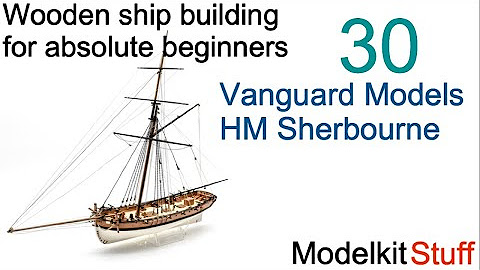
Here is a link to the Sherbourne-kit.
I think you just have to look at the picture of the ship and you will see it´s not a difficult ship to build or to rig.

Here is link to youtube, 30 videos.

¨Wooden ship modeling for absolute beginners¨
 
Hello all

I am looking for my first wooden starter kit (over 60 years in plastic) and the

"Vanguard Models" HM Armed Cutter Sherbourne – 1763 is looking like a good one to begin with.

Is it a good company to deal with or is there any other kit makers to consider?
All advice is greatly appreciated.
Cheers
Dave
Hi Dave,

Vanguard’s HM Sherbourne was the first wooden ship model I built. It took me 7 months and I am very pleased with the results. There’s a YouTube channel named “Modelkit Stuff”. Jason Port, the channel’s creator started a beginner’s series with the Sherbourne. I recommend to watch a few episodes. And I definitely recommend HM Sherbourne as a first build.
 
¨The instructions can be found as PDFs on the model expo site. You can download them to your computer and can enlarge the pictures. This makes them much easier to see.¨

Have you tried it yourself?
The problem is the quality of the photos, if you enlarge them they just get blurrier.
UBJS,

I have done it with the Constitution cross section instructions. They are definitely enlargeable to get a better look. I have not done it with other kit instructions.

Rob
 
It's interesting news to me that Model Shipways is cutting corners on parts and materials. That's not the sort of thing I'd expect Dave Antscherl to stand for. I did notice that Model Expo bought out the Midwest Products wooden model line and are now selling those. Model Shipways just came out with what appears to be a relabeled and perhaps somewhat revised version of the San Francisco Scow Schooner kit Midwest Products developed back in the 1980's. I remember when the San Francisco National Maritime Museum referred Midwest's model designer to me for an expert review of the plans he'd drawn up. There were a number of glaring errors in his plans which I graciously pointed out in my written report along with suggested supplementation and revisions. I declined any charge for my services but told him I'd love to have a kit when it issued. Never heard from them again and when the kit came out, none of my recommendations were followed. From the looks of the picture on the cover, it's still historically inaccurate and butt ugly, as far as scow schooners go. I even told him there were accurate plans in the HAAMS at the Smithsonian, but NO-O-O-O-O-O! Another kit designed with a price point in mind; more sizzle than steak.

If Model Expo is pimping Model Shipways' hard-earned reputation, I'm going to have to revise my opinion of Model Shipways. That's an old trick we see all the time. Buy out a company with a great reputation, cut quality and operate it on the cheap until there no life left in the brand. (Remember "Bell and Howell" and "Black and Decker?") I'll be the first to admit that my most recent "hands on" experience with Model Shipways kits was back in the "Yellow Box" days when they were out of Bogota, NJ before Model Expo bought them out. "Buyers beware!" still applies, I guess.

That said, and without getting into a big dispute about the quality of Vanguard's Sherbourne (which will bring all of Chris Walton's fans to my castle drawbridge waiving pitchforks and torches) I'll just say this: "double planking" on "MDF bulkheads" do not a "novice" model make. A lot of "novices" buy them because that's getting to be all that's on the kit market these days and that's why we don't have as many ship model hobbyists as would otherwise.
 
Croatian Maris Stella also proposes a beginners' series. I don't know how good or bad they are, but maybe someone else on this forum does.
 
I strongly recommend Bob Cleek's bit of advice. The model expo 3 ship series can be bought individually. If you build the Dory and send a picture of you holding it built they will give you full credit towards your next build. I can not think of a better way to learn. I do not know what the situation purchasing one of them in Great Britain is, But I think you should definitely start on something simpler.I have been doing plastic models for many years and can tell you from my few years of experience wooden ships are certainly a different beast.

That being said we are all here to help each other and I have learned much from the advice I have garnered here. Build logs and you tube videos are invaluable.

Welcome aboard from Connecticut!

Rob
Model Shipways are marketed over here as Mamoli. I've just received their English Pinnace & Longboat kits from CMB, both Mamoli boxed.
I 'cut my teeth' on Mamoli's (original Italian co) “Blue Shadow” in '83 - no internet, so no helpful forums - I must admit that once the masts were fitted she got put into 'ordinary'for 30 years due to personal & family commitments, and model railroading!
 
I realize that I may be "flogging the poodle" as it appears you are smitten by Vanguard's Sherbourne kit, but I feel compelled to put a finer point on my previous comments. While Vanguard produces high quality kits with excellent instructions, those assessments are relative, being made in comparison to the current ship model kit market offerings in general. My opinion in that regard accepted as a given the many concerns the hobby in general has with the present-day selection of available ship model kits (which is for our purposes at the moment "a story for another night.") The quality of today's ship model kits is dictated in significant measure by a variety of inhibiting factors, including but not limited to, raw materials availability and costs, and shipping, sales tax, and tariff expenses which affect the size, shape, and weight of packaging contents. All of these factors additionally tend to dictate the engineering parameters of today's kit models.

Even more critically, the somewhat unique economics of the obviously "niche market" ship model kit industry demand that its products attract the largest possible customer base. When you hear the often-repeated exhortation, "We need more ship modelers.", "buyer beware!" ;) Ship model kits are a good thing in concept, but the "novice" consumer must recognize that in addition to the fact that in large measure, profitability is dependent upon keeping production costs as low as possible, the more kits are sold to a customer, the less likely the customer will be to buy another one, so in order to remain profitable, new customers who lack the experience and skills to build the kits must be continually recruited. In short, the ship model kit business depends a lot more on the "sizzle" than it does the "steak."
Every ship model kit manufacturer faces two marketing contradictions which must be overcome if it is to survive. The first inherent challenge is the simple fact that, although there are those who enjoy assembling kits as a hobby in and of itself and will happily do so for a good long time, (a pursuit analogous to assembling plastic kits,) it is a natural progression that as "wooden sticks and strings" kit ship modelers naturally acquire knowledge and skills in the course of their builds, they tend to transcend the kit assembler's initial dependence on kits entirely and graduate to building original and unique models of subjects of their own choice from plans purchased or developed from their own independent research, thereby ending the prospects of their buying any more ship model kits. The second inherent challenge the kit model industry faces is that in order to continue to build and maintain their customer base, they must continually recruit "novice" ship modelers who are in large measure inexperienced and unskilled in the wide range of craft skills required to build even a kit. Consequently, the market for ship model kits is what a marketing specialist would call "aspirational." In other words, in order to sell the product, it has to promise to give the buyer some status the buyer aspires to attain. Now, building a model ship is not rocket science, but does involve a lot of other esoteric historical knowledge and a wide range of craft skills, woodworking, jewelry making, sheet metal work, drafting, surgical instrument knot tying, and fine wood finishing, to name but a few. Most are mastered with relative ease, if patiently and persistently pursued. All anybody needs to know is in any number of books, and now online videos on these subjects. However, most first-time ship model kit purchases are impulsive, regardless of how long it may take the buyer to make their selection. The "novice" kit buyer is usually nowhere near able to judge whether a kit is within their capabilities because they've never tried to build one before. It often seems that the majority of first-time ship model kit buyers revert to six-year-olds on Santa's lap, wanting the "biggest one" which is, of course, the farthest beyond the outer limits of their abilities. Consequently, many Victories and Constitutions are sold, but few are finished. Which is just fine with the kit manufacturers, but not so good for the "novice" kit buyers who abandon their expensive model kits in frustration and never get a fair chance at further pursuing what could have been a most rewarding hobby.

Now, it appears to me from a review of the instructions that what Vanguard has done with their Sherbourne kit is to attempt to create a ship model kit with very accurately laser cut wooden parts, metal castings and photo-etch, as well as perhaps some 3D printed plastic parts, which as closely as possible replicates in those prefabricated parts the process and experience of building a plastic model kit, i.e., the kit is a collection of accurately pre-cut parts designed for simple assembly per instructions minimizing to the greatest extent possible the need for fabrication or fitting. In other works, a "wooden" ship model kit that works like a plastic model kit. That's a very smart thing to try to do if you are looking to sell your kits as "easy to build," which is, as explained above, the threshold stumbling block the salesman has to overcome if he's going to sell any model kits at all. I think Vanguard has made a fairly good attempt in that direction and I expect this model is easier to build the way Vanguard has designed it, if the goal is to make plastic modelers comfortable with buying it. The laser-accurate cutting of parts alone eliminates one of more common pitfalls of "novices" sawing along printed lines to get parts out of sheet stock (if you don't mind the endless nasty mess of sanding the black charcoal "laser char" created by the laser burning of the edge of each part before use.) Of course, while that approach may make building the kit "easier," it doesn't make it "easy" because wood isn't plastic by a long shot. Vanguard's Sherbourne is a standard "double plank on bulkhead" wooden ship model and one need look no further than the instruction book to see that it is no less complex or demanding than any other model hull of its class. In fact, it's double planking on particle board bulkheads is the most labor-intensive method of constructing a hull of all and literally screams out to be in a kit that provides a pre-carved solid hull or stack of precut waterline "lifts" to be stacked up, glued, and faired by the builder. When you look at an instruction manual and see a picture that looks like this,

View attachment 562935

you're looking at wood that doesn't want to be where you need to put it and, while it can be done, it's not what I'd call "novice" level work. I'm not saying it's a bad kit. I've said I think it's a pretty good kit, although as a scratch builder, I'd definitely build the same hull quite differently, but I don't have to worry about the cost of machine carving, packaging and shipping the box, or selling it as a kit to anybody.


While again a purely subjective opinion, with over fifty years of ship modeling experience under my belt, I would not characterize Vanguard's Sherbourne kit as one I would ever advise a "novice"' to tackle as a first wooden ship kit build. The difference between my assessment and Vanguard's own expressed in their advertising is probably the result of my perspective as a modeler who was once a novice at it and Vanguard's perspective as a ship model kit manufacturer who is in the business of selling ship model kits to "novices."

If you've got your heart set on Sherbourne, well and good. But I see you doing far better justice to it as a third or fourth kit, after you've built at least the Norwegian Pram and the Muscongus Bay Lobster Smack from the Model Shipways instructional series. Those two or three models will give you the opportunity to learn how to do much of what Sherbourne will then later demand of you. At least, after planking the lobster smack you'll know what decent planking stock looks like, and how to lay out, spile, and hang single plank correctly with a lot less work and a lot more satisfaction than what Vanguard's design involves. You'll also be able to acquire quality examples of the tools you'll require along the way and not get stuck paying for the "turkeys" in Vanguard's "package deal" selection.

You don't have to "jump into the deep end of the pool" right at the start to learn how to build ship models. Most of the guys in this forum has been building ship models, kits or scratch-built, for decades. Nobody's going to steer you wrong. Trust what you hear from the modelers in here and realize it's a lot better information than what you'll read in any kit manufacturer's advertising copy. Not that kit manufacturers are necessarily bad guys at all but just don't forget what's in their rice bowl when you're dealing with them.
Very well written, Bob. Your reference to getting "frustrated" with the more expensive kits, falls on my doorstep! This frustration has crept up on me & 'bitten me on the ar$e' with my 1:72 Victory, that's why I've taken a break from her & bought the Model Shipways/Mamoli pinnace & longboat kits for a more relaxed break.
 
Very well written, Bob. Your reference to getting "frustrated" with the more expensive kits, falls on my doorstep! This frustration has crept up on me & 'bitten me on the ar$e' with my 1:72 Victory, that's why I've taken a break from her & bought the Model Shipways/Mamoli pinnace & longboat kits for a more relaxed break.

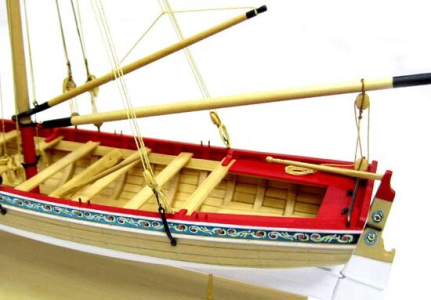
If the Mamoli and Model Shipways longboat kit are the same, take a close look at the arrangement of the tiller and mainsheet horse.

1765704080588.png

As any sailor will instantly see, the tiller is on top of the horse and even from their advertising photos, it is obvious that this is a gross error as the lower mainsheet purchase block in the picture is fouling the tiller. Under sail, when the boom crosses the center line, it therefore necessarily forces the tiller to leeward, turning the boat uncontrollably into the wind! I discussed this error with the model's designer who maintained the position that he had based his model on the original in the National Museum, Greenwich and that is how the contemporary model in NMG's collection was built. He was indeed correct. In fact, there is also another similar contemporary small craft in the NMG's collection with the same error. While we cannot know for sure why this error appears in two models in the NMG's collection, it is indisputably grossly incorrect. The whole purpuse of a mainsheet horse is to permit the tiller to run beneath the horse so as to permit the lower mainsheet purchase block to slide along the horse over the tiller without fouling it. This may be explained by the possibility that another "lubber" who conserved these two models at some point. The designer's argument in the face of these facts was that his model was an exact "model of a model" in the NMG, so it wasn't an error. When you build the model, you can decide whether you want to build "a model of a model version" or the "model of a boat that would be capable of being sailed" version. ;)

Other than that, it's a damn fine model. One of the best on the market in terms of design and accuracy in all other respects.
 
If the Mamoli and Model Shipways longboat kit are the same, take a close look at the arrangement of the tiller and mainsheet horse.

View attachment 563600

As any sailor will instantly see, the tiller is on top of the horse and even from their advertising photos, it is obvious that this is a gross error as the lower mainsheet purchase block in the picture is fouling the tiller. Under sail, when the boom crosses the center line, it therefore necessarily forces the tiller to leeward, turning the boat uncontrollably into the wind! I discussed this error with the model's designer who maintained the position that he had based his model on the original in the National Museum, Greenwich and that is how the contemporary model in NMG's collection was built. He was indeed correct. In fact, there is also another similar contemporary small craft in the NMG's collection with the same error. While we cannot know for sure why this error appears in two models in the NMG's collection, it is indisputably grossly incorrect. The whole purpuse of a mainsheet horse is to permit the tiller to run beneath the horse so as to permit the lower mainsheet purchase block to slide along the horse over the tiller without fouling it. This may be explained by the possibility that another "lubber" who conserved these two models at some point. The designer's argument in the face of these facts was that his model was an exact "model of a model" in the NMG, so it wasn't an error. When you build the model, you can decide whether you want to build "a model of a model version" or the "model of a boat that would be capable of being sailed" version. ;)

Other than that, it's a damn fine model. One of the best on the market in terms of design and accuracy in all other respects.
Thank you for that info., Bob, it comes in time as the kits only arrived yesterday late afternoon, I've only had a quick look, & not studied the instructions. I plan to display them alongside Victory & not struggle with the 'silly' kit boats!
 
Hi Bob, I have a caldercraft HM brig supply if you're interested. I bought this last year but the ongoing problems with my shoulders mean I'll never be able to do anything with it. I'm looking for £130 plus postage or collection from Nelson Lancs.
Hi Mick,
If you don’t get a reply to your offer, I would be interested. I live near Oxford so it would have to be posted as you are in Lancashire.
 
I have no relationship to this company financial or otherwise and have never built one of their kits BUT: Bluejacket Shipcrafters offers a beginners Dory kit as well a number of others rated for beginners (they call it their Ensign level). These include an Opti Pram; familiar to many small boat sailors.

If Model Shipways’ quality is not what it used to be, take your business elsewhere.

Roger
 
Back
Top