

-

SUBSCRIBE TO SHIPS IN SCALE TODAY!
The beloved Ships in Scale Magazine is back and charting a new course for 2026!
Discover new skills, new techniques, and new inspirations in every issue.
NOTE THAT OUR NEXT ISSUE WILL BE MARCH/APRIL 2026 -

Win a Free Custom Engraved Brass Coin!!!
As a way to introduce our brass coins to the community, we will raffle off a free coin during the month of August. Follow link ABOVE for instructions for entering.
You are using an out of date browser. It may not display this or other websites correctly.
You should upgrade or use an alternative browser.
You should upgrade or use an alternative browser.
Stropping blocks
- Thread starter zoly99sask
- Start date
- Watchers 8


That’s a great article, it explains the method very well.


Great Article I saw one similar a few years back and I use that Method ever since.

Excellent article, one of things that stands out on this site , besides the skilled builds and friendly members is the great accesses to reference material. Many articles you find are good articles but no “how does it look “pictures. Like many builders I use allot of trial and error to get a certain procedure right. Having a picture of the process gives me that visual to compare with, maybe its just me but it helps. Onther thing on rigging blocks is knowing how read the plans, understanding the terms. For example an early mistake I made was rigging blocks without understanding what a purchase was. As many of us have found out the hard way a purchase is there for a reason, and the block has to be removed and rigged again, which is not always easy. This simple tool is invaluable to me when rigging blocks.

Great article, easy to read and to absorb. I booked market it for my future reference.
Thanks mate
Greg
Thanks mate
Greg

Very good article - thanks for the link my friend 
Did you all checked also the other tutorials?
Take a look at building a ladder, making shakles, hooks etc. - Worth to read
Did you all checked also the other tutorials?
Take a look at building a ladder, making shakles, hooks etc. - Worth to read

How do you "book mark" somethingGreat article, easy to read and to absorb. I booked market it for my future reference.
Thanks mate
Greg
J
G'day JHow do you "book mark" something
J
I'm using Chrome as my browser.
1: On the top right there are 3 Virtual dots.
2: Click that and a pull down menu appears.
3: Then click the star outline on top of the menu. And the bookmarks is saved.
To look at your bookmarks
Do the first 2 steps as above.
3: go down to bookmarks and there you will see all the bookmarks that you have done.
I would assume that other browsers would be similar.
Hope that answers you question.
Greg
Thank you GregG'day J
I'm using Chrome as my browser.
1: On the top right there are 3 Virtual dots.
2: Click that and a pull down menu appears.
3: Then click the star outline on top of the menu. And the bookmarks is saved.
To look at your bookmarks
Do the first 2 steps as above.
3: go down to bookmarks and there you will see all the bookmarks that you have done.
I would assume that other browsers would be similar.
Hope that answers you question.
Greg


Stropping Aid
Some time ago I bought a set of small broaches for reaming out holes in rigging blocks.
I have since found an additional use: they are good for holding blocks or deadeyes while applying strops. Being square and serrated they prevent the item rotating - as they used to do when I held them on drill bits.
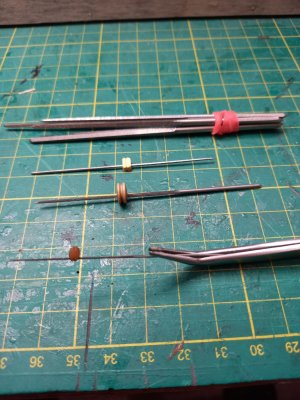
Some time ago I bought a set of small broaches for reaming out holes in rigging blocks.
I have since found an additional use: they are good for holding blocks or deadeyes while applying strops. Being square and serrated they prevent the item rotating - as they used to do when I held them on drill bits.


Very nice idea. Thanks for posting.Stropping Aid
Some time ago I bought a set of small broaches for reaming out holes in rigging blocks.
I have since found an additional use: they are good for holding blocks or deadeyes while applying strops. Being square and serrated they prevent the item rotating - as they used to do when I held them on drill bits.
View attachment 605309
Indeed, the article is an excellent explanation of how to strop blocks. However, there are a few comments that I'll share from my own experience and observation that might be of further assistance to some.
As the article recommends, The Masting and Rigging of English Ships of War 1625-1860 by James Lees is the "Bible" on the subject. It's gotten a bit pricey on the used market recently, but in my opinion any period ship modeler who doesn't have a copy as his first "go-to" on masting and rigging details is working at a serious disadvantage. (See: https://www.amazon.com/Masting-Rigging-English-Ships-1625-1860/dp/0870219480) Don't think of this book as a luxury. Think of it as an investment.
I prefer a reversable quick-setting adhesive and for that reason do not use CA for the purposes described in the article. I find pre-mixed clear shellac, which is immediately reversable with an application of plain alcohol, to be a much easier adhesive to work with. (Zinsser's Bulls Eye brand in the pint or quart can, not the rattle can.) It sets when the alcohol solvent evaporates and is reversed by simply blotting up with added alcohol. Evaporation can be accelerated by simply blowing on the wet shellac and is nearly as rapid as CA. Shellac and its solvent are non-toxic. (Shellac is actually edible and commonly used in candy-making to impart a gloss finish on things like jellybeans.) Shellac is a lot less expensive than CA adhesive and it has no noxious fumes. (It's also a great all-purpose sealer for wood and will do anything "watered-down PVA" will and do it much better.) Shellac won't glue your fingertips together, either. Finally, shellac has well-proven far superior archival qualities compared to CA.
While the mechanics of the illustrations in the article are correct, the scale of the parts in the illustrations are in several instances wildly out of relative proportion. Particularly, the hooks illustrated are hugely over-scale. The widths of the seizings are also much too wide in some instances. A quick review of a reference work like Lees' Masting and Rigging will quickly demonstrate the correct scale proportions of the various elements of any type of block. Over-sized scale hooks, both in terms of the shape of the hook and the gauge of the wire used to form them, are very frequently seen "built in" errors in many kits.
I routinely use a "surgeon's knot" rather than a plain overhand knot when tying on as shown in the article. An overhand knot, particularly when tied with a slippery synthetic thread, will not hold tension well of its own accord. The "surgeon's knot" is simply an overhand knot with the running part of the thread passed around the standing part two or more times more than required to form an overhand knot. When the "surgeon's knot" is pulled taunt, it holds the tension of its own accord. To "lock" a surgeon's knot, a simple overhand knot may then be tied on top of it. Parenthetically, there is much a ship modeler can benefit from learning to tie knots like a surgeon. There are many excellent YouTube videos posted by medical schools for use by medical students on surgical "instrument tying." If you learn the suturing techniques using surgical instruments such as hemostats and "needle holders" which surgeons employ, you'll find your rigging skills taking a quantum leap to the next level and your blood pressure returning to normal levels.
As the article recommends, The Masting and Rigging of English Ships of War 1625-1860 by James Lees is the "Bible" on the subject. It's gotten a bit pricey on the used market recently, but in my opinion any period ship modeler who doesn't have a copy as his first "go-to" on masting and rigging details is working at a serious disadvantage. (See: https://www.amazon.com/Masting-Rigging-English-Ships-1625-1860/dp/0870219480) Don't think of this book as a luxury. Think of it as an investment.
I prefer a reversable quick-setting adhesive and for that reason do not use CA for the purposes described in the article. I find pre-mixed clear shellac, which is immediately reversable with an application of plain alcohol, to be a much easier adhesive to work with. (Zinsser's Bulls Eye brand in the pint or quart can, not the rattle can.) It sets when the alcohol solvent evaporates and is reversed by simply blotting up with added alcohol. Evaporation can be accelerated by simply blowing on the wet shellac and is nearly as rapid as CA. Shellac and its solvent are non-toxic. (Shellac is actually edible and commonly used in candy-making to impart a gloss finish on things like jellybeans.) Shellac is a lot less expensive than CA adhesive and it has no noxious fumes. (It's also a great all-purpose sealer for wood and will do anything "watered-down PVA" will and do it much better.) Shellac won't glue your fingertips together, either. Finally, shellac has well-proven far superior archival qualities compared to CA.
While the mechanics of the illustrations in the article are correct, the scale of the parts in the illustrations are in several instances wildly out of relative proportion. Particularly, the hooks illustrated are hugely over-scale. The widths of the seizings are also much too wide in some instances. A quick review of a reference work like Lees' Masting and Rigging will quickly demonstrate the correct scale proportions of the various elements of any type of block. Over-sized scale hooks, both in terms of the shape of the hook and the gauge of the wire used to form them, are very frequently seen "built in" errors in many kits.
I routinely use a "surgeon's knot" rather than a plain overhand knot when tying on as shown in the article. An overhand knot, particularly when tied with a slippery synthetic thread, will not hold tension well of its own accord. The "surgeon's knot" is simply an overhand knot with the running part of the thread passed around the standing part two or more times more than required to form an overhand knot. When the "surgeon's knot" is pulled taunt, it holds the tension of its own accord. To "lock" a surgeon's knot, a simple overhand knot may then be tied on top of it. Parenthetically, there is much a ship modeler can benefit from learning to tie knots like a surgeon. There are many excellent YouTube videos posted by medical schools for use by medical students on surgical "instrument tying." If you learn the suturing techniques using surgical instruments such as hemostats and "needle holders" which surgeons employ, you'll find your rigging skills taking a quantum leap to the next level and your blood pressure returning to normal levels.
Thanks Bob. The problem is how to implement this at say 1/64 scale? Knots can easily be 1/2 as large as the block.
Here stropping and forming a hook, on 1/64 cannon tackle block with wire. S hooks formed with the two pins in the wood block.
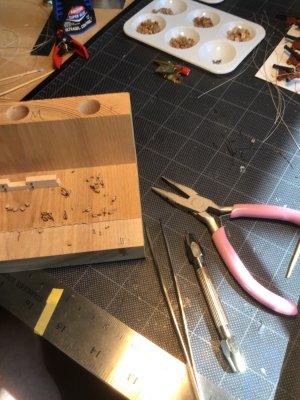
Here stropping and forming a hook, on 1/64 cannon tackle block with wire. S hooks formed with the two pins in the wood block.