• Ships of Scale has incorportated an extra level of security when you log In. Please follow on-screen prompts to acknowledge that you are not a robot via a "Check Box" or a "Pictorial Check Box Puzzle". This is needed due to higher level of AI Activity Security.
  • SUBSCRIBE TO SHIPS IN SCALE TODAY!

    The beloved Ships in Scale Magazine is back and charting a new course for 2026!
    Discover new skills, new techniques, and new inspirations in every issue.

    NOTE THAT OUR NEXT ISSUE WILL BE July/August 2026
  • Win a Free Custom Engraved Brass Coin!!!
    As a way to introduce our brass coins to the community, we will raffle off a free coin during the month of August. Follow link ABOVE for instructions for entering.

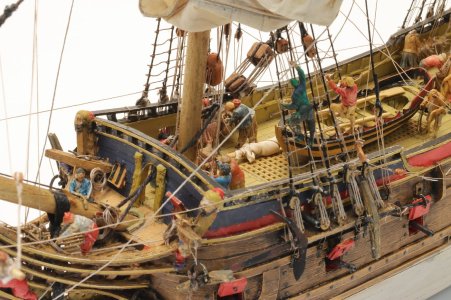
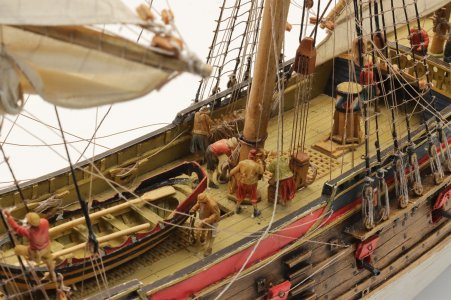
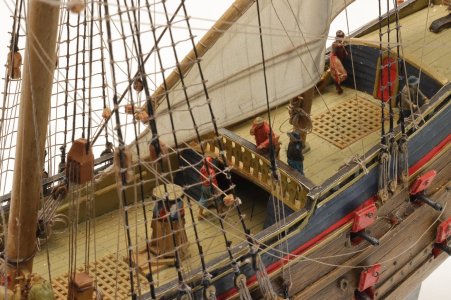
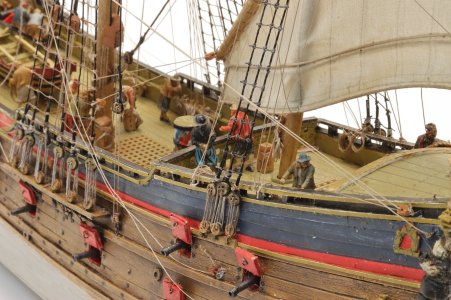
The frigate 'de Brak' (1661)

Joined
Mar 20, 2020
Messages
695
Points
403

Location
Alkmaar, Holland
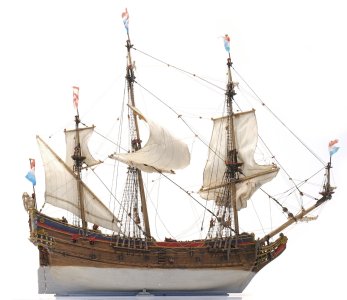
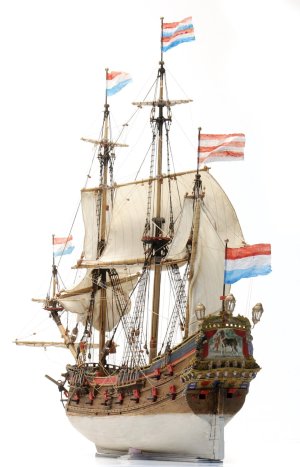
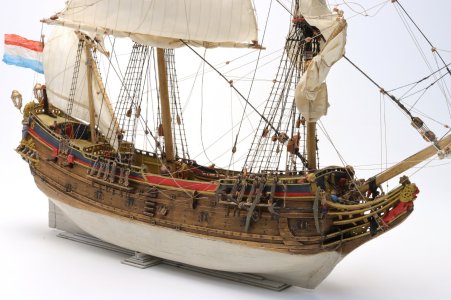
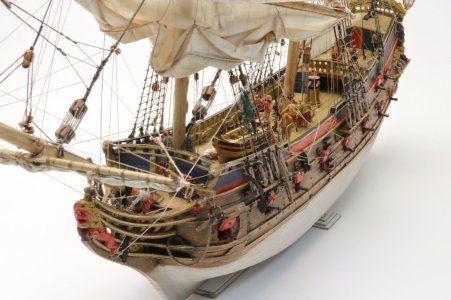
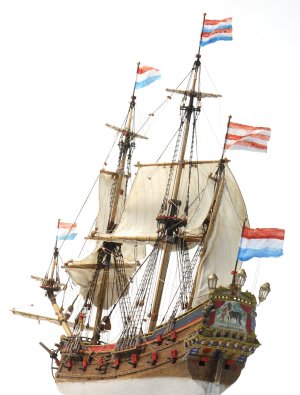
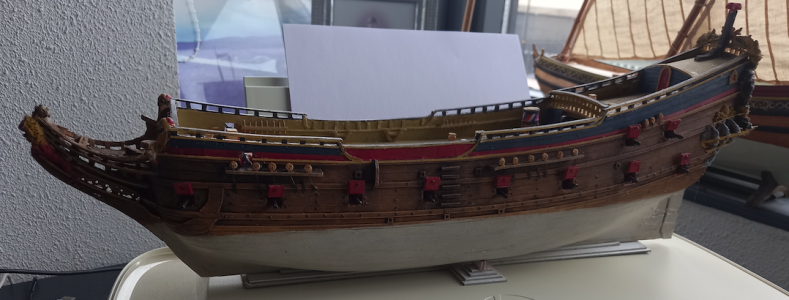
Yes, I know—I had previously announced that I would stop building and rigging three-masted ships. Problems with my hands and eyes forced me to do so. Yet, I find it difficult to give up a hobby I have pursued for some seventy years.Even after the last three-masters had been delivered to a few museums and a private collector, I couldn't resist the temptation and built a small frigate; it sat in my cabinet for a long time because I dreaded the rigging process. I built it purely for the pleasure of crafting a beautiful hull.
Schermafbeelding 2025-01-24 om 15.26.13.png
20250219_105314.jpg

My average time for completing a three-masted ship used to be around three months—rigging included—but those days are gone. I did recently finish this model, though; yet if I ever stood a chance ofgetting into heaven (assuming such a place actually exists), I have utterly destroyed that prospect by rigging this particular ship. I am glad no one had to witness the blasphemous, vulgar outbursts and curses I unleashed whenever I had to repeat the exact same step for the fourth or fifth time in a row. The inability to perceive depth makes complex rigging tasks nearly impossible—and, come to think of it, simple ones too—while trembling hands certainly don't add to the joy of the work.
In short, the work is no longer fun, and this is where it ends. I’ve run out of steam. Despite myself, I did build one last small frigate this spring; Emiel can now take over by placing it in a historically accurate setting. Photos are attached.

IMG_7672 kopie.JPGIMG_7677 kopie.JPGIMG_7678 kopie.JPGIMG_7685 kopie.JPGIMG_7694 kopie.JPGIMG_7707 kopie.JPGIMG_7796 kopie.JPGIMG_7802 kopie.JPGIMG_7804 kopie.JPGIMG_7805 kopie.JPGIMG_7806 kopie.JPGIMG_7808 kopie.JPGIMG_7809 kopie.JPGIMG_7811 kopie.JPGIMG_7819 kopie.JPGIMG_7820 kopie.JPG

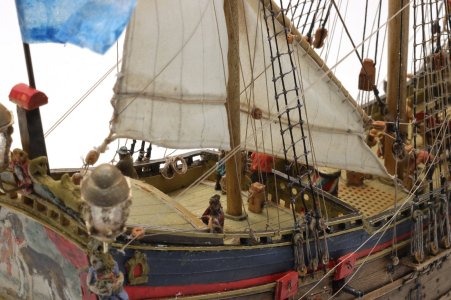
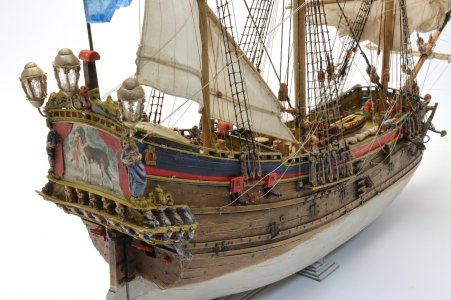
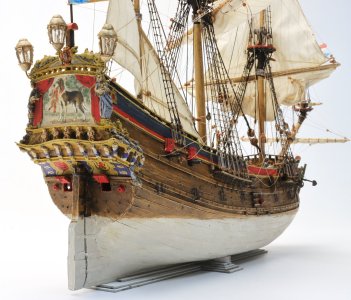
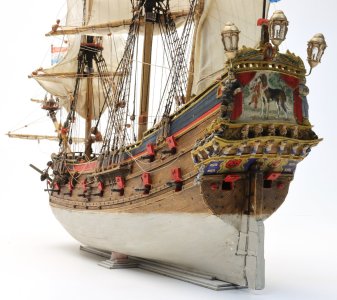
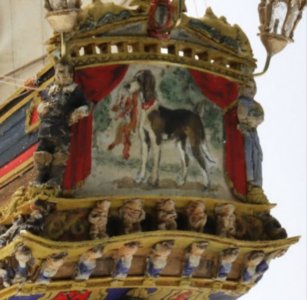
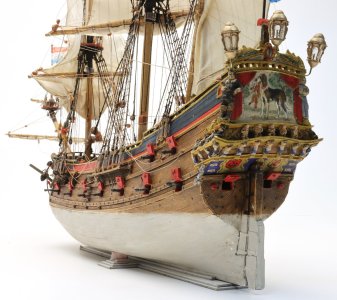
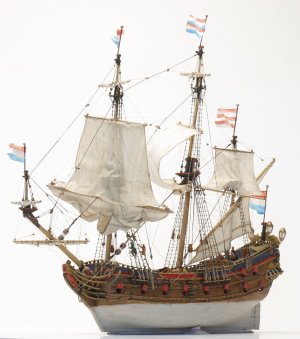
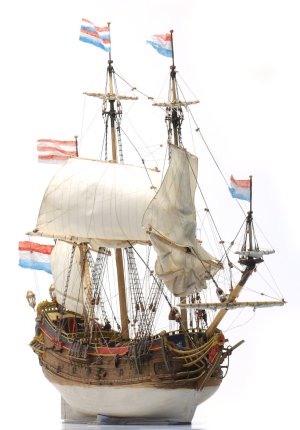
It is an intriguing little vessel—one of the small frigates that took part in the Raid on the Medway (often referred to as the Raid on Chatham) in 1666. Its name is 'De Brak'. I hadn't realized it before, but a 'brak' is a type of hound; today, we know the breed as the 'beagle'. Naturally, knowing this was crucial for designing the ship's stern.This time, I decided not to sculpt the design in relief but simply to paint the image. I am a painter's son, yet my (partial) colorblindness has always prevented me from using that technique on a ship model. I put a great deal of effort into the sails, as I wanted to depict them in a specific configuration. If Emiel does his job well, we will see an impression of the moment De Ruyter's fleet was ordered to muster for the attack—hence the red-white-red-white-red-white flag on the mizzenmast. And all this during a sudden squall...
The crew figures were supplied by the company Artitec. The owner, my good friend Herbert Tomesen—himself an excellent model maker—printed them especially for me in my preferred 1:77 scale. I am delighted that the model is finished and has turned out exactly as I had hoped.

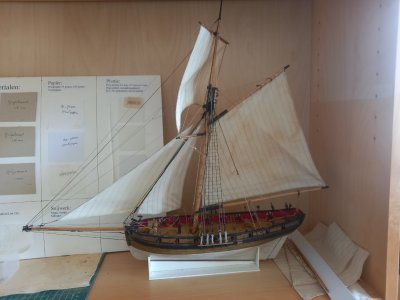
Does that mean I will stop building altogether? I cannot imagine that. Over the past year, I tried to build a model of a cutter with a relatively simple rigging setup, but even that is beyond my capabilities now without compromising my own principles or offending religiously minded colleagues. O, I nearly forgot. I also made this model, because the original Dutch name was 'de Brak', just like the 1661 frigate I built recently. It was a Dutch ship, built after British example, but bigger. The British renamed her into 'Braak' (for unclear reasons) after it was taken and rebuild and re-rigged to make it suitable for English naval services. The ship sank off the American coast in 1798. It was ketch rigged by then, because the new owners found working with her too heavy. There is no mentioning of such complaints when it was in Dutch hands....

20250826_124710.jpg

What I do still make are ships that require no rigging—dockyard models—even though these are, by definition, of English origin. Moreover, due to the material chosen (cardboard) combined with my physical limitations, they are far from flawless; still, they do at least somewhat resemble a ship model. I recently fitted three of them with display cases, as can be seen here: https://shipsofscale.com/sosforums/threads/hms-sussex-a-dockyard-model-made-of-card.17693/ .the thread will be updated in a minute.
These lend the models a certain status.

I thank my followers and readers for their stimulating words and positive reactions to my work, and I will continue to use this forum at least as a reader, hopefully for a longtime to come.
 
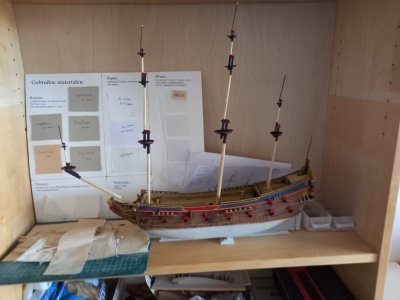
Yes, I know—I had previously announced that I would stop building and rigging three-masted ships. Problems with my hands and eyes forced me to do so. Yet, I find it difficult to give up a hobby I have pursued for some seventy years.Even after the last three-masters had been delivered to a few museums and a private collector, I couldn't resist the temptation and built a small frigate; it sat in my cabinet for a long time because I dreaded the rigging process. I built it purely for the pleasure of crafting a beautiful hull.
View attachment 627828
View attachment 627829

My average time for completing a three-masted ship used to be around three months—rigging included—but those days are gone. I did recently finish this model, though; yet if I ever stood a chance ofgetting into heaven (assuming such a place actually exists), I have utterly destroyed that prospect by rigging this particular ship. I am glad no one had to witness the blasphemous, vulgar outbursts and curses I unleashed whenever I had to repeat the exact same step for the fourth or fifth time in a row. The inability to perceive depth makes complex rigging tasks nearly impossible—and, come to think of it, simple ones too—while trembling hands certainly don't add to the joy of the work.
In short, the work is no longer fun, and this is where it ends. I’ve run out of steam. Despite myself, I did build one last small frigate this spring; Emiel can now take over by placing it in a historically accurate setting. Photos are attached.
View attachment 627830View attachment 627831View attachment 627832View attachment 627833View attachment 627834View attachment 627835View attachment 627836View attachment 627837View attachment 627838View attachment 627839View attachment 627840View attachment 627841View attachment 627842View attachment 627843View attachment 627844View attachment 627845

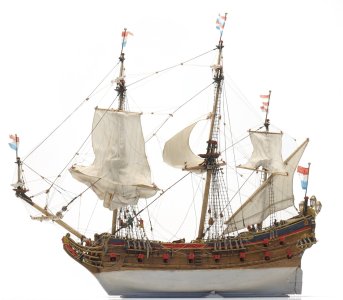
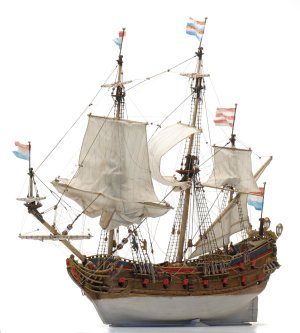
It is an intriguing little vessel—one of the small frigates that took part in the Raid on the Medway (often referred to as the Raid on Chatham) in 1666. Its name is 'De Brak'. I hadn't realized it before, but a 'brak' is a type of hound; today, we know the breed as the 'beagle'. Naturally, knowing this was crucial for designing the ship's stern.This time, I decided not to sculpt the design in relief but simply to paint the image. I am a painter's son, yet my (partial) colorblindness has always prevented me from using that technique on a ship model. I put a great deal of effort into the sails, as I wanted to depict them in a specific configuration. If Emiel does his job well, we will see an impression of the moment De Ruyter's fleet was ordered to muster for the attack—hence the red-white-red-white-red-white flag on the mizzenmast. And all this during a sudden squall...
The crew figures were supplied by the company Artitec. The owner, my good friend Herbert Tomesen—himself an excellent model maker—printed them especially for me in my preferred 1:77 scale. I am delighted that the model is finished and has turned out exactly as I had hoped.

Does that mean I will stop building altogether? I cannot imagine that. Over the past year, I tried to build a model of a cutter with a relatively simple rigging setup, but even that is beyond my capabilities now without compromising my own principles or offending religiously minded colleagues. O, I nearly forgot. I also made this model, because the original Dutch name was 'de Brak', just like the 1661 frigate I built recently. It was a Dutch ship, built after British example, but bigger. The British renamed her into 'Braak' (for unclear reasons) after it was taken and rebuild and re-rigged to make it suitable for English naval services. The ship sank off the American coast in 1798. It was ketch rigged by then, because the new owners found working with her too heavy. There is no mentioning of such complaints when it was in Dutch hands....

View attachment 627851

What I do still make are ships that require no rigging—dockyard models—even though these are, by definition, of English origin. Moreover, due to the material chosen (cardboard) combined with my physical limitations, they are far from flawless; still, they do at least somewhat resemble a ship model. I recently fitted three of them with display cases, as can be seen here: https://shipsofscale.com/sosforums/threads/hms-sussex-a-dockyard-model-made-of-card.17693/ .the thread will be updated in a minute.
These lend the models a certain status.

I thank my followers and readers for their stimulating words and positive reactions to my work, and I will continue to use this forum at least as a reader, hopefully for a longtime to come.
My respect for this very nice finish of ‘de Brak’, Ab. With a very natural-falling sail rigging And waving flags. I am very curious to see what Emile will make of this.
Regards, Peter
 
Lovely ship, as always, Ab. Do you achieve that extreme billowing effect of your unfurling main topsail with fine wire glued to the edges of the sail, and concealed by the bolt ropes?
 
Yes, I know—I had previously announced that I would stop building and rigging three-masted ships. Problems with my hands and eyes forced me to do so. Yet, I find it difficult to give up a hobby I have pursued for some seventy years.Even after the last three-masters had been delivered to a few museums and a private collector, I couldn't resist the temptation and built a small frigate; it sat in my cabinet for a long time because I dreaded the rigging process. I built it purely for the pleasure of crafting a beautiful hull.
View attachment 627828
View attachment 627829

My average time for completing a three-masted ship used to be around three months—rigging included—but those days are gone. I did recently finish this model, though; yet if I ever stood a chance ofgetting into heaven (assuming such a place actually exists), I have utterly destroyed that prospect by rigging this particular ship. I am glad no one had to witness the blasphemous, vulgar outbursts and curses I unleashed whenever I had to repeat the exact same step for the fourth or fifth time in a row. The inability to perceive depth makes complex rigging tasks nearly impossible—and, come to think of it, simple ones too—while trembling hands certainly don't add to the joy of the work.
In short, the work is no longer fun, and this is where it ends. I’ve run out of steam. Despite myself, I did build one last small frigate this spring; Emiel can now take over by placing it in a historically accurate setting. Photos are attached.
View attachment 627830View attachment 627831View attachment 627832View attachment 627833View attachment 627834View attachment 627835View attachment 627836View attachment 627837View attachment 627838View attachment 627839View attachment 627840View attachment 627841View attachment 627842View attachment 627843View attachment 627844View attachment 627845

It is an intriguing little vessel—one of the small frigates that took part in the Raid on the Medway (often referred to as the Raid on Chatham) in 1666. Its name is 'De Brak'. I hadn't realized it before, but a 'brak' is a type of hound; today, we know the breed as the 'beagle'. Naturally, knowing this was crucial for designing the ship's stern.This time, I decided not to sculpt the design in relief but simply to paint the image. I am a painter's son, yet my (partial) colorblindness has always prevented me from using that technique on a ship model. I put a great deal of effort into the sails, as I wanted to depict them in a specific configuration. If Emiel does his job well, we will see an impression of the moment De Ruyter's fleet was ordered to muster for the attack—hence the red-white-red-white-red-white flag on the mizzenmast. And all this during a sudden squall...
The crew figures were supplied by the company Artitec. The owner, my good friend Herbert Tomesen—himself an excellent model maker—printed them especially for me in my preferred 1:77 scale. I am delighted that the model is finished and has turned out exactly as I had hoped.

Does that mean I will stop building altogether? I cannot imagine that. Over the past year, I tried to build a model of a cutter with a relatively simple rigging setup, but even that is beyond my capabilities now without compromising my own principles or offending religiously minded colleagues. O, I nearly forgot. I also made this model, because the original Dutch name was 'de Brak', just like the 1661 frigate I built recently. It was a Dutch ship, built after British example, but bigger. The British renamed her into 'Braak' (for unclear reasons) after it was taken and rebuild and re-rigged to make it suitable for English naval services. The ship sank off the American coast in 1798. It was ketch rigged by then, because the new owners found working with her too heavy. There is no mentioning of such complaints when it was in Dutch hands....

View attachment 627851

What I do still make are ships that require no rigging—dockyard models—even though these are, by definition, of English origin. Moreover, due to the material chosen (cardboard) combined with my physical limitations, they are far from flawless; still, they do at least somewhat resemble a ship model. I recently fitted three of them with display cases, as can be seen here: https://shipsofscale.com/sosforums/threads/hms-sussex-a-dockyard-model-made-of-card.17693/ .the thread will be updated in a minute.
These lend the models a certain status.

I thank my followers and readers for their stimulating words and positive reactions to my work, and I will continue to use this forum at least as a reader, hopefully for a longtime to come.
That's beautiful!
 
Yes, I know—I had previously announced that I would stop building and rigging three-masted ships. Problems with my hands and eyes forced me to do so. Yet, I find it difficult to give up a hobby I have pursued for some seventy years.Even after the last three-masters had been delivered to a few museums and a private collector, I couldn't resist the temptation and built a small frigate; it sat in my cabinet for a long time because I dreaded the rigging process. I built it purely for the pleasure of crafting a beautiful hull.
View attachment 627828
View attachment 627829

My average time for completing a three-masted ship used to be around three months—rigging included—but those days are gone. I did recently finish this model, though; yet if I ever stood a chance ofgetting into heaven (assuming such a place actually exists), I have utterly destroyed that prospect by rigging this particular ship. I am glad no one had to witness the blasphemous, vulgar outbursts and curses I unleashed whenever I had to repeat the exact same step for the fourth or fifth time in a row. The inability to perceive depth makes complex rigging tasks nearly impossible—and, come to think of it, simple ones too—while trembling hands certainly don't add to the joy of the work.
In short, the work is no longer fun, and this is where it ends. I’ve run out of steam. Despite myself, I did build one last small frigate this spring; Emiel can now take over by placing it in a historically accurate setting. Photos are attached.
View attachment 627830View attachment 627831View attachment 627832View attachment 627833View attachment 627834View attachment 627835View attachment 627836View attachment 627837View attachment 627838View attachment 627839View attachment 627840View attachment 627841View attachment 627842View attachment 627843View attachment 627844View attachment 627845

It is an intriguing little vessel—one of the small frigates that took part in the Raid on the Medway (often referred to as the Raid on Chatham) in 1666. Its name is 'De Brak'. I hadn't realized it before, but a 'brak' is a type of hound; today, we know the breed as the 'beagle'. Naturally, knowing this was crucial for designing the ship's stern.This time, I decided not to sculpt the design in relief but simply to paint the image. I am a painter's son, yet my (partial) colorblindness has always prevented me from using that technique on a ship model. I put a great deal of effort into the sails, as I wanted to depict them in a specific configuration. If Emiel does his job well, we will see an impression of the moment De Ruyter's fleet was ordered to muster for the attack—hence the red-white-red-white-red-white flag on the mizzenmast. And all this during a sudden squall...
The crew figures were supplied by the company Artitec. The owner, my good friend Herbert Tomesen—himself an excellent model maker—printed them especially for me in my preferred 1:77 scale. I am delighted that the model is finished and has turned out exactly as I had hoped.

Does that mean I will stop building altogether? I cannot imagine that. Over the past year, I tried to build a model of a cutter with a relatively simple rigging setup, but even that is beyond my capabilities now without compromising my own principles or offending religiously minded colleagues. O, I nearly forgot. I also made this model, because the original Dutch name was 'de Brak', just like the 1661 frigate I built recently. It was a Dutch ship, built after British example, but bigger. The British renamed her into 'Braak' (for unclear reasons) after it was taken and rebuild and re-rigged to make it suitable for English naval services. The ship sank off the American coast in 1798. It was ketch rigged by then, because the new owners found working with her too heavy. There is no mentioning of such complaints when it was in Dutch hands....
View attachment 627851

What I do still make are ships that require no rigging—dockyard models—even though these are, by definition, of English origin. Moreover, due to the material chosen (cardboard) combined with my physical limitations, they are far from flawless; still, they do at least somewhat resemble a ship model. I recently fitted three of them with display cases, as can be seen here: https://shipsofscale.com/sosforums/threads/hms-sussex-a-dockyard-model-made-of-card.17693/ .the thread will be updated in a minute.
These lend the models a certain status.

I thank my followers and readers for their stimulating words and positive reactions to my work, and I will continue to use this forum at least as a reader, hopefully for a longtime to come.
If I am not mistaken, this ship was recovered in the late 1960’s or early 70’s just off of the coast af Leeds Delaware. One side of hull planking and ribs ,I believe.
 
Hello Ab, yes there is a mistake very often made because they are quite similar but different - the rememberable verse is:
"Where the beagle ends the brak starts."

This is a "German Brak" and it is 40-53cms tall in shoulder and the ancester of these hunting dogs/hounds (some 1000 years old) very big Problem are the after legst out of anatomic reasonable position till 30 years:
Deutsche-Bracke.webp
and here the smaler Beagle, who is only 33-40cms in hight and of other appearence (but with the same silly stylish after legs angle) and tail position:
pies-rasy-beagle.jpg
Hope this helps a bit and gives some orientation.
 
No, Ab, certainly not! I would like to say your dog isn't tuned towards "modern aestetic" and kept a much healthier physical stand This due to these outstanding legs are dislocateing the point of the force's input of wight into the hip pan very badly. So the poor dogs do get much trouble in stand and by age a lot of pain by this silly only modern aestetically choosen breed result
Polish_20260824_114252003.jpg
instead of a physically logical one given by mother natur für some hundredthousand years - looking at wolfs and your prototype.
 
By the way, Ab, could you kindly tell us a bit of your technique to your creation of these beautyful lamps? This will be very helpfull to a plenty of us - as I have to admid they are my most feared Nemesis as they are a very prominent item I can even on a hull model keep out of manufacturing and adding the model to become a complete model.

Thank you very much for sharing this Beauty.

IMG_7820 kopie.JPG
 
It's in my book 'Dutch 17th century ships in paper'.

Lanterns

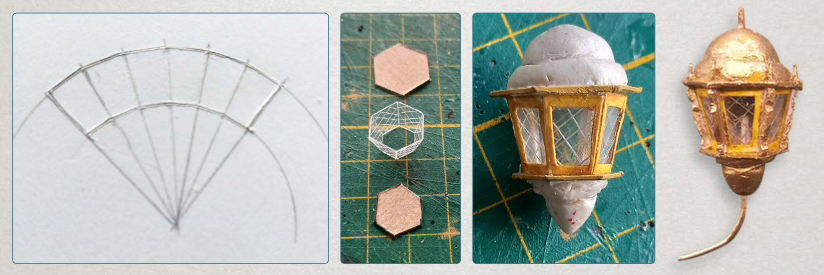
Lanterns on the stern are like the cherry on a sundae. They form the crown of the whole scene. Small ships like fluits usually carried one lantern, avarage size ships had three of them and some big warships even had five. They were big. A grown-up man could stand straight inside them. The round top was made of hammered copper and sometimes provided with decorated vents.

I always start with some transparant plastic from packaging. The shape is given in the sheets. I scribe the small glasses in the plastic and glue the whole thing to a hexagonal top and a bottom. The corners can be adorned with paper statues or narrow twisted strips of thin paper. Top and bottom are made of Magic Sculpt.

Just a tip: every time that stuff is used there will be some leftovers. I have a habit of rolling little balls of it and storing them somewhere. Sooner or later small balls in all sizes are needed for decorations, mast trucks and so on. It is good to have a broad selection of sizes. The iron foot holding the lantern can be made of 1 mm brass wire. Drill a hole trough the bottom and paint the top part of the wire white. Once sticking out inside the lantern it will look like a candle.
Schermafbeelding 2026-08-24 om 15.25.15.png
 
Back
Top