
• Win a Free Custom Engraved Brass Coin!!!
    As a way to introduce our brass coins to the community, we will raffle off a free coin during the month of August. Follow link ABOVE for instructions for entering.
  • PRE-ORDER SHIPS IN SCALE TODAY!

    The beloved Ships in Scale Magazine is back and charting a new course for 2026!
    Discover new skills, new techniques, and new inspirations in every issue.

    NOTE THAT OUR FIRST ISSUE WILL BE JAN/FEB 2026

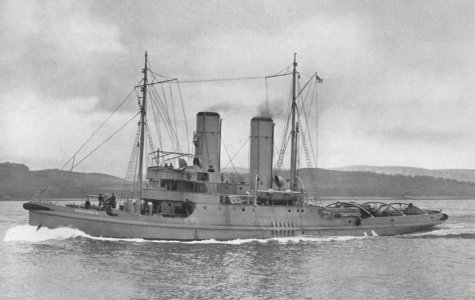
The Ocean going rescue tug, HMT Rollcall W81 1920, Built using Caldercraft's Resolve grp hull and plans (much modified).

Joined
Aug 14, 2018
Messages
829
Points
403

ROLLCALL2.jpg
This is the photo that sold me on this build. I think it has a sort of 'Orwellian' cold charm about it that I hope to capture.
Ever since reading 'The Tattie Lads' by Ian Dear I have been toying with the idea of building this 'vessel' (the discription given in Lloyd’s Register), but boat to you and me, for a few months now but it would never have happened except I found the Caldercraft kit on ebay for just over four hundered quid which is just about right for what you get. The kit is primarley desinged for R/C and hence the hull is sturdy but lacking in the finer detail you would want in a static model, so trying to improve that will be my first task.
So far all I have done is build a strong work stand and check that all is there and correct. But or course all is not correct. More of that later, but first a bit about HMT Rollcall.
In my idleness I have been having some fun with AI and after much coaxing I managed to get this out of our friendly,(so far),non-human brains.

From Warship to Tender:
The Life of His Majesty’s Tug Rollcall


A Resolve-Class Admiralty Salvage Tug (1918–1958)​


Introduction​

Among the unsung workhorses of the Royal Navy, few vessels embody resilience and adaptability like His Majesty’s Tug Rollcall. Built in 1918 as part of the Resolve-class salvage tugs, Rollcall’s story spans four decades—from its origins in wartime Britain to its final years as a passenger tender.

Construction and Specifications​

Rollcall was constructed by Ferguson Brothers Ltd., Port Glasgow, as Yard No. 238. Launched on 2 August 1918 and completed on 27 December 1918, it was one of six Resolve-class Admiralty salvage tugs. These vessels were designed for heavy towing and salvage operations, featuring reinforced hulls and powerful steam engines.

Technical Specifications​

• Builder: Ferguson Brothers Ltd., Port Glasgow
• Yard Number: 238
• Launched: 2 August 1918
• Completed: 27 December 1918
• Class: Resolve-class Admiralty salvage tug
• Length: 175 ft (53.3 m)
• Beam: 34.2 ft (10.4 m)
• Depth: 16.4 ft (5.0 m)
• Displacement: ~1,400 tons
• Gross Register Tonnage: 739 GRT
• Propulsion: Twin-screw, steam reciprocating engines (2 x triple-expansion)
• Power: 2,400 IHP
• Speed: 13.75 knots
• Fuel: Coal-fired boilers

Wartime Service​

Completed too late for active service in the First World War, Rollcall was intended for heavy salvage and rescue work. As part of the Resolve-class, it was equipped to recover damaged warships and assist in harbour operations.

Post-War Career​

In 1922, Rollcall was sold to Alexandra Towing Co., Southampton, and renamed Romsey. Converted into a passenger tender with lounge and enclosed bridge, one funnel was removed. In 1929, it was acquired by Compagnie Générale Transatlantique (French Line), renamed Minotaure, and based at Le Havre as a tender for ocean liners like Normandie. Throughout the 1930s, Minotaure assisted major liners and participated in rescue operations for L’Atlantique (1933) and Paris (1939).

Second World War​

In 1940, Minotaure was requisitioned by the French Navy and helped evacuate battleship Jean Bart from Saint-Nazaire. Later seized by German forces at Bordeaux, renamed S142, and used as a Channel Islands ferry. In 1944 she was torpedoed by a Royal Navy MTB near St. Malo. Suffering heavy damage and with the loss of over a hundred lives she was beached at Dinard.

Despite the extensive damage, she was refloated and towed back to Le Havre, there, remarkably, she was repaired, including a new fore end, and returned to service for the French Line as Minotaure in February 1948.

Final Years​

Minotaure continued as a tender until 1958, when it was broken up at Burcht, Belgium by Jos. de Smeldt.

Significance​

Rollcall’s life illustrates the adaptability of naval auxiliaries: from Admiralty salvage tug to luxury liner tender, then wartime troop carrier and post-war ferry. It was part of the Resolve-class—a group of robust steam tugs that bridged naval and commercial worlds for four decades.

Resolve-Class Overview​

The Resolve-class comprised six Admiralty salvage tugs built during WWI: Resolve, Respond, Retort, Rollicker, Roysterer, and Rollcall.( I guess all the good and hard sounding names starting with 'R' like Renown Repulse Resolution and Revenge where being kept for battleships. Resolve sounds like a cure for wind! JJ..). Designed for strength and endurance, they played key roles in salvage operations and later adapted to civilian service.

Major Events Timeline​

1918 – Launched as Rollcall
1922 – Sold to Alexandra Towing Co., renamed Romsey
1929 – Sold to French Line, renamed Minotaure
1940 – Evacuation of Jean Bart
1944 – Torpedoed near St. Malo
1948 – Returned to service after repairs
1958 – Broken up at Burcht, Belgium

References​

• Brown, D.K. Nelson to Vanguard: Warship Design and Development 1923–1945. Chatham Publishing, 2000.
• Jane’s Fighting Ships, 1944 Edition.
• Royal Navy Dockyard Records, ADM 140 Series, The National Archives (UK).
• Roskill, S.W. The War at Sea 1939–1945. HMSO, 1960.
• Lambert, A. The British Navy and the Post-War World. Naval Institute Press, 2012.
• Clydeships.co.uk – Rollcall entry.
• Naval-history.net – Admiralty tug records.
• Royal Navy Research Archive – Resolve-class overview.

Could not have said it better myself.

JJ.. Back in the saddle or something like that.
 
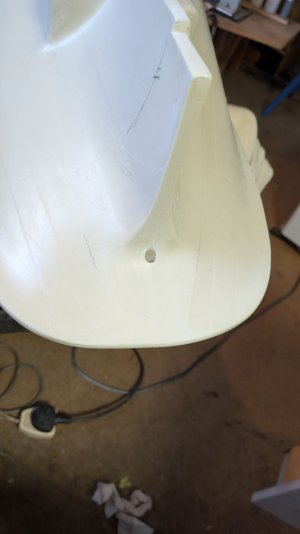
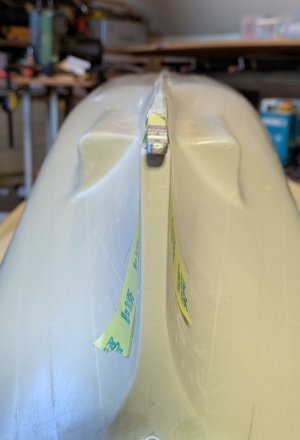
On close inspection of the hull I noticed a couple very small chips and a crack about 15mm long around the stem. The chipped off piece was laying in the box so I expect this hapened during transportation. Both where easy to fix and it gave me the opertunity to thin down the stem a bit. As it came it was about 11mm across, this worked out at around 20.5 inches which seems a lot to me so I took about 1.5mm of each side, I would have taken a bit more but was worried I might have went right through,
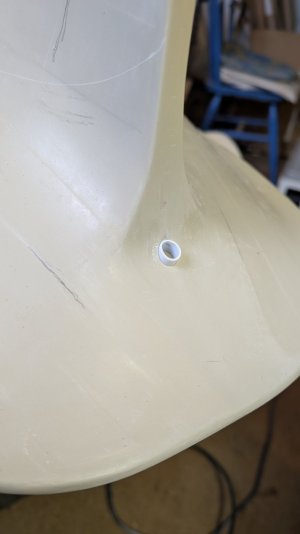
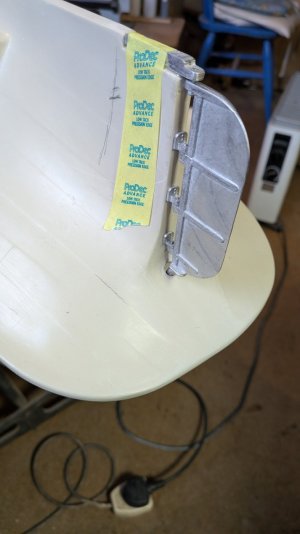
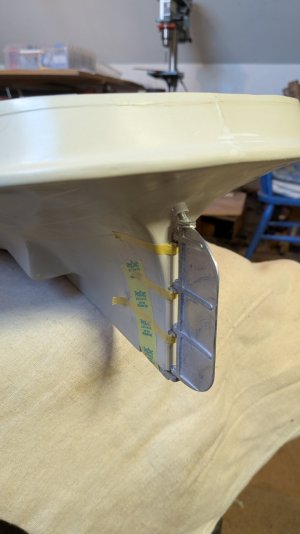
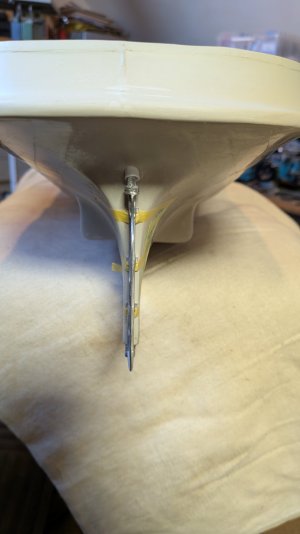
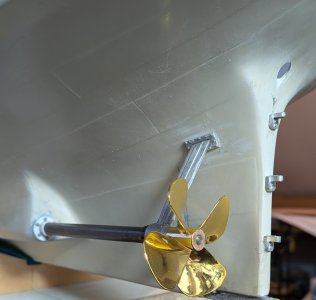
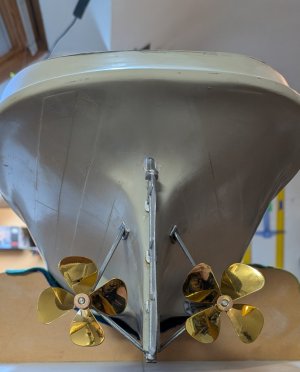
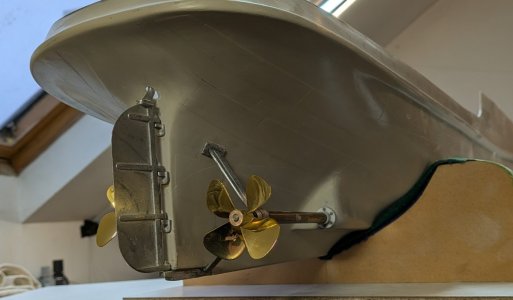
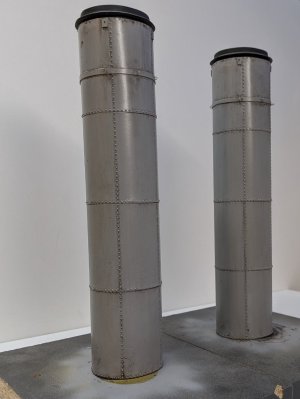
There are a lot of quite promanent seams I will need to rub down, otherwise the hull looks quite good. I decided to start with the rudder and propeller tubes and their outrigger supports all white metal, and to be honest mostly well cast, the rudder itself in particular. The kit comes with two rudders ; one very detailed and thin enough to be correct to scale, the other is more robust and very plain, so its the first for me. Fitting was easier than I expected and after cleaning up the gudgeons it all went together with no fuss. I shall leave it for a day or so now to let the epoxy harden. In the meantime I will make a start on the funnels.

Some pics. of the progress so far.

PXL_20251125_114251455.jpgPXL_20251125_114717482.jpgPXL_20251125_115758046.jpgPXL_20251125_122437294.jpgPXL_20251125_125134323.jpgPXL_20251125_125214971.jpgPXL_20251125_144229146.jpg

Cheers JJ..
 
I can't find the tattie lads at a reasonable price. I will keep looking. books you might enjoy.... grey seas under , and the serpents coil by farley mowatt. both are very good and about salvage tugs.
 
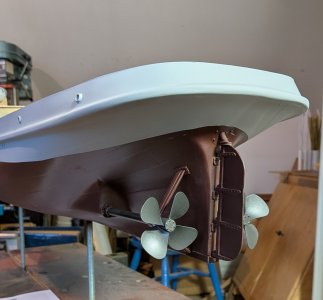
I have been meaning to give a progress report for a while but there hasn't been much to talk about. I have been working on the hull, adding prop shafts, rudder and screws, (the ones in the pic.,althouigh large, are too small I havea larger pair to paint) all needing 2- pack epoxy to attach. Really slow wjhen your more used to 'Cyno'.
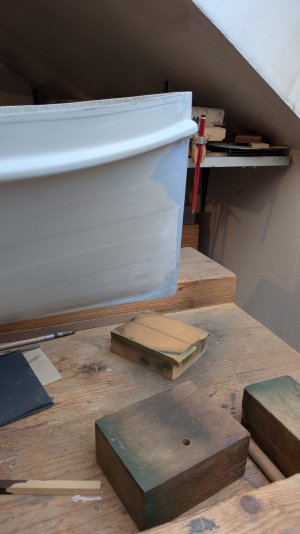
I am not sure what to do about the belting around the hull, on the boat it is made from 12" x 10" English Elm and has a square finish but on the Caldercraft GRP hull the size is more like a scaled 16 x 14 with a rounded profile; fine, I am sure, for a R/C boat but needs fixed for a static model. I thought about cutting it off and replacing with wood strip but because of the way the hull has been layed up it would mean cutting the hull in two. I could try filling the back then cut away the band but I cannot see how to do it without damaging the hull surface, so I am trying, slowly, to sand it square; might work.
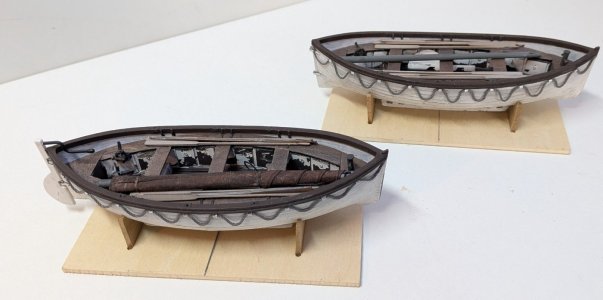
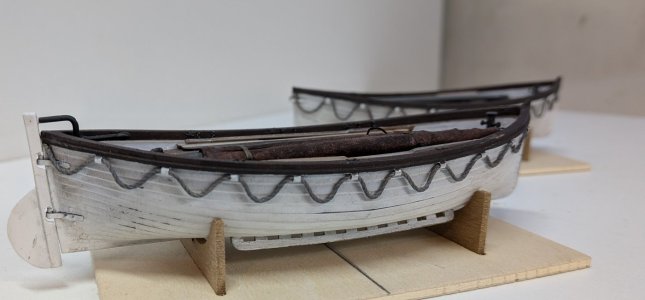
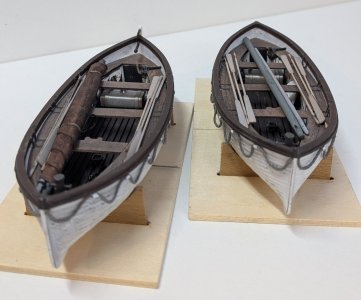
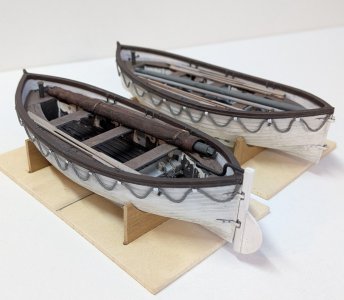
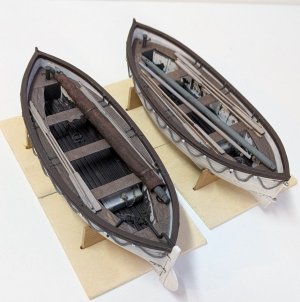
While this has been going on I have made apair of life boats. I have painted them to show a bit of ware and tear, I have done the same with the funnels but there is still work to do there.


Some pics..

PXL_20251222_100307376.jpgPXL_20251222_142932616.jpgPXL_20251222_143003105.jpgPXL_20251222_143952133.jpgPXL_20251222_144252361.jpgPXL_20251222_144311762.jpgPXL_20251222_144344409.jpgPXL_20251222_144412707.jpgPXL_20251222_144418005.jpg

Cheers JJ..
And a Very Merry Christmass to all.​
 
I can't find the tattie lads at a reasonable price. I will keep looking. books you might enjoy.... grey seas under , and the serpents coil by farley mowatt. both are very good and about salvage tugs.
Thanks for the suggestions Senorbob I will keep an eye for them, I paid £10 for the Tattie Lads so you might get lucky,

All the best JJ..
 
I have been meaning to give a progress report for a while but there hasn't been much to talk about. I have been working on the hull, adding prop shafts, rudder and screws, (the ones in the pic.,althouigh large, are too small I havea larger pair to paint) all needing 2- pack epoxy to attach. Really slow wjhen your more used to 'Cyno'.
I am not sure what to do about the belting around the hull, on the boat it is made from 12" x 10" English Elm and has a square finish but on the Caldercraft GRP hull the size is more like a scaled 16 x 14 with a rounded profile; fine, I am sure, for a R/C boat but needs fixed for a static model. I thought about cutting it off and replacing with wood strip but because of the way the hull has been layed up it would mean cutting the hull in two. I could try filling the back then cut away the band but I cannot see how to do it without damaging the hull surface, so I am trying, slowly, to sand it square; might work.
While this has been going on I have made apair of life boats. I have painted them to show a bit of ware and tear, I have done the same with the funnels but there is still work to do there.

A nice progress, Jack. With very realistic weathering on the funnels and life boats.
Wish you also a Merry Christmas.
Regards, Peter
 
I have been meaning to give a progress report for a while but there hasn't been much to talk about. I have been working on the hull, adding prop shafts, rudder and screws, (the ones in the pic.,althouigh large, are too small I havea larger pair to paint) all needing 2- pack epoxy to attach. Really slow wjhen your more used to 'Cyno'.
I am not sure what to do about the belting around the hull, on the boat it is made from 12" x 10" English Elm and has a square finish but on the Caldercraft GRP hull the size is more like a scaled 16 x 14 with a rounded profile; fine, I am sure, for a R/C boat but needs fixed for a static model. I thought about cutting it off and replacing with wood strip but because of the way the hull has been layed up it would mean cutting the hull in two. I could try filling the back then cut away the band but I cannot see how to do it without damaging the hull surface, so I am trying, slowly, to sand it square; might work.
While this has been going on I have made apair of life boats. I have painted them to show a bit of ware and tear, I have done the same with the funnels but there is still work to do there.

Stunning boats Jack. I wish you a fantastic Irish Christmas from a hot and sunny Melkbosstrand. Cheers Grant
 
Stunning boats Jack. I wish you a fantastic Irish Christmas from a hot and sunny Melkbosstrand. Cheers Grant
Thank you Grant, and of course my best wishes to you and all of yours.

All the best from Carrickfergus the centre of the Ulster Riviera! JJ..
 
I can't find the tattie lads at a reasonable price. I will keep looking. books you might enjoy.... grey seas under , and the serpents coil by farley mowatt. both are very good and about salvage tugs.

View attachment 558070
This is the photo that sold me on this build. I think it has a sort of 'Orwellian' cold charm about it that I hope to capture.
Ever since reading 'The Tattie Lads' by Ian Dear I have been toying with the idea of building this 'vessel' (the discription given in Lloyd’s Register), but boat to you and me, for a few months now but it would never have happened except I found the Caldercraft kit on ebay for just over four hundered quid which is just about right for what you get. The kit is primarley desinged for R/C and hence the hull is sturdy but lacking in the finer detail you would want in a static model, so trying to improve that will be my first task.
So far all I have done is build a strong work stand and check that all is there and correct. But or course all is not correct. More of that later, but first a bit about HMT Rollcall.
In my idleness I have been having some fun with AI and after much coaxing I managed to get this out of our friendly,(so far),non-human brains.

From Warship to Tender:
The Life of His Majesty’s Tug Rollcall


A Resolve-Class Admiralty Salvage Tug (1918–1958)​


Introduction​

Among the unsung workhorses of the Royal Navy, few vessels embody resilience and adaptability like His Majesty’s Tug Rollcall. Built in 1918 as part of the Resolve-class salvage tugs, Rollcall’s story spans four decades—from its origins in wartime Britain to its final years as a passenger tender.

Construction and Specifications​

Rollcall was constructed by Ferguson Brothers Ltd., Port Glasgow, as Yard No. 238. Launched on 2 August 1918 and completed on 27 December 1918, it was one of six Resolve-class Admiralty salvage tugs. These vessels were designed for heavy towing and salvage operations, featuring reinforced hulls and powerful steam engines.

Technical Specifications​

• Builder: Ferguson Brothers Ltd., Port Glasgow
• Yard Number: 238
• Launched: 2 August 1918
• Completed: 27 December 1918
• Class: Resolve-class Admiralty salvage tug
• Length: 175 ft (53.3 m)
• Beam: 34.2 ft (10.4 m)
• Depth: 16.4 ft (5.0 m)
• Displacement: ~1,400 tons
• Gross Register Tonnage: 739 GRT
• Propulsion: Twin-screw, steam reciprocating engines (2 x triple-expansion)
• Power: 2,400 IHP
• Speed: 13.75 knots
• Fuel: Coal-fired boilers

Wartime Service​

Completed too late for active service in the First World War, Rollcall was intended for heavy salvage and rescue work. As part of the Resolve-class, it was equipped to recover damaged warships and assist in harbour operations.

Post-War Career​

In 1922, Rollcall was sold to Alexandra Towing Co., Southampton, and renamed Romsey. Converted into a passenger tender with lounge and enclosed bridge, one funnel was removed. In 1929, it was acquired by Compagnie Générale Transatlantique (French Line), renamed Minotaure, and based at Le Havre as a tender for ocean liners like Normandie. Throughout the 1930s, Minotaure assisted major liners and participated in rescue operations for L’Atlantique (1933) and Paris (1939).

Second World War​

In 1940, Minotaure was requisitioned by the French Navy and helped evacuate battleship Jean Bart from Saint-Nazaire. Later seized by German forces at Bordeaux, renamed S142, and used as a Channel Islands ferry. In 1944 she was torpedoed by a Royal Navy MTB near St. Malo. Suffering heavy damage and with the loss of over a hundred lives she was beached at Dinard.

Despite the extensive damage, she was refloated and towed back to Le Havre, there, remarkably, she was repaired, including a new fore end, and returned to service for the French Line as Minotaure in February 1948.

Final Years​

Minotaure continued as a tender until 1958, when it was broken up at Burcht, Belgium by Jos. de Smeldt.

Significance​

Rollcall’s life illustrates the adaptability of naval auxiliaries: from Admiralty salvage tug to luxury liner tender, then wartime troop carrier and post-war ferry. It was part of the Resolve-class—a group of robust steam tugs that bridged naval and commercial worlds for four decades.

Resolve-Class Overview​

The Resolve-class comprised six Admiralty salvage tugs built during WWI: Resolve, Respond, Retort, Rollicker, Roysterer, and Rollcall.( I guess all the good and hard sounding names starting with 'R' like Renown Repulse Resolution and Revenge where being kept for battleships. Resolve sounds like a cure for wind! JJ..). Designed for strength and endurance, they played key roles in salvage operations and later adapted to civilian service.

Major Events Timeline​

1918 – Launched as Rollcall
1922 – Sold to Alexandra Towing Co., renamed Romsey
1929 – Sold to French Line, renamed Minotaure
1940 – Evacuation of Jean Bart
1944 – Torpedoed near St. Malo
1948 – Returned to service after repairs
1958 – Broken up at Burcht, Belgium

References​

• Brown, D.K. Nelson to Vanguard: Warship Design and Development 1923–1945. Chatham Publishing, 2000.
• Jane’s Fighting Ships, 1944 Edition.
• Royal Navy Dockyard Records, ADM 140 Series, The National Archives (UK).
• Roskill, S.W. The War at Sea 1939–1945. HMSO, 1960.
• Lambert, A. The British Navy and the Post-War World. Naval Institute Press, 2012.
• Clydeships.co.uk – Rollcall entry.
• Naval-history.net – Admiralty tug records.
• Royal Navy Research Archive – Resolve-class overview.

Could not have said it better myself.

JJ.. Back in the saddle or something like that.

you have me going now. found a book titled "rescue tugs at war"
 
Hi folks, a bit of an update.
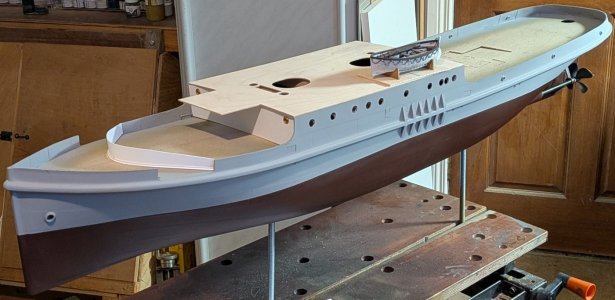
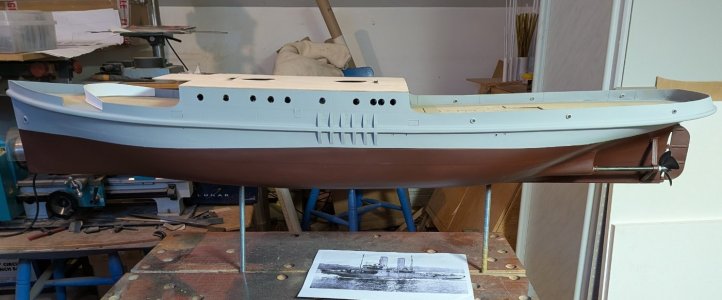
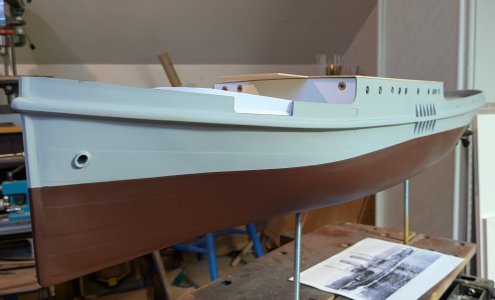
The hull; I have counted and made 42 modifactions to the hull from the CC Resolve kit and now Rollcall's hull is looking a bit more like the real thing, however it will never be more than a "best approximation" rather than a true, exact replica. Fundamentaly the Resolve kit is intended to build a RC toy,(far more so than CC's Sir Kay is). I have always liked the idea that 'If it looks right it is right', well this hull looks wrong, more like a fat toad than an Ocean going tug. Although only a scaled 11" wider than specified in the plans the hull looks far too beamy, ugly to my eye.
This begs the question should I waste any more of my time on it? I will have to think about that.

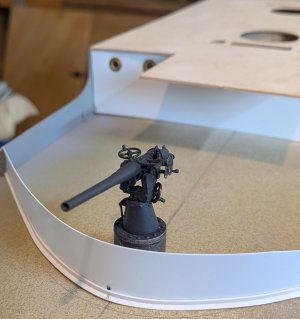
Here are some pics. of my progress so far.
PXL_20260202_090121203.jpgPXL_20260202_090318665.jpgPXL_20260202_090454201.jpgPXL_20260202_090525366.jpgPXL_20260202_091843201.jpgPXL_20260202_091957678.MACRO_FOCUS.jpgPXL_20260202_092050947.jpg

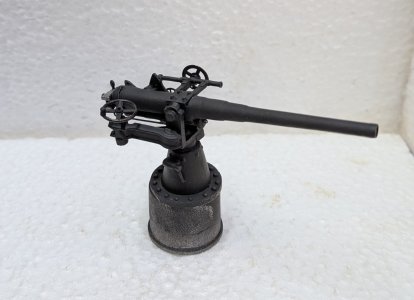
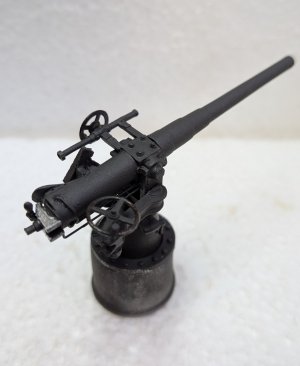
PS. For white metal the little 12 pounder gun turned out nice!

Cheers JJ..​
 
Hi folks, a bit of an update.
The hull; I have counted and made 42 modifactions to the hull from the CC Resolve kit and now Rollcall's hull is looking a bit more like the real thing, however it will never be more than a "best approximation" rather than a true, exact replica. Fundamentaly the Resolve kit is intended to build a RC toy,(far more so than CC's Sir Kay is). I have always liked the idea that 'If it looks right it is right', well this hull looks wrong, more like a fat toad than an Ocean going tug. Although only a scaled 11" wider than specified in the plans the hull looks far too beamy, ugly to my eye.
This begs the question should I waste any more of my time on it? I will have to think about that.

Here are some pics. of my progress so far.
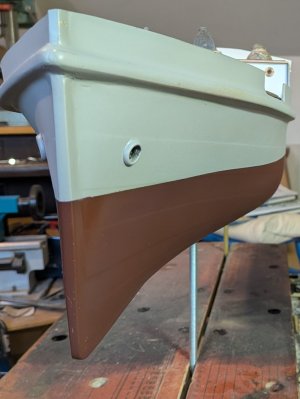
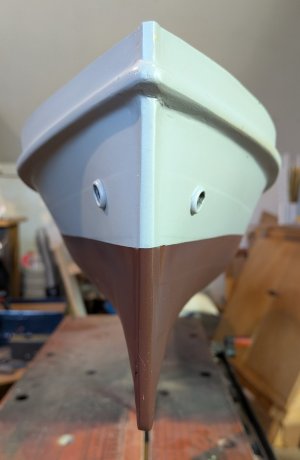
Nice to see a update of your build, Jack. The overall lines looks nice, but the part on the bow at the waterlines looks ‘a bit wavy’.
That could also be due to the camera's position, which distorts the lines somewhat.
But when the feeling is not right ……. ;) you will always look at it in a certain way.
Regards, Peter
 
Hi folks, a bit of an update.
The hull; I have counted and made 42 modifactions to the hull from the CC Resolve kit and now Rollcall's hull is looking a bit more like the real thing, however it will never be more than a "best approximation" rather than a true, exact replica. Fundamentaly the Resolve kit is intended to build a RC toy,(far more so than CC's Sir Kay is). I have always liked the idea that 'If it looks right it is right', well this hull looks wrong, more like a fat toad than an Ocean going tug. Although only a scaled 11" wider than specified in the plans the hull looks far too beamy, ugly to my eye.
This begs the question should I waste any more of my time on it? I will have to think about that.

Here are some pics. of my progress so far.
Good morning Jack. What a cool 12 pounder. I don’t see a “ fat toad” but photos don’t always represent very well. The props and rudder worked out really well. Love the details and bolts. Cheers Grant
 
Nice to see a update of your build, Jack. The overall lines looks nice, but the part on the bow at the waterlines looks ‘a bit wavy’.
That could also be due to the camera's position, which distorts the lines somewhat.
But when the feeling is not right ……. ;) you will always look at it in a certain way.
Regards, Peter
Thanks Peter, I see what you are saying but I think it is more the shape of the hull the flare of the bow is in part almost concave before reaching the slab sides. When you look along the water line it is arrow strait, allowing for my spraying of course. I cannot find any reference to boot topping but if I add it I will pay more attention.

PXL_20260203_105346577.jpgPXL_20260203_105307090.jpg

All the best JJ..
 
Good morning Jack. What a cool 12 pounder. I don’t see a “ fat toad” but photos don’t always represent very well. The props and rudder worked out really well. Love the details and bolts. Cheers Grant
Hi Grant, is it still nice and warm down there in Cape Town? its freezing here! Strangely I really like the little gun too. I usually don't have much good to say about white metal castings.

Six nations start soon.
Cheers JJ..
 
Hi Jack. Love what you’re doing with this build, I think that we’re in for a treat
 
Back
Top