

• Win a Free Custom Engraved Brass Coin!!!
    As a way to introduce our brass coins to the community, we will raffle off a free coin during the month of August. Follow link ABOVE for instructions for entering.
  • PRE-ORDER SHIPS IN SCALE TODAY!

    The beloved Ships in Scale Magazine is back and charting a new course for 2026!
    Discover new skills, new techniques, and new inspirations in every issue.

    NOTE THAT OUR FIRST ISSUE WILL BE JAN/FEB 2026

The Portuguese »patacho de guerra« 1616 — ships’ drawings are born

Joined
Apr 26, 2023
Messages
752
Points
403

Location
European Union
.​
It can be said that the work of Portuguese shipwright Manoel Fernandes from 1616, Livro de Traças de Carpintaria, a particularly attractive collection of designs for various vessels, from the largest merchant nao, through sailing warships and rowing galleys, to the smallest boats, accompanied by technical descriptions and fairly detailed dimensional specifications for specific types of vessels, is not widely known to the general public, and even those actively involved in this field refer to this work extremely rarely and in a rather cursory manner, particularly without delving deeper into strictly technical issues. My investigation of one of the cases contained therein, too, had to be paused for a few years due to the exceptional linguistic hermeticism of Fernandes' text. It was only with the help of a native speaker, @Arthur Goulart, who recently translated the long-transcribed text, that I was finally able to unblock this project.

The choice of this particular project for analysis, among all the others in this collection, was admittedly quite random, but from the point of view of recognising the design method employed by Fernandes, this is of little importance, since in this conceptual sense it is universal, i.e. identical for all other Fernandes' projects. For other types of ships described by Fernandes, of different proportions, only the specific values entered into this universal parametric model change.

This is about a design method in the general Mediterranean tradition, which was also adopted in England in the second half of the 16th century, and as a result, the fundamental features of this Mediterranean method are also described in the earliest English shipbuilding manuals up to the second quarter of the 17th century, and can also be identified in plans of English origin from that period.

Among these fundamental features, which testify to the above conceptual similarity, the following should be noted: geometric construction of the master frame normally consisting of three sweeps of constant radius (sometimes more or even less — just two, which is not particularly significant for the essence of this method); forming the hull shape by a single set of master frame template, transformed (transversally moved and rotated) over the ‘entire’ length of the hull, or at least between the quarter frames, and guided by the specific set of rising and narrowing lines — the line of the floor and the so-called ‘bocca’ line, the latter coinciding with or parallel to the deck line; and finally — geometric elements of the hull bottom (so-called hollowing/bottom curves), connecting the hull body proper with the keel assembly, defined at the end of the design process.

Fernandes' drawings, although visually impressive on the one hand, are not the epitome of precision and are primarily illustrative in nature, apparently to facilitate and encourage a favourable assessment by a decision-making body. However, they did not need to be dimensionally accurate, since this particular design method, due to its relative procedural simplicity, did not actually require the prior preparation of reduced-scale plans on paper, and the actual construction could be started immediately on a real scale, while the written dimensional specifications prepared in advance could be completely sufficient to commence the work.

Examining this case was by no means an easy task of just following a given recipe, as Fernandes basically limited himself to providing the dimensions of various components of the structure. Ultimately, however, this specific investigation allowed for the discovery of further, previously unknown details or design subtleties proper for this design method.

The ship in question was intended to be armed with 18 guns and its basic dimensions are as follows:

Length (between posts): 135 palmos (4.5 x breadth)
Keel length: 102 palmos (3/4 x length between posts)
Breadth: 30 palmos
Depth (distance from the upper edge of the keel to the greatest breadth): 15 palmos (1/2 x breadth)


Waldemar Gurgul


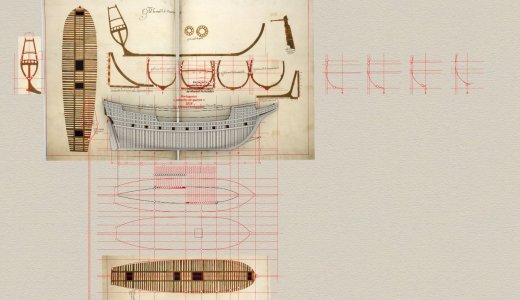
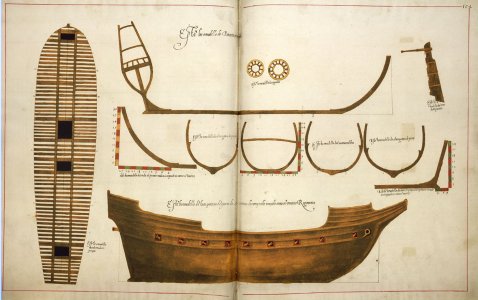
Drawing of the design in question on page 104 from the Livro de Traças de Carpintaria:
f191.jpg


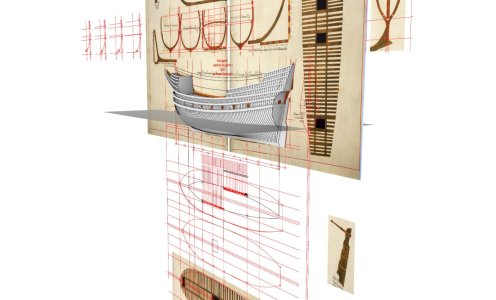
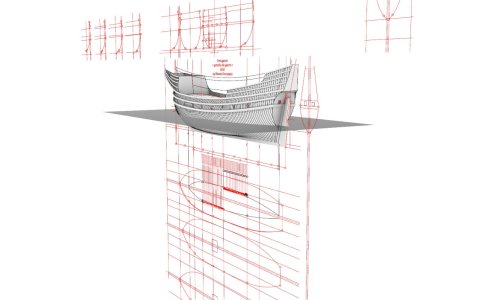
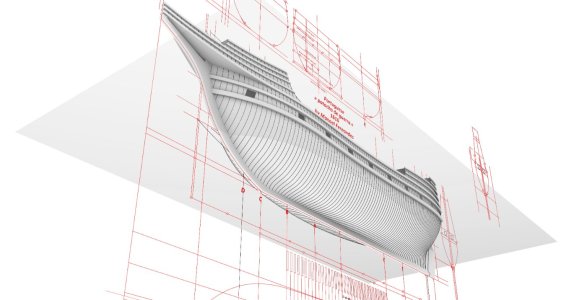
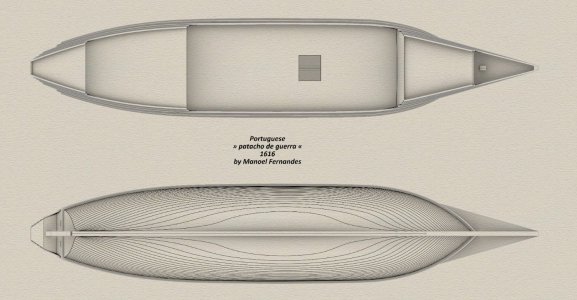
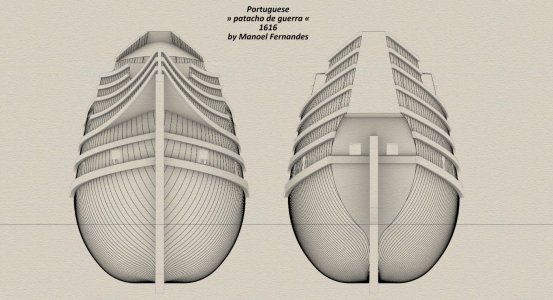
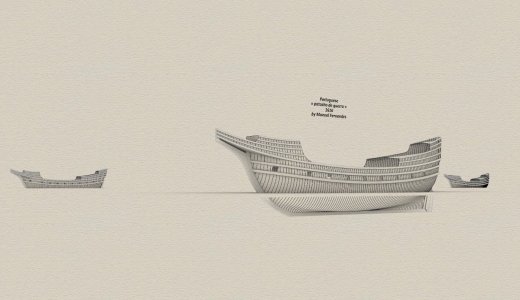
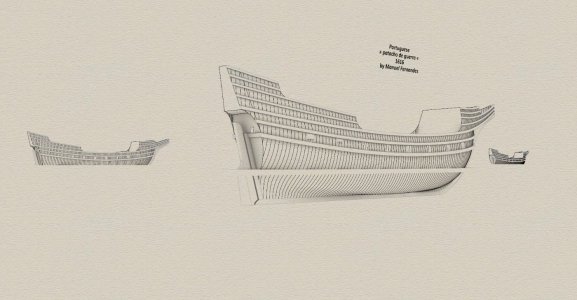
Reconstruction graphics:

ViewCapture20251228_230835.jpg


ViewCapture20251228_221658.jpg


ViewCapture20251228_221546.jpg


ViewCapture20251228_221159.jpg


ViewCapture20251228_223059.jpg


ViewCapture20251228_222545.jpg


ViewCapture20251228_224140.jpg


ViewCapture20251228_224852.jpg
.​
 
Last edited:
.​
Those would make beautiful framed prints

Thanks :). Despite their specific nature, such graphics in themselves may indeed appeal to some and be an unusual or quite surprising decoration. Although I admit that my original goal was mainly to demonstrate, that direct use of contemporary sources is possible and can be quite useful, including issues related to the lines or general shapes of ship hulls.

.​
 
@Waldemar, have you ever thought about writing up your research and submitting it for academic publication? Maybe, The Mariner's Mirror from the SNR... You have several articles worth of research to choose from over the years, and historic recreation from period materials using modern technology and CAD.... seems like a natural fit for the premier journal of maritime history... Just sayin'...
 
.​
@Waldemar, have you ever thought about writing up your research and submitting it for academic publication? Maybe, The Mariner's Mirror from the SNR... You have several articles worth of research to choose from over the years, and historic recreation from period materials using modern technology and CAD.... seems like a natural fit for the premier journal of maritime history... Just sayin'...

Yes, I am considering this possibility and am even being encouraged to do so, thank you, and it may eventually happen. It is a multidimensional issue, and among other things, such a switch to paid access (for readers) means an inevitable and drastic decline in readership, mainly to those sponsored by the institutions that employ them. And via the forum, everyone has free, convenient access. And there is also an opportunity for active participation.

.​
 
@-Waldemar- , I can't believe I missed this post for a whole month! ROTF I use SoS way less frequently, evidently. I have about a thousand questions, but, I think the big one would be: how is the master frame moved and rotated along the boca and rise of the floor lines? The patacho 3D model looks incredible btw, I'd love to see that further developed, and well, maybe a set of plans!
 
Last edited:
.​

@Arthur Goulart

Hi Arthur! Thanks again for your help in translating Fernandes' otherwise nearly impenetrable text. And indeed, I was curious to see if and when you would come across this thread on your own, which is probably why, as a kind of experiment, I didn't give you a hint earlier. Sorry :). And, lest I forget, I have the label ‘-Waldemar-’ here because ‘Waldemar’ was already taken by another user.

In any case, this presentation is definitely worth further development, and for several reasons. For example, it clearly confirms that there is really nothing fundamentally different between the Mediterranean method of shipbuilding and the ways described in the earliest English manuscript guides for shipwrights. Furthermore, although certain elements of the design process have already been explained in modern works (for better or worse), these fragments are still not enough for complete and fully conscious reconstructions of ships from that period and those regions.

This state of affairs is very well illustrated by the case of the iconic 16th-century Basque whaler San Juan, built in the same shipbuilding tradition. Despite enormous effort, time and money, the authors of a relatively recent and otherwise very ambitious archaeological monograph ultimately failed to complete and present a conceptual reconstruction of what was, in fact, a fairly simple design. It doesn't look any better in other archaeological monographs. Why? (my own, almost complete attempt at such a reconstruction is posted on the MSW forum).

Besides all that, I simply like this early modern period the most :).

.​
 
No problem at all, if you come across something that could use my help again, just let me know! I'm happy to be envolved in solving these little puzzles of history.

Oooops, I edited my last post so to quote the proper Waldemar now lol.

I definetely gotta look carefully through your San Juan presentation, I might even try to recreate your drawings to understand them properly. My experience thus far with ship design practices has taught me that messing around in Rhino is the best way to learn it. But, from briefly going over San Juan's topic, the process sure looks to be very similar to what you've done above. I wonder if that's part of the reason Fernandes limited himself to providing the dimensions of various components of the structure, and didn't get into how said dimensions were laid. If the theory that Livro de Traças de Carpintaria was part of the regulations debate is right, and it pretty convincingly is, then there would be no reason for Fernandes to go further than providing dimensions if the drafting practices were somewhat of a commonality thorought, well, Europe. Is that correct?
 
.​
No problem at all, if you come across something that could use my help again, just let me know! I'm happy to be envolved in solving these little puzzles of history.

Many thanks, Arthur. It is truly rare for someone to provide genuinely valuable assistance that requires any effort beyond quickly writing a few sentences. I looked through Fernandes' Portuguese text of the ‘Livro’ once again for any additional conceptual information, but I couldn't find anything that would indicate anything of a ‘game changer’ nature, so at least for a while you're probably not at risk. But, as they say, ‘the devil never sleeps’...

My experience thus far with ship design practices has taught me that messing around in Rhino is the best way to learn it.

Indeed, and to paraphrase a certain classic: ‘Test, test and test again’. I think it was the same individual who also said: ‘Control is the highest form of trust’. But more seriously, it could naturally be any true CAD software, although Rhino does seem to be optimal in such applications.

I wonder if that's part of the reason Fernandes limited himself to providing the dimensions of various components of the structure, and didn't get into how said dimensions were laid.

Indeed, Fernandes systematically omits these conceptual aspects as if their knowledge were obvious to everyone. For example, he indicates (sometimes) when to use graminho de besta or saltarella, but this only for the transverse movement of the master frame template between quarter frames (for defining the contours of other frames). And now, everything else has to be painstakingly recreated.

commonality thorought, well, Europe. Is that correct?

Actually, at least according to my current findings, common for the Mediterranean region (including Iberia) and Britain during this period. The rest of Europe, that is, the Germanic part of the continent (in the broadest sense of the term: i.e. the coasts of Germany, the Netherlands, Scandinavia) and also (part of) the Atlantic coast of France (the so-called Ponant) practised what I call the Northern tradition of shipbuilding.

.​
 
For example, he indicates (sometimes) when to use graminho de besta or saltarella
.​
It's a little amusing how many variations of one concept they had in that period, the besta type of graminho or the many palmos, be it de vara, de goa, or some other. Measuring systems really lacked standardization, which should be the whole point of measuring ROTF

.​
Actually, at least according to my current findings, common for the Mediterranean region (including Iberia) and Britain during this period. The rest of Europe, that is, the Germanic part of the continent (in the broadest sense of the term: i.e. the coasts of Germany, the Netherlands, Scandinavia) and also (part of) the Atlantic coast of France (the so-called Ponant) practised what I call the Northern tradition of shipbuilding.

.​
Ohhh, that makes sense, that would be the parabolic method you posted about for Wageningen. You really need to write a book on it, Waldemar.

Cheers!
 
.​
It's a little amusing how many variations of one concept they had in that period, the besta type of graminho or the many palmos, be it de vara, de goa, or some other. Measuring systems really lacked standardization, which should be the whole point of measuring ROTF

Well, yes and no :). Indeed, today, we are completely unable to cope with old units of measurement, but in the past it would have been the opposite. Let me give you two examples.

The first one is from Fernandes himself. Normally, he uses palmo de goa as the general unit of length, but sometimes he requires something to be one palmo de vara thick, minus one inch. After conversion, it turned out that the latter is nothing more than 3/4 palmo de goa. It seems that for people at that time, this method of using different units of measurement, which seems complicated to us, could be nevertheless more intuitive.

Some time ago, my father told me an essentially identical story about a boy from the countryside who was taught arithmetic in primary school during the last war, and already according to modern standards. When asked by the teacher how much 4 x 7 was, he was unable to answer that it was 28, but instead, in a split second, he gave the correct answer, only according to the traditional way: ‘half threescore less two’ (that is 1/2 x 3 x 20 – 2). Funny and instructive at the same time, isn't it?


You really need to write a book on it, Waldemar.

So far, none of the publishers have contacted me about this (including replies). They may not do so because, as it happens, they are burdened with existing publications by other authors whose concepts of fundamental historical significance are being disproved by my findings, and there is a clear conflict of interest. And this is, in fact, a very small community where everyone knows each other.


* * *​

Anyway, I intend to return to this very presentation in more detail over the next few days. If you wish, you can actively participate in it, for example by deciding on certain details that can be interpreted in more than one way, such as the deadrise height for the master frame (projections depicting frames suggest it is zero, however, in the side projection, the faintly visible line of the floor appears to be about one palm above the keel; and both variants are actually correct).

.​
 
Last edited:
Waldemar, I don't even comprehend how 4x7 becomes 1/2 x 3 x 20 – 2 ROTF . So, yeah, that in itself shows you have a point. Our inability today of understanding the practicality of something doesn't mean it wasn't practical. In the other hand, the imperial system is just worse than the metric, and I'll die on that hill. There is also a reason why the different palmos are no longer used. Never a straightforward answer, I guess.

In that spirit, I'll do my best to contribute to the non straightforward aspects of what Fernandes describes, but I'm definetely a student in your shipbuilding class.
 
.​
[...] the imperial system is just worse than the metric, and I'll die on that hill [...].

I generally agree with you, however, the duodecimal system also has its advantages over the decimal system, particularly in simple, everyday calculations. Please look: if the number 10 has only 2 and 5 as divisors giving an integer (apart from 1 and itself, of course), then 12 has as many as four such divisors: 2, 3, 4 and 6. This is undoubtedly a very practical property. And, in the duodecimal system, if the numbers 10 and 11 were written as a single character (as in the hexadecimal system), more advanced arithmetic operations could also undergo a metamorphosis compared to what they are now. But let's stop there, because someone might get the idea to push through such changes :).

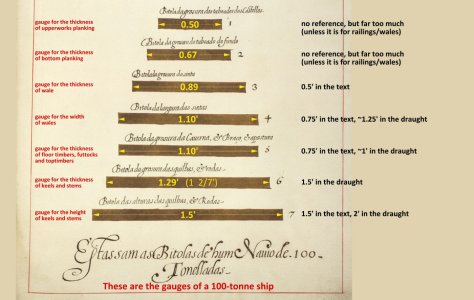
As for the continuation of the presentation, I am still working on some minor details, perhaps unnecessarily, as in fact they are not particularly important in a conceptual sense. Specifically, the dimensional synchronisation of the scantlings is particularly troublesome, because these dimensions are different in every possible way, i.e. they are different on the gauge scale attached to this very design (shown below, and scaled according to the keel height as per Fernandes' text), different in the text itself, and yet different on each individual projection of the draught. Sometimes it is really difficult to decide which dimension to choose to continue with :).


ViewCapture20260206_132822.jpg
.​
 
.​
I don't even comprehend how 4x7 becomes 1/2 x 3 x 20 – 2 ROTF

:)

A translation somewhat closer to the original would be indeed slightly simpler: ‘half-sixty less two’. This ‘sixty’ (‘kopa’ in the original) is nothing more than five dozen. Simple and intuitive, isn't it? And duodecimal. I think that still in my youth, for instance, eggs were sold and bought in multiples of sixty at farmer's markets. This must have been quite close to the time when Great Britain was almost forcibly made to abandon the duodecimal system in favour of the metric decimal one.

.​
 
Last edited:
.​

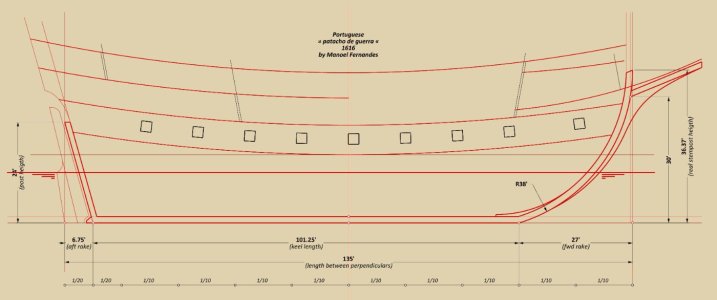
In addition to all the probably unintentional inconsistencies in patacho's design, as shown above, there are further complications related to Fernandes' deliberate, albeit minor, modification of the dimensions of the structural components, which, incidentally, made it somewhat difficult to determine the actual conceptual method of obtaining them. This refers in particular to routine rounding and even clear suggestions that these dimensions were obtained in some other way. In the case of the set of dimensions for the keel assembly, such a troublesome, deliberately applied ‘modifier’ turned out to be the rounding of the keel length to a whole number, with all the consequences that entailed, as well as the rather incomprehensible convention of measuring the stem only to the point where it meets the beakhead, omitting the part of the stem above it.

1. Keel assembly

Original text:

Tera desasete rumos do couse a couçe, a roda de proa terâ d’alto medido polla esquadria trinta palmos, terâ de lancamento vinte & seis palmos, orol por onde se hade rodar esta roda serâ com trinta & outro palmos, terâ de codaste vinte & quatro palmos de lançamento seis & meo que he antre o terço & o quarta.

Arthur's translation (slightly reworded):

It will have a keel of seventeen rumos (one rumo = six palmos de goa = 1.54 m), the stem will be thirty palmos high measured at the perpendicular, it will have a rake of twenty-six palmos, the radius of the stem will be thirty-eight palmos, it will have a sternpost of twenty-four palmos [high] and six and a half of rake, which is to be between the one third and the one fourth [of its height].


Most likely, Fernandes obtained the above values using the following proportions:

— length between perpendiculars (posts) = 4.5 x breadth (30 palmos) = 135 palmos,
— keel length = ¾ x length between posts = 101.25 (rounded by Fernandes to 102 palmos, or 17 rumos),
— sum of both rakes = ¼ x length between posts = 33.75 palmos,
— fore rake = 4/5 x sum of both rakes = 27 palmos
— aft rake = 1/5 x sum of both rakes = 6.75 palmos
— stem height = point of tangency between the stem arc and the fore perpendicular = 36.37 palmos (Fernandes gives this height only to the point where the beakhead begins; see diagram)
— post height = entry point of the tiller into the hull, which in this case is approximately halfway up the first deck.

Taking into account all the details and subsequent stages of the design, it seems that Fernandes himself did not consistently apply his minor modifications to the dimensions of the keel assembly, and as a result, they are only reflected in this initial part of the text description. Consequently, the presentation will continue according to the dimensions given in the diagram below.


ViewCapture20260207_020911.jpg

.​
 
Waldemar, I think explaining the inconsistencies as a matter of somewhat arbitrary rounding makes good sense. One very blatant one is that, while, by text, Fernandes gives the stem rake to be 26 palmos, he represents it as 27 palmos on the drawing. Meanwhile, he gives the keel 102 palmos in writting, as opposed to the 101.25 you found. It's as if he rounded 101.25 as 102, and, as to mostly mantain the same space between perpendiculars, he took that 1 palmo away from the stem's rake. The proportion he gives for the sternpost rake is totally weird "between one third and one fourth of its height", it almost feels like he wasn't quite sure of how he got to the 6.5 palmos for the rake in the first place, or maybe he didn't want to disclose it. Although, I find this latter option to be more unlikely, since giving a straight line a inclination is such a simple concept, and the rough proportions are more than clear regardless. It might be the case that he prepared the different designs in advance for the Livro de Traças, but then went on to not too precisely measure and describe them by writting, or maybe someone else wrote it. That's one theory.
 
Last edited:
.​


:)

A translation somewhat closer to the original would be indeed slightly simpler: ‘half-sixty less two’. This ‘sixty’ (‘kopa’ in the original) is nothing more than five dozen. Simple and intuitive, isn't it? And duodecimal. I think that still in my youth, for instance, eggs were sold and bought in multiples of sixty at farmer's markets. This must have been quite close to the time when Great Britain was almost forcibly made to abandon the duodecimal system in favour of the metric decimal one.

.​
That definetely makes better sense! ROTF
 
Back
Top