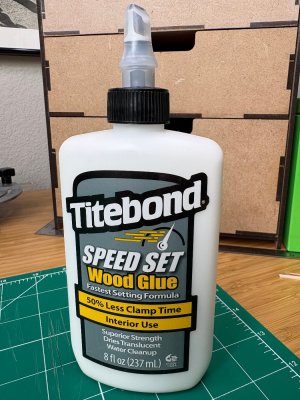
Titebond Speed Set - I am not so worried about the set time with PVA. Is Speed Set so fast that keeping a strong thumb pressure the whole time is something you want to do?
For me, it is more a matter of getting a strong clamp on the joint. The closer are the two wood surfaces, the stronger is the bond. A dried pond of PVA is a flexible plastic. Before Babebot, I dipped a foam stick applicator into a pool of PVA on a piece of CutRight wax paper. For luck, I used the same wax paper square for a whole project. The mound of left over polymerized PVA could get thick. I could flex it. This tells me that it is better to keep the layer where PVA chains intertwine with other PVA chains as thin as possible.
The troublesome bond for a strong clamping is planking. Either to a frame or to a beam - for much of it a skyhook is needed. I used to use brass lil pins in a predrilled hole with a scrap wood square as a hitch chock for a clamp. If the pin is bonded, it is - nipping it off flush and file. If it comes out there is a hole left. A Bamboo dowel is used to fill it. This means that the hole must be in a specific location on a plank. Random dowels here and there is not good. It is necessary to do the whole fastener pattern. Bamboo end grain and brass - this is not something that would be visible on a ship seen at a distance.
If a zone on two meeting surfaces is PVA coated and allowed to polymerize - 24 hrs - and when the plank is to be fixed in position - the rest of the meeting surface has wet PVA, a not too hot iron will activate the dry PVA to grab its opposite and be an instant bond. This is a strong clamp while the wet PVA produces the strong bond.
This saves a year of drawing Bamboo dowels - drilling a near infinite number of holes - dipping a dowel in glue and inserting it - nipping a filing. In the end all this work produces a look that should not be there to begin with.
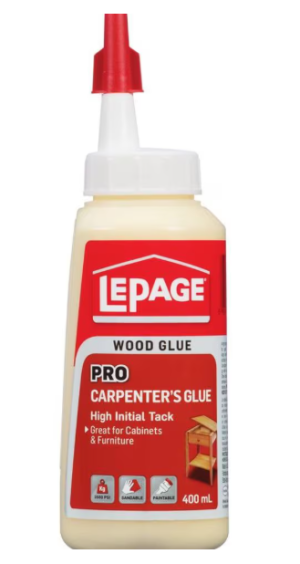
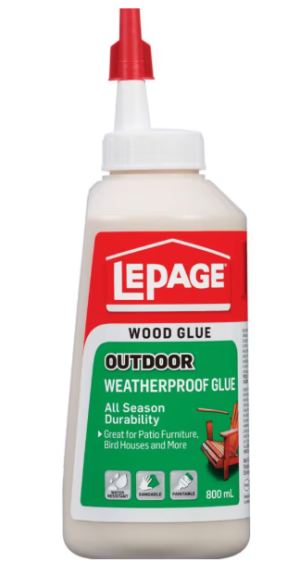
Lepage is a Canadian company. Franklin is in Columbus, OH. Makes sense that a Canadian retailer with a focus on low prices would source from a Canadian mfg.
White PVA dries transparent clear. Yellow PVA dries amber clear.
Titebond II is formulated to be water resistant. It does not survive immersion.
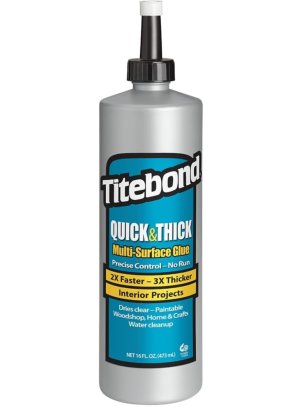
Except for perhaps really low cost generic versions, I doubt that the bond strength is all the different on a practical basis between brands or between white and amber. Yellow has a strong grip on the woodworker market. TV shows get paid for displaying brand names products. I figure that for many of the brand name versions - especially companies with a broad range of different types of glue -that it is more of a matter of labeling. One or two companies may actually synthesize the chemicals and beyond this it is
more of a matter of the label on the container at the end of the filling and labeling line. If two brand names have the same type container - I see that as a dead giveaway that they come from the same source.
As for Titebond II - for me - it is a comfortable and reliable tool that been staying with over a long time. Probably more of a neurotic comfort than anything else. It is not worth the risk to switch to white. Lineco pH neutral is white so if amber is a problem, it is good enough.
The original Lepage was fish glue. A protein glue in the same class as hide glue. Hot ethanol totally denatures protein glue. If the hot ethanol can penetrate a bond there is near instant release. The adhesive residue is curled up little balls easily removed by rubbing or scraping. As for hide glue - the premixed has urea added to keep it liquid - for maybe a year at RT. There is a high water fraction in premixed. Water does unpleasant things to a wood surface that is sanded and or scraped to a final finish.
The hot pot granules come as about five grades - the higher the number the stronger the bond - the shorter the working time. For the highest - if you blink it may be too late. There is a trick involved though. The stronger the bond - the more rigid is the glue. At the top end a sharp wack stands a good chance of shattering the dry glue.