


• "Thank you for your Donations and Support"
    As we close this Annual Donations Drive, we want to thank you all for your Generosity in Donating to Ships of Scale. It is Greatly Apreciated !!!
    Ships of Scale continues to explore exciting things to offer to the Ship Building Community.
  • SUBSCRIBE TO SHIPS IN SCALE TODAY!

    The beloved Ships in Scale Magazine is back and charting a new course for 2026!
    Discover new skills, new techniques, and new inspirations in every issue.

    NOTE THAT OUR NEXT ISSUE WILL BE MARCH/APRIL 2026
  • Win a Free Custom Engraved Brass Coin!!!
    As a way to introduce our brass coins to the community, we will raffle off a free coin during the month of August. Follow link ABOVE for instructions for entering.

Tricks of the trade

......anyway I googled the size of the Bounty's main anchor rope and it was 4" in diameter having a circumference of 12.568" but 4" scaled down to 48 times is in metric =2.116mm which is similar to what everyone has done here but I don't know how unless you work thru to find out the diameter of each rope.
I have James Lee's book arrived just now, and it confuses me on Page 188 how one moment the author is writing about the main mast ropes sizing etc and then in the same breath, talking about anchor ropes LOL. I think it may takes some time to see how he ( Lee) the author works. lol
However I will take James Lee's writings as the real McCoy. Got to remember The Bounty was not built as a armed ship but as a collier cargo carrier built for coastal trading, so as a merchant ship she may have been different in build as to a naval ship of war.
Sorry folks , my brain is running riot. LOL
 
Last edited:

it confuses me on Page 188 how one moment the author is writing about the main mast ropes sizing etc and then in the same breath, talking about anchor ropes LOL.

Hi Gary
Maybe the newest edition is different than the older ones so what I found may not be applicable. The mast rigging in my copy is on pages 185-186 and the anchor rope is under miscellaneous ropes on page 188. He gives the circumference of the anchor cable as 0.62 X the diameter of the main mast. Is it the same in your edition? The first dimensions in the dimensioning ratios are for the mast length and diameter and I am pretty sure are the same ratios as given by Steel for the late 18th century in The Elements and Practice of Rigging and Seamanship on page 39 (https://maritime.org/doc/steel/).

Allan
 
Hi Gary
Maybe the newest edition is different than the older ones so what I found may not be applicable. The mast rigging in my copy is on pages 185-186 and the anchor rope is under miscellaneous ropes on page 188. He gives the circumference of the anchor cable as 0.62 X the diameter of the main mast. Is it the same in your edition? The first dimensions in the dimensioning ratios are for the mast length and diameter and I am pretty sure are the same ratios as given by Steel for the late 18th century in The Elements and Practice of Rigging and Seamanship on page 39 (https://maritime.org/doc/steel/).

Allan
It is the same Allan, but what is here referring to as the "main mast" and then x 0.62. It appears like it's black and white here to me, where I find the diameter of the mast is such a size, and then multiply by 0.62. The main mast, I think he refers to, is the one in the centre of a 3-mast ship. That is how it reads to me. That's the problem, as I cannot see it any other way. Just remember, take it easy on me, as I am new to this stuff. LOL.
I am only used to some rope from the store or from the hardware shop. lol, and then I see that there are nearly a trillion different-sized ropes included in the rigging of the boat. I hope I can figure out how many layers make a certain-sized rope.
Actually, that is a topic of what the real secrets are to recreating the correctly sized rope. Surely it's not just guesswork. All I know 99.9% of the ropes are Z laid
Cheers
 
The main mast, I think he refers to, is the one in the centre of a 3-mast ship. That is how it reads to me.
Yessir. Lees, and subsequently Steel use various ship lengths and breadths to start then figure the main mast length. Everything then goes from there.
There are a LOT of rope circumferences, but at our scales, a dozen different sizes should satisfy 95% of model builders, be it kit or scratch.
Allan
 
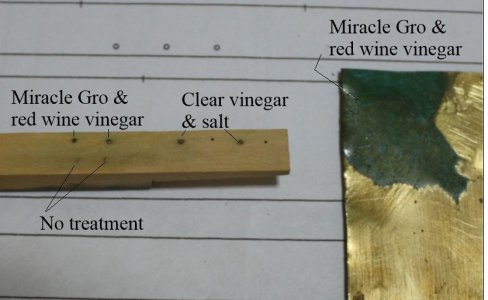
Creating a verdigris color on copper for the bottom plates and other copper parts such as bolts is usually a challenge. I did some experimenting for my current build to create the greenish color on the copper bolts of the keel scarphs. This could also be an option for ships with copper bottom plating. More experimenting would be useful as the sample below is quite dark, but I suspect some variation on ratios of materials would yield agreeable results.

I did some experimenting last night with producing a verdigris color on the keel scarph bolts which were copper on the actual ships.

I tried vinegar and salt on one pair, one part Miracle Gro fertilizer granules to three parts red wine vinegar on another pair, and one pair untreated. It is subtle, but there is a difference between the treated and untreated bolts. The Miracle Gro and red wine vinegar is my choice as it does not rub off as easily as the vinegar and salt treatment. For the vinegar and salt a clear acrylic coat helps protect the coating from rubbing off.

Test comparison. The sheet on the right is treated with the Miracle Gro and red wine vinegar. My current build did not have a copper bottom, but I thought to try it to see how it looks. I think it is too dark for bottom plating, but some experimenting with proportions or clear vinegar rather than red wine vinegar may get better results. Sorry the photos are not more clear.

Allan

Test pieces
1780921874649.jpeg
 
A cloth saturated with household Amononia and a little salt. Put in a sealed jar with the part suspended above. Let the fumes do the job.
The problem is that the keel on this build is nearly 30 inches long with three scarphs. I cannot find a jar that tall!!! Time for another piece of pvc pipe and end caps to rig a wire to hang the part. Then again, how does PVC hold up to the fumes? I would hate to open it up the next day and find a mess.

Allan
 
No Allan! This wouldn’t work for a completed part. I did use for a sheet of copper and brass supports that formed the base of my longboat model. I then attached the treated sheet with two sided tape to plywood or MDF. Different from the usual polished wood but I liked the effect.

Not just the PVC glue; imagine what it would do to your always precise and beautiful woodwork.

Roger
 
Hi guys, thought I would jump in on this one. Natural patina on copper and brass result from surface oxidation and comes mostly from carbon dioxide, but can also come from pollutants in the air, like sulfur dioxide. The process is very slow and typically takes years. Ammonia (and other amines) react very quickly with copper (brass is an alloy of copper and zinc). It forms a complex with copper that has a blue-green color, actually more blue than green. This is why the Miracle Gro works, because one of its main components is Ammonium sulfate. It works very well and quickly. The method given by Roger is perfect, as you only need the ammonia fumes not actual liquid contact. The ammonia wouldn't do anything to the PVC, but as Roger pointed out, it will affect the wood and possibly the glue holding parts together. Treating wood with ammonia will cause it to darken. It's a method used by some wood workers to enhance the color and contrast of the grain. It won't actually damage the wood, but it is going to change the color. Liquid ammonia on the other hand will damage the wood.
Here is a really good website that provides recipes for getting patina on copper and brass of many different colors depending on what is used. All of these recipes are good only for treating the metal, not the wood
Hope this helps
 
We live on a small ranch and our water comes from our own well which is about 275 feet deep. While producing great water in abundance, it does have one quirk. There is sometimes a fair amount of sulphur dioxide in the water. I could install an aeriation tank to let the sulphur dioxide dissipate, but it's not worth the cost to put in the tank. The gas isn't noticeable when the water is cold, but when it is heated, the gas is released from the water, so you get a whiff of "rotten eggs" when taking a hot shower when there's sulphur dioxide coming up in the water. I put an inexpensive (battery operated) brass cased ship's clock on the wall in my bathroom. I have a gix about lacquered brass and remove it entirely to bare brass whenever a lacquered brass piece, like this clock, starts to "get the pox." I then keep it polished thereafter. There's nothing like a hand polished brass object. Except this one... when it was exposed to the steam from hot showers with water with the sulphur dioxide in it, that bare brass turned jet black! I guess I'll have to get it polished up again one of these days.
 
Back
Top