

• Win a Free Custom Engraved Brass Coin!!!
    As a way to introduce our brass coins to the community, we will raffle off a free coin during the month of August. Follow link ABOVE for instructions for entering.
  • PRE-ORDER SHIPS IN SCALE TODAY!

    The beloved Ships in Scale Magazine is back and charting a new course for 2026!
    Discover new skills, new techniques, and new inspirations in every issue.

    NOTE THAT OUR FIRST ISSUE WILL BE JAN/FEB 2026

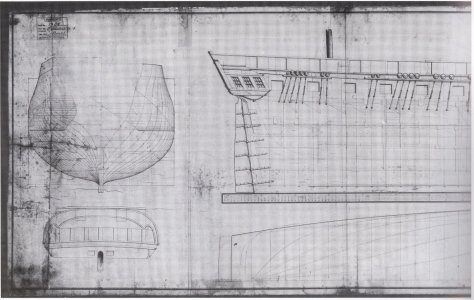
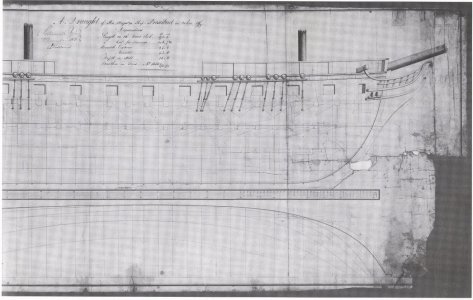
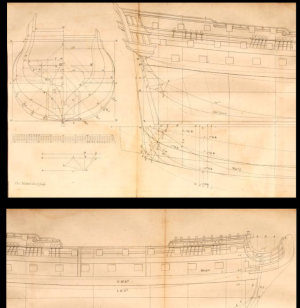
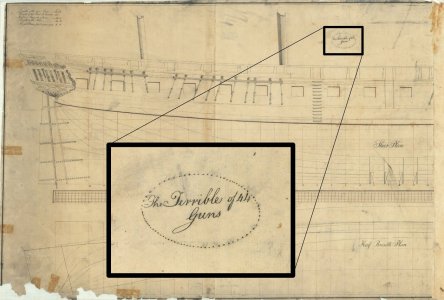
US Frigate “Terrible” — design proposal by Joshua Humphreys, ca. 1796

Joined
Apr 26, 2023
Messages
682
Points
403

Location
European Union
.​

Actually, this relatively ‘late’ period is beyond my immediate interest in the subject, yet, prompted by a hunch, or rather encouraged by the hull shapes quite characteristic of Northern style of design, I decided to take a closer look at this case as well. Specifically, it concerns Joshua Humphreys' design proposal for the intended ‘Constitution’ class of frigates (many thanks for @Martes for providing this information), i.e. a design from around 1800.

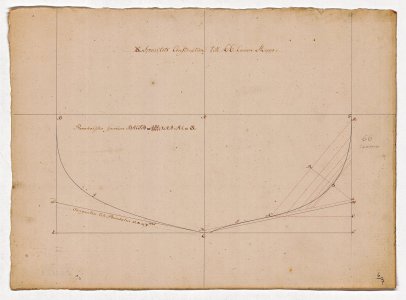
Preliminary tests confirm that Joshua Humphreys did indeed design ships using one of the sub-variants (parabolic) of the general Northern tradition, yet, for greater certainty, a similar analysis can be performed for his 1776 frigate Randolph as well, of which the original plan has been preserved in the archives. Until now, the design methods employed by American shipbuilders of that period were not recognised, and this issue was merely speculated upon by various authors dealing with the subject on premises other than the actual, comprehensive analysis of the design lines. Needless to say, without conclusive results.

Finding the right design method allows for the correction, with unprecedented certainty and precision, of the not very precisely hand-drawn hull lines, which is quite characteristic of manual drafting, and without resorting to clumsy synchronisation of waterlines, buttock lines and cross-section lines in order to make the surfaces fair, and which, as is often the case, still further distorts the original shapes intended by the designer.

In addition, the design method found can also be used for rational and realistic reconstructions of other vessels, based on their known general dimensions, from that time and place, or at least those designed by Humphreys himself.

It can also be added that the plans from the era of captured American vessels, as well as those of other countries, drawn up by the British, although on the one hand may quite well reflect the general shapes of the hulls, and even be quite sufficient for practical applications such as the construction of ‘duplicates’ of such ships, yet, on the other hand, they cannot represent the original shapes very accurately, because for the purposes of making these secondary plans, other design methods were used by the British, which inevitably generated different specificity of shapes, and as a result, only better or worse approximations of the original shapes could be created.

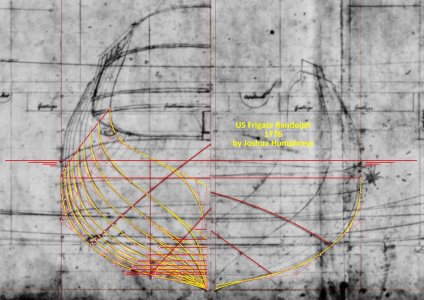
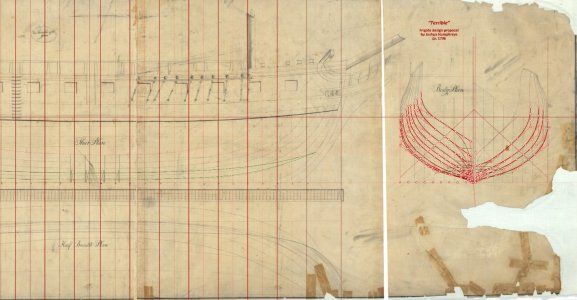
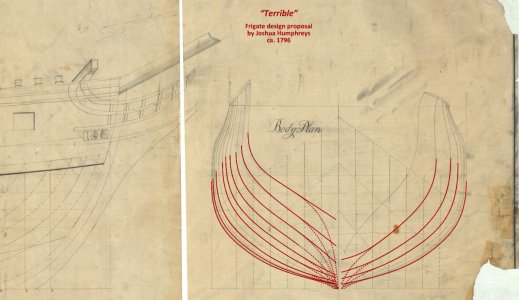
Below are the results of the tests carried out. The red lines, superimposed on Humphreys' original plan (American archives), were generated according to the design method found. As can be seen, they coincide quite satisfactorily with the lines on the plan, except, partly, for the so-called hollowing/bottom curves, which either made some trouble due to their slightly greater complexity to draw, or – more likely – the possibility that in order to speed up the drawing process they could have been drawn in the ‘express’ mode, i.e. without following the formally correct geometric procedures (hence the need for verification diagonals).

The presented results of the shape study are preliminary, which means that the reconstruction still needs to be refined in a consistent manner according to the very precise course of the main longitudinal design lines (after their prior, already more exact determination), which will ultimately guarantee flawlessly fair hull surfaces that are also consistent with the designer's intentions.

As a final note, it can be said that most of the key design lines forming the basis of the project have been removed from the drawing (and, as a result, they need to be painstakingly recreated), leaving only the resultant and verification lines.
The Terrible ca 1796 - 01.jpg


The Terrible ca 1796 - 02.jpg


.​
 
.​

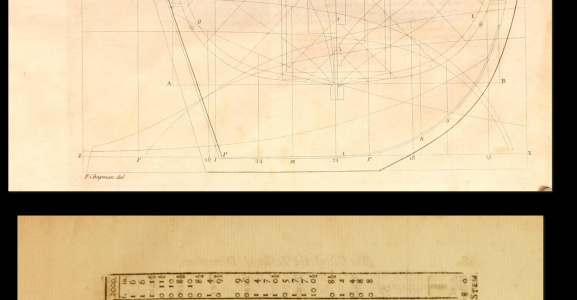
To be more certain, I decided to conduct a similar test for the second preserved plan by Joshua Humphreys, namely of the frigate Randolph 1776, which was actually built and had a chance to be put into service.

The results of the test for the aft part of the hull can be seen in the graphic below. Admittedly, the original drawing is not without problems (drafting inaccuracies and subsequent distortions of the paper medium, as well as not quite full compliance with the dimensional specifications of the ship preserved in Humphreys' papers), nevertheless, the conformity of the reconstructed lines with the original lines is very good, and there can be no longer question of coincidence when it comes to the recognised design method.


Randolph 1776 - frame contours.jpg
.​
 
.​

For greater clarity, it should be added that this concerns a developmental, ‘parabolic’ variation of the design method in the ‘age-old’ Northern tradition (in the European context), the earliest known examples of which date back to the last decades of the 17th century (the French fluit Le Profond 1684, the French transport ship La Belle 1684, whose wreck was recovered off the coast of Texas in the Gulf of Mexico in modern times, or the design of a frigate by Dutch shipwright Hendrik Bindem from around 1700).

.​
 
This is a very, very interesting approach and I will follow your efforts with joy and pleasure!

Maybe one remark. According to Howard Chapelle (The American Sailing Navy) it is very likely that "the Terrible" was in fact designed by Joshua Humphreys - but most likley before Doughty and Fox made their copies in 1794 and 1795 (Fox´s very liklely never been used). It is very likely that this plan was done to be presented to a) authorities and b) as a template for the other gentlements copies for the Boston (Constitution) and New Yok (President) builds. Humphreys - being the responsible for the Philadelphia build US frigate United States - did (according to Chapelle) not need nor like drawings. Therefore: the plan for the Terrible seems to be older than 1795.. more like 1794 or maybe even 1793.

@Waldemar do you intend to compare the concept plan with the Doughty plan? .. the President "as caught" .. and even the final ship?

In any case: have fun with this interesting project !
 
.​
Hi @Marcus.K.

Thank you for your additions. Fortunately, this hopefully clearer insight into the date and circumstances of the drawing's creation does not turn anything upside down, as the main purpose of this exercise was to reveal the design method employed by American shipwrights throughout this period, based on genuine, extant materials from that era.

Hmm, Chapelle's statement, which you quoted, that Humphreys did not need and did not like to use plans for shipbuilding, is probably worthy of more extensive commentary, and perhaps even debate, however, his two extant plans speak for themselves quite eloquently.

@Waldemar do you intend to compare the concept plan with the Doughty plan? .. the President "as caught" .. and even the final ship?

Such a comparison of plans of different origins (especially original and British-made ones), which you mention, could indeed be an interesting and useful exercise, but I would gladly leave this task to someone else, because its essence would not be to identify design methods, which is my primary goal, but "merely" to identify the degree of approximation or similarity of these derivative plans ‘as taken’ in relation to the original plans, which normally goes beyond my primary agenda. At this point, I assume a priori that these secondary plans cannot be a reliable basis for recognising actual design methods, and for several reasons, although on the other hand they could be a good basis for reconstruction projects.

I was not aware of the existence of any other American plans from this period apart from those presented above. Could you please provide me with these other plans or indicate a source of sufficient quality for examination?

Thanks :)

.​
 
Oh there are beautiful plans available at the National Archives Cataloge:
I have to admit: I still did not understand 100% how to find things and also there are a lot of mistakes done by the archivists as we see below:

There is one which is - wrongly named "Constitution"
"Dimensions for the USS Constitution" (a wrong statement!)
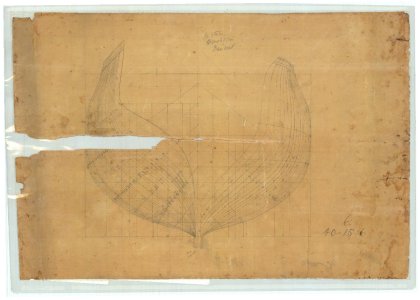
NAID: 518072402Local ID: 40-15-6EArchitectural and Engineering Drawings
1798 unknown-frigate-by-Sam-Humphreys.jpg

and also the same plan is stored now named "Philadelphia" https://catalog.archives.gov/id/365107457
Plan of the USS Philadelphia
NAID: 365107457Local ID: 40-15-6E

I think that both of that is wrong!
Its non of them! Which ship it is? ??

Then there is another plan by Humphreys:
NAID: 365107466Local ID: 40-15-6D
Plan of unidentifed Ship 1797:
1797 Unidentifed 22 - 24 gun Ship by Samuel Humphreys 05-04-02_08.jpg

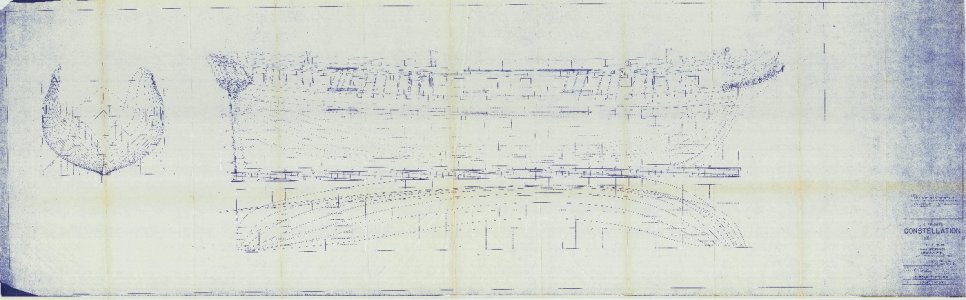
And here the blue print of USS Constellation:
NAID: 75841344

1797 Constellation_Fr_01.JPG
This plan seems to be a 1944 blue print from original drawings which provide an immens amount of information about the ships equipment and inner structures.
I am not sure if the drawing was done by Doughty for Humphreys .. I am not that deep in this ships history yet.


Back to USS Constitution and Humphreys original 44-gun-ship concept:

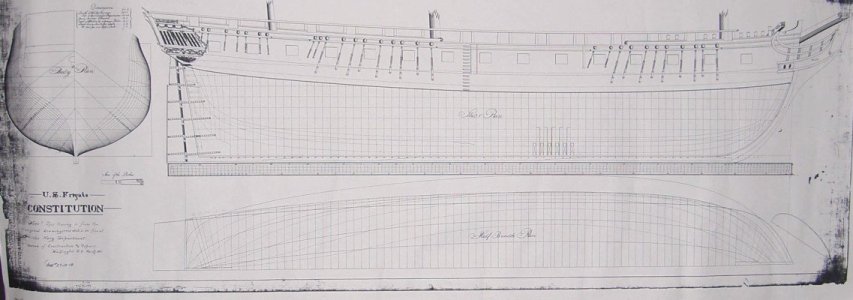
Doughty´s copy of Humphreys 44-Gun-Design done in 1794 - most likely to be distributed to Boston and New York - is available on the USS Constitution-Museum´s homepage:

I did attach this PDF below.

Unfortunatly the Museums online-collection is a mess.. a lot of 1926-30 drawings - which are interesting for the later ships history. But many, many available material is NOT available at the museums collection. Unforunatly I have the impression that in the US no one is really interested in collecting, sorting, archiving and shareing ALL available material online.

But although this drawing is often called "The original" or the "Humphreys drawing" - its neither of that.
As a matter of fact: its Doughtys drawing - and also it is a later copy of the original! .. as one can read in the header on the right bottom side.
I once found in the depths of the WWW a drawing - obviously the same lines - but an "older" header - this time on the left center .. Which in my eyes is at least an older copy - if not the "original" - Doughty drawing. I never found out were the real "paper orginal" is stored or who owns it.

1794_doughty_plan.jpg
But for us it does not realy matter too much - as the PDF´s drawing really seems to be a technically reproduced "copy" - not a manually done.

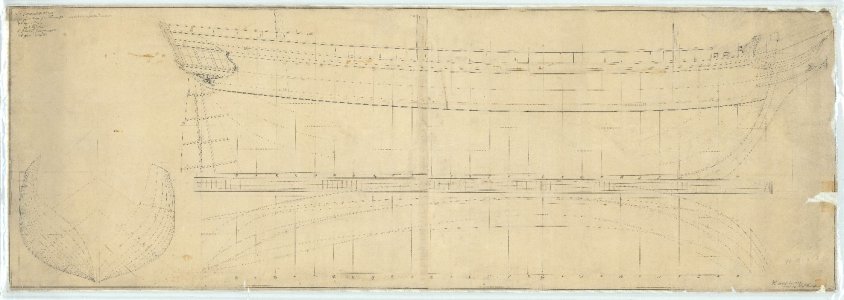
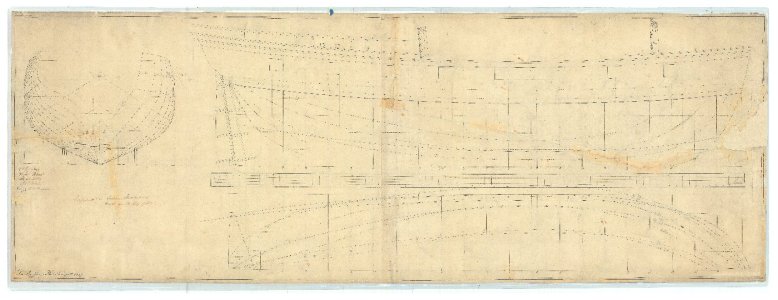
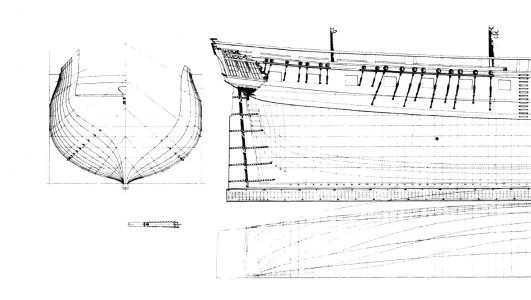
And then there is the - most likly 1795 done - "Fox Drawing" which seems to have been done - but not followed neither in New York (USS President) nor in Boston (USS Constitution).
1795 Fox Plans Stern.JPG1795 Fox Side View.JPG
As we know: Fox and Humphreys later had an ongoing dispute about who DID the design of the frigates.. and it seems the experts do trust Humphreys MORE than Fox .. although Chapelle is right: it is hard to give the credits for the total design to only one person - as a complex product like such a frigate can not really be done by one person alone.

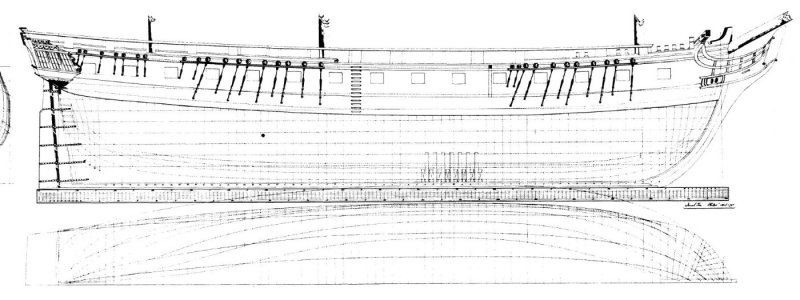
Now, the British plan availabel is to be ordered by the NMM as they own the rights. Nevertheless there is a tiny digitial copy floating around in Internet which I think I can share here. If you want it more precise: pls. contact the NMM in England.

1815_USS-President_as-is-rear.jpg1815_USS-President-as-is-bow.jpg

As you intent to investigate the design methods the President drawing may just be helpful indirectly - as this is a drawing "as caught" therefore "as build".

Whether Doughty or Fox used design rules to prepare their copies or just copied from Humphreys "Terrible" drawing is unkown to me and might be intereseting to find out by comparision. Fox did alter the design - as we know - and even if non of the big 44-gun frigates was done according to his design it would be interesting to learn how much he applied different (british?) rules compared to Humphreys.

We also don't know if the shipwrights followed those drawings when doing their 1:1 frame templates in their mould lofts.. or if they did all that based only roughly on given written dimensions (by Humphreys) according to their - possibly a bit deviating - rules. In those days ships were not yet really planned based on drawings as today! The tables and rules were known by the experts and at least it was said for Humphreys that he relied more on those rules, tables and halfmodels rather than on drawings.
 

Attachments

Last edited:
.​
A beautiful, genuine gift. Thank you, Marcus. Now I need to take a closer look at it and think about what and how exactly to do with it next. And it already looks very promising and certainly broadens the perspective. :)

.​
 
I just realized : the two very first ships I posted in the former post were done by a Humphreys .. It wasn´t Joshua Humphreys but his son Samuel - who was about 18 - 19 years old in 1797-1798. So it was most likely his fathers design - but the son seemed to have done the drawings.

"The Terrible" on the other hand most likely hasn´t been done by the son .. as he was only about 14 years when that drawing was done in 1793.

Nevertheless:
those lines are at least from the Humphreys family shipwright tradition .. and most likely all of them were at least supervised by Joshua Humphreys himself.
 
ah .. and there is one more I found:

Plan of the USS United States, USS Constitution, and USS President
NAID: 365107459Local ID: 40-15-6CArchitectural and Engineering Drawings

I just don´t know how old this one is .. or who was the person doing it!

If you go for the link: you can download a even much bigger file with 70 MB ! ..
Maybe this is even more helpful for your research - although I admit:
not knowing who did it when for which purpose .. makes it hard to use as a source. Just to see that the paper is an old one does not really help..

1795 Plan President Constitution United States Lines 01 - 05-04-02_05.jpg
 
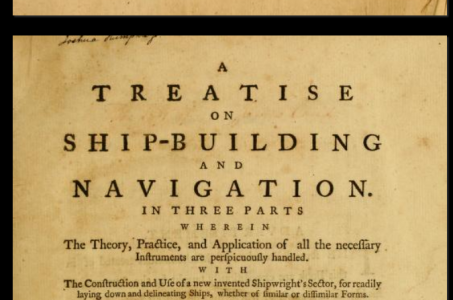
another beautiful finding in the National Archive: A version of Mungo Murreys "A treaties of shipbuilding" - published in 1754.

Screenshot 2026-01-01 072949-Title.png

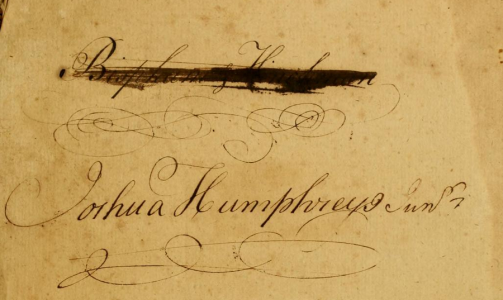
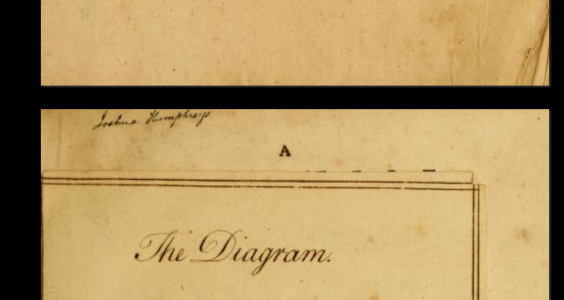
It seems to be possessed by Joshua Humphreys jun - which is "our" J.H. .. not his father.

Screenshot 2026-01-01 072104.png

He seemed to have valued that book - which has been porperty of someone else before. He was adding his name on several pages!
The previous owner was striked through and is not readable anymore it seems.

Screenshot 2026-01-01 072845.png


But interestingly the book had another well known owner, connected with US Naval history!
Screenshot 2026-01-01 072815.png

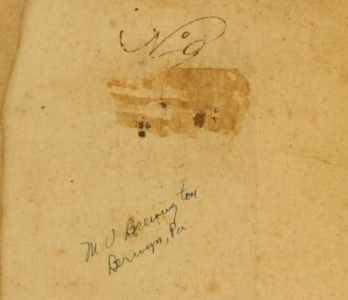
A M.V. Brewington seemed to have owned that book too ...

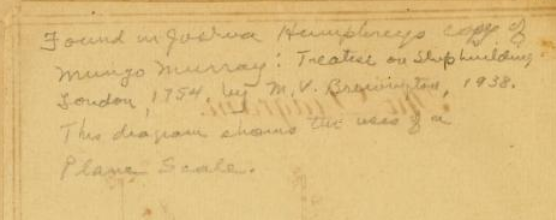
And there is another text on one page refering to Brewingtons and Humphreys Ownership:
Screenshot 2026-01-01 072913-Text.png
"I found in Joshua Humphreys copy of Mungo Murray: Treaties of Shipbuilding, London 1754 by M.V. Brewington, 1938."

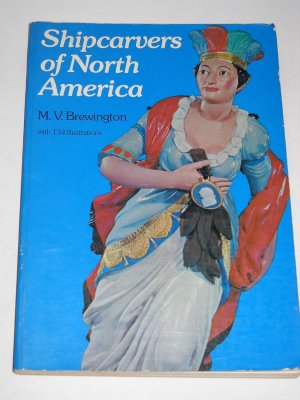
Mr. Brewington is the author of "Ship Carvers of North America" - a beautiful book about the art of ship carving and how it developed in the United States - published in 1962. He later was - beside other roles - well respected Assistant Director und Curator of Maritime History am Peabody Museum of Salem.

Brewington_.jpg

That old book of Humphrey may interest you @-Waldemar- as it
a) was obviously known to Joshua Humphreys
b) explains ways and principles to design ships
Screenshot 2026-01-01 073300-Method.png

c) contains a strange page (in different Paper!?) refering to Chapman ..?? Maybe a loose paper inside the book?
See the bright paper, compared to the brownish original paper on next page:

Screenshot 2026-01-01 073617-Chapman.png

Hope you can find interesting inspiration in this one too ...

HAPPY NEW YEAR to everyone !!!

 
.​
@Marcus.K.

Marcus, the materials you bring up here are an absolute game changer, providing significant help! Thank you once again for your extremely useful and welcome contribution. :)

Incidentally, you have inadvertently put me in a strange, somewhat amusing quasi-philosophical or mental state, because I cannot decide whether to be surprised or not by the circumstance that it is a European who is helping by providing this key archival data of American origin (and who is also quite well versed in it). :)

At the moment, I am starting to look particularly closely at the brig by Samuel Humphreys (built for the Dey of Algiers?) of 1797, the plans for which you have kindly provided. Among other things, because it is one of the few plans of American origin in which the crucial design line of the floor has not been removed, which makes the investigation not horribly difficult, but simply difficult. And after a few hours work I have already been rewarded with another subtlety in the form of the fourth sub-variant of the double parabolic method (it turns out that in practice this double parabolic method could be and was applied in various ways, as can be inferred from the designs of Dutch frigates by Bindem (ca. 1700) and Slegt (1723) and from the designs by Joshua Humphreys).

But all this still requires a lot of work, since you have created a sort of so-called ‘feast of abundance’ that needs to be dealt with somehow... :)

Many, many thanks...

.​
 
Last edited:
First of all:
I am very glad and happy if I can help here !

And second:
I have to emphasis:
all presented on my side was not found by myself alone but by the help of so many others pointing me to information too.

So the thank should go the community here and in other forums like Segelschiffsmodellbau.de or Modelshipworld.com - and others! .. , authors of so many books, employees of archives, museums, libraries and all the organizers of any source for information about this so interesting subject !

AND thanks to YOU
for bringing up and working on this very interesting subject - I would not dare to start with. Although having a bit of experience with CAD Design I still hesitate to try to understand those "treatise" and the complex descriptions and tables of "how-to" in which - for my taste - are still much to few pictures! I am a visual thinker. I need to see what I have to think about. 3D is my world. Words to me are only simple to produce - but very hard to read I have to admit!

that it is a European who is helping by providing this key archival data of American origin
Well, that´s an interesting thought - and I noticed in so many different occasions that it seems to be hard to gain professional help for these subjects in the US - as it seems: the need to earn money with the subject you deal with - and the lack of public (tax) budget for these things make it harder to have sufficient professional staff and to gain results. The latest cutting of budget won´t help here. I fear the focus stays more on things which really attracts masses and a lot of publicity increases the pressure on "real research" and causes more sensational "Disneyland-like" presenations for a wider audience - leaving the very few "nerds" offside .. To be not mistaken: I have to thank to so many professional historians, archivists and employees for their help and assitance! But one can not ignore that they don´t have the time and / and budget to really dig into the questions very deep.

The strange fact that there seems to be no one, no institution, having a more "universal" overview about all the exisiting drawings available (and there are A LOT! even before 1926 - which are of course a dangerous source for the ships earlier history!) or at least published as list (!) was thrilling and astonishing me before.

There is the USS Constitution Museum ( https://ussconstitutionmuseum.org/ ) - doing a great job with the Museum and the Blog .. there is the Naval History and Heritage Command ( https://www.history.navy.mil/ ) also constantly improving their online archives with Pictures, Paintings, information - but still both of them have only partly the available information collected or shared in a way which allows the public to really find things quickly and simple. In addtion the huge information in the US Internet Archive or the Library of congres ( https://www.loc.gov/ ). But I find it hard to identify and re-find information I once found there as I seem to be to ignorant to understand their search function.

Even professionals seem to not invest too much time in research "waiting for NEW information" instead of re-looking the available information and re-interpret them with a much wider basis of availble info. One can learn from the available source if you compare more of them more carefully. Today there is so much digitalized information available - a researcher 30 years ago had to travel to so many places, libraries and archives.. All that leaves the public view on ships like Old Ironsides in a very mistaken way - being fooled by myths, interpretations and mistakes former researcher who had not chance to avoid them.


"Double Parabolic Method" sounds interesting! So if you have a visual explanation about this, I would be very interested. But don´t waste your time with that - and go on with your studies, pls..


the brig by Samuel Humphreys (built for the Dey of Algiers?) of 1797
Oh - thats fun!

The 22-gun brig Hassan Bashaw/Hassan Pasha, designer Samuel Humphreys, launched in 1798 in Philadelphia, 275 long tone, 97 feet or 93 feet 2 inches plus 27 feet plus 11 feet 6 inches
as stated here in Wikipedia:


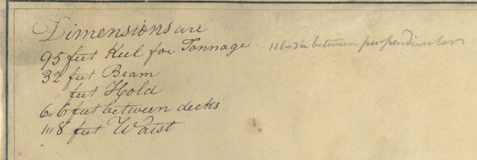
The drawing says:
Dimensions-possible-Bashaw.png
That seems plausibe, right? I know already that the "x feet keel for tonnage" is NOT the length we see on a drawing - but a calculate value to specify a vessel.
I did not yet understand how and why that calculation is done .. but that doesn´t matter for now.

I did not recognize this interesting piece of a puzzle. It is not very likely that Samual Humphreys was working on 2 very comparable sized Brigs in his father´s ship yard the same time. So the probablity that this "unkown ship" IS in fact the Hassan Bashaw is far bigger than 0 ! .. Very cool !! 'Thanks for this finding!

That wikipedia article points to an interesting book with 52 pages which might be useful for your work too:

ISBN : 0913346195

John Lenthall, naval architect: A guide to plans and drawings of American naval and merchant vessels, 1790-1874​


Unfortunatly I can not purchase it from Germany ...:rolleyes: .. but I should appreciate that - as I should not purchase more books anyhow!

 
Last edited:
Naming a ship 'USS Terrible' I'm sure would have caused many a brawl in bars defending her honor.
 
Back
Top