• SUBSCRIBE TO SHIPS IN SCALE TODAY!

    The beloved Ships in Scale Magazine is back and charting a new course for 2026!
    Discover new skills, new techniques, and new inspirations in every issue.

    NOTE THAT OUR NEXT ISSUE WILL BE MARCH/APRIL 2026
  • Win a Free Custom Engraved Brass Coin!!!
    As a way to introduce our brass coins to the community, we will raffle off a free coin during the month of August. Follow link ABOVE for instructions for entering.

USS Constitution by BlueJacket 1:96

Thanks Peter, I used the same drill bit used for the holes. I have the same set you do, which are really made for PCB boards and not true screw bits. They have more of a square point. I simply lined up the bitt with a temporary gate to keep my distance and very carefully moved forward to make the groove. Not an easy task. Once finished, I cleaned up the groove with a file.
To your point, I had mentioned to Mustafa some time back that I reeeeaaally wanted to get a Proxxon mill after watching you're guy's work. You are absolutely correct, it would have made the job much, much easier. Maybe for Xmas? If I'm lucky
 
Yeech, I guess I forgot how expensive that baby was. I was looking it up on eBay figuring I'd turn you on to a used one at a discount but, there aren't any. To make it worse, to have this thing be of real use, you have to invest in at least one vice. I found it incredibly useful to have two. And of course then there is the dividing attachment. It does add up.

Still, if I only had one tool to get me through a build, this would be the one.

Christmas seems like such a long way off..
;)
 
Yes Peter, that is the hurdle to jump, but boy would it be nice to have. Xmas is a ways off, but then it's hard to believe this year is already almost half over, so I'm sure it will be here soon enough.

TB glad to have you following along. I hope you find something of use. When you do get around to it, I did repost my entire build on "that other site". (MSW)
 
I compared the two mills recently, thinking I would "trade up" to the Sherline. I decided against it for several practical reasons aside from it being nearly twice the price. By the time you add in the "accessory" package, you're at $1,174. I also didn't like the enormous motor drive unit seemingly in the way of the Z axis handwheel. It may be beefier, but I didn't see features here that trumped the Proxxon.
 
Thanks to both of you for the info. Since I am totally new to ship building and really don't know how far I will go with this hobby, I am certainly not inclined to spend more than $1000 for something I may not use that much. I have found a Proxxon on eBay for $429 plus shipping, which is a chunk, but a price that I could live with if it makes building this ship more enjoyable. Of course, even at that price, I still have to get it past the Admiral :)
 
I got started working on the Mizzen mast fife rail. As with everything, the more times you do something, the better you get at it.
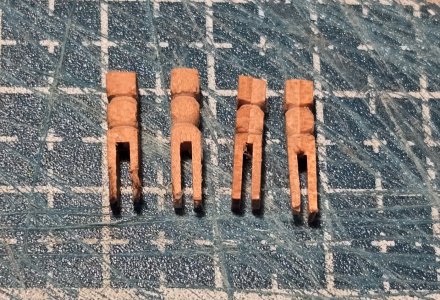
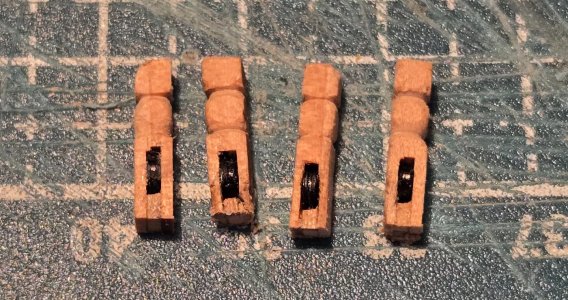
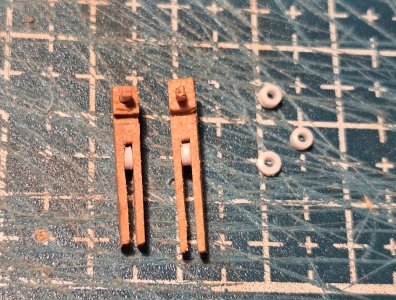
I started off on the sheave posts. I cut a stock piece to 0.10 square and turned the "rounded" section toward the top. With the sucess I had on the Bitts for the Foremast, I decided to use the same technique of cutting in the sheaves. Thankfully, it worked out wee

20260529_145456.jpg

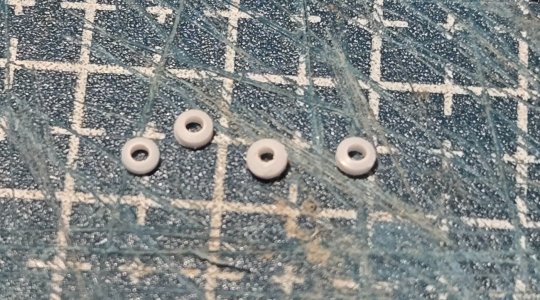
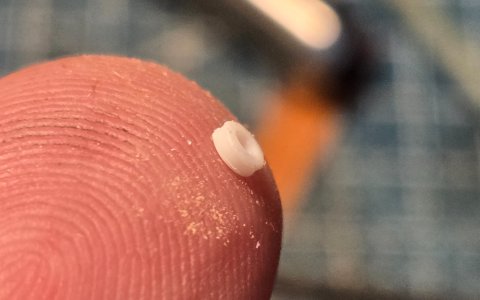
Unlike the Foremast posts, I did something a little different for the sheaves. The true diameter is 8 3/4", which is almost exactly 3/32 at scale. I have some 3/32 styrene tubing. I put a small piece of this into my lathe and with an Xacto blade, was able to easily slice off some very thin pieces with just the right thickness
20260529_144301.jpg 20260529_144329.jpg
These were "painted" black using a Sharpie pen and then glued into place with a little 5 minute epoxy. Finally, the bottom of the hole was closed up with a small piece of wood
20260529_182646.jpg
I feel this looked much better than the previous posts I made by drilling out the holes, and I found a very easy way to make sheaves of any size.
 
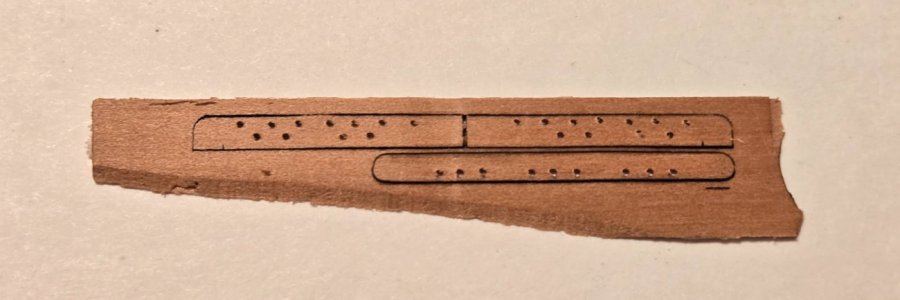
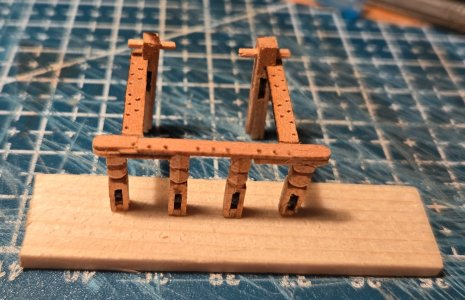
So I have the Mizzen mast fife rail completed. I first cut the rails using the laser
20260530_163653.jpg
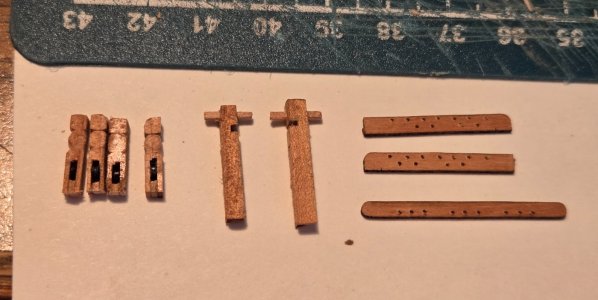
Before removing the pieces, I drilled out the holes using the dots as guides. Then I made up the bitts with cross pins
20260530_164236.jpg
Finally, cut out the groove for the sheaves on the bitts
20260530_170541.jpg
Things were going great up to this point. I was all ready to glue in the filler piece on the bottom of the bitts and finish the assembly when I realized I cut the groove on the wrong side. This wood is at a premium and I didn't want to waste the pieces, so, after a long string of "colorful" words, I just filled in the entire gap and after letting the glue dry overnight, re-cut the groove on the correct side. The side sheave was made as before by cutting a piece of .040" wood to size and sanding a portion of it down to .020". Finally, attempted to assemble the whole thing. Yet another problem. On the real rail, the sides pieces are dovetailed into the front. If you look at Mustafa's excellent build, you can actually see this dovetail joint. I wasn't about to attempt that at this scale, but felt I needed more than just a butt joint to hold everything together. The solution is a lap joint, so I sanded down the end of the rail to half it's thickness and sanded a groove in the front rail to accept the sides. These pieces are already incredibly thin, so after thinning them down for the joint, you can imagine how delicate they are. My thought was that once glued the joint would be thicker and stronger. Unfortunately, while assembling everything, I put a little too much pressure on one end and snapped it off. to fix it, I put a small reinforcing strip under the break and glued everything together. I did the same for the other side, partly for symmetry and partly to make sure I didn't break that side as well. Of course the broken piece didn't line up perfectly, but at a distance it is not so noticeable.
20260602_111216.jpg

With this one done, I'm ready to move on to the Mainmast fife rail that is curved. Yet another problem has arose. I seem to have misplaced (nice way of saying lost) my piece of Constitution wood. With this rail being curved, I need a piece that is at least 1/2" wide and all the bits and pieces I have from what I've done so far are less than that. Not sure what I'm going to do.
 
I just had a thought, prompted by my having to move my fife rails for a photo-op on my Constitution. I neglected to drill holes and insert pins into the bottoms of the posts when I made mine. I may come to regret that when it's time to permanently glue the fife rails in position on the spar deck. Matching locating holes drilled into the spar deck would have been the second half of that process. Something for you to consider before you make the fife rails for the main mast?


P.S. I'm wondering how you'll deal with the sheaves in the likes of the spanker boom and other spars.. I don't think you'll want to split a yard or boom to fit a styrene pully.
 
Yes Peter, that is definitely one of those things to think about ahead of time. I had thought about pins, but the post just seemed so small that I thought putting pins in them would be difficult. My plan was to actually mortise the posts into the deck, thus giving them more glueing surface and hopefully a stronger grip. For the Foremest rails, I made the bitts and three of the sheave posts (outside and middle) longer to extend into the deck. Unfortunately, I forgot to make the posts longer on the Mizzen mast rails, although the bitts are. I may go ahead and try to put some pins in. For the Mainmast, there are no sheave posts. The posts are solid and they are shaped/contoured on each of the three levels. My plan was to make each section separately and use a pin going all the way through to line them up perfectly. I was just going to make the pins long enough to extend into the deck. That's the plan anyway. We'll see how it works out.
Of course, as you pointed out, the tricky part is going to be getting holes in the spar deck to line up with everything.

As for the sheaves in the spanker, etc. Well, I may be in a position to get that mill by then. If not, I'll have to figure out another way, probably just drill two holes and make a groove.
 
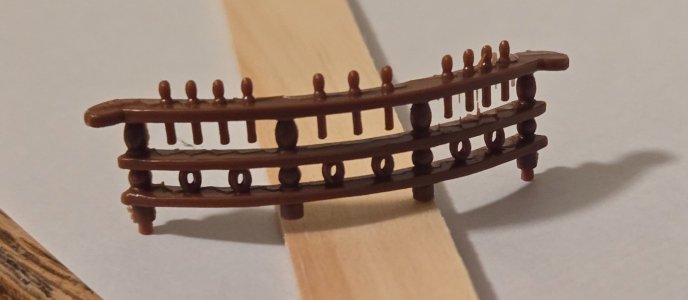
Update from the Alachua Shipyard - making progress on the Mainmast fife rail. As already mentioned, I am making the curved fife rail. Here is the part from the Rvell kit, which is what I am trying ot reproduce:
20260521_203032.jpg

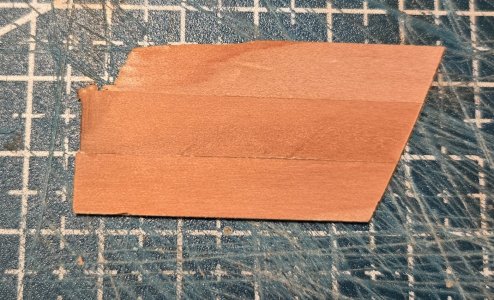
I managed to get three pieces from the wood I had left that I could edge glue together to get a piece wide enough to make the rails. I should have taken a photo before I cut them but here is what was left
20260605_090900.jpg
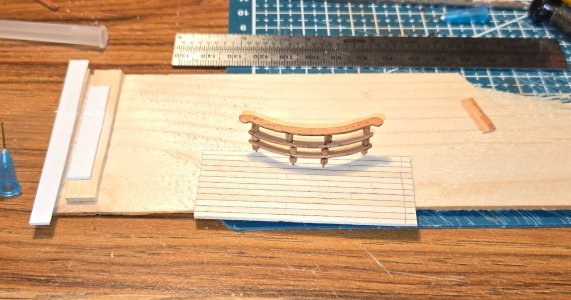
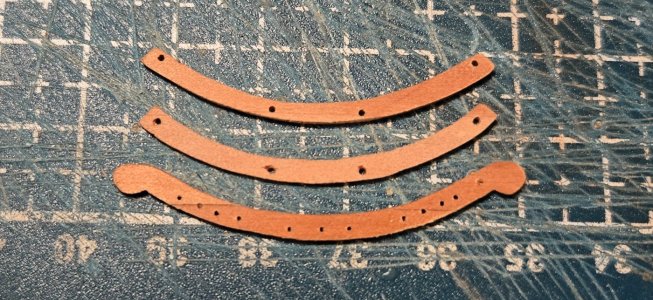
Thankfully, the piece was long enough, and just wide enough to get the three rails. Of course this did not go perfectly. I cut the rails using the laser, but didn't have the power high enough to go completely through, so had to very carefully cut each one without breaking them. one freed, I drilled the holes for the posts and the belaying pins
20260605_090519.jpg
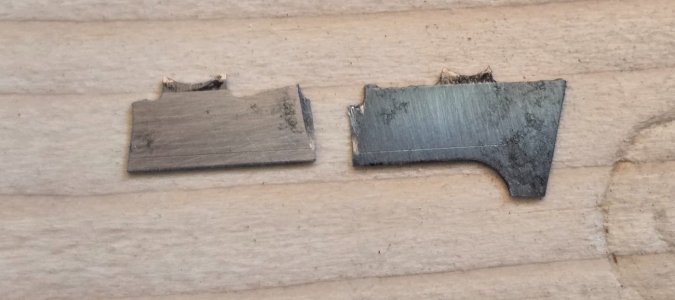
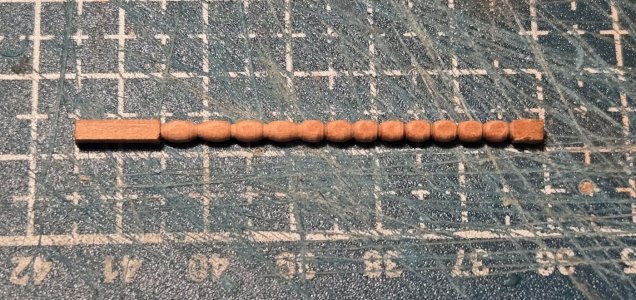
As you can see from the top photo, the posts are not square, but rather have an oval shape. I wasn't very successful at making a dowel on the lathe that I have, but after ALOT of practice, I was able to at least shape a piece of square stock to give me somewhat oval shaped pieces. To accomplish that, I made two cutters. One for the lower posts and one for the uppers, which are slightly longer, They were made from carpet cutting blade using a cutoff wheel on a Dremel.
20260605_100059.jpg

here is what I managed to get
20260605_100446.jpg
The square stock is .090" wide, so the oval pieces are slightly smaller than that. Now all I have to do is drill a hole perfectly in the center of each piece. No problem, right?
I'll let you know how that goes
 
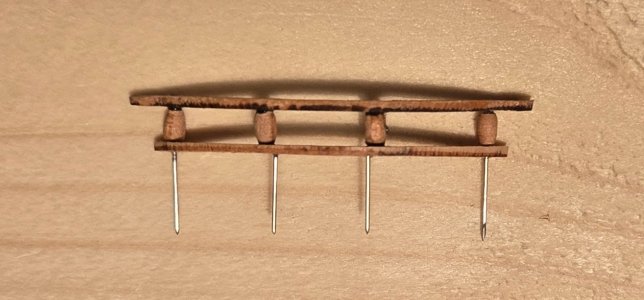
Well Peter, they didn't turn out half bad. In the photo above showing the three individual rails, you can see where I drilled holes for the pins. When drilling these, I laid the two rails on top of each other and drilled both at the same time so they would be perfectly aligned. I was going to drill these through all three rails, but found a slight problem. It seems the curve of the two bottom rails is ever so slightly different than the top rail. Because of that, I could either center the two outside holes or the two inside, but not all four. I decided to go with the outside. After drilling the holes, I glued the pins in place. The pins are actually 25 gauge syringe needles cut to length. I used these because the steel is very stiff. I glued everything in this assembly using 5 minute epoxy. The pins appear to angle outward, but that is just an optical illusion. They are actually perfectly vertical
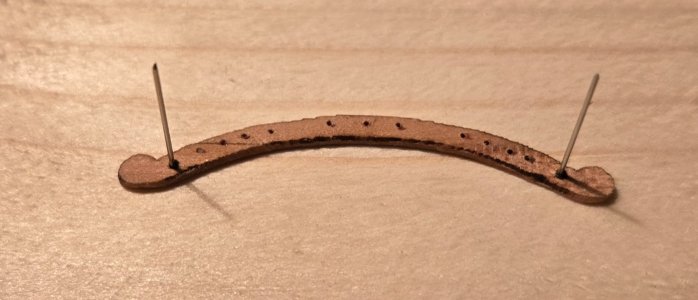
20260607_074720.jpg
After letting the epoxy set for a few hours, I put the first set of posts in place and capped them with the second rail. Once the rail was securely glued down, I put in the second set of pins for the inside. The inside posts under the top rail are of course just glued in place with no pin.
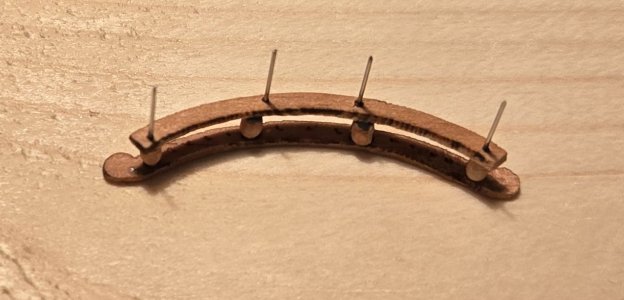
20260607_100644.jpg 20260607_100800.jpg
As you can see, the inside pins don't exactly line up with the top posts. Just have to live with that because moving these inward would have covered up the holes for the belaying pins. Again, I let the epoxy set up for a few hours to make sure the pins didn't come loose while trying to assemble the next layer. The next set of posts were placed on the pins and the last rail put into position. That last part was a bit tricky, trying to get four pins into their prospective holes, but it finally went together
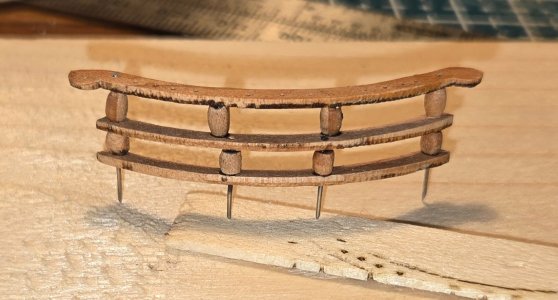
20260607_104917.jpg
Finally, the last set of posts were attached. When looking at the super closeup, it looks a little rough, but if you look at the second photo from about 1 foot away, it's not too bad. I think once it gets some stain on and a little coat of poly, it will look just fine.
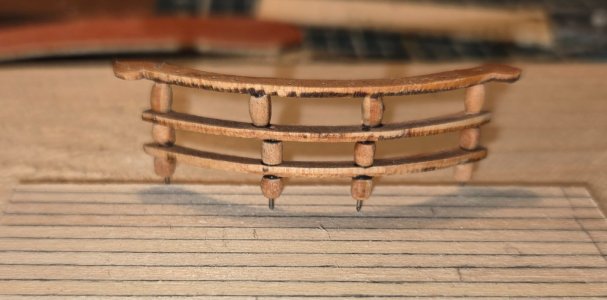
20260607_111419.jpg 20260607_111622.jpg

One rail left to do. There is a small rail behind this curved rail called the monkey rail. it sits between the Mainmast bitts. Once I get that done, I'll get back to trying to make the ships wheel.
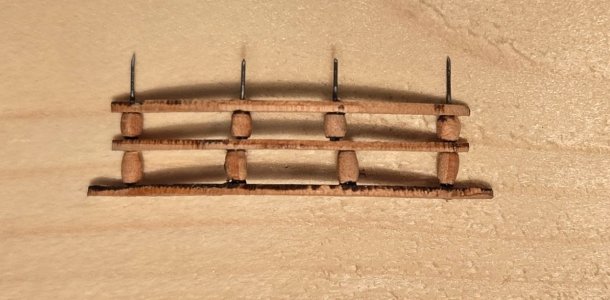

20260607_104830.jpg
 
By the way, Grant, "Fiddly bits" is an understatement. You can imagine once all the individual posts were cut from each other handling and trying not to lose a dozen little pieces the size of a grape seed was not easy
 
Nice thing about using those syringes is the ease with which you'll be able to mark where on the Spar deck to drill later, yes? Or will the next round of grape seeds totally encapsulate the remaining length of the "nails"?
 
Thanks Paul, I'm definitely pleased with it.
Peter, if I had used a different needle for each post, then the answer to your question would have been yes, since each would have had a very nice sharp point at the end the make a mark on the deck. However, I used two syringes and cut them to the desired length, so only two of them have a nice point on them. I plan to put a little dab of paint on the ends to make a mark so I know where to drill the holes. Fingers crossed.
 
Back
Top