Thanks Peter, I'm sure I will. I would imagine the folks here are just as friendly and helpful as those I got to know on MSW.
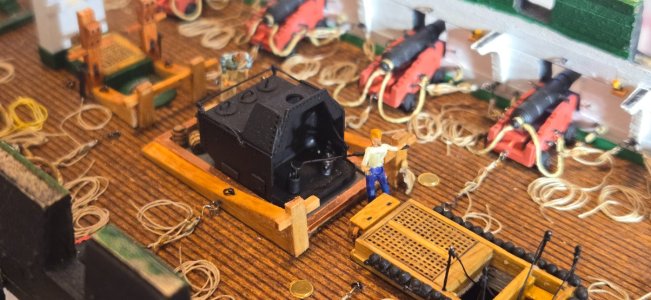
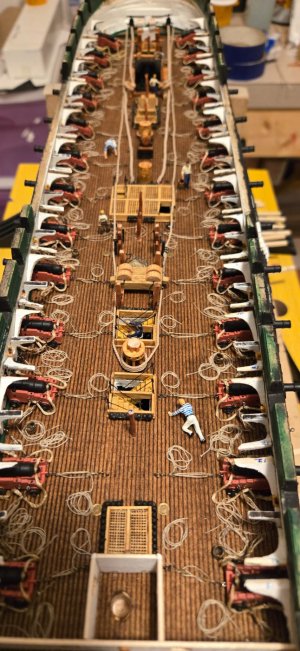
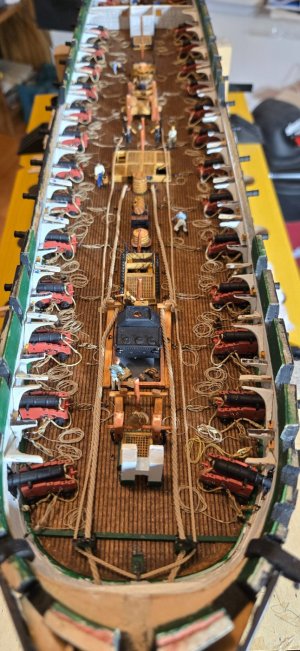
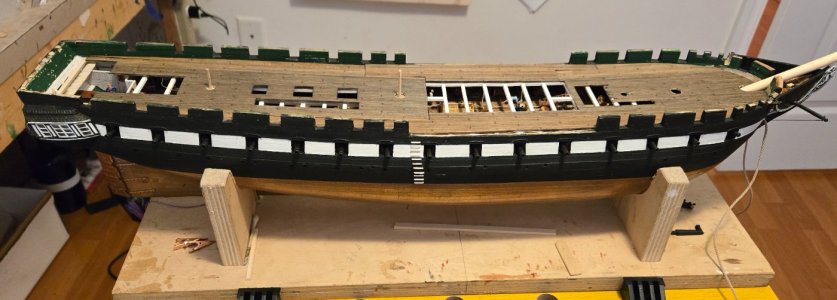
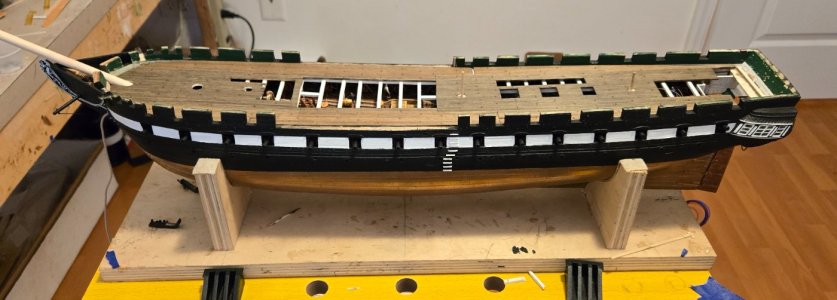
Having gotten the spar deck planking all figured out, it was time to get started on all the furniture. I have a fairly good sized piece of wood taken from the Constitution during the '73-'76 overhaul. I wanted to use this wood to fabricate all the parts of the deck that would be stained or varnished and not painted. Mostly this includes the fife rails, pin rails, hatches and the ships wheel. The ships wheel was going to be the most challenges for sure, especially at 1/96 scale, so I got started on that first.
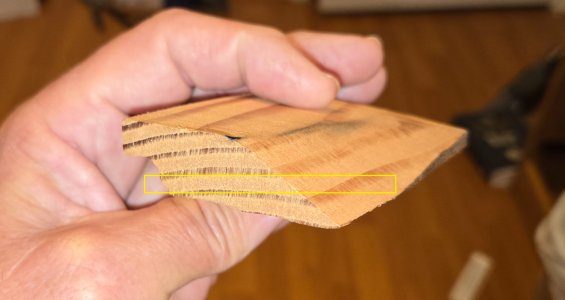
At first, I thought the wood I had was pine because of the large grain pattern, but then realized it was Douglas Fir by the typical redish color.
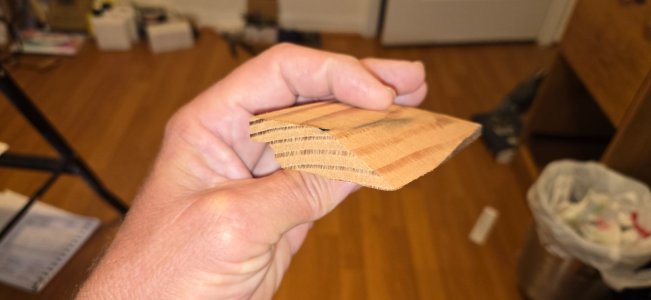
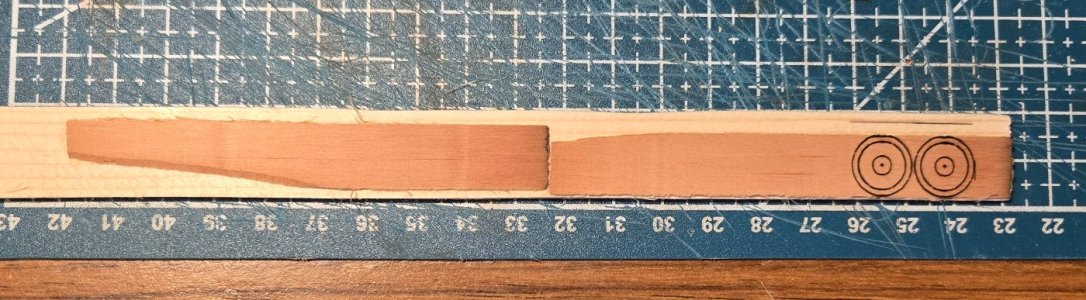
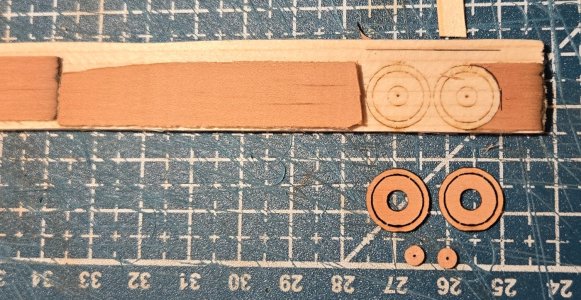
Considering the grain is very close to that of pine, I used a pine 2x4 with a similar grain pattern to practice with. The plan was to cut a thin strip, sand it down to proper thickness and then use the laser engraver to cut the parts. According to the Navy plans, the wheel is 2- 3/4" thick. At scale, that would be .028", which is not much to work with. I decided to try .040", as I didn't think the difference we be too noticeable. The first problem encountered was the grain. Turns out the heartwood doesn't burn as easily as the softwood. To get enough power to cut through the heartwood, the softwood would get excessively scorched. The solution was to cut the wood in a manner that would provide me with a small strip that was mostly the softwood. After many failed trials, I finally got things tweaked to where I could get nice clean wheels with out too much scorching
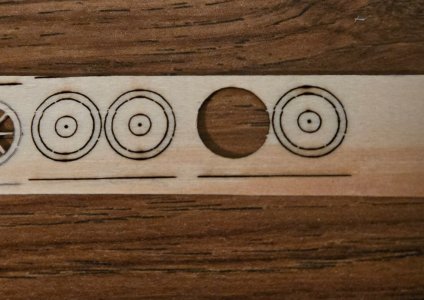
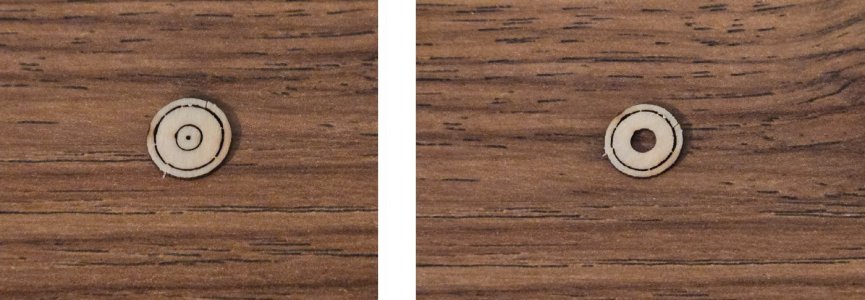
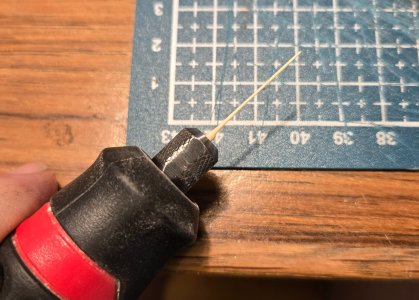
With the center hole removed, I could place the wheel on a dowel and using a jig I put together, I could drill the holes around the perimeter for the spokes. The spokes were made by cutting a very thin strip from the heartwood and placing that in a dremel. With the dremel turned on I squeezed the piece between a folded piece of sandpaper to create a very small dowel - about .020" in diameter
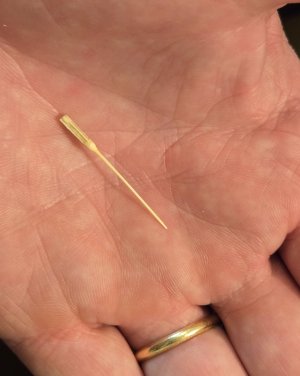
Once the holes were drilled in the wheel, the center could be punched out and then spokes installed
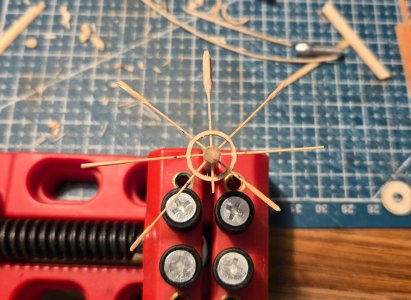
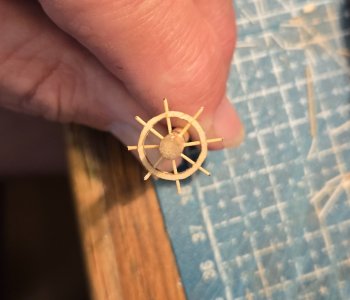
Then repeat with another wheel
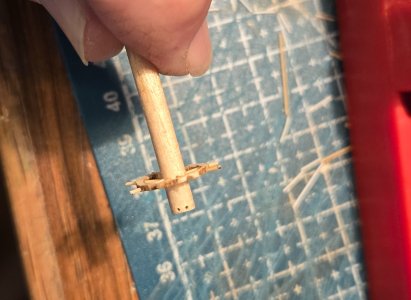
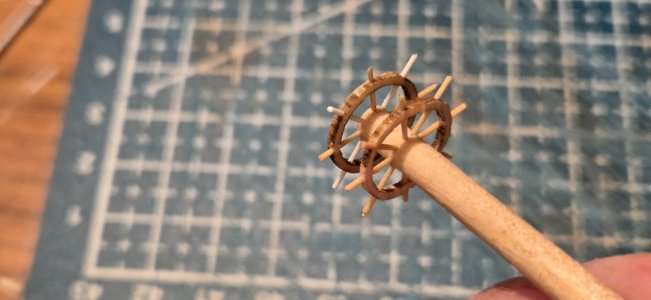
Once the two wheels were attached to the drum, I could easily cut the dowel flush
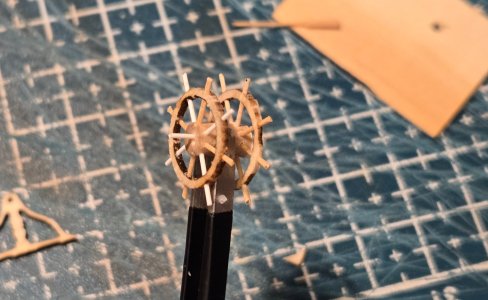
I got a little lazy at the end and used some .020" styrene rod for a few spokes. The point of this was proof of concept. Since I was already happy with my ability to make wooden spokes, I didn't bother with the last few. You can also see in this photo that I had drilled a hole in the center of the dowel to place a pin to help position the side frames. The frames were cut using the laser and turned out pretty nice
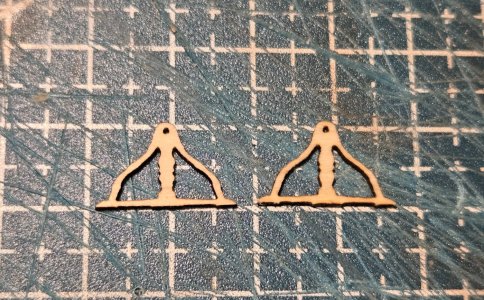
And finally, a complete wheel assembly
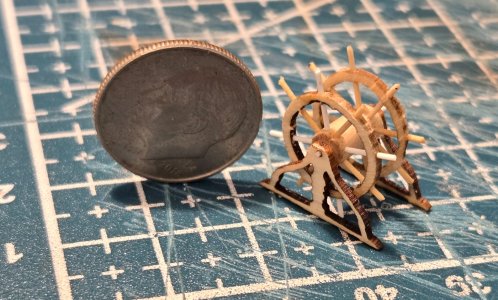
Once stained, the scorch marks from the laser will blend in. Overall, I was very pleased with the result, especially considering the size. Now to do it all over again with the wood piece from the real ship













 )
)