Follow along with the video below to see how to install our site as a web app on your home screen.
Note: This feature may not be available in some browsers.
Ships of Scale has incorportated an extra level of security when you log In. Please follow
on-screen prompts to acknowledge that you are not a robot via a "Check Box" or a "Pictorial Check Box Puzzle". This is needed due
to higher level of AI Activity Security.
The beloved Ships in Scale Magazine is back and charting a new course for 2026!
Discover new skills, new techniques, and new inspirations in every issue.
NOTE THAT OUR NEXT ISSUE WILL BE July/August 2026
Win a Free Custom Engraved Brass Coin!!!
As a way to introduce our brass coins to the community, we will raffle off a free coin during the month
of August. Follow link ABOVE for instructions for entering.
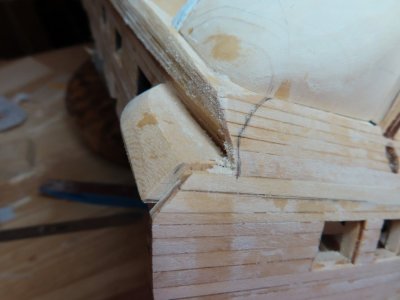
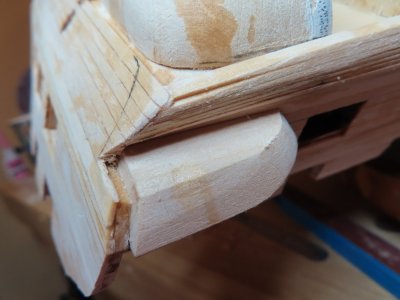
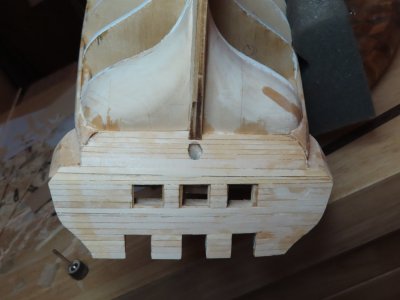
The wales were tapered with a sanding stick and lots of elbow grease, so it took a while. Now came the part I was not too sure of. As I mentioned earlier. I did not trim the lower transom because I was quite unsure where or what the cut was supposed to line up with. Well, I found out. It was only after I trimmed the excess transom planking that I realized that the wale was supposed to bend around the stern and mate up with the transom. Mine didn’t. Had I trimmed the transom first, as instructed by the practicum, I might have realized what should have been done.
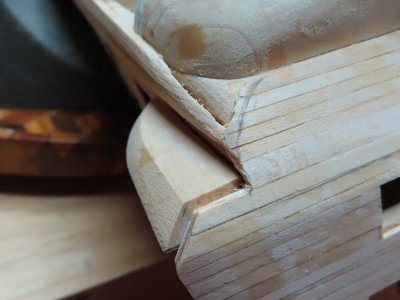
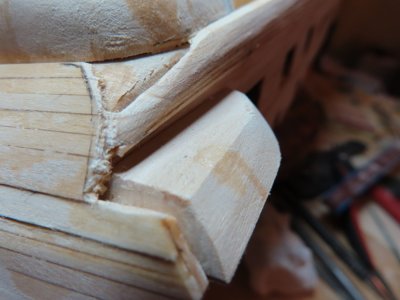
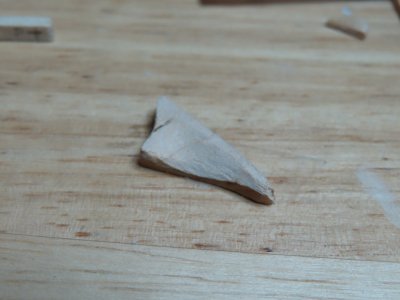
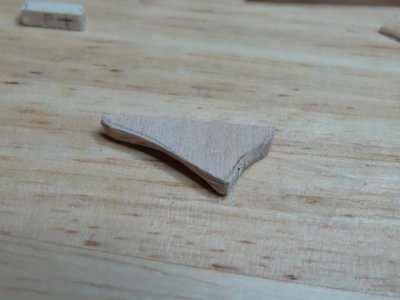
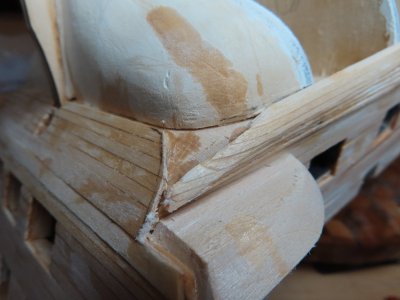
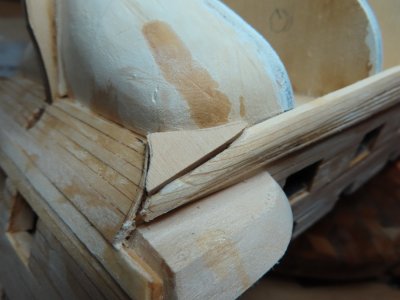
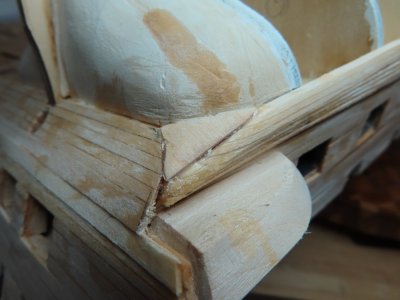
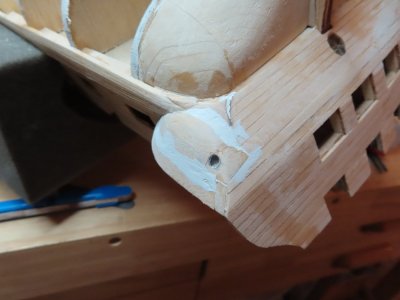
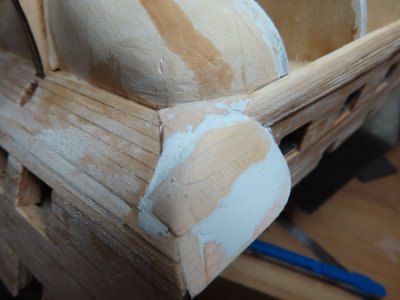
Luckily, this area of the model probably will not be seen very well by the casual observer. Following my sketch line, I continued to trim the transom and filed down the corner of the wale. Instead of ripping out chunks of the wale to make the repair (and probably my hair as well), I opted for a wooden filler patch. The whole thing will eventually be painted black and will be on the underside of the model in the shadows so hopefully it won’t attract any attention.
The patches were made by taking a piece of scrap basswood and cutting it into the basic triangle shapes to match the areas of repair. Through repeated trial and error, I carved the necessary contours on the bottom of the patch so they would snug. The patches were then glued into position and then filed to their final shape.
I don’t feel too bad as Mr. Hunt stated in his practicum that he had to use a bunch of wood filler as well. Once I finish the basic structure of the quarter galleries, I will fill in any remaining gaps with wood filler.
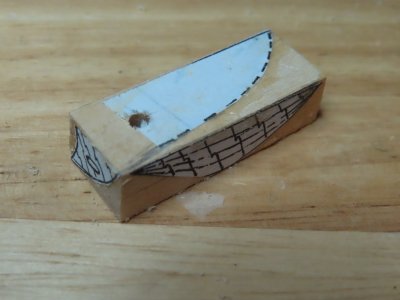
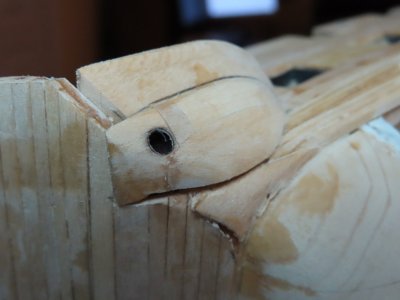
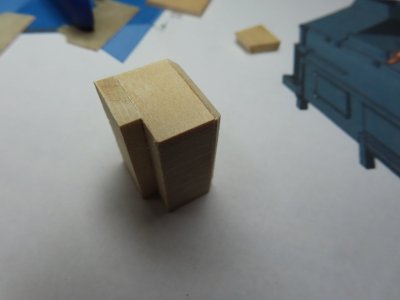
Continuing with the bottom quarter galley filler, I cut out the patterns from copies of the plans and rubber cement them onto the wood blocks. The plans show only the starboard side so of course you must make a mirror filler block for the port side. So far, so good. However, the starboard pattern also show the position of a hole that is supposed to be “under the officers’ head” in the quarter galley. I drilled an 1/8” hole in the starboard block as indicated by the plans. The question was, does the port side also have a head? According to the USS Constitution Museum’s documentation (January 18, 2014, Life at Sea Blog), “The captain had the cushiest arrangements. His private privy was located in one of the quarter galleries.” Since the captain had only one privy, I left the port side alone. No privy hole was drilled.
The blocks were initially carved to shape using a disk sander and custom fitted into position by dry fitting and adjusting the shape with sanding sticks and files. This took a while and I got as far as my skills would take me. They still needed filler to complete the job. Thankfully, all of this will be covered in black paint.
At this point I’m going to leave Robert Hunt’s practicum for a while, leaving the hull planking unfinished. I need to install all the goodies in the gun deck before I close off the hull. If you may remember, I added hand ropes and stanchions to the ladders going below the gun deck. These have been effectively knocked off and must be repaired which requires access through the hull. And, before I can do that, I must finish the gun deck. There is a lot of stuff to add, and most of it I don’t have any plans, I will be an adventure.
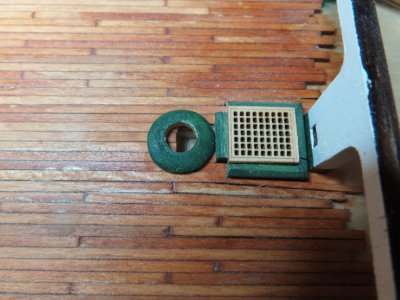
Gun Deck Mast Rings
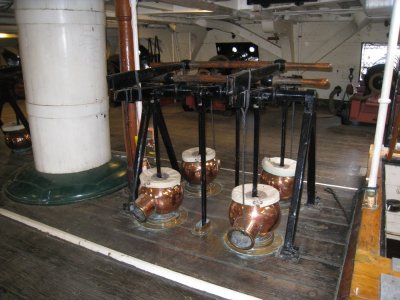
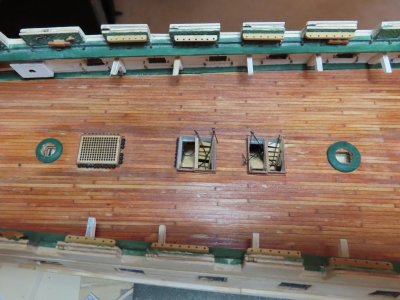
The first things to install on the gun deck were the mast rings. The kit provides mast rings for the spar deck, obviously none for the gun deck. Because I could not find a US Navy plan that showed mast ring details, all I had to go on were the Navy’s deck plans and a few photos of the main mast ring. Because the bilge pumps were photographed a lot, a few captured the main mast which was next to them. As many photos as there were, very few included the main mast with a clear view of the ring. I could not find any photos of the mizzen or foremast rings.
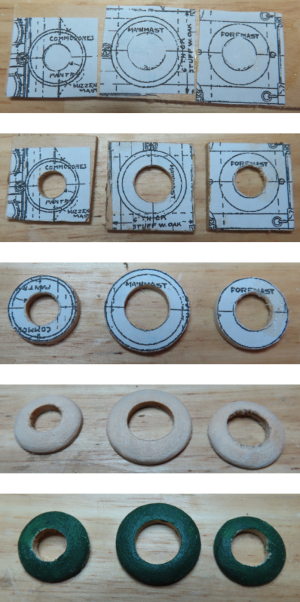
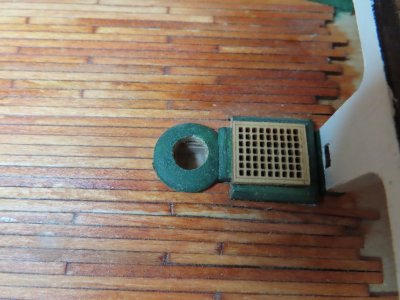
Using the thickness of the rings supplied by the kit and the plan view of the rings from the Navy, templates were made, and rubber cemented to a piece of 3/32” basswood stock. They were then drilled cut, carved, and sanded into shape. Finally, they were painted green.
It was at this point I realized something was wrong with the foremast ring. It didn’t fit completely over the hole on the gun deck. It seems I had made the grating next to the mast a bit too long. Knowing this error would be difficult to see, I chose to flatten on side of the ring. Unless you knew, you wouldn’t know.
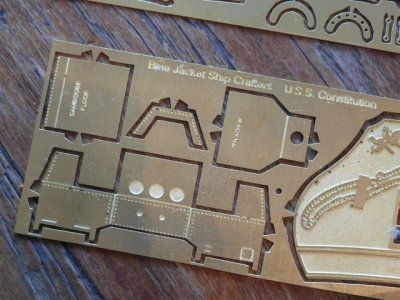
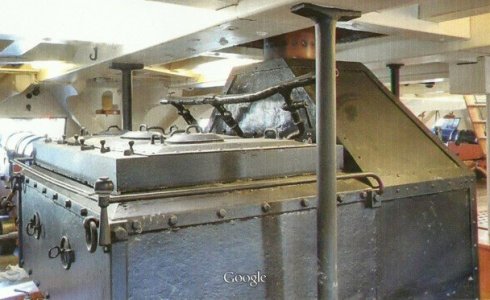
This ship’s stove is totally scratch built without any solid plans to go by. The Camboose is more than likely a variant of a Brody Stove of which I have found some plans, but none matched exactly what is on the ship today. As most of us do, I follow numerous other builders to see how they handle certain problems and challenges. In doing so, I discovered that BlueJacket’s model of the Constitution is supplied with photo etched parts to construct a stove albeit at 1:96 scale. Fortunately, I found a particularly good image online of these parts.
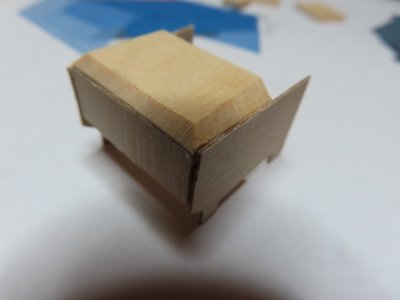
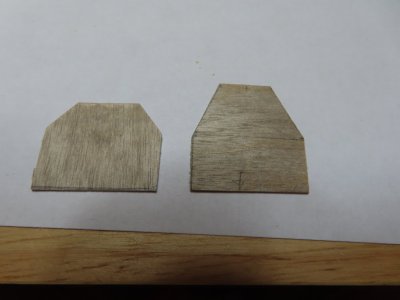
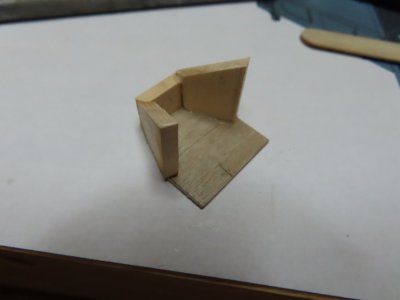
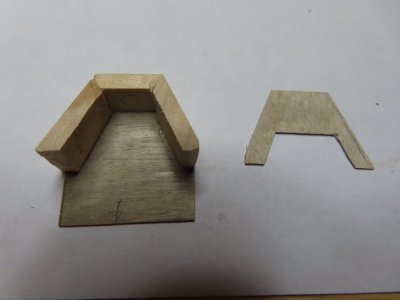
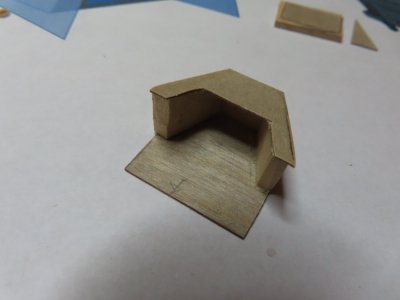
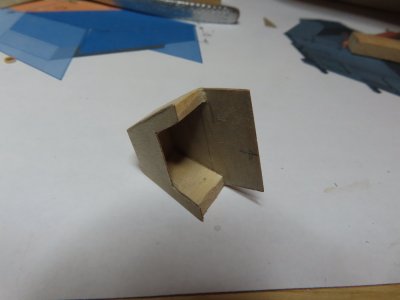
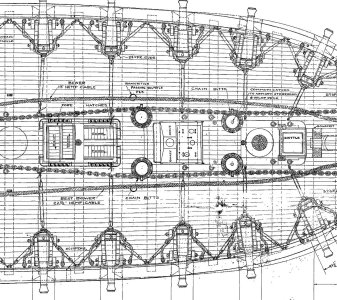
I scaled the image of the photo etched parts to match the US Navy arrangement plans of the gun deck at 76.8. Now I could measure the photo etched parts directly for my dimensions. I constructed the BlueJacket stove using card stock to get a feel of what I needed to do when I designed my stove out of wood. Stock and plywood.
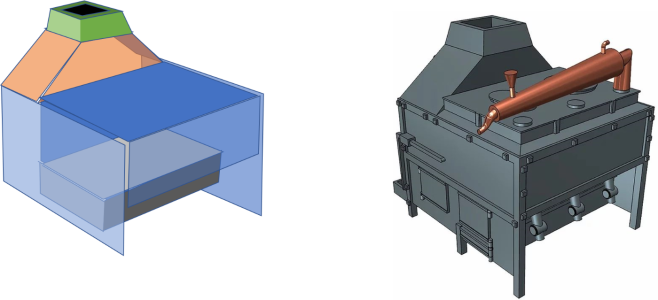
In addition, I found a computer-generated image of that stove based on those parts. I now had a simplified image from which I could work from.
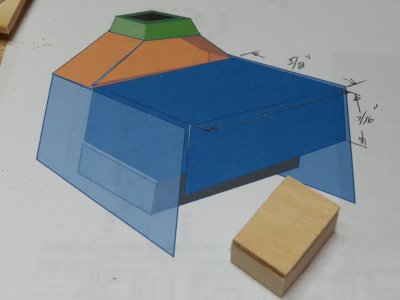
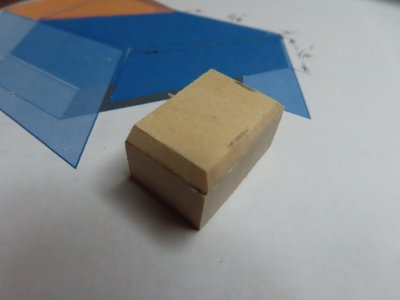
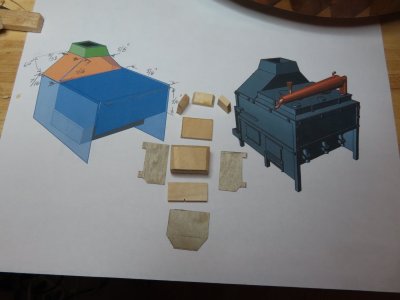
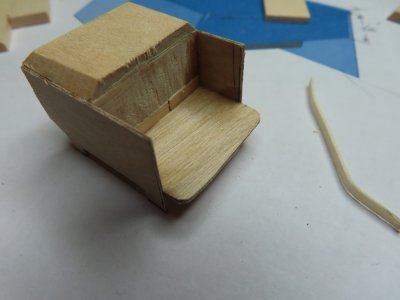
Using my highly sophisticated CAD program, MS PowerPoint (that’s a joke), I worked out how I was going to construct my stove. At the core, would be a solid block with 1/64” plywood side panels. This would provide the basic shape. All the other parts would be added to it.
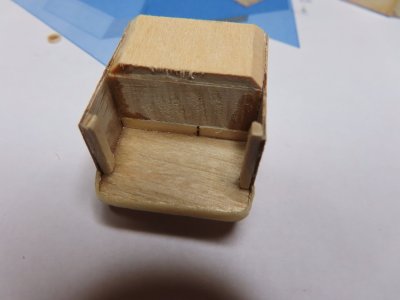
The edge of the tray was formed using card stock. It was initially glued on with CA glue and then lightly covered with addition CA glue to solidify it. BTW, most of the gluing was with PVC glue as it gives me a chance to make final adjustments before it sets. I also added some posts as a gluing surface.
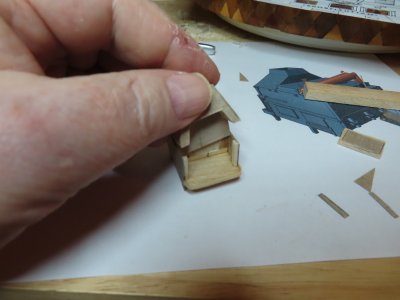
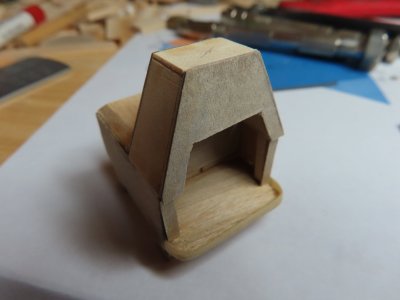
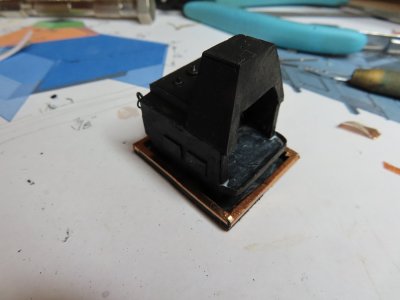
When I went to make the tent looking hood, I realized that BlueJacket’s stove didn’t match the stove on the actual ship, so I had to redesign the back plate.
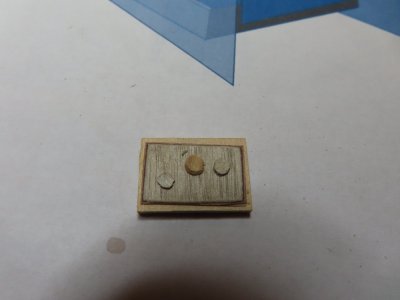
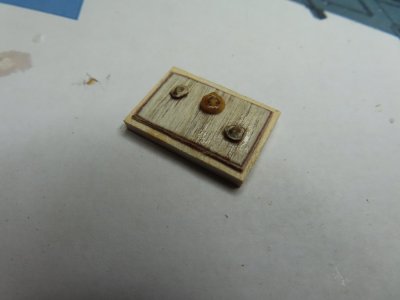
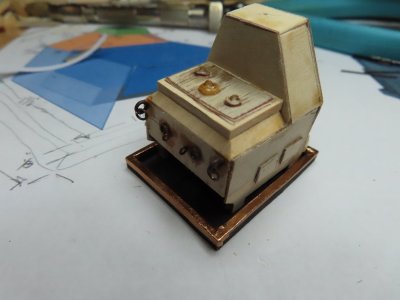
The last section to be completed was the forward-facing stove top. This was made from a piece of 1/64” plywood with beveled edges sitting on top of a piece of 1/32” plywood. Shown on the Navy plans and seen in the photographs, there are three oval and circular plates with handles. These things are exceedingly small and difficult to hold and shape. I tried slicing a thin dowel, but tiny pieces kept breaking off because the grain of the wood was perpendicular to the sliced flat surface. After numerous attempts only one survived. I ended up using 1/64” plywood filed to shape. The results were a bit ragged.
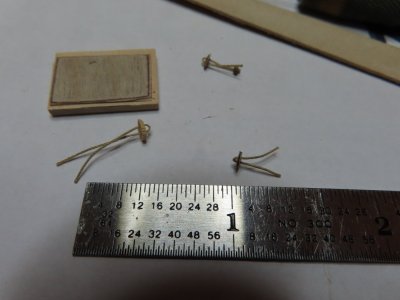
Once the plates were formed, I had to think a bit as to how to make their handles. I elected to use thread. It’s strong and easily handled. With a No. 80 drill, two holes were carefully drilled into the plates and then threaded to form a loop. CA glue was applied on the underside which was drawn up through the hoes. The thread became solid when the glue set. The excess thread below was cut off and the bottom surface was sanded smooth. Finally, the stove top was glued into place.
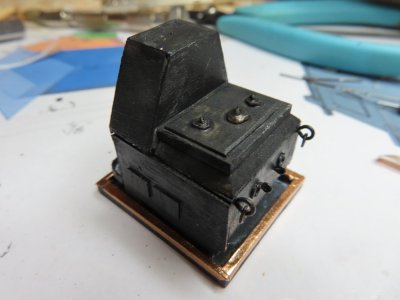
I might add some other details such as eye bolts and rings. However, considering that the whole stove is going to be painted black and place in a dark area below the spar deck, the effort to add more handles, a rod railing on the stove top, rivets which just can’t be seen, among other doodads is not worth the effort.
What was added was the tray in which the stove sits. Surprisingly, the US Navy arrangement drawings do not show on their plans. At least I haven’t been able to find any.
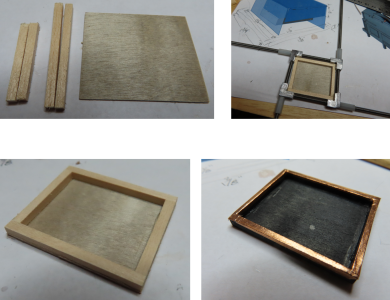
The stove tray dimensions were eyeballed and guesstimated from photos of the stove. The construction was simple enough. I used 1/64” plywood as the base and 1/8” x 1/8” basswood stock for the sides. I finally got to try out my clamp for making square frames for the first time after having purchased it so many years ago. All my other attempts to use it were failures because as small as it is, it was too big for most of my constructs I was attempting.
I got a nice result but trimmed off 1/32” from all four sides because the walls just looked too wide to my eyes. Based on the photos, I first painted the tray black, then used copper tape I got at a crafts store, to plate to top of the tray walls and partially down the sides. This copper tape is much thinner than the copper tape supplied by the kit for the hull plating.
At this point I said to myself, “awe what the hell” and added a couple pieces of 1/64” plywood to each side of the stove to simulate side door panels and some eye bolts and rings. I also added a thin whitewash to the surface of the tray as well as to the surface of the tray inside the stove. This again is to reflect what I saw in the photos. Unless there is a strong light on the stove, most of these minimal details will be lost to the viewer in the completed model. Final mounting of the stove to the gun deck will after I have constructed and positioned the chain bitts and their associated accouterments