• SUBSCRIBE TO SHIPS IN SCALE TODAY!

    The beloved Ships in Scale Magazine is back and charting a new course for 2026!
    Discover new skills, new techniques, and new inspirations in every issue.

    NOTE THAT OUR NEXT ISSUE WILL BE MARCH/APRIL 2026
  • Win a Free Custom Engraved Brass Coin!!!
    As a way to introduce our brass coins to the community, we will raffle off a free coin during the month of August. Follow link ABOVE for instructions for entering.

USS Constitution - Model Shipway’s 5/32” = 1 ft. (1:76.8) Kit No.: MS2040

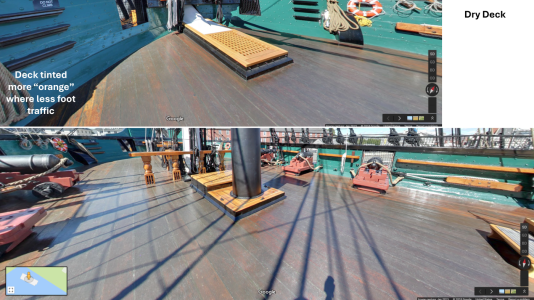
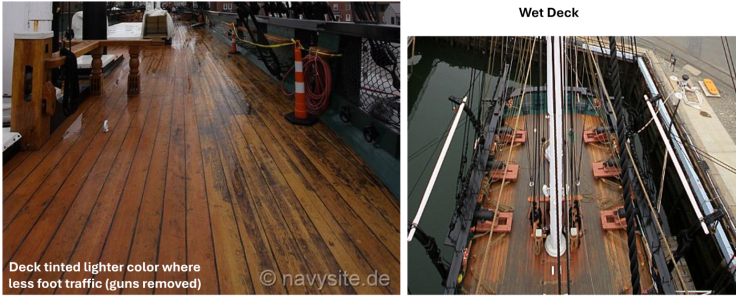
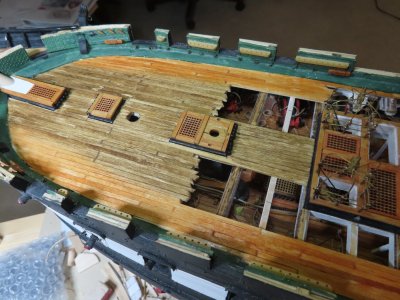
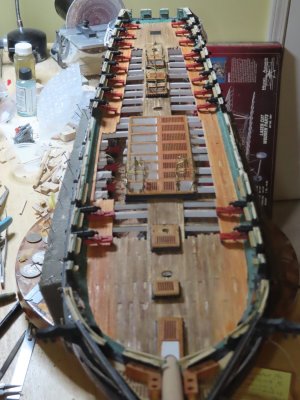
As I mentioned in an earlier post, the reason I had to plank the spar deck at this point was so I could install the captain’s skylight. Well, that will have to wait a bit more as I must sand and stain the spar deck first. And this brings up the question: What color is the spar deck? Well, it depends on several factors like whether the deck is dry or wet, was it sunny or cloudy when the photo was taken, is it a high foot traffic area (think tourists) or not. The main thing I noticed is there are two distinct color zones
  • Low traffic orange tint - The area of the guns from the waterway to the end of the gun carriage and some spots along the centerline of the deck
  • High traffic brown/gray - The public area for tourists. They tend to deposit dirt from their footwear, soiling up the walked area of the deck.

Spar Deck Color 01.png

Spar Deck Color 02.png
 
Obviously, my color scheme will be based on a dry deck. On a working ship, however, I would assume the deck would look different because the sailors would periodically swab the deck and scrub with holystones, saltwater and sand. Also, because of the cut away areas coincides within the high traffic areas, a lot of the brownish gray areas won’t be shown on the model.

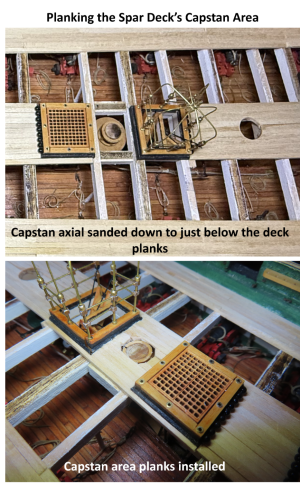
There is one last area that still needs to be planked, the small area around the spar deck capstan. I left that open till I at least fabricate the capstan base. I don’t know yet if I need to plank around the base or if I can plank under it. So, in keeping true with one of Murphy’s Laws, “No matter what you have to do, you must do something else first,” before I can install the captain’s skylight, I must at least sand the planks, prepare for the capstan, and stain the deck.

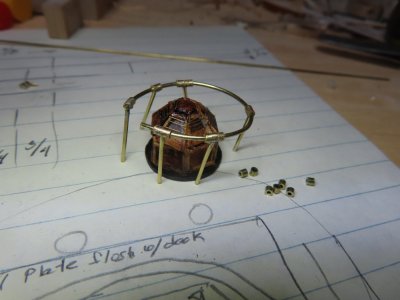
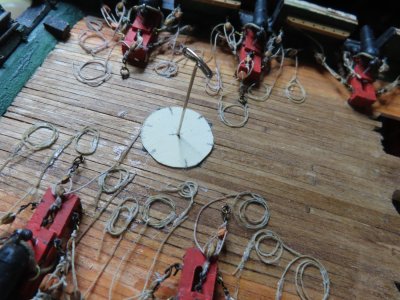
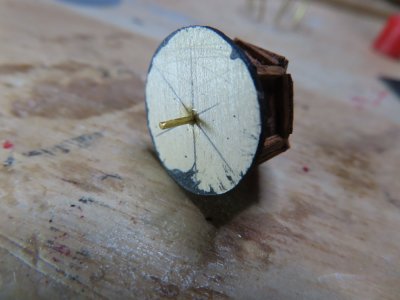
As I examine the capstan location, I realize that I made the gun deck capstan protrude about a 1/16” above the spar deck. At the time, I was thinking that I would extend the axial of the capstan into the spar deck capstan. As it turned out, there was no reason to extend the axial. First, attempting to get a perfect alignment would be tedious and second, it wouldn’t be seen. I sanded the protruding axial so that its top was just below the surface of the planking. Now I simply planked around the spindle. The area left open will be covered by the spar deck capstan. In the end, it won’t be obvious what method was used to install the spar deck capstan as it will all be hidden.

Planking the Spar Deck’s Capstan Area.png
 
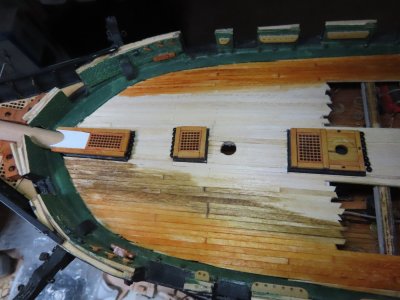
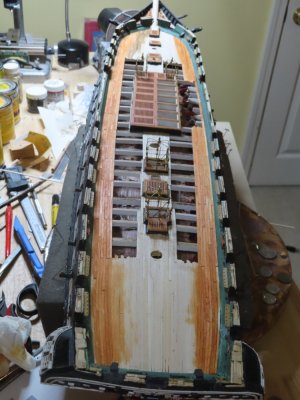
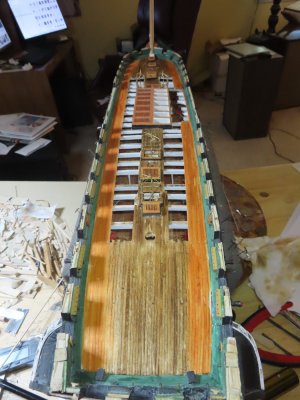
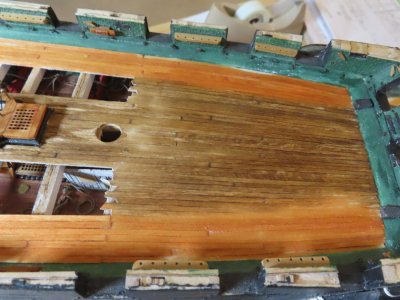
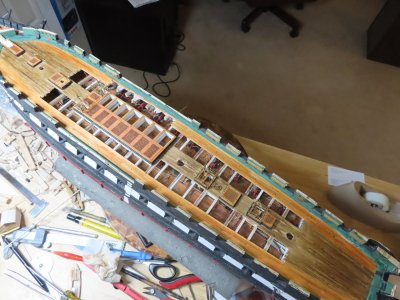
Now there are numerous items that need to be installed on the spar deck including the captain’s skylight. However, before any of that can be done, the spar deck must be stained first. This gave me some trepidation. As mentioned earlier, unlike the gun deck, the spar deck is open to the elements and weathers differently depending on the foot traffic around all the items on the deck, I must get the stain done right and done right the first time. Area
According to the practicum, Mr. Hunt had an elaborate process to accomplish this. Unfortunately, some of the products he used are no longer available, specifically Floquil Grimy Black and Floquil Roof Brown or any Floquil product for that matter. He would have you sand, apply paint, wipe off the paint, and scrape. I really didn’t like the idea of using paint in lieu of stains and physically scraping the wood. Other builders used different methods and color stains to get their weathered look, resulting in effects different from each other. The one thing I noticed was that all the spar decks were stained monotone, that is, no one area on the spar deck looked different than another. Yet, if you look at the images I posted earlier, there are color shifts. My model does not have a fully planked deck, so a lot of the dark areas shown in the photos will not exist. The area where the carronades are located, appear to have a more orange tint, while the foot traffic aeras along the center, bow and stern (on my model) are more brownish-black. This is what I will attempt to emulate.

I did some tests with the stains I had available on scrap pieces of wood. I tried straight staining and various over lapping combinations. Based on those results I bought some more stains and experimented again. I think I came up with a simple scheme to get the desired results.

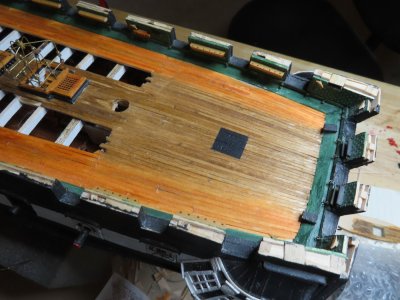
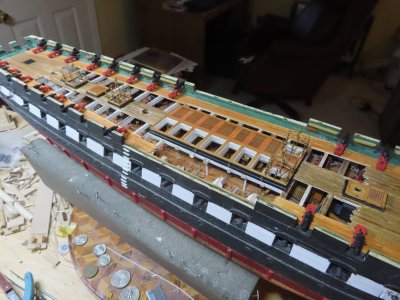
I held my breath and took the plunge. The first coat consisted of two stains: Along the bulwarks where the carronades are, I used Minwax Gunstock 231. This has an orange tone. In the center area I used Minwax Early American 230 which is brownish tone. At the border where the two colors met, they overlapped each other slightly. Once the stains dried, the deck was lightly sanded. This time I streaked some dark tones with Varathane Espresso . This somewhat emulated Mr. Hunt’s colors of black and brown. Like it or not, it’s done, but I think it will work.

IMG_2887.JPG

IMG_2888.JPG

IMG_2889.JPG

IMG_2890.JPG

IMG_2891.JPG

IMG_2892.JPG
 
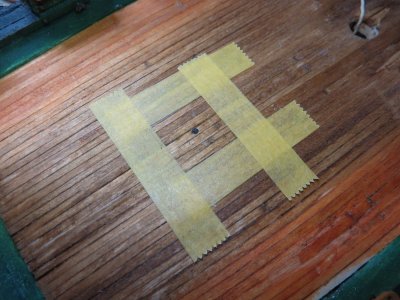
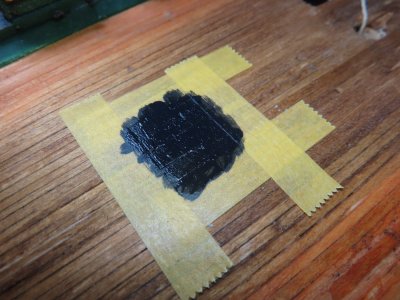
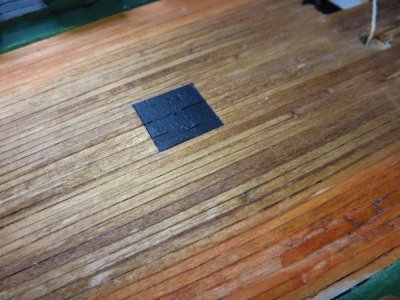
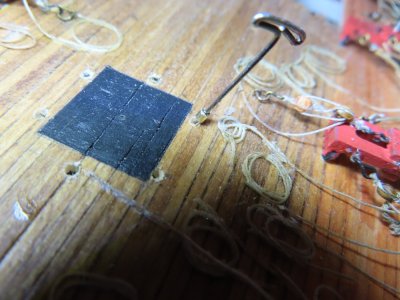
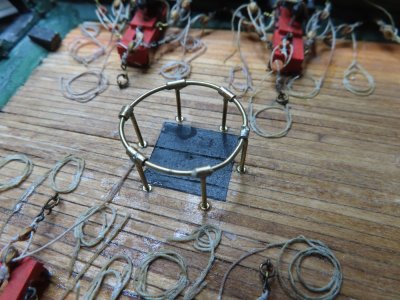
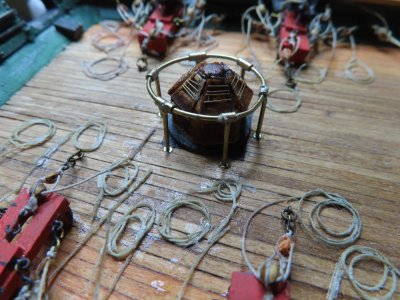
You may (or not) have noticed that the stove stack is missing in some of the most recent images. This is because due to working on the spar deck, my hand has been constantly bumping into it. So, I took it off for safe keeping. On that same note, I decided to delay installing anything to the spar until all the carronades have been completely installed. However, one partial exception was the black “plate” that the captain’s skylight will sit on. This was “installed” simply by painting a black square in the proper location. I’ll embed the stanchion bases into the deck when the skylight is installed.

IMG_2895.JPG

IMG_2896.JPG

IMG_2897.JPG

IMG_2906.JPG
 
Spar Deck Carronades

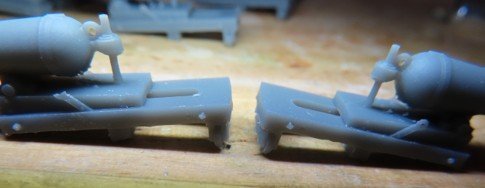
Now for the carronades. I wanted to fabricate the carronades like I did the gun deck, guns. However, as I have mentioned preciously, I purchased 3-D printed carronades because they matched quite closely the carronades depicted in Marquardt’s book. The amount of work it would have taken to separate the gun barrels and mounts from the trucks without damaging anything, just so I could make my own trucks resulting in no appreciable difference, did not seem worth the effort. So, I swallowed my pride and decided to the printed guns.

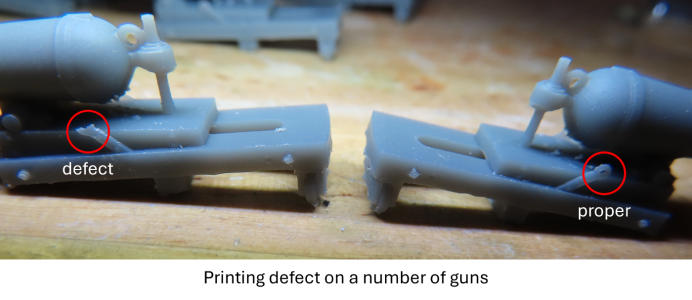
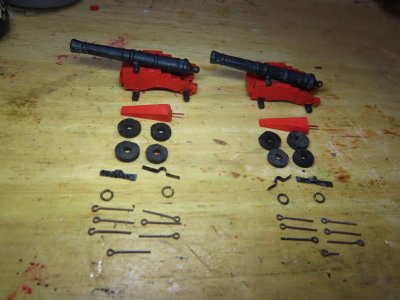
Removing the spruce trees from 22 guns was slow, delicate, and tedious, and unfortunately revealed one persistent defect. Several guns had one or more deformed eye bolts, required for rigging the guns. I have some ideas for a repair in the near future. In the meanwhile, painting the guns is next.

Printing Defect on 3-D Carronades.png
 
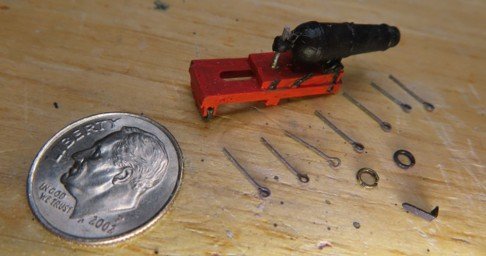
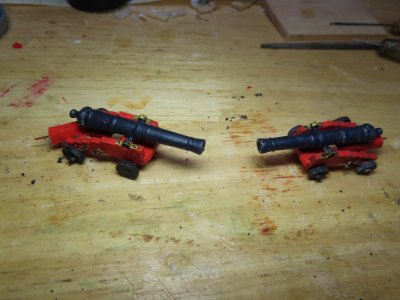
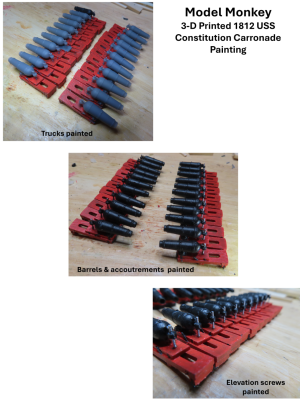
Painting was also a tedious endeavor because I was painting a complete model…22 times. Painting individual parts before assembling is a lot easier. These were complete guns with attached trucks. First, I painted the trucks Model Expo acrylic orange/red. Then I painted the gun barrels, mounts, and small accoutrements on the trucks, Model Expo acrylic black. Getting all the nooks and crannies covered with paint was not simple as I kept missing spots and had to keep going back to cover those surfaces while trying not to touch previous painted areas…but I did. When I fixed those, I reintroduced additional painting errors…etc. Finally, all I had left was the screw mechanism for adjusting the barrel elevation which I painted Testors enamel steel, which I already had.

Painting Carronades.png
 
As it turned out, the 3-D misprinted/broken recoil rope eye bolts for are a moot point as I had to remove all of them anyways. They were very fragile, delicate, and broke when I tried to attach the required ring to them. The plastic is very stiff, inflexible, and will snap if any stress is applied to them.

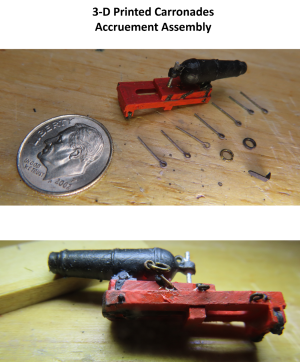
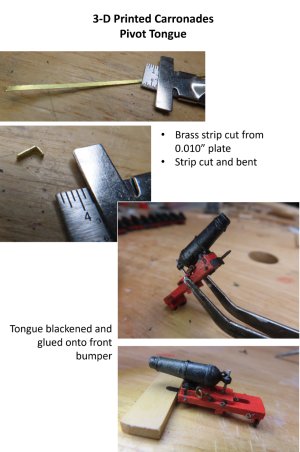
Each of the 20 carronades required seven 1/32” eyebolts, one each for the two tackles per side, one for the recoil rope per side, and one on the rear of the gun slide. The recoil eyebolts have a ring passing through their eye through which the recoil ropes are threaded. These were replaced with trimmed eyebolts bent 90° with the attached ring.

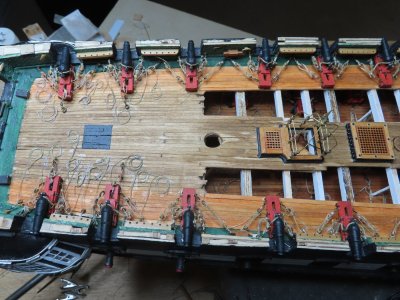
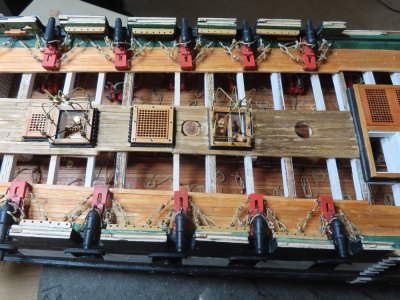
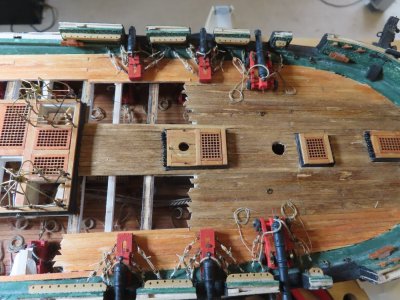
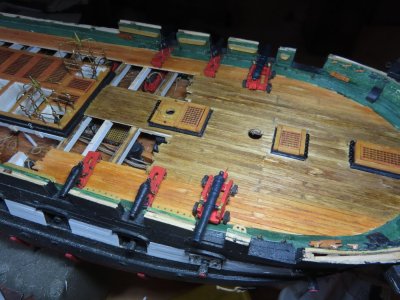
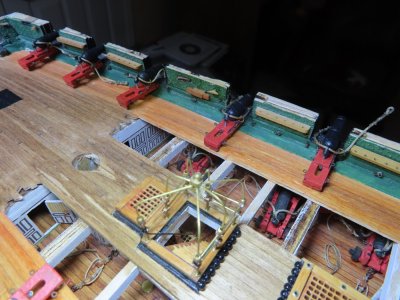
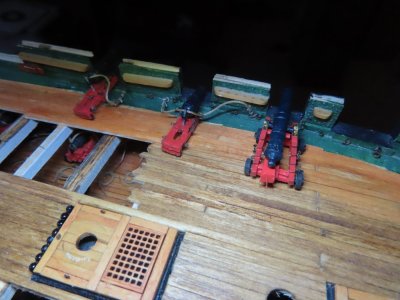
All 20 carronades were dry positioned on the spar deck ready to be rigged. First, I need to fabricate the two long guns to complete the spar deck’s armament.

3-D Printed Carronades Assembly.png


3-D Printed Carronades Pivot Tongue .png

3-D Printed Carronades Adding Hardware.jpg

IMG_2918.JPG

IMG_2922.JPG

3-D Printed Carronades Replacing 3-D Recoil Rope Eyebolt.jpg
 
Spar Deck Long Guns

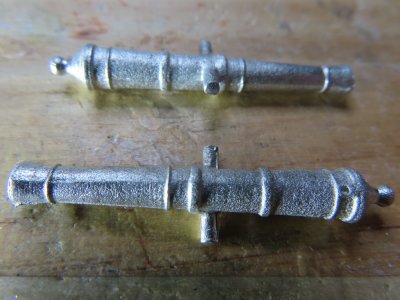
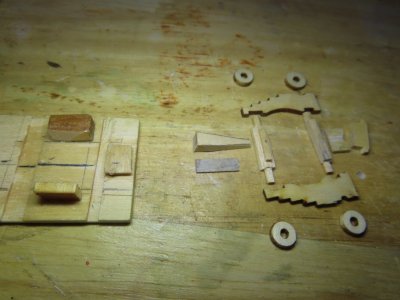
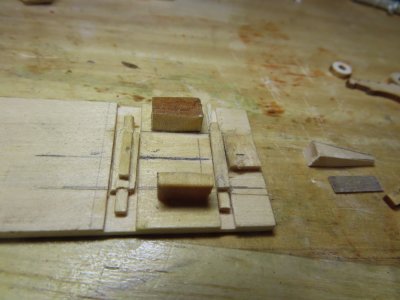
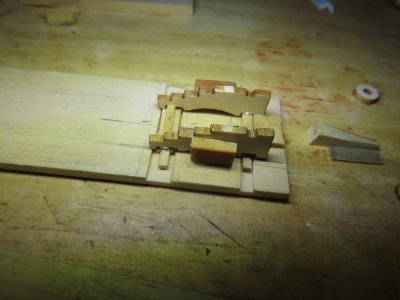
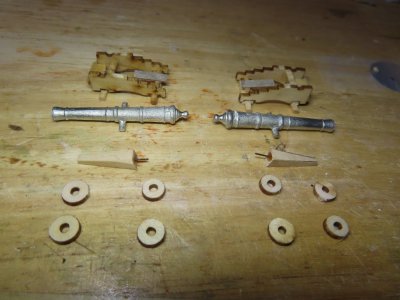
Finally, the last armament to be fabricated for the spar deck were the two 24 pounder long guns. These were made almost identical to the guns for the gun deck. I say “almost” because this time I used the laser cut carriage sides provided by the kit, If you may remember, I had to scratch make my own sides for the gun deck guns because for some reason, the gun ports were a bit too high relative to the gun deck planking and I had to compensate with a slightly taller gun carriage. Which by the way, was closer to the US Navy plans version.

I made all the other pieces as before and assembled them using the jig I used before. However, the jig had to be adjusted a bit because my scratch made sides were a bit different thickness than the laser cut ones. Also, this time, the blackening didn’t seem to stick as well as last time, so I will have to use some touch black paint where the shiny brass shows through. Still to be done. I will glue down the quoin when the guns are aligned properly and glued into their final positions. Till then, rigging the guns is next.

IMG_2923

IMG_2923.JPG

IMG_2928.JPG

IMG_2929.JPG

IMG_2930.JPG

IMG_2931.JPG

IMG_2932.JPG

IMG_2933.JPG

IMG_2934.JPG
 
Rigging the Spar Deck Carronades

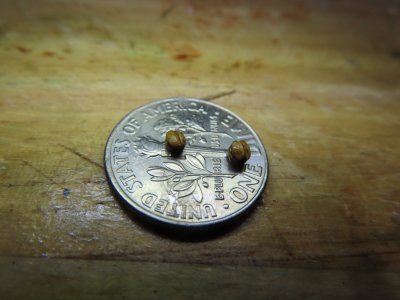
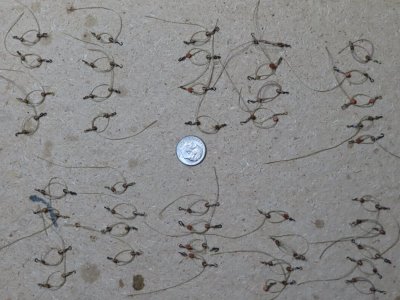
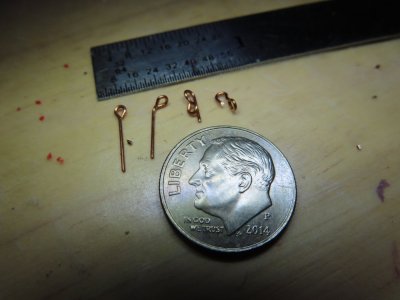
There are three components to gun tackle: the rope, the hooks, and the blocks. I will initially be using .008” (.20 mm) Syren Ship Model Co, miniature tan rope and 3/32” (2.4 mm) blocks (single & double). The hooks I must make myself from 1/32” (0.8 mm) eyebolts. As far as I know, nobody makes 1/32” hooks with a quarter twist so that the eye is turned 90° from the hook. There are 20 carronades each requiring a minimum of 4 hooks. Then there are 5 hooks each for the two 24 pounders. That’s 90 hooks minimum assuming I don’t lose any during the fabrication process. I’ll make about 100 of these for the time being. So that alone is going to take a while to fabricate.

IMG_2483.JPG
 
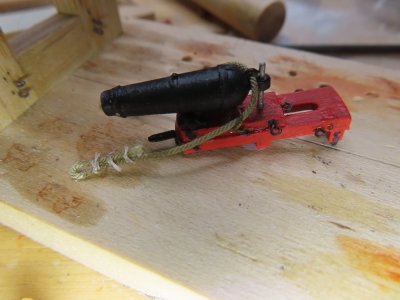
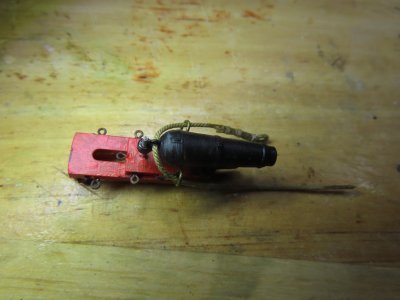
I did make a prototype recoil tackle to determine how much line I would need for that, approx. 3”. Looking at the miniature rope provided by the kit, the smallest diameter line provided were parts Nos. WP2589 (black) & WP2587 (tan) 3/0, 0.005” (0.13 mm) dia. two strand nylon. They did not look rope. They did look good for seizing line, so that is what I tried. My first attempt was a tad crude, but it won’t be noticed unless you have fantastic eyesight. I should improve as I make more.

IMG_2937.JPG
 
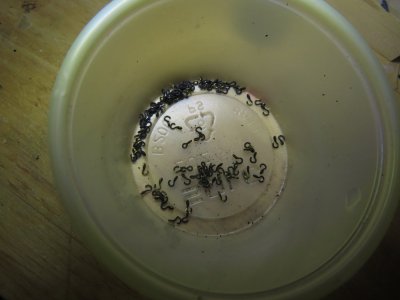
Would you believe there are 100 hooks in this container? Once I got into the rhythm of bending the 1/32” eyebolts, I could do about 2, to 3 per minute, but it was tedious and working using the pliers, wire cutter. with a magnifier headset was tiresome. Now comes the really tiresome part, making 5 identical sets of tackle per each of the 20 carronades and 2 long guns. Oh joy.

IMG_2938.JPG
 
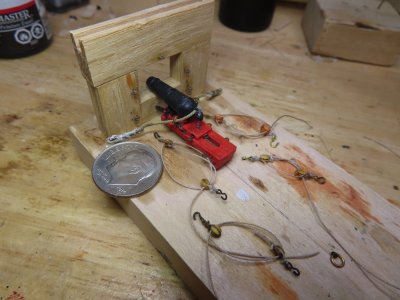
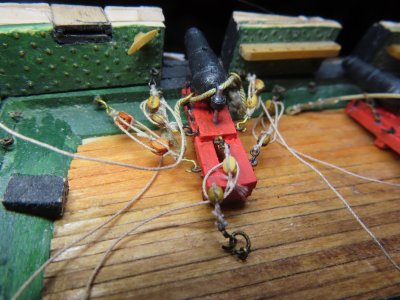
Using the mockup gun port I originally made for the gun deck; I fabricated the recoil rope and a set of typical tackles. The blocks, both single and double were 3/32”, the tackle rope was tan 0.008” (0.028 mm), and the recoil rope was Ultra tan 0.030” (.76 mm), all from Syren Ship Model Co. As previously mentioned in the prior post, the seizing line was the 3/0 nylon rigging line from the kit. Once I was happy with first completed set, I made just the recoil ropes for all 20 carronades first.

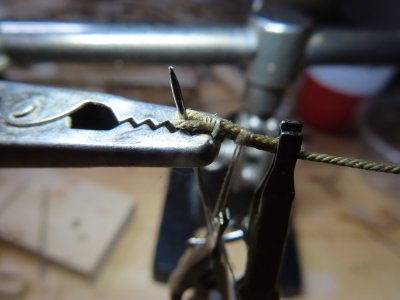
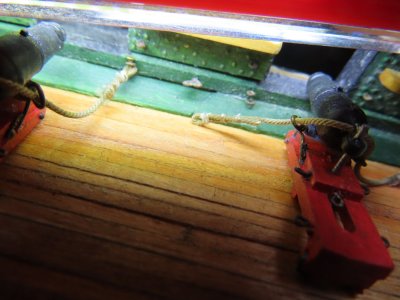
While seizing the loops, I noticed quite quickly that the loop would not pass through the recoil rings already attached to the guns. The rope loops were just not flexible enough at this scale. Therefore, after seizing the first loop, the recoil rope was threaded through the rings on the gun with the “un-looped” end first. Then the free end was seized creating the second loop.

IMG_2939.JPG

IMG_2940.JPG

IMG_2941.JPG

IMG_2943.JPG

IMG_2944.JPG
 
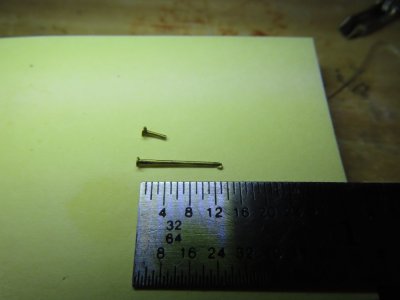
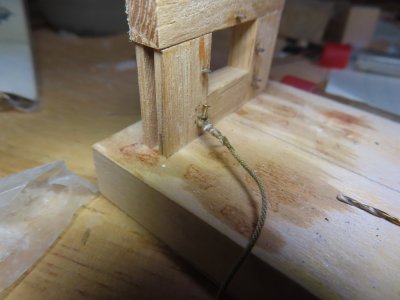
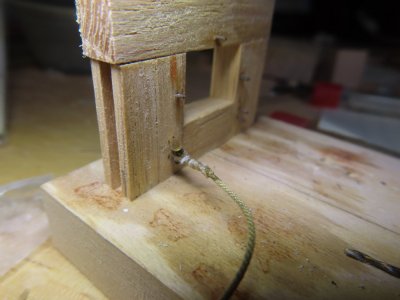
As is my masochistic custom of following the more difficult path, I chose to attach the recoil rope to the bulwark like I did on the gun deck by inserting the rope loop between two eyebolts mounted one above the other when the bulwarks were installed many years ago. Then a short drop bolt is inserted into the top eyebolt, though the rope loop, and out the bottom eyebolt. The drop bolt was made from a 3/8” long 0.025” shaft diameter flathead nail which was cut to 1/8” length. I apologize for the out of focus image. A zero depth of field, in a confined space, with a shaky hand are not a good mix. I didn’t realize I had a poor-quality photo till I was composing this post. So, I demonstrated the process using my gun port mockup.
IMG_2950.JPG

IMG_2945.JPG

IMG_2951.JPG

IMG_2952.JPG
 
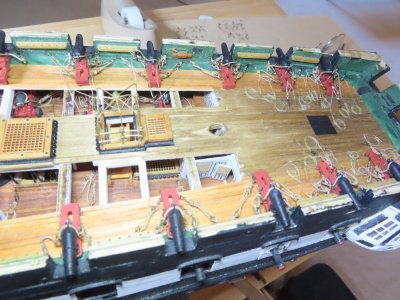
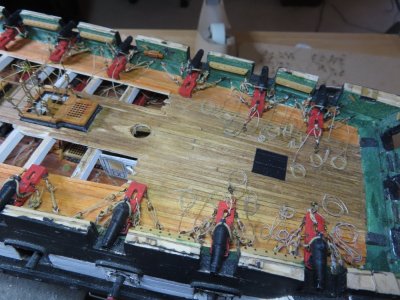
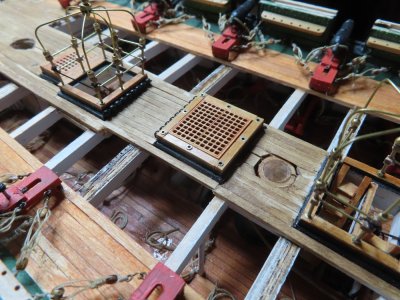
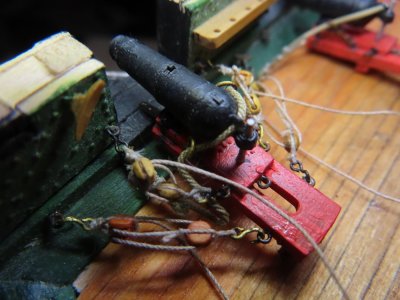
I then went on and added the remaining tackle. At this point, nothing is glued in place, and the lines are not neatly coiled up and positioned yet. The last three guns on each side of the stern will have a fifth tackle to pull back the gun slide where the spar deck is not cut away as seen in the last photo below. This last tackle is not installed on the actual ship as they are tourist tripping hazards in the modern world.
IMG_2947.JPG

IMG_2949.JPG
 
Back
Top