• SUBSCRIBE TO SHIPS IN SCALE TODAY!

    The beloved Ships in Scale Magazine is back and charting a new course for 2026!
    Discover new skills, new techniques, and new inspirations in every issue.

    NOTE THAT OUR NEXT ISSUE WILL BE MARCH/APRIL 2026
  • Win a Free Custom Engraved Brass Coin!!!
    As a way to introduce our brass coins to the community, we will raffle off a free coin during the month of August. Follow link ABOVE for instructions for entering.

USS Constitution - Model Shipway’s 5/32” = 1 ft. (1:76.8) Kit No.: MS2040

Final Touches

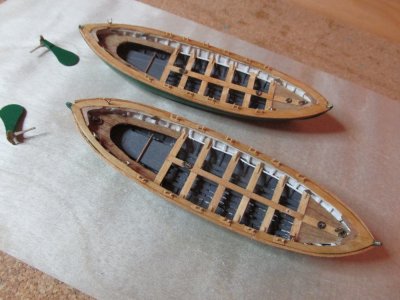
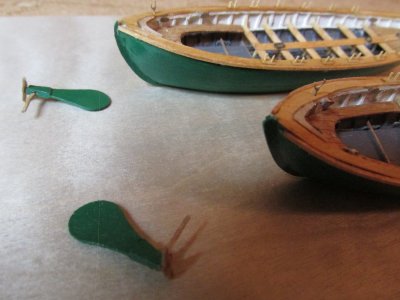
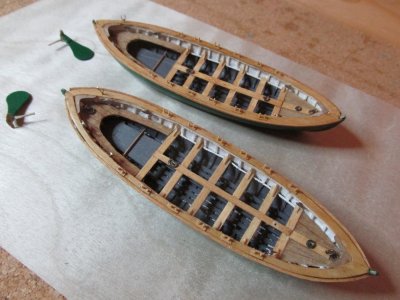
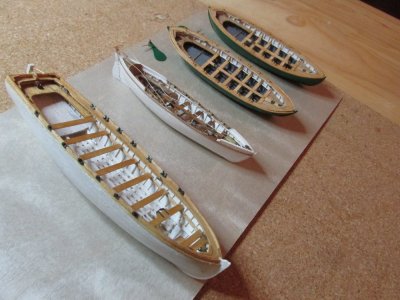
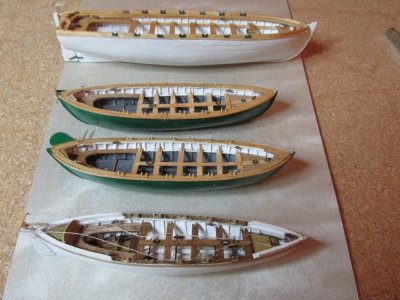
I chose not to attach the rudder assembly to the boats due to their very delicate structure. In actuary, the rudders are not stored inside boat when not used. All the oars, masts, and any other accoutrements will be made at the time the boats are to be installed.

IMG_1238.JPG

IMG_1239.JPG

IMG_1240.JPG

IMG_1241.JPG

IMG_1242.JPG

IMG_1243.JPG
 
The Main Build

So much for the appetizers, now the main course!

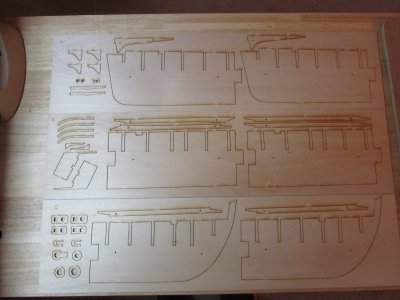
With a deep breath, I took the sheets with the keel parts from the box. I carefully removed them from the sheets and marked them with their respective reference lines. Nothing has been trimmed or glued, just laid out on the table. Some major decisions need to be made now.

First – Am I going to use the simulated guns or opt for showing some of the lower deck which would require buying additional guns and carriages?

Second – How is the model to be displayed, with pedestals or a cradle? If with pedestals, I want to ensure that the pedestal screws won’t break the keel should the model get moved or handled a bit rough. I want to re-enforce those areas. If a cradle is used, how is the model held down during transport, should it need to be moved. This is a problem I presently have with my Rattlesnake.

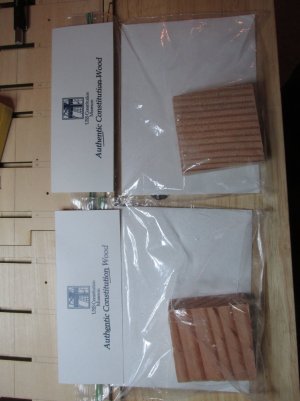
Third – I have a couple of pieces of authentic USS Constitution oak wood which I would like to incorporate into the model. The pieces are approximately 2 ¼” x 2 3/8” x 7/8 – 5/8” and 2 3/8” x 2 3/8” x ¾”. They were purchased just before the ship went into dry dock 3 years ago. I have not been able to procure any additional wood since, let alone different sizes or shapes.

IMG_1245.JPG

IMG_1246.JPG

IMG_1247.JPG
 
Jon,
Thanks so much for reposting your entire build log. You are one of my go to sources and there are several things you have done in the past that I have not got to yet. I'm glad I will still have this valuable source.
Keep up the great work my freind
 
Hey Jon! Nice to see you recreating your Constitution build log here on SoS. You did some great work with excellent details and explanations, so it's nice you are taking the time here to repost.

I'll do something with mine here sometime soon, but since mine is in such an early stage, I am only going to begin at its current point.

It is nice to see, though, as Jake and Elwood said in Blues Brothers, "we're putting the band back together".
 
Hey Jon
Not that it really matters, but you mentioned above that the wood you have from the actual ship is oak. I beleive Oak has a mucher finer grain. Based on the wide grain and reddish color, I would think what you have is Douglas fir.
Either way, they serve their purpose.
I have a similar piece but haven't started working with it yet. How was this wood to work with? Did it keep an edge ok?
 
g8rfan99, whatever kind of wood it is, it came from the real ship and that's good enough for me. The wood was used in the keel where the two pedestals attach. I have left them un coppered so they could be seen. Also, the fore pedestal's base is also made of the ship's wood. Holding an edge was not critical. so it really wasn't put to the test. It certainly was better than bass wood though.

Jon
 
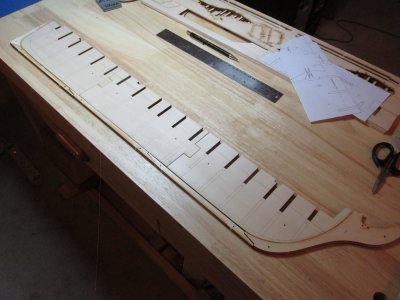
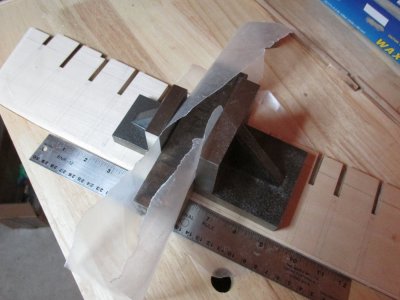
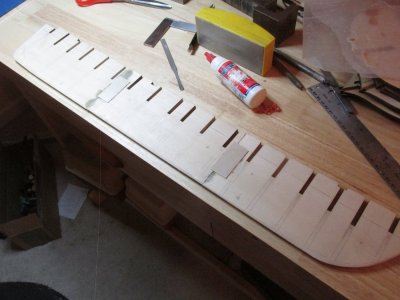
So far, I have created the rabbet on keel bulkhead and tapered the stem and rudder post pieces as indicated in the plans. The three pieces of the keel bulkhead have been glued together and the two joints reinforced with 1” x 2” 1/32” plywood. I used wax paper so that my weights would not be glued to the wood. The glue did adhere slightly to the wax on the paper which gave the wood a water-stained look.

IMG_1261.JPG

IMG_1265.JPG

IMG_1262.JPG
 
Trailboard Preliminaries

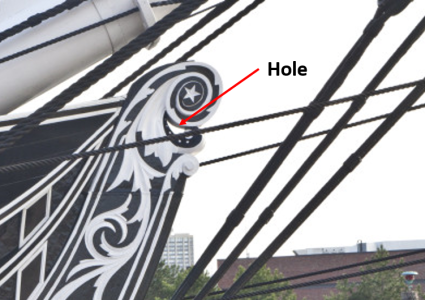
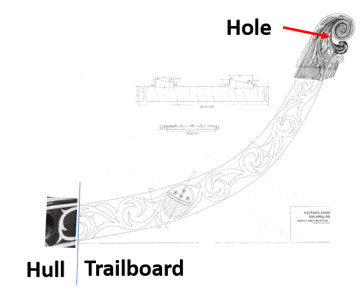
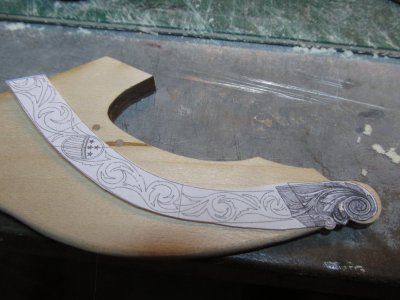
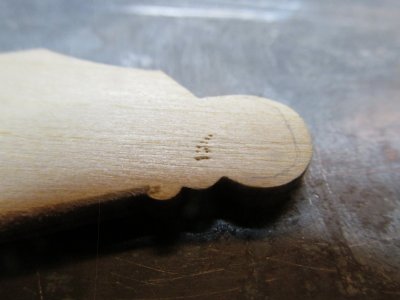
Looking at the stem piece, it seemed to me that now would be a good time to think about the trailboard decorations. Because I have the US Navy plans CD from the USS Constitution Museum, I have the plans for the decorations and the billet head so why not use that instead of the kit’s rendering? The billet head is a separate drawing. I merged the two images on the computer and printed a kit size template. The reason I did this is because the billet head has a carved hole which does not appear in the kit plans, but is obvious when looking at the real ship. I laid the template on the stem and marked the shape and position of the opening with pin marks.

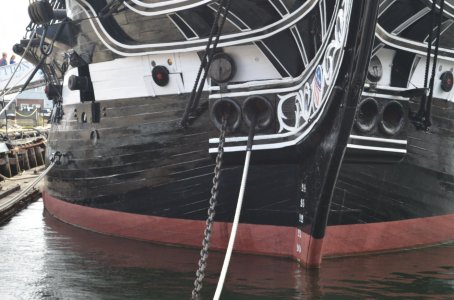
One other thing I have not seen in other builds. The trailboard decorations are not completely on the trailboard. Just a bit wraps onto the hull. Strangely, the CD does not have that part of the decoration plan, so I used an image of the real ship to complete the design on my template.

dsc_0159.jpg

Ship's Billethead.png

Trailboard Annotated.png
 
Trailboard Preliminaries Continued

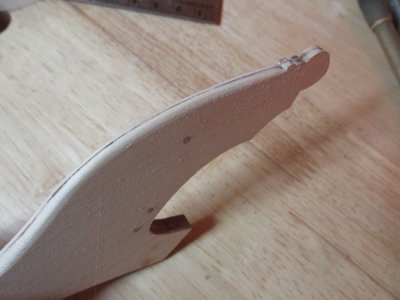
Using the pin marks I made on the stem, I drilled out the opening and fine-tuned it with an X-acto knife. I’m going to assume the opening might be a bit bigger than I made it, but I’ll address that when the trailboard carvings are made and attached.

IMG_1263.JPG

IMG_1264.JPG

IMG_1280.JPG

IMG_1281.JPG
 
Installation of the Keel

The keel was glued on in sections. First the oak wood from the actual ship was inserted into the forward and aft keel pieces. The position was dictated by where I planned to use pedestals to display the model. You can see where I marked the keel bulkhead with arrows. The length of the oak was limited to the approximate 3” square pieces of oak I had.

IMG_1275.JPG

IMG_1276.JPG

IMG_1277.JPG
 
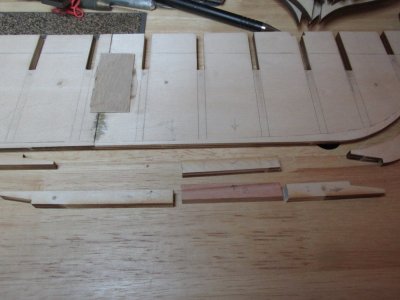
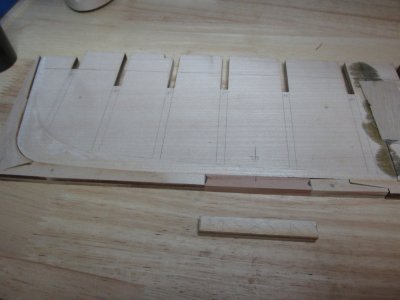
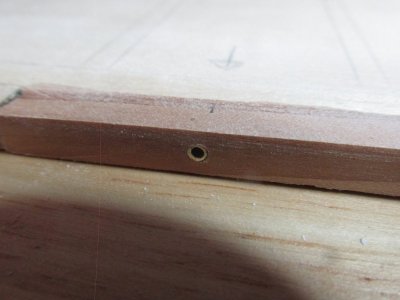
Once the oak was glued into the keel pieces, a 3/32” hole was drilled through. The keel pieces were ready to be glued to the keel bulkhead. First, I glued together the stern post to the aft keel section and the stem to the forward keel section. Then these two sections were glued to the keel bulkhead. This left a gap in the center for the last keel section. This was done this way to ensure that any errors in my cutting of the keel pieces and replacing them with the oak pieces would appear in the center of the model. Then the last piece, the center section keel was glued into place. And, as it turned out, my cutting precision left a little bit to be desired. There were gaps on either side of the center keel section which had to be filled in and sanded.

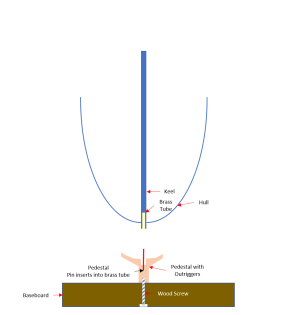
I went back to the pedestal holes and drilled the holes, so they continued into the keel bulkhead. Now they were ready to have the brass 3/32” tubes inserted. I see a lot of model displays with the ship model supported by keel pedestals. I just don’t trust that the screw/bolt going up the thin keel is strong enough to support a heavy model if there are any lateral loads (bumped table, transporting, etc.). I also didn’t want a cradle support (like my Rattlesnake) because the model would be loose. I plan on using a pedestal with outriggers (like a mini cradle) so that any lateral load will be supported by the model’s hull. Bob Hunt’s practicum shows his model supported with pins protruding from the model’s keel into the pedestals. He wanted to be able to remove the model from the stand as he worked on it. I liked that idea, but reversed the pins. I can still remove the model to work on it without having to protect the pins sticking out of the model since they will be embedded in the pedestals. At the completion of the build I will have the option of gluing the model to the pins for a permanent display.

IMG_1282.JPG

Display Stand.png
 
Bulkhead Preparation

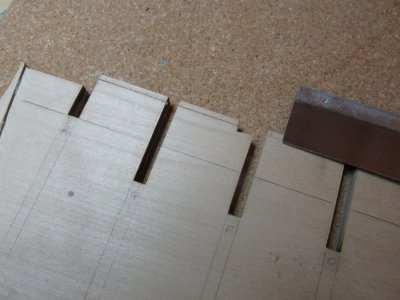
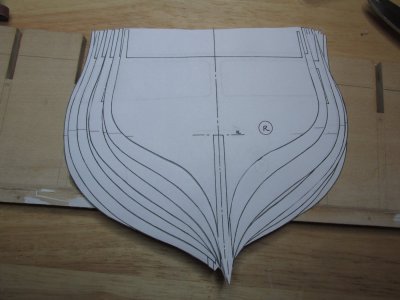
The first thing I thought I should do was add the bevels to the edges of the bulkheads as shown in the Hunt practicum. I cut out the patterns of each bulkhead from copies I made of the plans. For those bullheads that had a bevel, the pattern showed the bevel on the right side only. By flipping the pattern over, I was able to trace the bevel lines onto both sides of the bulkhead. Now as many of us Conny builders have discovered, neither the laser cut bullheads, nor the drawings are exactly symmetrically cut or drawn, and nor do they necessarily exactly match each other. For this reason, I chose not to add the bevels before they are fastened to the keel. The bevel lines I drew will only be used as a guide and the bevels themselves will be created once the bulkheads are in their final position and glued into place.

IMG_1284.JPG

IMG_1285.JPG
 
The Plunge

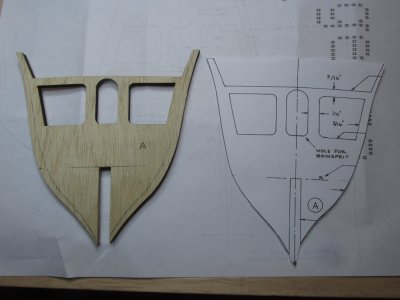
Being the “I think I can do anything provided I have something to follow” guy, and since there are a lot of great build logs out there, I took the deep plunge into the unknown (for me at least) and decided I did not like the concept of dummy cannons. I wanted a full set of “real guns” on my model. That meant to accommodate a layer of 1/32” plywood base and 1/16” decking planks, I had to remove from the bullheads as well as the keel 3/32” of material. Making a mistake here affects just about the whole build.

Now what is the point of adding a full set of cannons to the gun deck if you cannot see them? That means I will have to provide some mechanism so that one can see, at least in part, the gun deck and that also means I will have to populate that deck with all the details one would expect to see. I just made this project juuuuust a wee bit more challenging.

The spar deck cross beam supports of the bulkheads had to be removed. First because the bulkheads are made of plywood and were charred in the initial laser cutting process. Second, access will be needed to the gun deck for the installation of all decking, guns, and details. Third, I assume that some of the replacement cross beams will be exposed and will need to be more realistic.

The 3/32” lines were drawn along the top of the gun deck cross beam support of the bulkheads as well as the top of the keel bulkhead with a compass set to 3/32”. This was done because both the beams and the longitudinal length of the deck are curved. Using a ruler would have messed up the sweeping curves.

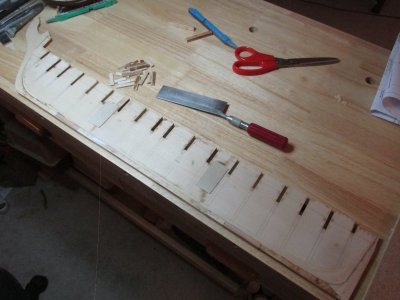
The cross and vertical supports were cut off first using a fine-tooth saw. The stubs of the cross support were left in place so that the replacement cross beams could easily be re- attached. Using my rotary tool as a drum sander, most of the now excess wood above the 3/32” line was removed from the bulkheads. The areas in the corners where the drum could not reach were removed using the fine tooth saw and files. The wood on the keel was removed using just the hand saw.
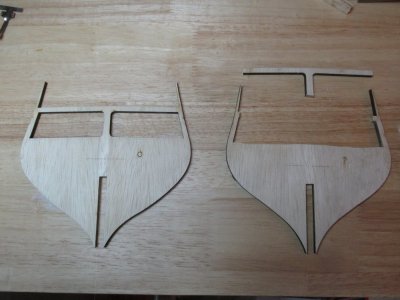
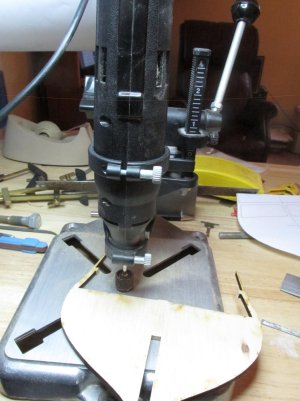
IMG_1287.JPG

IMG_1288.JPG

IMG_1289.JPG

IMG_1290.JPG

IMG_1291.JPG
 
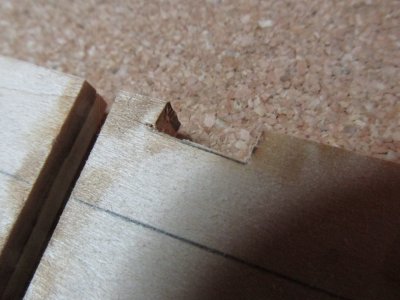
Continuing with the keel modification, the three masthead notches were extended 3/32” to compensate for the gun deck modification. Technically this did not have to be done because once the plywood and decking are installed and mast hole are drilled, the length of mast notches should match the original length of the notch cavity. I just wanted additional strength. I just have to remember to extend the base mast lengths by 3/32”.

IMG_1292.JPG

IMG_1293.JPG
 
Hi Jon
You are totally correct, it really doesn't matter what kind of work it is, just knowing it came from the actual ship is enough. I am curious how you knew exactly where it came from. Mine just said "recovered during 1970 overhaul". The piece i have doesn't have a tiny bit of black paint left on, so I'm assuming it was from the exterior somewhere
 
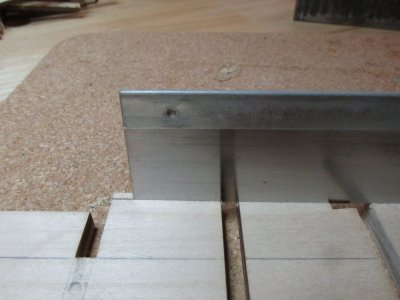
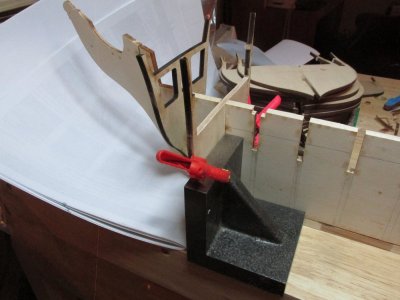
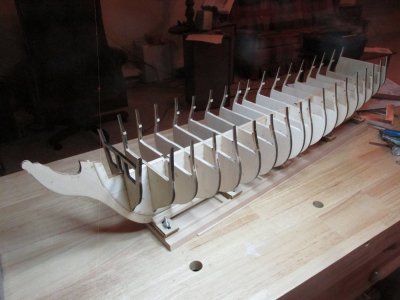
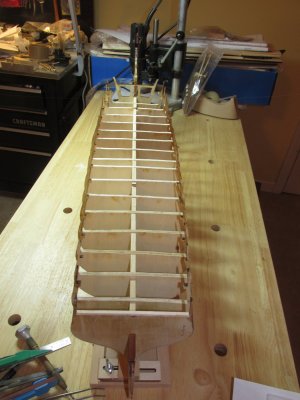
The bulkheads were installed one by one using a set of heavy angle irons I got from Micro-Mark when I started my Rattlesnake. After I took this picture, I rotated the angle iron onto its side, so I could clamp to both the bulkhead and the keel. I just forgot to take another photo.

IMG_1294.JPG

IMG_1296.JPG

IMG_1297.JPG
 
Transom Filler Block

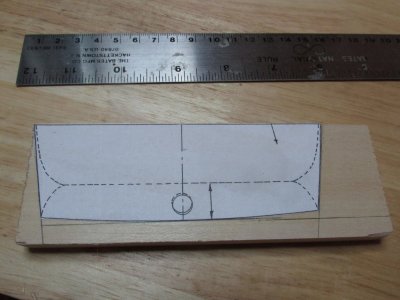
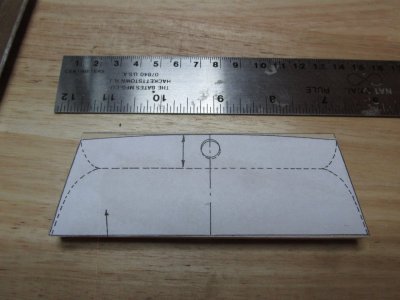
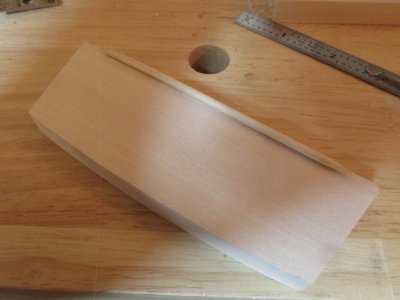
Using the kit plans as a template, the plan view was pasted with rubber cement onto a piece of basswood supplied by the kit for this piece. The transom filler block was cut out using the Byrnes saw.
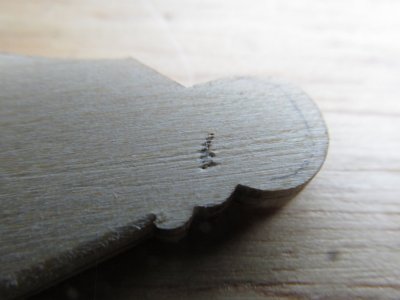
IMG_1298.JPG

IMG_1299.JPG
 
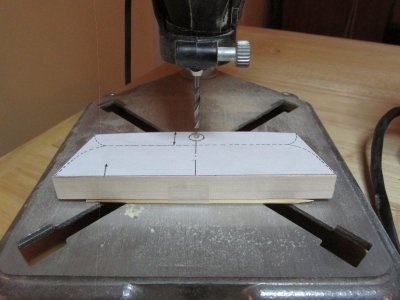
There is a rudder post hole which must be drilled at a slight angle parallel to the stern post. This is easier done now, before the aft edge is created. I found that if I taped a bamboo skewer to the forward edge I got the right pitch for the hole. Using my Dremel drill stand, I drilled a pilot hole with consecutively larger drill bits until I used the largest bit that would fit in the rotary tool. The resulting hole was still smaller than the required 5/16” diameter I needed. This was done using a full-size handheld electric drill with the 5/16” bit. I would have used a drill stand if I had one of the proper size, but the pilot hole did its job.
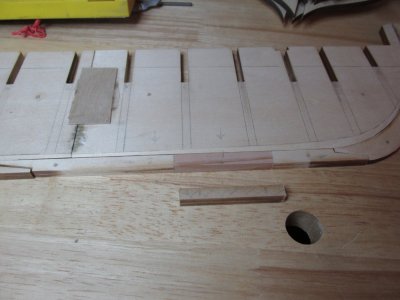
IMG_1300.JPG

IMG_1301.JPG
 
Back
Top