• SUBSCRIBE TO SHIPS IN SCALE TODAY!

    The beloved Ships in Scale Magazine is back and charting a new course for 2026!
    Discover new skills, new techniques, and new inspirations in every issue.

    NOTE THAT OUR NEXT ISSUE WILL BE MARCH/APRIL 2026
  • Win a Free Custom Engraved Brass Coin!!!
    As a way to introduce our brass coins to the community, we will raffle off a free coin during the month of August. Follow link ABOVE for instructions for entering.

USS Constitution - Model Shipway’s 5/32” = 1 ft. (1:76.8) Kit No.: MS2040

Joined
Aug 29, 2018
Messages
326
Points
113

Location
Aiken SC
On May 2, 2026 the members of the Model Ship World were informed that the site was hacked and was wiped clean of all data. They stated:
In the last three days, there has been a global issue regarding the software that operates computer servers. This has impacted websites and servers around the world. An unscrupulous group of hackers had found a way around server security and had broken into many servers, destroying data.

Unfortunately for us, Model Ship World’s server was one of countless to be affected.

Over the last 36hrs, our host had taken our server offline to apply software patches which would secure our server, but by the time they did this, it was too late.

The attackers not only deleted the files from our primary disc, housing MSW, but also deleted the three backups we had on a secondary, separate drive.

So, where are we at?

Model Ship World does not exist in any form. All files, photos, structure, posts, and data have gone.
 
As a result of this catastrophe, my USS Constitution and Rattlesnake build logs are gone. However, because of my belief that nothing is ever secure or will remain in the same place on the internet where I last saw it, I have copied everything I’ve posted including the posts of others that I have followed. Therefore this 8-year build log will start at the beginning. It will consist of just about everything I’ve posted, but not necessarily the comments. If anyone has questions between the posts in this log, I’ll try to answer them as best as my memory will allow.

I should mention here that I have MS Word documents of a majority of USS Constitution logs posted on MSW that I read. Should anyone want a copy of their lost build log, send me a PM.

USS Constitution - Model Shipway’s Kit No.: MS2040
“Old Ironsides” 1797 Frigate
Scale: 5/32” = 1 ft. (1:76.8)
Feb 19, 2017 -

This is my second POB square rigged ship; I spent about seven years building my first, Mamoli’s Rattlesnake. Like the first one, I will be following Hunt’s practicum, but unlike the first, I have a multitude of excellent build logs and books to supplement it and help guide me through the inevitable pitfalls that are sure to raise their ugly heads. Hopefully, based on this and my hard-earned experience with the Rattlesnake, it won’t take another half a lifetime to build.

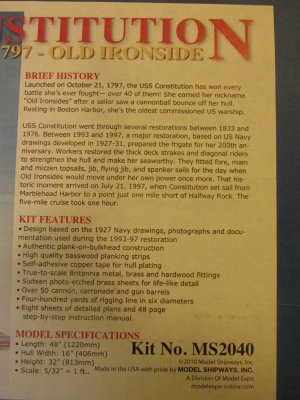
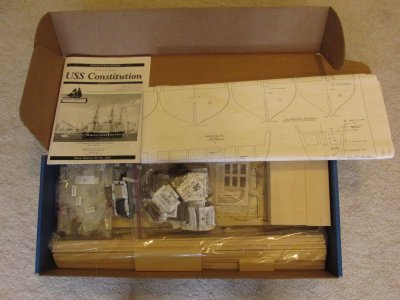
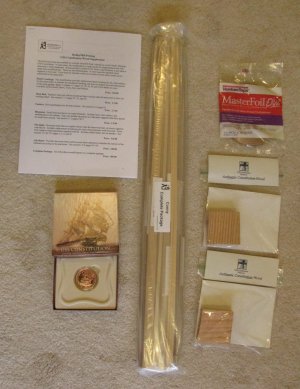
Now for the obligatory part. Below is the kit box and contents. I won’t bore you with showing all the little packets that are stuffed in the box, that has been done very well by numerous other builders. I will state that in addition to what came with the kit, I purchased a few more items:

  • Robert Hunt’s practicum
  • Hobby Mill’s wood supplement package (based on Hunt’s practicum) *
  • Additional copper plate tape (as I understand it, the kit was a bit too frugal with their supply)
  • 2 - 2½” x 2½” x ¾” genuine pieces of USS Constitution wood **
  • Medallion made from genuine USS Constitution copper plate. Not sure yet how or if it will be used.
* Wood package purchased before HobbyMills closed shop. The supplement package was derived by HobbyMills where Mr. Hunt made his substitutions in the practicum. It was not identified as a package that could be purchased in the practicum. I have the original price list which describes what the wood is being substituted for and where in the practicum it is being described. If anyone wants a copy of the supplement wood list, please send me a PM.

** Constitution wood was purchased from the museum just before the ship went into drydock, December 2014. I have since tried to get a larger size for the keel or nameplate but accordioning to popeye2sea (who as I understand it volunteers on the ship), the US Navy is withholding any more wood from the public for now for reasons unknown. The museum told me, maybe in the Spring sometime.

This will be my third attempt at constructing this model. The first attempt was done when I was a child building Revell’s small plastic model which I really botched. I hadn’t yet learned to read and follow instructions, but just dove into assembling the parts with expected results. My second attempt was as a young teenager and when the wounds of that failed build had waned, went a bit better. This time I got the larger plastic model. I did follow instructions and even painted the parts but had absolutely no idea how a rigged ship worked let alone how the lines were attached or what they were for. It looked decent to my young ignorant eyes at the time. Both models met their demise at my hand with firecrackers; usual method of disposing such items

This time I expect a glorious finish…I hope.
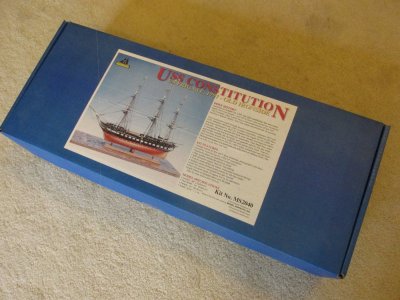
IMG_1057.JPG

IMG_1058.JPG

IMG_1059.JPG

IMG_1060.JPG
 
Last edited:
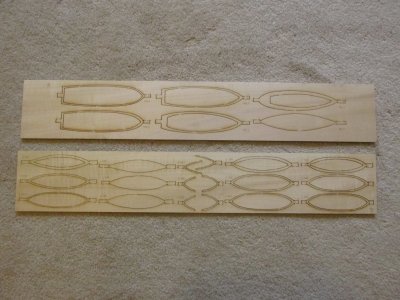
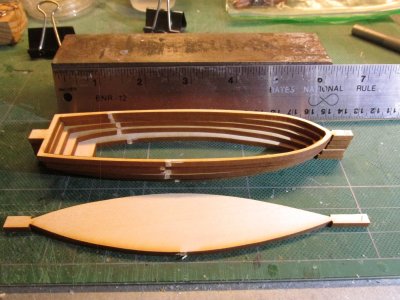
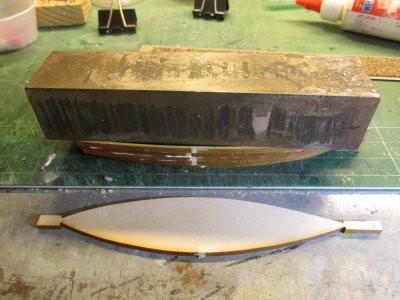
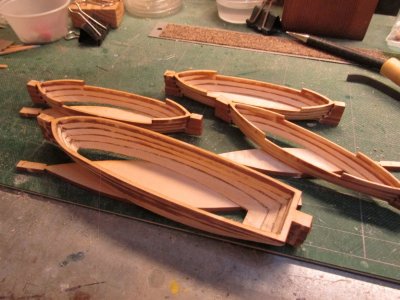
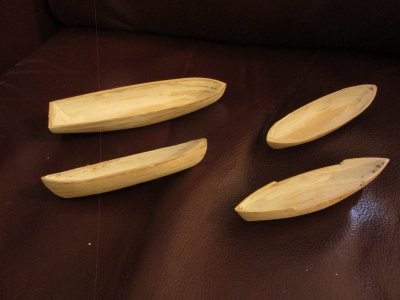
OK, it been almost two week since my original post and as I had mentioned before, I’ve deviated from the practicum by starting on the ship’s boats first. These boats are designed to be built as a layer cake, a method I have never done before. Using the tabs of each layer, the pieces are aligned for gluing. Having read numerous other logs, I knew not to glue the bottom layer so as to allow better access to the interior for carving, something the practicum did not do. Using my piece of nuclear grade stainless steel block of scrap metal I obtained many years ago, while working as a Quality Assurance Engineer at a nuclear power plant project (doesn’t everyone have one??), I simply weighted down the layer as they dried.
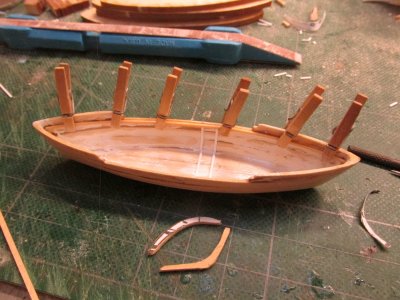
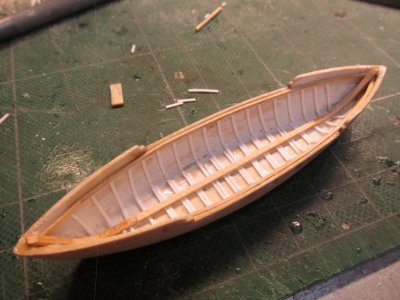
IMG_1062.JPG

IMG_1063.JPG

IMG_1064.JPG

IMG_1065.JPG
 
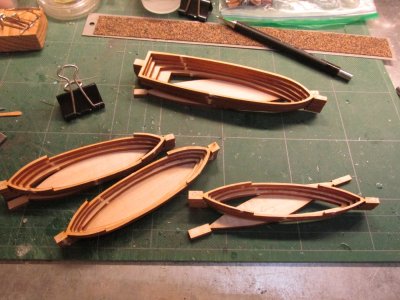
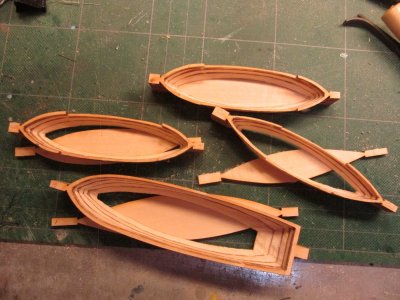
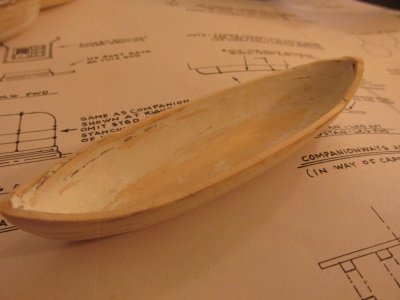
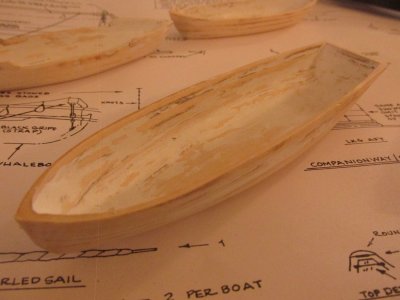
Using a no-name Dremel like rotary tool with a drum sander for the wholesale removal of wood, various cutting bits for the more finer cuts, and finally hand files and sand paper for still finer detail shaping, I arrived at the basic shell shape of the boats.

IMG_1066.JPG

IMG_1067.JPG
 
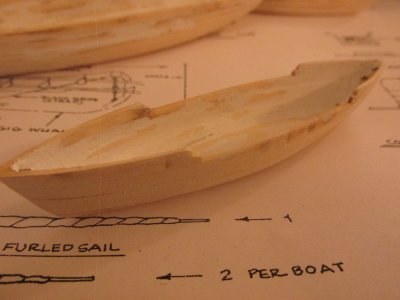
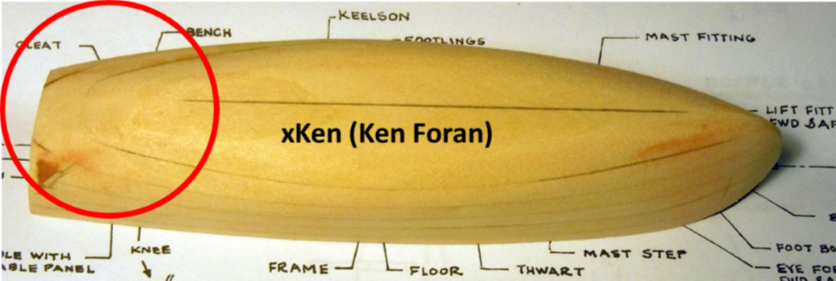
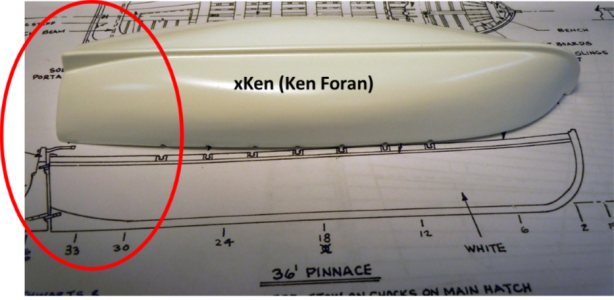
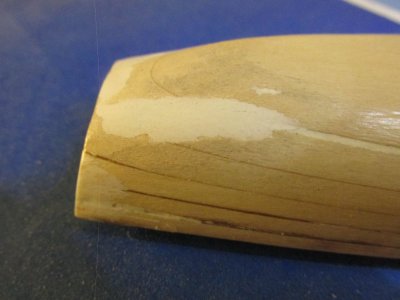
The bottoms were then glued on, the stems cut off, and the final shaping of the boats commenced. The final shaping was done using just files and sand paper. Following the lead of xKen, I used 3M Acryl-White Glazing Putty as a wood filler to smooth out the little inconsistencies He also suggested Bondo Glazing & Spot Putty – I just found the 3M version first. I just smeared it over the void waited about a ½ hour for light coats and a bit long for the thicker ones then filed or sanded off the excess.

IMG_1070.JPG

IMG_1071.JPG

IMG_1072.JPG

IMG_1068.JPG
 
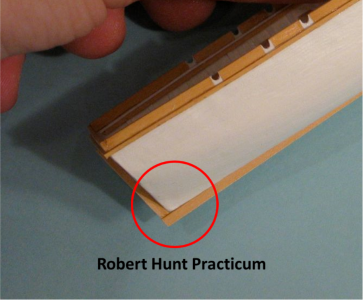
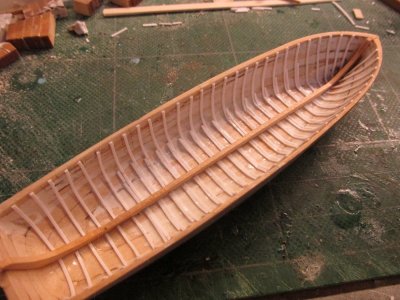
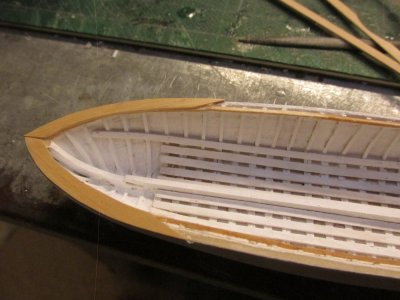
Once the shells were sanded, 3 coats of Minwax Polycrylic were applied with fine sanding in between. The next step was to add the frame ribs. Starting with the Pinnace, the kit calls for 1/64” 1/32” (0.016” x 0.031”) stock material. Bob Hunt in his practicum chose not to use wood, but substitute Evergreen 020" x .040" styrene strips styrene strips (Evergreen No. 122) because “they bend easily to conform to the interior shape of the boat.” Since these parts are going to painted, struggling to bend the wood made no sense, I agreed with him.

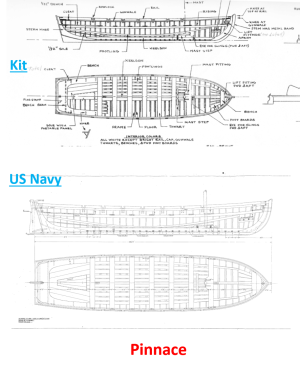
I did not have any styrene strips in stock however; I had to order some. Looking at the Pinnace plans, I noticed that the boat’s stern knee and apron (like an interior stem) are mount directly to the boat’s shell whereas the Keelson rests on top of the frame ribs. Therefore, I could move ahead and install those or at least make the parts while waiting for the styrene…or so went the theory.

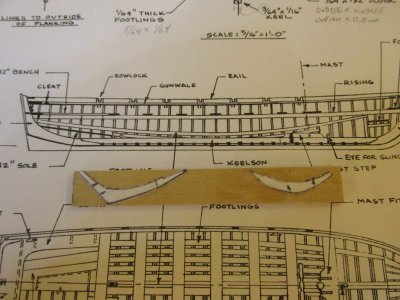
I made a copy of the profile plan of the pinnace to use as a template to cut out the shape from 1/16” x 5/64” boxwood (my choice of material) since I like it a lot better than the kit’s basswood. It’s a hardwood and holds an edge much better than basswood. I cut out the knee and apron templates and rubber cemented them onto the stock boxwood (left over from my Rattlesnake).

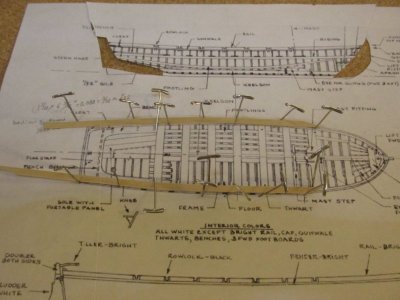
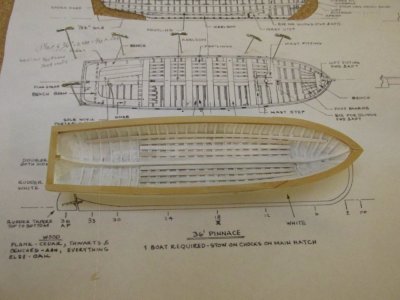
Pinnace Plans Comparison.png
 
Looking at the pieces to be cut, I began to wonder if they (especially the knee) would even fit on my boat shell. Using a contour gage, I took the profile of the transom. Not only did my transom not match the plans, it wasn’t even close. My boat transom contour better matched the outer surface of the knee than anything. I needed to remove more material in the bottom corner where the knee was supposed to fit.

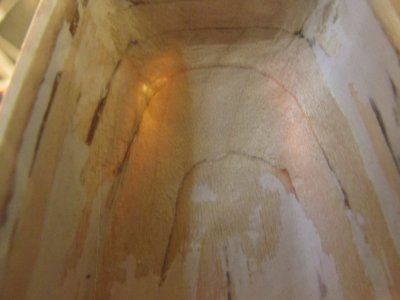
If you look at the boat’s plan above, it shows the transom to be 1/32” thick. That is paper thin if you carving it, which I was. The only way I could achieve that thickness would be to slice off the transom and rebuild it with 1/32” planks. My Byrnes saw can only cut at best 1” thick pieces. I wouldn’t attempt this with a hand saw even if I had one. Due to the confined space in the bottom corner of the transom, as best I could, I removed as much material as I dared using my rotary drill. I used a ball cutter for the wholesale removal and various shaped diamond tipped metal grinding heads for finer removal. The grinding heads removed material slowly for better control. Putting the shell up to the light, I could almost look right through the wall. Bob Hunt in his practicum actually wore right through his boat and had to make repairs.

IMG_1074.JPG
 
I checked the contour again and it was very close to what the plans required, so I cut out the knee and apron with my 40-year-old Dremel scroll saw. One of these days I’m going to get a new one that doesn’t vibrate so much and is a lot quieter. With a few minor adjustments with a file, they fit!!! I felt a whole lot better now that it was done right

IMG_1073.JPG
 
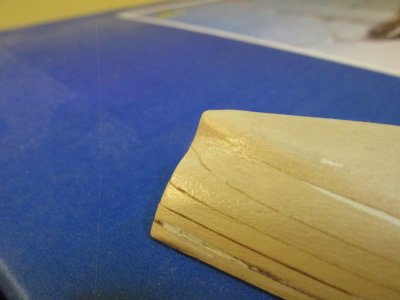
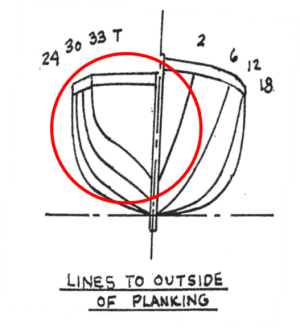
Moving on, I thought I would make the stem and keel parts while still waiting for the styrene strips. It was at this point that my good feeling sank a bit. Looking at the practicum, my pinnace shell looked very similar to what was shown. However, when I looked at the plans to make the templates for the keel and stem I found another problem. The aft end of the boat angled up. See the pictures below. I checked other build logs and those with images of the pinnace that showed the bottom of the boat, all agreed with the plans, not the practicum. So, I have a bit more carving to do. In case you haven’t noticed, I’m still a novice when it comes to reading ship lines on plans.

Pinnace Stern - Hunt.png

IMG_1075.JPG

Pinnace Stern - Plans.png

Pinnace 1 - xKen.png

Pinnace 2 - xKen.png
 
I got out the rotary tool and put the sanding drum on it and sanded down the stern to match the plans, added more filler to smooth out the minor imperfections, and then applied the three coats of Minwax Polycrylic to the newly exposed wood again.

IMG_1078.JPG
 
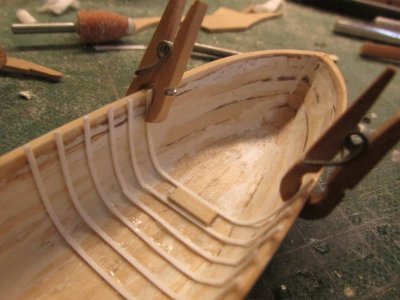
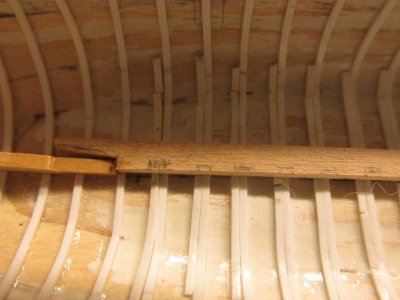
OK, back on course, if pardon the nautical reference. My styrene arrived and I proceeded to start the ribs. Having looked at several build logs, this didn’t appear to be too much trouble to do…riiiggghhht. I started by drawing a center line down the middle of the inside of the boat shell to ensure that when I glued the apron, keelson, and the stern knee, it would be properly positioned. Then I marked the position of the center rib. Using CA glue, I cemented the rib in place a bit at a time. I was using clothes pin clamps, and I didn’t want those to get glue on them. When I was done, I saw that the rib had shifted a bit so it was not perpendicular to the center line. This was important because all the other ribs would be positioned off this rib using a spacer block; so it had to be right. When I tried to lift the rib from the shell with very little pressure with an X-acto blade, it snapped. The CA glue had made the flexible styrene brittle. So when gluing these ribs, they have got to right the first time.

Another thing I noticed while reviewing other build logs where they have documented their ship’s boats construction, is that no two pinnaces were built the same even though MS provides a detailed plan based on the US Navy plans. I can understand when the actual ship and plans no longer exists so the builder has a lot of room for interpretation. Well, I guess I will find out why as I progress through the construction of this beautiful little craft.

Following the construction process of the practicum, I used a “spacer” to maintain the separation of the ribs as each one was glued into place.

IMG_1076.JPG
 
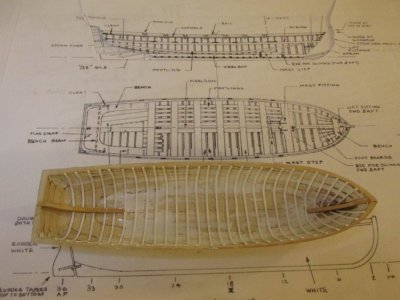
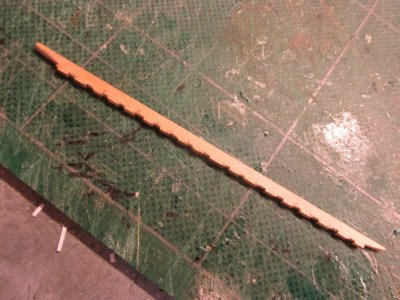
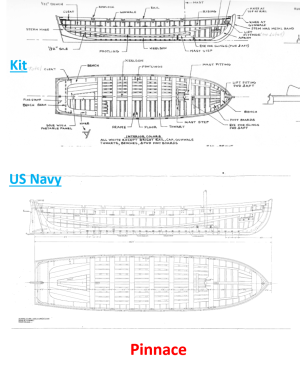
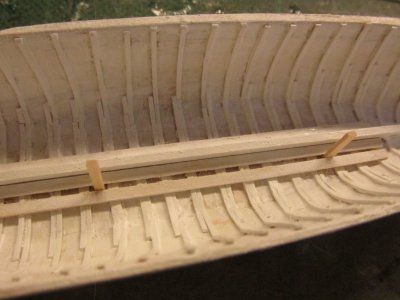
The practicum showed that Mr. Hunt had glued all the ribs in place and then glued the apron and knee on top of them. Both the MS plans and the US Navy plans show the apron and the knee glued directly to the shell with the ribs butting up them. This is what I did. Both plans show the keelson notched for the ribs and footings (which have yet to be installed) so it can be glued on top of the ribs and footings.

IMG_1077.JPG
 
In my last post, I had forgotten that I had taken some shots of the notched keelson (they were still in the camera) so here they are. BTY, you can see where the styrene broke. Luckily, all of this will be under a couple of coats of paint and nearly hidden once the boats are completed. So unless you know they are there and have very good eyesight with proper lighting, it will be hidden.

IMG_1079.JPG

IMG_1080.JPG
 
General Thoughts

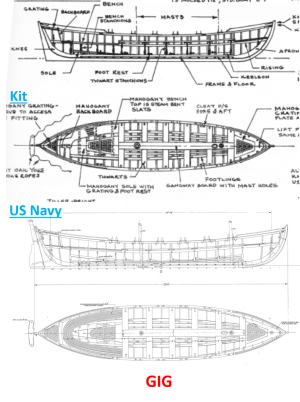
Having the actual plans from the US Navy for the ships boats is wonderful and luxurious. Usually when making a model I must rely totally on the kit to provide me with the all the details because I normally don’t have the real thing to look at. My Rattlesnake is an example. With the actual plans, I can see how the kit’s plans adjusted for scale and ease of building. With the build logs, I can also see what other builders added, modified, or eliminated.

Pinnace Plans Comparison.png

Gig Plans Comparison.png
 
At this point I had intended to paint the pinnace before moving on. However due to some unknown circumstance, my order for the USS Constitution paint package which was ordered last month never arrived. Both Model Expo and the US Post Office have recorded the package as being delivered within a week of my order, but that was a month ago, and I never got them. Model Expo has promised to resend another shipment. Thus, I have moved on to the gig.

IMG_1081.JPG
 
Gig

Like the pinnace, the gig kit plans are very accurate as compared to the US Navy’s plans. Hunt’s practicum shows you how to make an acceptable looking model though not necessarily complete or accurate. Some points:
  • The practicum uses one strip of styrene over the ribs to form the gig apron, keelson, and knee. Like the pinnace, I plan to use separate pieces for each and notch the keelson to fit over the ribs as shown on the plans The average observer may not see this detail, but I will know.
  • A lot of the hardware and detail (e.g., lifting rings) were left off due to scale size, visibility, or complexity.
  • The gig backboard and all the gratings were eliminated
  • The gig thwart support stanchions were eliminated
  • The oarlocks were eliminated
  • The “wing” on top of the rudder, and the pintle and gudgeon were eliminated
  • The slats for the stern benches are too fine for this scale and were rightfully replaced by a single sheet of wood. I have ideas about those and the gratings.
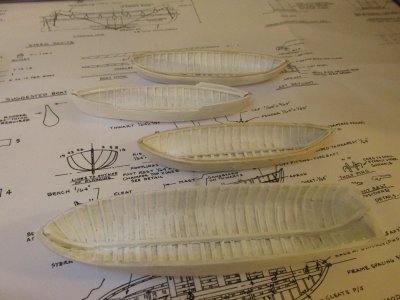
My intent is to add as much of the detail shown on the plans to the model to the limits of my ability and patience. Here is the gig at the same point as the pinnace with the ribs and flooring supports waiting paint. The only difference is that I added the interior gunwale. So, onto the two whaleboats:

IMG_1082.JPG

IMG_1083.JPG
 
The two whaleboats progressed in the same manner as the gig. At this point, Model Expo came through and my paint package arrived...supposedly again. This time it did not disappear. A coat of white primer was applied to all four boats. I hadn’t realized that I didn’t coat evenly until I saw this photo, but a second coat of primary color paint should take care of that.

IMG_1084.JPG
 
Pinnace

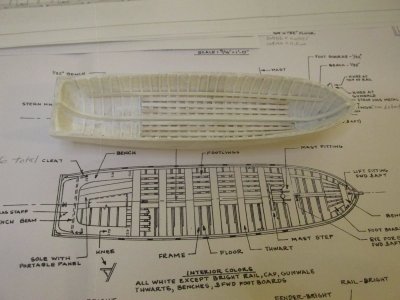
Now I will concentrate on one boat at a time. The pinnace is the first. The plans call for 1/64” thick footlings but don’t specify their width. The US Navy plans show these are 5” x 1” or about 1/16” x 1/64” but the kit does not provide 1/64” wood stock. Using the Byrnes saw and some of the kit wood stock (I forget which size I used), that was easily remedied. I painted the cut pieces first and then glued them into place using 1/32” wide spacers.

IMG_1085.JPG

IMG_1086.JPG
 
The rail cap was next. The practicum used styrene, I used boxwood. The plastic would have been easier, but boxwood is nicer. Also, according to the plans, the cap is not painted white. Due to the severe curve of the side rail, this was accomplished with two pieces of 1/32” thick boxwood – one cut to the shape of the bow curve and the other was edge bent after soaking in water for a while. The transom was simply a straight piece of wood.

IMG_1087.JPG

IMG_1088.JPG

IMG_1089.JPG
 
Pinnace Mast Step

Now that the Pinnace’s interior shell has been completed, the interior structures can now be made. First is the mast step. As usual, my first order of business is to find pictures of the real thing and research how others made theirs. Try as I might, I could not find a single pictures on the internet nor in any of the books on the Constitution I have, nor in any of the books on small boats I have. I did have the Navy plans, but even those were a bit confusing. The practicum skipped this part all together.

Of the 34 build logs I have collected, less than five devoted any detail or images as to how they did what they did for the ship’s boats. And of those, nobody followed the kit’s plans which mirrored the Navy plans, meticulously. As usual, just about everyone used artistic license to either skip a lot of details or alter the design for one reason or another. That was their choice and I have no problem with that. My choice is to try and follow the Navy plans as best I can.

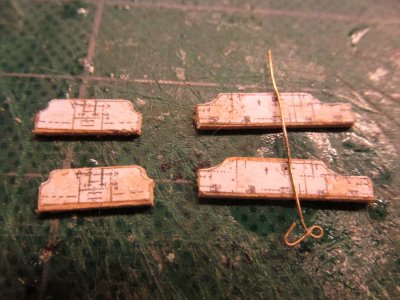
Using the Navy plans, the four main parts of the mast step were reduced to scale and used as a template. The plans call for a 1 inch bolt to pass through the two beam structures. This would also pass the curved bottom mast so that the mast could pivot along the length of the beam of the boat. A 1 inch bolt reduces to scale of 0.013” or the same as a #80 drill. Any of the images I’ve seen of other builder’s boats, their bolts appear to be thicker. My initial thought was to use some real thin copper wire for this.

IMG_1091.JPG
 
Back
Top