Follow along with the video below to see how to install our site as a web app on your home screen.
Note: This feature may not be available in some browsers.
Ships of Scale has incorportated an extra level of security when you log In. Please follow
on-screen prompts to acknowledge that you are not a robot via a "Check Box" or a "Pictorial Check Box Puzzle". This is needed due
to higher level of AI Activity Security.
The beloved Ships in Scale Magazine is back and charting a new course for 2026!
Discover new skills, new techniques, and new inspirations in every issue.
NOTE THAT OUR NEXT ISSUE WILL BE July/August 2026
Win a Free Custom Engraved Brass Coin!!!
As a way to introduce our brass coins to the community, we will raffle off a free coin during the month
of August. Follow link ABOVE for instructions for entering.
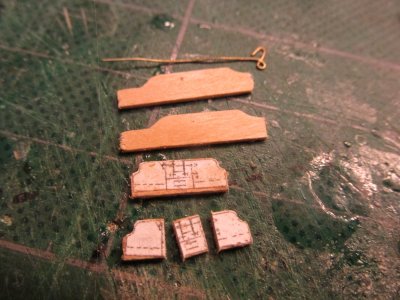
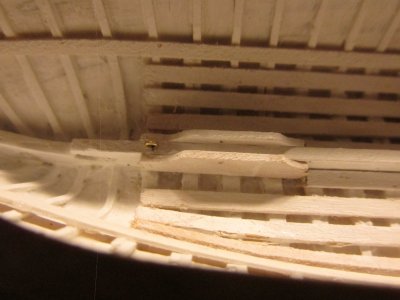
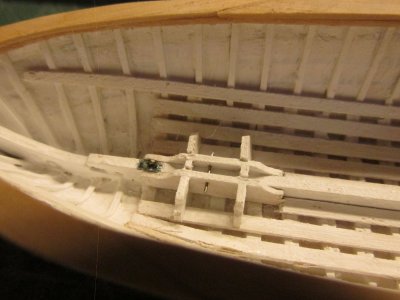
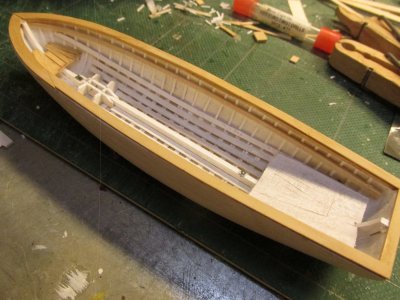
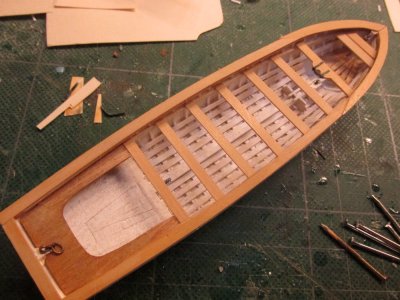
Two of the pieces fit at right angles to the beam pieces and appear to sit on the floor boards. This is where I was confused. The plans state that the two beam pieces fit against the keelson. From the plan view, the cross pieces appear to fir over the beam pieces. The elevation view implies that they butt up against the beam pieces. My best guess is that this structure is constructed somewhat like a grating. Because this was going to be painted and was in a limited view area, I “cheated” and tried to make it look right, not necessarily built right. That license sure comes in handy.
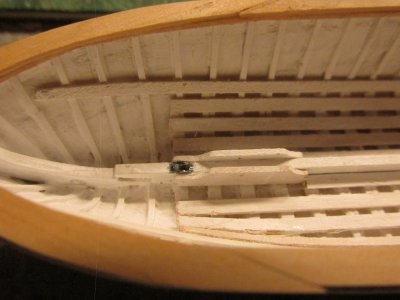
The pre-painted beam structures were glued in first using PVC glue so I could make small adjustments. At his point, I decided I didn’t like the copper wire for the bolt. I decided to sacrifice the #80 bit I used to drill the bolt hole as the bolt itself. It was stiff and had the right thickness and color.
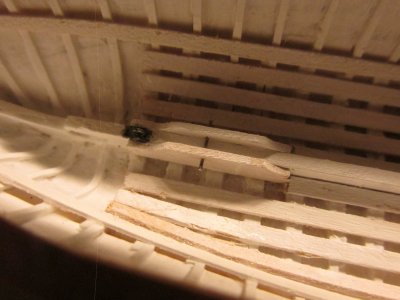
An eyebolt was required just forward of the step. The eyebolt was not shown a dimension on the Navy plans so I made some measurements off the plans and reduced it scale. It came out to be approximately 1/16”. Because the eyebolt was shown on a metal plate, I painted the bolt and a square area around the bolt black to simulate the metal plate.
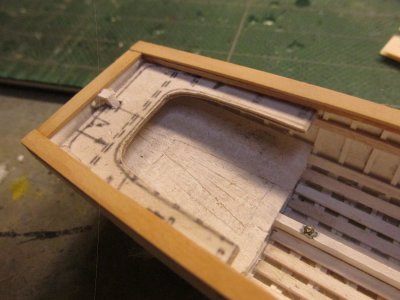
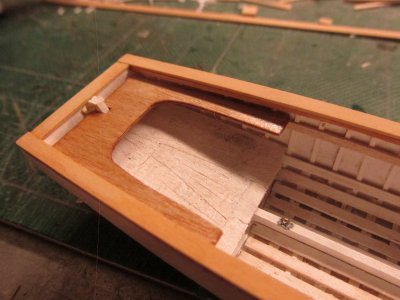
Finally, the cross structures were added, the two outer “wings”, then a filler piece in the center. A bit of touch up paint, and it was complete. The whole mast step is just ¾” in length.
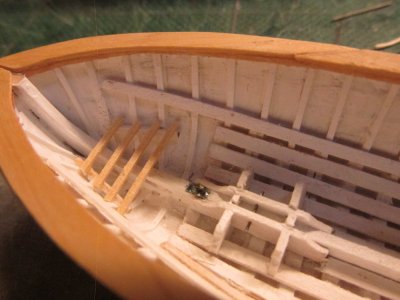
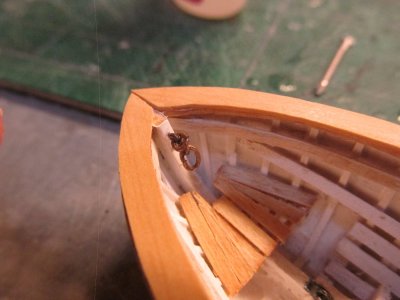
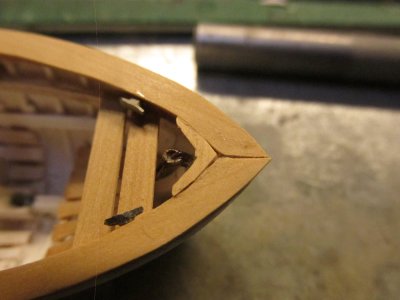
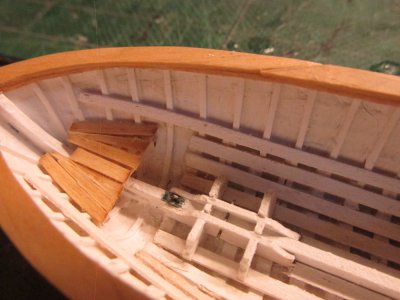
These are the short footboards at the bow. According to the Navy plans and the kit’s plans (although you’d be hard pressed to see the detail in their scale size plans), there are four 4 support members that pass over the keelson and supported along the inside walls. From those builders that have posted this detail, including the practicum, nobody has included them in their build. I did, even though you can’t see them when the model finished.
Additionally, everybody (those that I can see) installed 5 footboards radiating from the bow. I counted seven on the plans. So, I installed seven. Let me tell you, those pieces are small and only 1/32” thick.
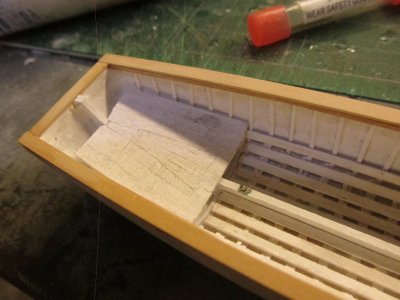
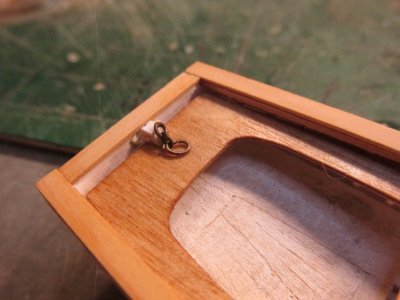
Being a landlubber, I was not familiar with boats when I started building these models. So once again, I’m modeling something I have no knowledge about. I’m referring to the aft end on the pinnace, something called the “sole.” This appears to be a floor section of the boat and in this case, one with a portable panel. I’m not certain as to sole’s purpose, but I assume the portable panel is there to gain access to the area below it.
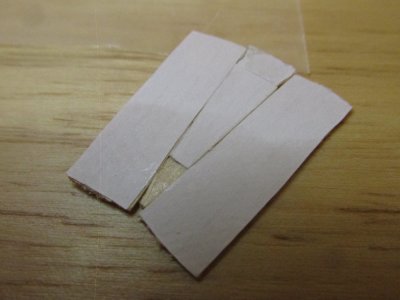
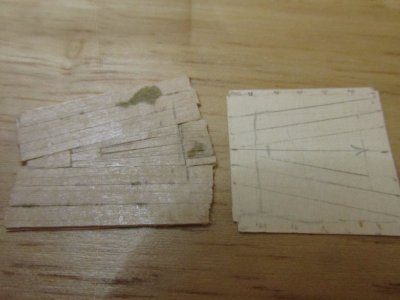
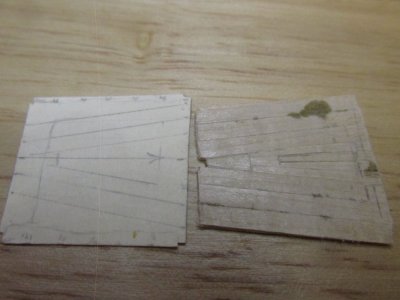
The practicum simulates the sole with a piece of styrene etched with lines imitating pieces of wood. I’ve seen others use 1/64” plywood and do the same. I thought I would try something different. Using individual pieces of 1/32” basswood, I reconstructed each piece of the sole as best I could. First a pattern was made based on the plans but adapted to conform the actual model. This was used to size the pieces and orientate and locate their final position. The problem was that the sole required that the piece be glued edge to edge. This is not structurally strong. To compensate for this lack of mechanical strength, the pieces were PVC glued directly onto paper in five separate groups.
The pattern was covered with wax paper to prevent the modules from sticking to the pattern as it was being put together and glued into the final assembly.
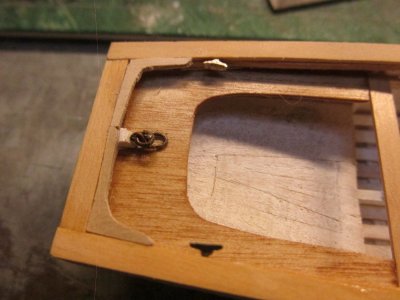
The sole then given two coats of diluted white paint; I didn’t want a thick coat of paint. The idea here was that I was hoping the individual planks would be visible after the paint dried. In the end, I still need to enhance the edges around the portable panel with an X-acto blade. Finally, it was fitted into the stern. Another eyebolt with a painted simulate plate was also installed.
BTY, I wasn’t concerned that the edges of the sole were not fitted into the sides of the boat model as these will be hidden by the stern bench seat.
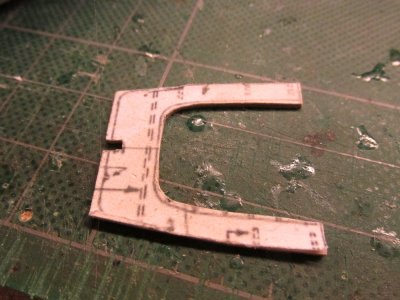
Once more I deviated from the practicum. In this case, the practicum constructed the bench seat from three pieces of boxwood: two side seats and the transom seat. I elected to use one piece of 1/32” plywood because I wanted to use a template I made from the US Navy plans. Interestingly, those plans show the bench as one piece. If the bench in real life was made in multiple pieces, it doesn’t indicate where the seams are. Like the practicum, I did not install any of the underlying support knees or braces. They would have been a lot of work and in the end wouldn’t be seen.
Before I made the template, the 3/64” x 1/64” rising was installed about an 1/8” from the top of the rail. It will support the bench seat and the thwarts.
The template was rubber cemented to the plywood and cut out with my 40 year old Dremel hobby scroll saw. To my delight and surprise, with just a few minor tweaks with a file, the bench seat fit perfectly.
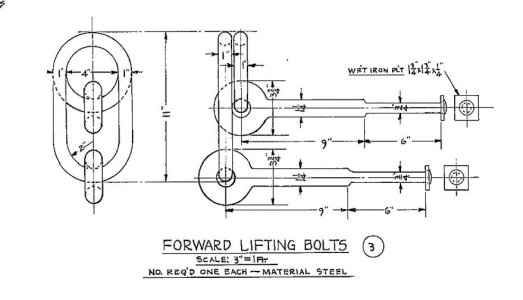
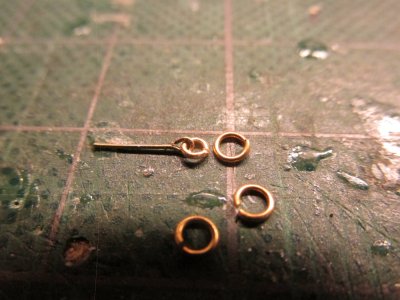
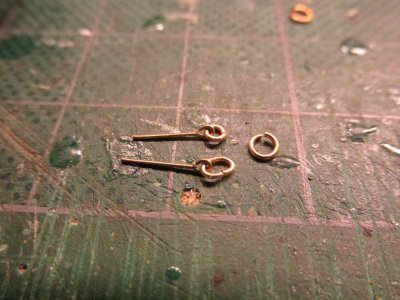
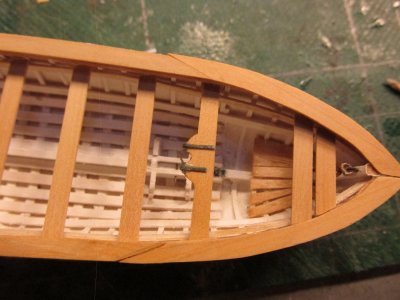
Continuing my way from the bottom interior up, the thwarts were next. But before I started those, I thought it would be prudent to install the lift fitting double eyebolts at either ends of the boat. Based on the dimension shown on the US Navy plans, 1/16” eyebolts closely approximated the scale needed. Each eyebolt had a ring. The lower eyebolt’s ring was oblong in shape such that it came to the same height as the top eyebolt’s round ring when pulled to the vertical position. The width of both rings was the same.
To approximate this at scale, I used the smallest ring I had: 1/8”. For the top ring, about a quarter of the circumference of the ring was snipped off and the resulting ends joined together. This reduced the size of the ring closer to scale. The bottom was squeezed to the width of the top ring and resulted in an oblong shape. They were then installed
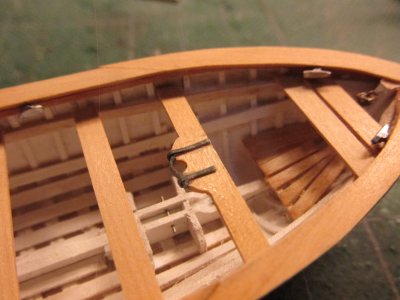
The thwarts were made from 1/32” boxwood. The mast thwart clamps were made from card stock (file folder) and painted black. I tried using the styrene, but due to the size of the pieces, trying to hold them in place while trying to glue them with CA (PVC couldn’t hold the plastic) was neigh impossible. With the card stock, I could use the PVC and its tackiness would hold the parts in place as I maneuvered their positions. These pictures were taken prior to any staining of the thwarts.
I’ve noticed that some builders have installed the pinnace cleats and others not. The practicum does not. Being the crazy fool that I am, I made the attempt.
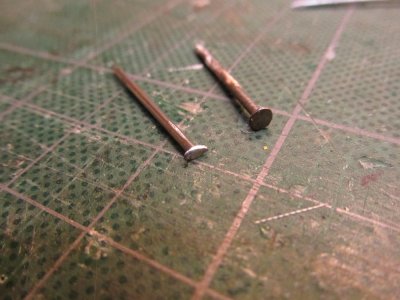
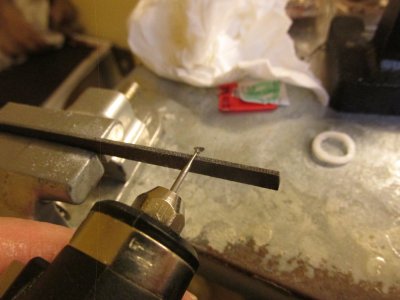
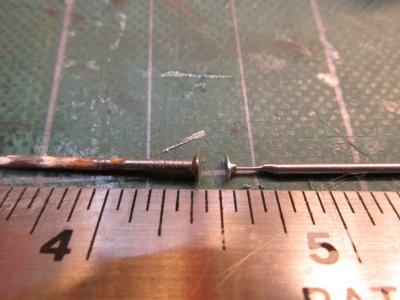
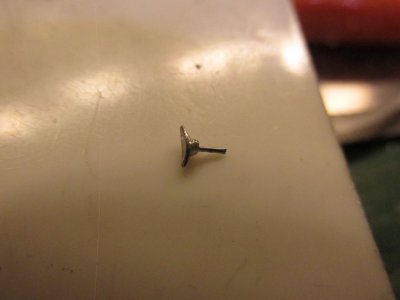
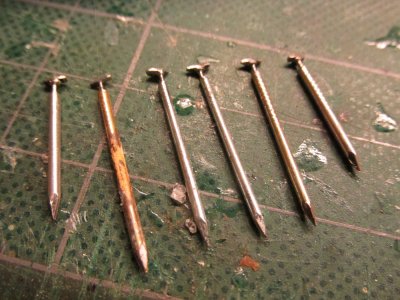
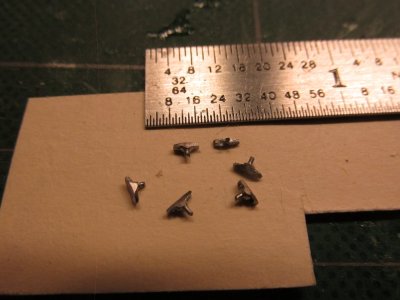
Using a technique that as far as I know, no one else has used, I made six cleats. The first four images below are from my Rattlesnake build where I needed one very small cleat. The last three from this build.
The US Navy plans give the dimensions of two different size cleats, 8’ x 1 7/8” (the other being 6 ¾” x 1 5/8”). At this scale, it won’t make much difference. I chose to base mine on the larger of the two which worked out to be approximately 1/8” x 1/32” at scale.
Using some picture hanger nails, ones with a flat head, I filed off two sides of the nail head right up to the nail shank. Then placing modified nail in my rotary tool, I ground it on a file held in a vise. When done, I was left with a very stubby shank just under the modified head followed by a very thin shank. The thin shank is what will anchor the cleat into the wood. Holes were drilled into the rail and the six cleats were then CA’d into place.
Using my reduced down to kit size US Navy plans, I made templates for the stern (2 pieces) and bow lower-level horizontal knees – a total of three. I could have used the kit plans but the US Navy plans produce a much finer line drawing. These were rubber cemented onto 1/32” bass wood, cut out and fitted into place.
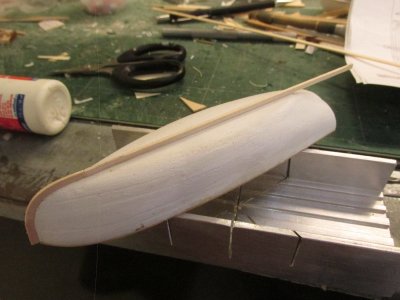
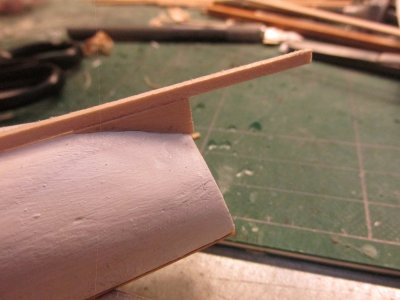
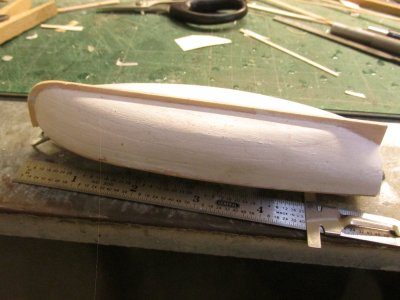
Before I move onto the rail and the rowlocks, I wanted to add the stem and keel to the outside of the boat. The rail needs to attach to stem. The stem was made in two pieces: the rounded bow and the straight upright portion of the stem. Trying to edge bend the 1/8” x 1/16” stock was near impossible. Once the stem assembly was fabricated and installed, the keel was added with lots of overhang. The keel widens as it follows the shape of the up to the transom. I made a card template to get the shape, and transferred it to some stock wood. The piece was then fitted and glued into place. All of these pieces, including the knees described above were glued with PVC glue to aid in adjusting the parts. The stem and keel were then painted (not shown).