



• SUBSCRIBE TO SHIPS IN SCALE TODAY!

    The beloved Ships in Scale Magazine is back and charting a new course for 2026!
    Discover new skills, new techniques, and new inspirations in every issue.

    NOTE THAT OUR NEXT ISSUE WILL BE MARCH/APRIL 2026
  • Win a Free Custom Engraved Brass Coin!!!
    As a way to introduce our brass coins to the community, we will raffle off a free coin during the month of August. Follow link ABOVE for instructions for entering.

USS Constitution - Model Shipway’s 5/32” = 1 ft. (1:76.8) Kit No.: MS2040

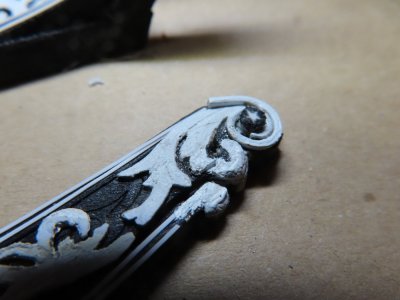
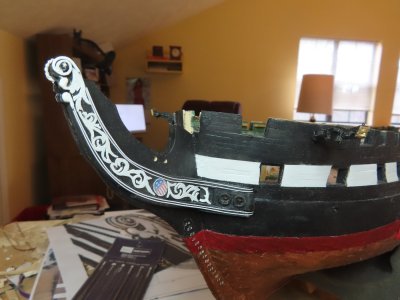
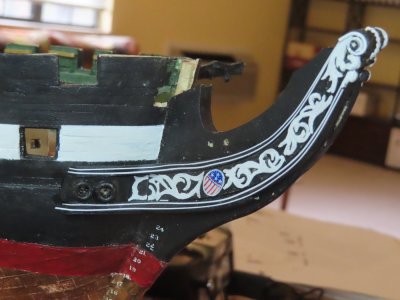
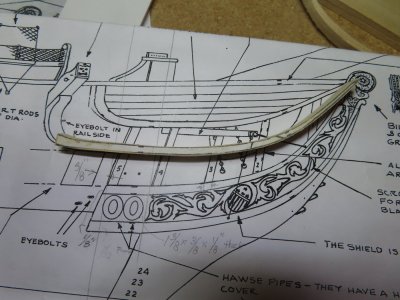
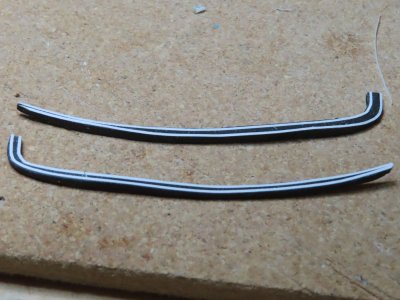
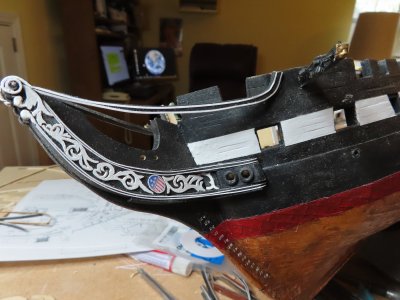
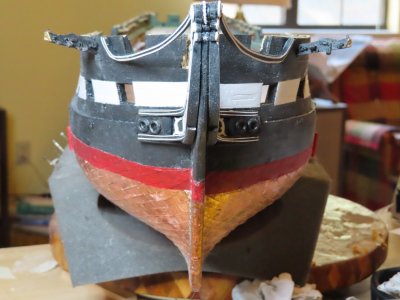
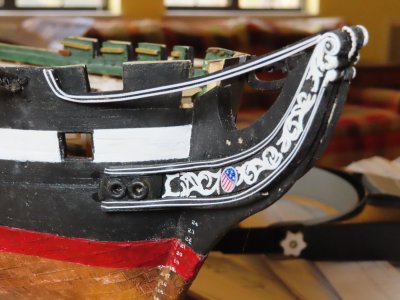
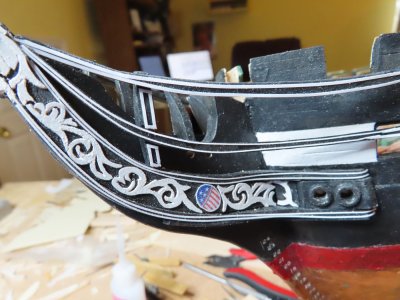
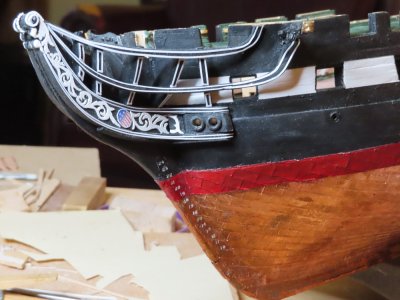
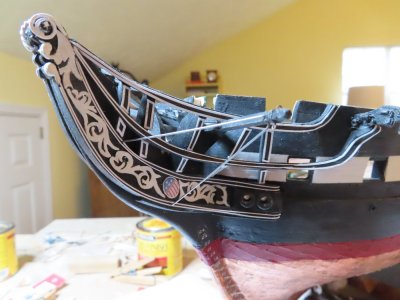
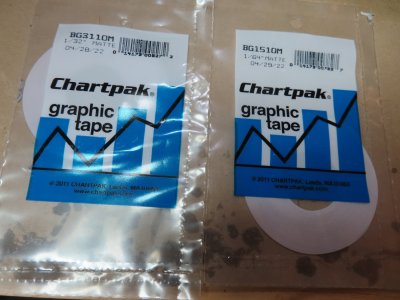
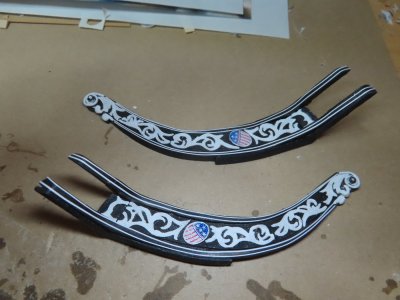
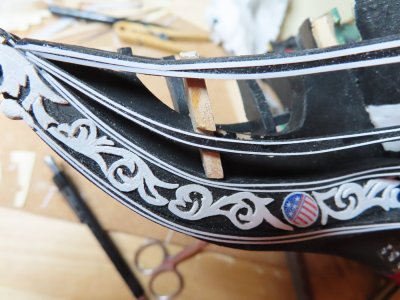
Based on kmart’s (another MSW builder’s build log) idea (post 146), of the white architectural pinstriping tape, it is a lot easier to use than trying to work with very fragile narrow wood strip which must bend to the contour of the rails. 1/64” and 1/32” tape was purchased for the pinstriping of the bow. Only the 1/64” tape was used to pinstripe the trailboard. Additional white paint was used on the scroll work at the tip of the fiddlehead. Lucky, you can’t see all the imperfections that you do see in the magnified images.
IMG_2241.JPG

IMG_2242.JPG

IMG_2243.JPG
 
Finally, the trailboards where glued into place. Then the hawsers were painted black and glued into position. Using my normal cordless drill with an 1/8” bit, the two openings in each hawser were drill out into the interior of the model so that the future anchor chain and rope can pass through.

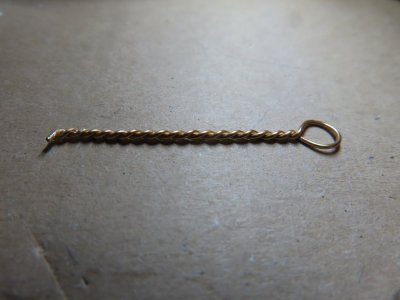
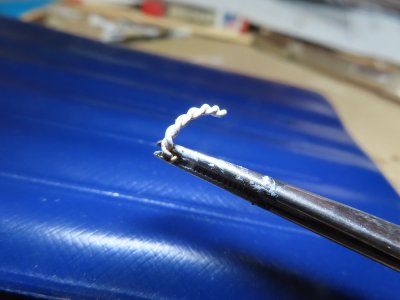
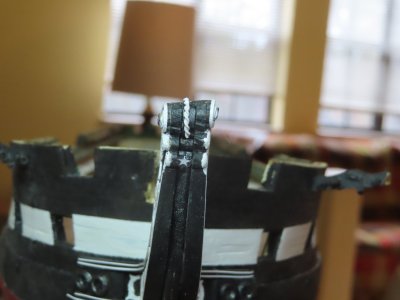
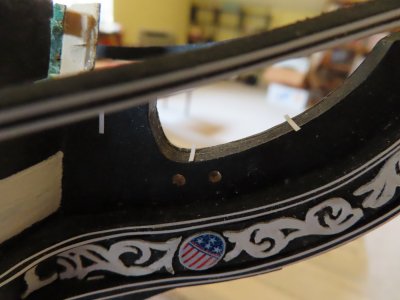
The final touches were the white star and the braid on the front of the fiddlehead. The braid was made by twisting two strands of brass wire tightly and then cutting the resulting piece to length. Two holes were drilled into the fiddlehead for each end of the braid to be inserted. Before the insertion, the braid was paint white. I should note that the thickness of my fiddlehead turned out to be thicker than the US Navy plans call for. Had I been aware much earlier on, the stem would have been tapered. But it is what it is.

IMG_2244.JPG

IMG_2245.JPG

IMG_2246.JPG

IMG_2248.JPG

IMG_2247.JPG
 
The Cheek Knees and Rails

Following the practicum again, I proceeded to the next rail, the one up from the trailboard or as the MS plans identify it, 3rd from the top. The practicum claims it’s “probably the most difficult of the rails to construct. The reason is that the rails twists and turn in three dimensions, have no straight lines, tapers from one end to the other, and must connect to seven different points on the model precisely.

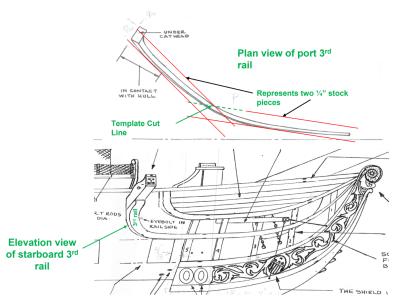
The practicum’s method is to make the 3rd rail out of two main components as shown below, plus a third component, the cathead support called the cheek knee, that fits under the cathead sticking out 90 degrees with the cathead from the hull. This is because the rails’ complex shape would require very thick pieces of wood if the rails were to be carved as single units. The image below shows the MS plan’s elevation and plan views.

Bow 3rd Rail.png
 
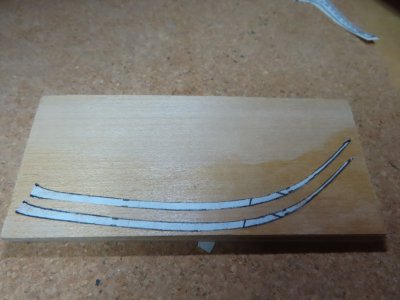
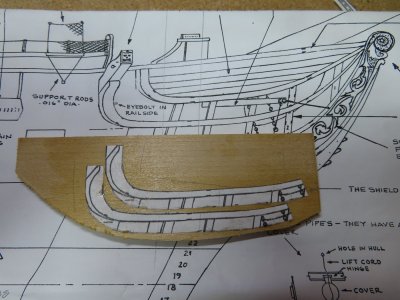
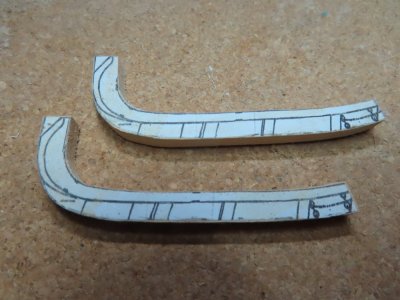
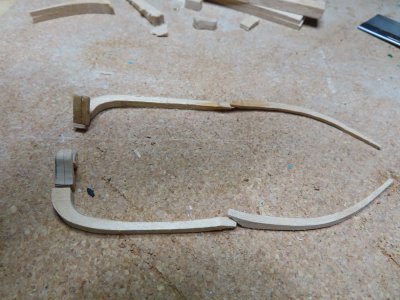
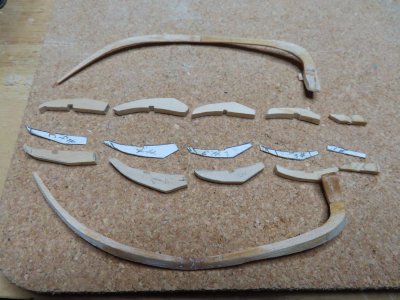
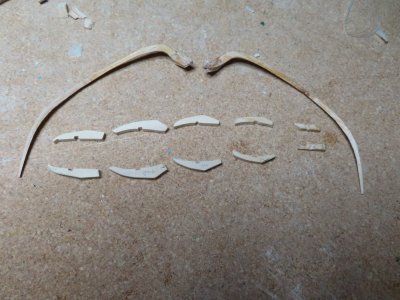
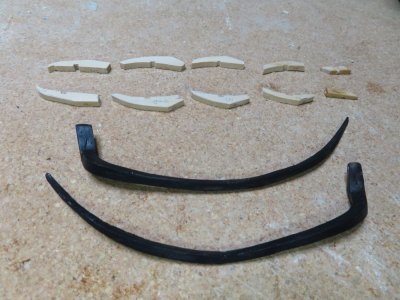
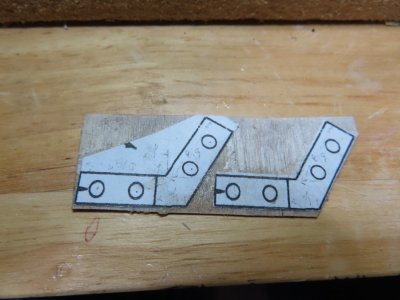
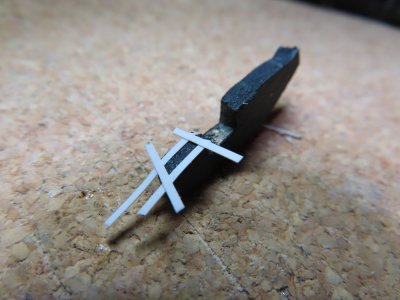
The practicum calls for ¼” stock or 1/8” layered stock if you didn’t have the ¼” stock. Not having any ¼” stock at my immediate disposal, I glued and clamped two pieces of 1/8” stock, enough to make the two rails. Then as directed by the practicum, rubber cemented the images of the port and starboard rails from their fiddlehead tip to just where it turns upward to meet the cathead for the first rail component. The second component starts from under the cathead to where it overlaps the first to create a diagonal joint. I had to reapply the paper elevation and plan templates to the pieces that came from under the cathead so I could cut the wood in both the X and Y planes. Those parts curve in two directions.
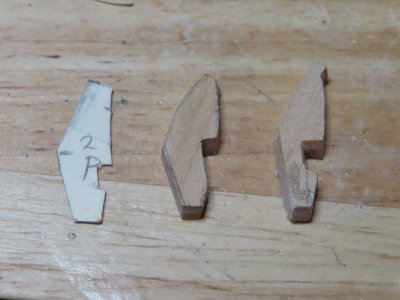
These are fragile pieces when they are cut out of the stock which made filing and sanding them to form their required shape, a delicate task.
IMG_2249.JPG

IMG_2250.JPG

IMG_2251.JPG

IMG_2252.JPG

IMG_2253.JPG

IMG_2260.JPG
 
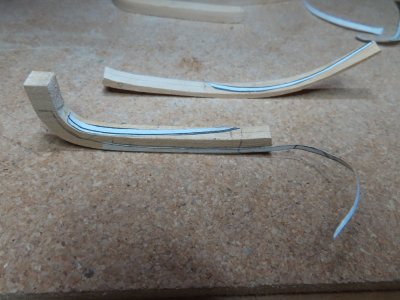
To complete the fabrication of the rails, the two components that made up each of the rails, were glued together. This had to be done on the faith that I fabricated the pieces perfectly so when they were attached together perfectly, they created the rails to perfectly fit on a perfectly formed hull. With my skills, I knew I hadn’t a chance of pulling this off on the first try. I made it sound straight forward, but it was not. I made numerous attempts and tried different methods to reconcile the process.

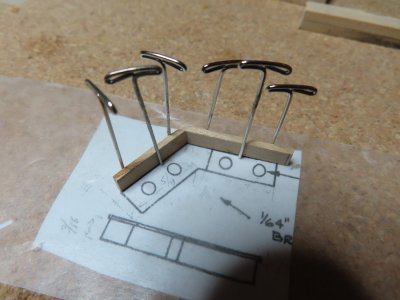
To help me figure out where the rails had to fit, I cut out the five vertical rail supports out of 1/8” stock for each side of the bow. This presented its own set of problems. Although the rail supports were shown to be notched to accept the rails on the plans, I needed to know where the rails would touch the supports on the actual model. I couldn’t ensure that the rails were formed properly to fit into the supports until the supports were notched. And I couldn’t notch the supports until I knew where the rails would finally be in their proper position. What also hindered this process was, I couldn’t do dry fit ups because none of the parts were glued in place for the remaining parts to be dry fitted to. The rails hung out in space and needed to be connected to cantilevered support notches.

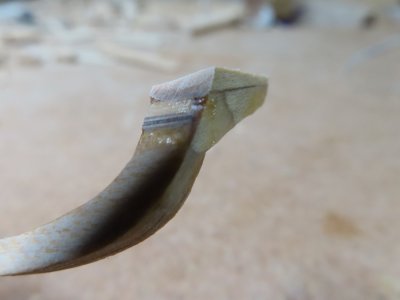
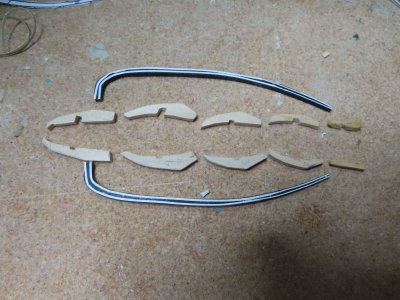
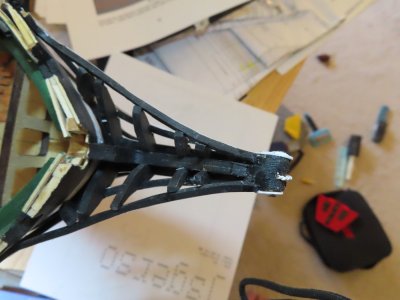
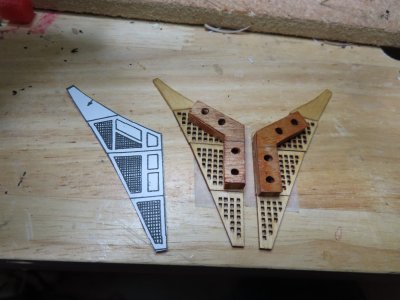
When I attempted to at least hold the rails in position with my fingers, I found that the compound angles of the cathead cheek knee were not correct (surprise, surprise). To reconcile the compound angles, additional wood had to be added, and original wood removed with sanding sticks and files in strategic areas on the cathead knee, to make the rails fit where they were supposed to go. I was sculpting the wood supports liked they were made of clay. I could get away with this method because everything is to be painted black and no one will be able to see the multitude of pieces that make up the cathead knee. You can see where wood was added and carved off in the second image below.

IMG_2261.JPG

IMG_2262.JPG

IMG_2263.JPG
 
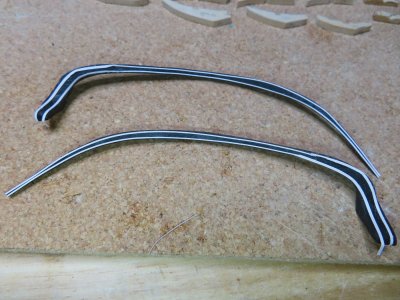
By trial and error, piece by piece I fitted and refitted the parts with some semblance of hope they would all fit together the way the plans showed them. Finally, when I felt it was a good as I was going to get, the rails were painted black and the pin striping was added. This time I used the 1/64” pin striping tape at the narrow portion of the rails and the 1/32” tape where it widened.

IMG_2264.JPG

IMG_2265.JPG
 
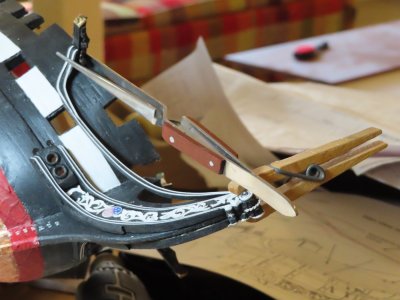
The next logical step seemed to be installing “3rd rail from the top. First, I used PVA glue to fasten the starboard side rail just to the underside of the cathead only. I left the stem tip end unglued to allow me some wiggle room when adding the rail supports. I anticipated that the rail supports had to be at least fitted with the rail installation. Therefore, the rail supports (port and starboard) were fabricated based on MS plan detail 4A at the same time as the 3rd rail.

IMG_2266.JPG
 
The practicum stated:

The second rail from the top is made from 1/8" stock. This rail is fairly simple and straight forward. It is not curved from side to side. So, the only template we need is one of the profile of the rail, which we can take directly from the profile drawing.

Great, easy straight forward pieces to make…or so I thought. So, I proceeded and made the 2nd rails as instructed, complete with paint and pin stripes,

IMG_2268.JPG
 
However, using the 2nd rails to dry-fit the rail supports, I soon found out that the rail supports did not fit properly between the rail and the stem. Then, reading section 8.1.4 in the practicum about installing the “2nd rail from the top” I discovered that Mr. Hunt also ran into this problem. He believed through his investigation that the MS plans were in error for the shape of the rail supports. I then checked the US Navy plans and there were only very slight differences that I could discern, so both Mr. Hunt and I don’t know where or what error(s) occurred. His solution was to fabricate and install the 2nd rail first, then custom fabricate and fit the rail supports then, work backwards to install the 3rd rails last. Because I only glued the 3rd rail to the starboard side at just one point, it was relatively easy to pry the rail off to continue following the practicum’s solution.

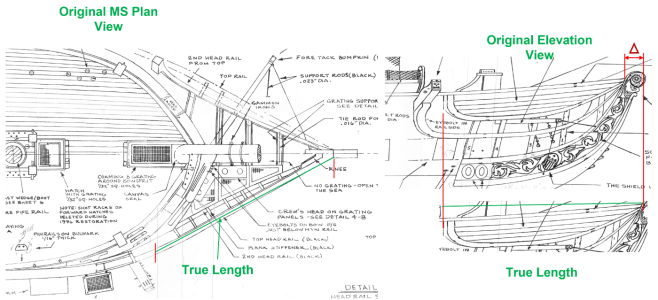
Going back over the practicum instructions, I noticed the practicum’s instruction for fabricating and installing the 2nd rails weren’t correct. The first error was to use the MS plan profile (elevation) view of the rail directly from the MS plan. Unfortunately, this is a foreshortened view because the rails are angled from the hull inwards towards the tip of the bow stem as indicated in the plan view. (I had this same foreshortening problem when I constructed the transom) To get the true view, that is the true length of the rails, I scanned the elevation view of the rail into my computer, using PowerPoint, rotated the image to match the angle of the rail in the plan view, then stretched the image till it matched the length shown in the plan view. Only then could I print the image with the proper rail length and make a template.

2nd Rail From Top - True View.png
 
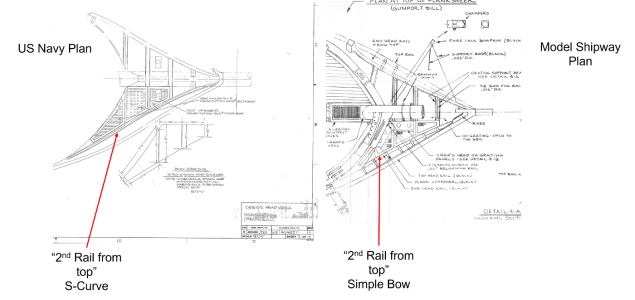
The next thing the practicum stated about the rail was, “It is not curved from side to side.” Wrong again. According to the MS plan, the second rail has a slight horizontal bow inward towards the stem, a much simpler curve than that of the 3rd rail. But I didn’t realize that until I re-read xKen’s another MSW builder’s build log (starting at post #294) of how he made his rails where he accounted for the inward bow. To double check, I looked again at the US Navy plan and saw that the bow was actually a slight S-curve. To be fair, the MS plan didn’t show the full length of the 2nd rail so you couldn’t see that it swung back slightly to form the S-curve. Unfortunately, I had already made the pair of 2nd rails. I reluctantly abandoned my first attempt and started over again this time using 1/8” layered stock (1/4” total thickness) to account for the S-curve.

2nd Rail From Top - Plan View.png
 
BTY, I’m not knocking Mr. Hunt’s practicum. I could not have gotten this far if it weren’t for it. But I have learned that he’s human and he's the first to admit that his way may not be the best which is why in addition to using his practicum as a guide (not my bible), I also check how other builders solve these problems.

My second fabrication attempt at the 2nd rails went relatively smoothly; and they were glued into placed. In the first image below, I attempted to show the slight curve in the rails.

IMG_2269.JPG

IMG_2270.JPG

IMG_2271.JPG

IMG_2272.JPG

IMG_2273.JPG

IMG_2274.JPG
 
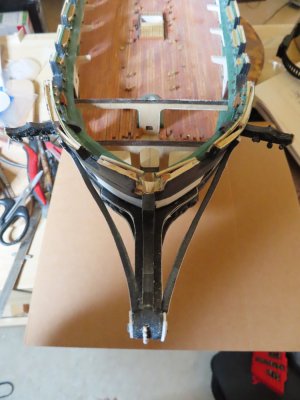
Now it’s time to install the rail supports. These are positioned such that the joints of the floor grating in the seats of ease area, rest on the horizontal structural beams attached to the rail supports. In other words. Where the gratings meet, that is where the rail support is supposed to be. Using the grating parts supplied in the MS kit, I taped the three pieces together that make up most of the flooring, to mark off where the joints are with the architect tape on the stem.

IMG_2275.JPG

IMG_2276.JPG
 
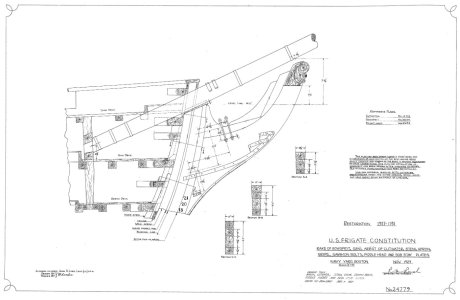
This is when I discover a new problem. According to the MS plans, the precut gammoning holes in the stem are supposed to be between supports Nos. 2 and 3. Per the marks I just made with the gratings, the gammoning holes straddle rail support No. 3. The gammoning holes are where the gammoning chains pass through. Looking at the US Navy 1927 -31 Restoration plan No. 24779, the gammoning holes have been replaced with eye bolts embedded into the stem. The gammoning chains are then connected to the eye bolts. The chains are fastened to the bowsprit in the same manner as shown in the MS plans. These stem bolts are positioned half the distances apart as the pre-cut holes are and appear to be straddling rail support No. 3 from the numerous photos that I’ve looked at. Based on all the ambiguities, just about nobody will even know about or bother to look inside the rails supports to see if there is even any gammoning there, let alone whether it is correct or not. Therefore, I am going to use the existing gammoning holes as they exist on my model in lieu of the embedded bolts shown on the US Navy plans, just because as builder of the model, I like the way they look.

IMG_2277.JPG

24779001.jpg
 
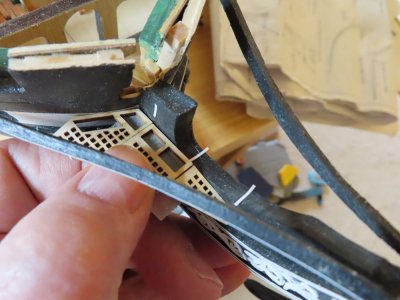
As I mentioned in an earlier posting, the MS plan drawings of the rail supports do not fit properly on my model. Whether I’m at fault or the plans are, is immaterial. These must be custom made now., By trial-and-error measuring using card stock, a first try template was drawn and cut out of the cardstock. Once I got the card stock to fit, it was traced onto 1/8” thick stock wood. Once I got the wooden piece to fit, I realized that it had to be refined a bit more. A second wood rail support was fabricated. This was able to fit properly onto the rails. The support was removed, painted and pin striped. Finally, it was installed. This was repeated the same manner (with or without extra preliminary wood supports as needed) for the remaining nine supports.

IMG_2281.JPG

IMG_2282.JPG

IMG_2283.JPG

IMG_2284.JPG

IMG_2285.JPG

IMG_2286.JPG
 
Bow Boomkins

I was about to install the grating and fabricate the seats of ease in the bow when I realized that the pair of bow boomkins needed to be fabricated and installed first because they were physically below the grating. Surprisingly, the practicum did not address these components.

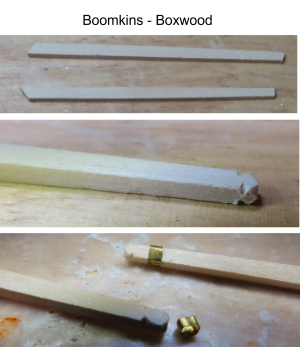
Initially, utilizing the kit’s 1/8” x 1/8” stock basswood, the boomkin were fabricated by tapering the pieces of wood to 3/32” x 3/32” at one end. Then, with a square cross-section needle file, the triangular indents on the tapered ends were formed. Using 0.005” brass metal sheet, two strips of the metal were cut to size, wrapped around the boomkins to form the brass bands, and then blackened.

Boomkin - Boxwood.png
 
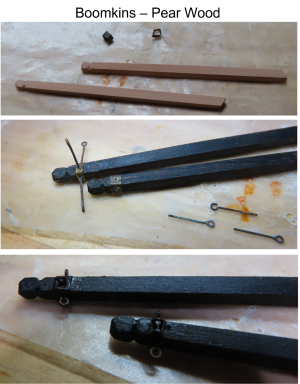
Looking at my efforts, I realized I needed to do this all over again but with a harder wood because the square edges of the boomkins were already beginning to wear down during the fabrication process. Using 1/8” x 1/8” stock pear wood that I had left over from when I constructed my Rattlesnake, the results were much better. They were then painted black. The brass bands held three eyebolts. Two eyebolts, one on the aft side and the other on the bottom of the boomkin, were aligned lengthwise following the line of the boomkin. The third eyebolt located on the top of the boomkin was installed perpendicular to the boomkin as was shown in the various photographs of the actual ship. To do this, a pin was used to make the initial dent in the brass for the #77 drill bit. The holes were drilled through the brass into the wood. After each hole was drilled, a full-size eyebolt was inserted so the brass band would not move while the next hole was being drilled. Then the eyebolts were removed, cut to size, and permanently installed with CA glue. This secured the brass bands as well.

Boomkin – PearWood.png
 
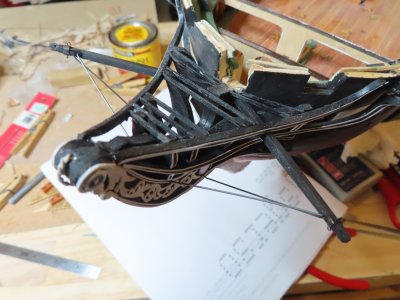
I assume the boomkins on the actual ship had some sort of fasteners to hold the beams in place to the hull, but I could not find any information on that. Therefore, they were just glued into place. The boomkins did have two metal rod hull braces each. The kit called for 0.023” wire for these braces. I needed something stiff, so brass and copper wire were not suitable, but I did have “0.020” and 0.026” music wire. I chose to use 0.026” wire in lieu of 0.023”, which I did not have. Holes were drilled into the hull and boomkins in the appropriate places following the kit plan with a #72 drill bit. After a little trial and error, the wire was sized for length and the wire ends bent for the appropriate holes.

IMG_2302.JPG

IMG_2303.JPG
 
Grating and Seats of Ease

The kit plans called for pairs of 1/32” x 1/16” rail support beams on either side of the rail supports. Accordioning to the plans both the kit and the US Navy, these cross beams are flush with the top of the rail supports. They support the gratings upon which the seat of ease rest. However, either I or Mr. Hunt misinterpreted the plans because at the end of Chapter 8.1 he states: “I chose not to model these as it's nearly impossible to see them.” See them or not, they are important as I interpret the plans. As result, his construct of the gratings and seats of ease, are lower than the cross beams had he installed them, while mine are resting top of cross beams. Be that as it may, here is what I did.

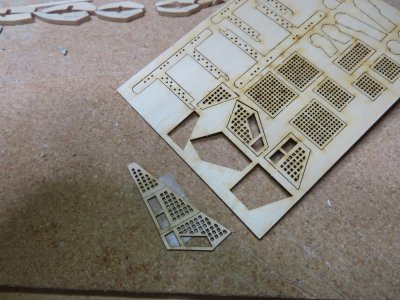
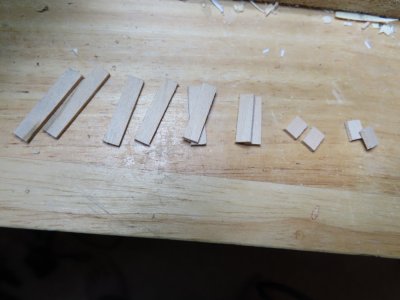
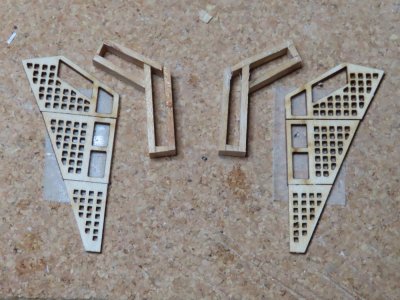
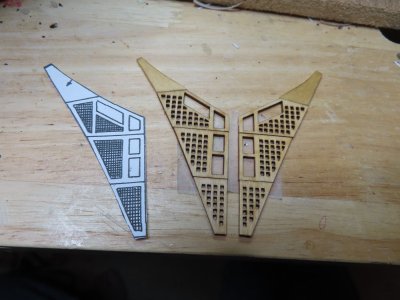
Following the practicum, I cut the seat of ease side pieces from 1/16” basswood stock and assembled them using the kit’s plan as my template. The kit actually called for 1/64” thick pieces to be used, but since their thickness would not be seen by the viewer, the thicker pieces were more stable and easier to handle. The kit provided three laser-cut pieces of the grating for each side, which I temporarily taped together for dry fit purposes.

IMG_2287.JPG

IMG_2288.JPG

IMG_2289.JPG
 
The top pieces with the seat holes had to be 1/64” thick because the seat openings exposed the thickness of the material. I chose to use 1/64” plywood for the top “L” shape pieces, for the required width of stock and its strength. The seat holes were drilled out before the parts were cut from the stock sheet to prevent breakage. A line was drawn both on the top and on one side of each of the components to represent a separation line that the actual ship has. It appears that the real seats were made in two sections each. Finally, solid wood triangular pieces were fabricated to complete the flooring. The final image shows the dry fit.

Just as a note, Mr. Hunt brought up the point that the grid pattern showing the openings beneath the seats contradicts the pattern used to construct the seats. Specifically, the grid opening shape against the hull, is a parallelogram whose end forms an acute angle to the hull. The seat end, on the other hand, is at right angles to the hull. Mr. Hunt chose to make his seats follow the grid pattern. I chose the right angle based on a US plan (showing six seats per side) as well as some modern photos. BTW, finding any images of the bow showing the seats of ease area, are exceedingly rare because the public is not allowed in that area. No public, no pictures.

IMG_2290.JPG

IMG_2291.JPG

IMG_2292.JPG

IMG_2293.JPG

IMG_2294.JPG
 
Back
Top