



.
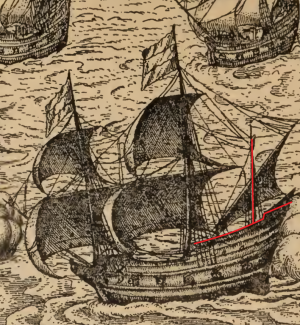
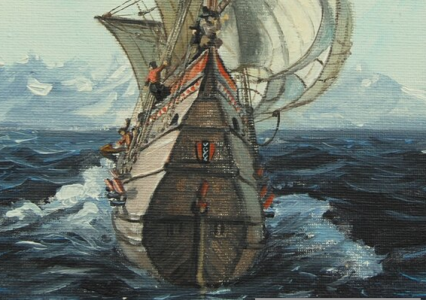
Encouraged by @Heinrich , who also provided me with interesting and essential source material — in particular, relevant contracts for the construction of vlieboots from the last decade of the 16th century, transcribed by Werner Ulrich — I decided to undertake a conceptual reconstruction of the vlieboot “De Zwane”, part of the fleet of the famous explorer Willem Barents. Significantly, the ship chosen for Barents’s difficult mission was regarded at the time as the best seafarer in the region, and the choice of such a vessel is hardly surprising, given the completely unknown waters and winds through which it was to sail. Heinrich chose not to impose anything regarding the reconstruction itself, despite my invitation to actively participate in this exercise; nevertheless, he suggested including this introduction from a work by Menno Leenstra, discussing the history of the vessel and its crew members, as well as the inventories relating to its preparations for Barents’ polar mission:Well-known Dutch historian and expert translator of 17th century Dutch manuscripts and transcripts, Menno Leenstra, argues that the “Vlieboot” Zwaan which was used in both Dutch expeditions to the Polar Regions in 1594 and 1595 is, in all likelihood, the best example of what Willem Barentsz’s ship could have looked like during the 1596 expedition. This is courtesy of the fact that considerably more is known about this ship than what has been published to date.
The expedition to Waygats in 1594 was originally organized by the merchant Balthasar de Mucheron, who had moved from Antwerp to Zeeland. After he sought support for this expedition from the States of Holland and Zeeland, the organization and leadership were taken out of his hands by the States General, largely against his will. The States General, in turn, commissioned the outfitting of the ships from the admiralties. As a result, a lot of information about the ship De Zwaan, which was on the account of this admiralty, can be found in the preserved accounts of the Admiralty of Zeeland. Since payments for costs made in the "preparatory phase" were also made by this admiralty and Mucheron submitted a detailed account for this, some details about it can also be retrieved from this administration.
* * *
The conceptual reconstruction of the vlieboot ‘De Zwane’ will be based in particular on a contract for the construction of a vessel of this type dating from 1592, which contains most of the key numerical data and which, amongst a number of other surviving shipbuilding contracts from those years, is considered to relate specifically to the vlieboot ‘De Zwane’.
It should be noted here that previous ship reconstructions, based on these early Dutch contracts from the turn of the 16th and 17th centuries, have not been entirely successful, as they have encountered a difficulty in interpreting the numerical data relating to the hull height that has so far proved insurmountable. The point is that the values given in these early contracts were interpreted in a manner now accepted for later decades, so to speak within a structural rather than a conceptual paradigm, which did not allow even generally correct hull proportions to be obtained; in particular, the ships would have had far too little draught in relation to the height of the superstructure (they should be more or less equal), nor would it be possible to add the ‘mandatory’ weather deck above the main deck (whether in the form of a light grating deck or a slightly more robust koebrug), even at the cost of bringing the gun ports right down to the waterline!
On this specific point, a solution is therefore proposed that is closely based on the recently identified Dutch design methods within the broader Northern tradition (illustrated, for example, by the design of the frigate Wageningen 1723, https://shipsofscale.com/sosforums/threads/dutch-frigate-»wageningen«-1723-—-a-couple-of-decades-ahead-of-chapman….18387/), which resolves the previously insurmountable problems mentioned above. Indeed, the proposed solution coherently reconciles all the fundamental requirements for this case (and others):
— a depth of the submerged section no less than that of the unsubmerged section of the hull in the midship region, which is one of the most important factors influencing the weatherliness or its lack of a seagoing vessel,
— sufficient height of the hull’s above-water section for a double-deck configuration,
— the correct position of the hull’s maximum breadth in relation to the waterline from the point of view of the ship’s transverse stability, a circumstance known to shipwrights of the time (here a fairly typical distance of 2 feet above the waterline),
— sufficient distance of the gun ports from the waterline (here 4 feet, suitable for smaller and medium sized vessels of essentially non-military purpose).
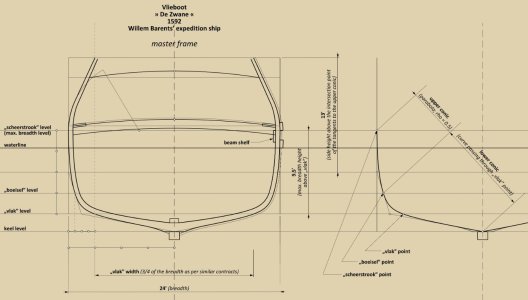
Furthermore, the proposed interpretation has a direct impact on the shape of the master frame itself, in a sense facilitating the identification of its realistic contours, as intended by the vessel’s designer (note: nevertheless, some elements defining this contour, such as the position of the ‘boeisel’ point or the extent of the tumblehome, still had to be inferred; similarly, the width and height of the ‘vlak’ were proportionally derived from other contracts of that decade for vessels of the same type).
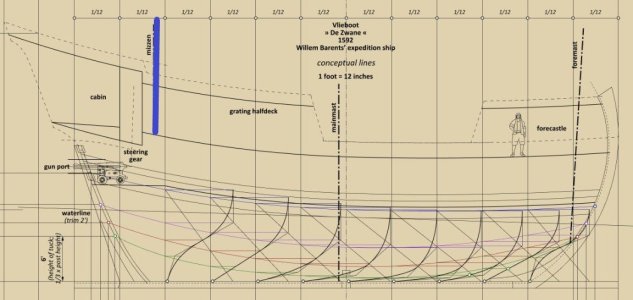
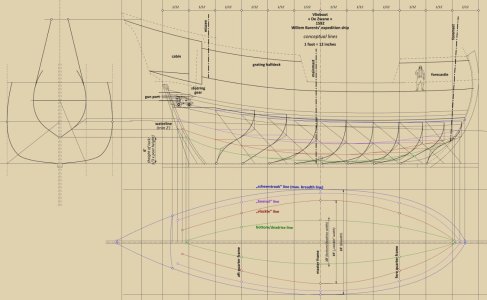
Strictly speaking, this is only the beginning of the work, but I think that the initial results can already be presented. Hopefully, the diagram below is clear enough in itself and requires no further explanation; nevertheless, it should be clarified that the proposed interpretation of the following provisions in the contract is as follows:
„… diepe derthyen voeten” (depth 13 feet) as — the side height above the intersection point of the tangents to the upper conic,
„… de bantwegers […] gelecht aen weder syden aen boort, op negen ende een halve voeten...” (beam shelf fixed on both sides at a height of 9.5 feet) as — max. breadth height above „vlak” level 9.5 feet.
Waldemar Gurgul
.
Last edited:


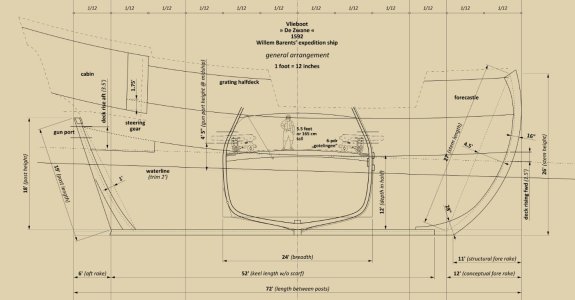

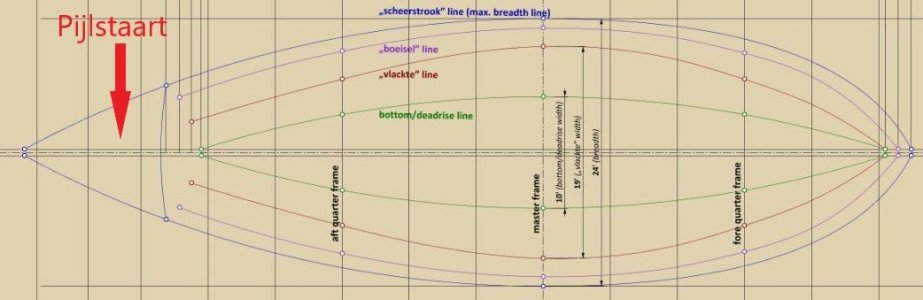
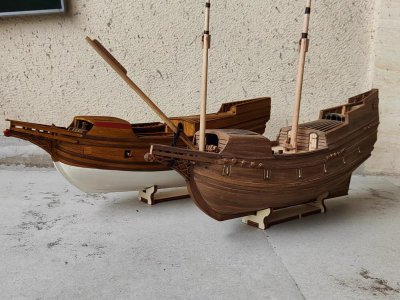
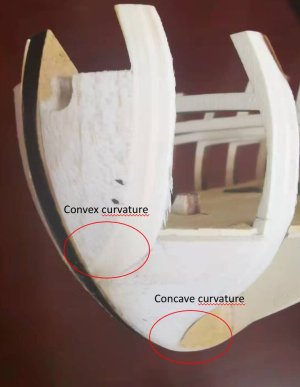
 ), and I’ve just finished shaping the underwater section of the hull. As can be seen in the attached graphic, I chose the shape of design lines in such a way as to achieve almost the maximum possible sharpness of both the entry and run, which seems essential for such a proportionally short hull (only 3:1!), so that the vessel isn’t horrendously sluggish and leewardly, and which distinguishes it in this regard as well from previous reconstruction attempts and replicas of the vessel.

![pinasschip of jacht van 70 x 19 x 9 voet - 1630 - A.0149 [nr 0021].jpg](https://shipsofscale.com/sosforums/data/attachments/590/590510-a4ab29afe5699cfacfecb234dff44265.jpg?hash=dlCPaTxn2p "pinasschip of jacht van 70 x 19 x 9 voet - 1630 - A.0149 [nr 0021].jpg")
![pinasschip van 90 x 24 voet - 1650 - A.0149 [nr 0016].jpg](https://shipsofscale.com/sosforums/data/attachments/590/590511-0f1645c105d948b3bdbdfc40885f98ab.jpg?hash=cIc073rnxw "pinasschip van 90 x 24 voet - 1650 - A.0149 [nr 0016].jpg")






 Why This Matters to Modelers