
-

SUBSCRIBE TO SHIPS IN SCALE TODAY!
The beloved Ships in Scale Magazine is back and charting a new course for 2026!
Discover new skills, new techniques, and new inspirations in every issue.
NOTE THAT OUR NEXT ISSUE WILL BE July/August 2026 -

Win a Free Custom Engraved Brass Coin!!!
As a way to introduce our brass coins to the community, we will raffle off a free coin during the month of August. Follow link ABOVE for instructions for entering.


You are using an out of date browser. It may not display this or other websites correctly.
You should upgrade or use an alternative browser.
You should upgrade or use an alternative browser.
Vlieboot »De Zwane« 1592 — Barents discovers the Arctic
- Thread starter -Waldemar-
- Start date
- Watchers 11



.
I’m sorry, Bela, but I’ve recently fallen victim to a surprising act of manipulation. It’s true that I later received an apology, but only in private, which of course doesn’t resolve the matter fairly given the harm caused in public, and is in fact a continuation of the manipulation. You must understand that my trust and willingness to engage, especially with anonymous users of unknown intentions, have once again been severely curtailed as a result. The late, kind Don was absolutely right when he advised me to simply ignore provocations and potential provocations by leaving them unanswered.
You must also understand that providing additional substantive explanations at someone’s individual request, in return for not even a polite ‘thank you’, is not a particularly appealing prospect for me, and perhaps for anyone else for that matter.
.
.
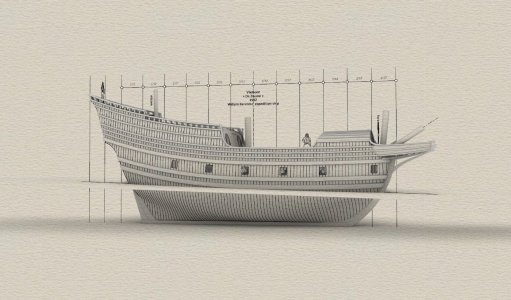
BeakheadAs the contracts make no mention whatsoever of the beakhead, the reconstruction of its appearance and structure must necessarily be based on illustrations of ships from the expedition itself, as well as a wealth of other iconography from that period which does not directly relate to Barentsz’s ships. In order to maintain the greatest possible consistency with all the depictions in de Veer’s account, I have essentially opted for a so-called ‘closed bow’ and a beakhead deck height at the level of the sheer line (gunwale) level, which in turn also allows for the bowsprit to be secured by breasthooks, as in the previously shown model of the Danish ship from 1634.
As for the figurehead decoration itself, I have taken the liberty of interpreting the simplified illustrations from de Veer’s account somewhat more freely, whilst remaining consistent with trends evident in other contemporary engravings dating from just a few years later.
In this way, I am slowly approaching the end of the conceptual reconstruction phase in the stricter sense. Admittedly, the contracts still contain quite a lot of other data; however, this relates to the scantlings and number of structural elements which are either irrelevant to the conceptual reconstruction and can be easily and directly replicated during the actual model construction without the need for much interpretation, or, for the most part, will not be needed at all for building the model using the planned POB technique (for example keelson, beam shelves, deck beams, frame components etc.).
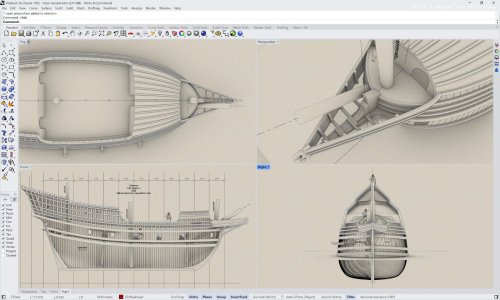
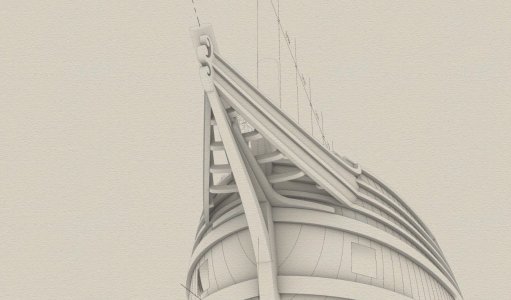
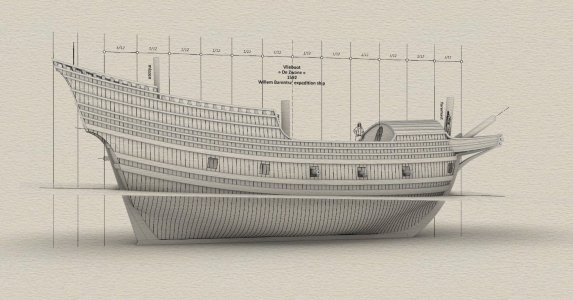
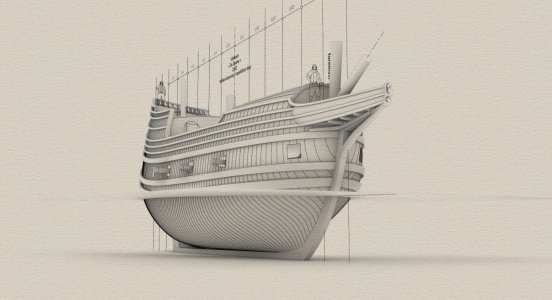
.
Last edited:

- Joined
- Jan 9, 2020
- Messages
- 10,741
- Points
- 938

Dear Waldemar. You have done an admirable job on the beakhead - a very challenging part of the design. With only the available iconography to draw on and your obvious experience and expertise, your rendering is entirely convincing. Looking at the overall profile picture of the ship, my attention was not drawn to the beakhead - indeed my focus fell on the utterly compelling and perfectly proportioned lines of the ship. Whilst that may sound as a strange thing to say (we are after all, discussing the beakhead), to me it is a very good sign. The design of the beakhead blends in so well with the rest of the ship that it does not draw any attention on its own.
I was really tempted to build this ship as a POF model, but at some point, sanity must prevail. Once the frames-and lines plans have been completed, I must give those to someone who can do the laser cutting of the false keel, actual keel, stem, stern, rudder, frames, decks etc. for me on a once-off basis. This will not be a cheap exercise as there will be no economy of scale to talk of - unless, of course, I can convince a manufacturer to produce a kit of De Zwane. With all of these limitations in mind, I do believe a POB build will be the more viable of the two options.
I was really tempted to build this ship as a POF model, but at some point, sanity must prevail. Once the frames-and lines plans have been completed, I must give those to someone who can do the laser cutting of the false keel, actual keel, stem, stern, rudder, frames, decks etc. for me on a once-off basis. This will not be a cheap exercise as there will be no economy of scale to talk of - unless, of course, I can convince a manufacturer to produce a kit of De Zwane. With all of these limitations in mind, I do believe a POB build will be the more viable of the two options.
.
Many thanks, Heinrich, for your positive assessment and favourable reception.Indeed, it is immensely satisfying to do something much better than academic researchers can: As far as Dutch shipbuilding is concerned, it can be repeated that, until now, historical design methods have not been identified. What is more, in the academic world it was even widely believed, following the lead of a few researchers, that principles of naval architecture, properly understood, had no application whatsoever.
It is only my latest research and findings that shed entirely new light on this completely neglected field, which may be rightly regarded as the most important in the shipbuilding process (one need only look at and compare the fees charged by individuals involved: designers, carpenters, loftsmen, riggers, etc.). As a result, even the very creators and notorious proponents of today’s misguided doctrine of ‘eyeball’ shipbuilding seem to be finally changing their views, though in the process of reversing their stance they naturally point to their own decisive contributions to this particular achievement (which in fact do not exist, and in reality the opposite is true), whilst I am left to contend with the hostility of the most die-hard admirers of these well-known researchers. What a perverse life…

* * *
This will not be a cheap exercise as there will be no economy of scale to talk of - unless, of course, I can convince a manufacturer to produce a kit of De Zwane.
Essentially, the conceptual reconstruction of De Zwane was carried out for your and my personal benefit and satisfaction. The idea of turning it into a commercial venture seems also a very attractive, except that it represents a complete paradigm shift in the process, requiring a different approach — in particular, establishing the scope of responsibility, terms of cooperation, technical issues, and so on.
The best course of action would be direct contact with a potential manufacturer willing to produce a model kit of the ship based on my reconstruction. On the other hand, I have presented the essence of the design method used to recreate the shape of De Zwane in such detail that attentive readers should be able to repeat the process themselves without too much difficulty. Provided, of course, that enough time and inclination are available…
.
- Joined
- Jun 29, 2024
- Messages
- 2,169
- Points
- 488

Nice job! I find these Sixteenth Century vessels to be interesting. Unfortunately advancing age convinces me to stick to shorter term projects.
A question? Is the replica that you show on the previous page that of the Red Bay Galleon?
Roger
Answered my own question. Didn’t realize that she had been launched.
A question? Is the replica that you show on the previous page that of the Red Bay Galleon?
Roger
Answered my own question. Didn’t realize that she had been launched.
Last edited:
.
A question? Is the replica that you show on the previous page that of the Red Bay Galleon?
Thanks, Roger. That’s right, it shows a very recent and ambitious life-size replica of the Basque whaling ship San Juan from around 1560, which is quite close in time to ‘our’ De Zwane. I’ll also take this opportunity to say that I had the San Juan (particularly its similar characteristics) in mind during this specific investigation. I had previously analysed the San Juan in greater detail, but the (nearly completed) thread was lost in the recent MSW forum crash and I still need to reconstruct it (fortunately, I have a backup).
Apart from that, your use of the term ‘galleon’, also in reference to De Zwane, may even be quite apt: personally, I am not entirely sure that the term ‘vlieboot’ is relevant to Barents’ ships. But fortunately, it is just a name, which does not really change the essence of the matter.
.
- Joined
- Jan 9, 2020
- Messages
- 10,741
- Points
- 938
And I believe this is exactly what will happen - it will remain a highly exclusive build with the aim of redefining that oh-so-elusive concept of "historical accuracy". And quite frankly, this is the route that I would ultimately prefer. My reference to a kit manufacturer was more tongue-in-cheek than anything else.Essentially, the conceptual reconstruction of De Zwane was carried out for your and my personal benefit and satisfaction.
The first time that I encountered hostility from this "well-known researcher", was precisely the moment when I realised that I was on the right track. In any case, that is all behind us now and the next challenge at hand will be to bring this wonderful rendition of yours to fruition by creating a tangible construction. At this very moment, I have no idea of how, when and where that will happen, other than to say that it will happen. I also aim to bring to light one of the most influential figures in Dutch history - both on national and maritime levels - who, until now, has been shrouded in obscurity. I suppose the theorem of the prophet not being recognised in his own time, holds true on many fronts!whilst I am left to contend with the hostility of the most die-hard admirers of these well-known researchers. What a perverse life…
- Joined
- Jun 29, 2024
- Messages
- 2,169
- Points
- 488
The archeological reports use the term Galleon. Maybe just to attach a familiar name in order to raise public awareness. I don’t claim enough expertise in these old vessels to question. I’ll leave that to you guys!
Roger
Roger
- Joined
- Jan 9, 2020
- Messages
- 10,741
- Points
- 938
Roger it is great to see you here! The naming of Dutch ships was a very arbitrary matter at best. Some sources have tried to define "vlieboot, jacht and pinas", but in reality, these nomenclatures meant little to historians who seemed to name them whatever they pleased. De Zwane was called a "Boot, Boodt, Vlieboot and Jacht" in official transcripts.The archeological reports use the term Galleon. Maybe just to attach a familiar name in order to raise public awareness. I don’t claim enough expertise in these old vessels to question. I’ll leave that to you guys!
Roger
During the 1595 expedition, De Zwane's sailing partner was De Griffioen, which was named as a war pinnace when it was - in all likelihood - a galleon.

.
Broadly speaking, it can probably be said that for the Mediterranean world — and, by extension, for the English as well, given its deep roots in the former — the term ‘galleon’ is entirely appropriate. However, at the time, this term did not catch on at all in the Germanic languages of northern Europe (it has only done so in modern times). Instead, in a structural or design context, apart from the examples given by Heinrich, the term ‘spiegelship’ or similar — meaning basically ‘square-tuck ship’ — was used for more or less equivalent cases.
.
Waist-treesAmong the elements visible on the outside of the ship, contracts for the construction of vlieboots from those years also stipulated the fitting of so-called waist-trees (“a dolboom made of solid oak beams 4 inches thick and 5 inches wide”).
These longitudinal beams were intended to support a light, protective structure covering the midship section, consisting of transverse beams (ledges), chains, wooden gratings, rope nettings and sails. If this was a temporary structure, intended, for instance, solely for the duration of battle, it was known as a ‘loos boevenet’ (see, in this regard, the Resolution of the Admiralty of Holland of 20 November 1593 or J. Elias, De vlootbouw in Nederland 1596—1655, 1933, pp. 5–6).
Besides, Englishman Henry Mainwaring also describes a similar structure in considerable detail in his early 17th-century manuscript, The Seaman’s Dictionary, and it is considered worthwhile to quote the relevant passages in full in order to give the better idea of the entire structure:
Nettings are those small ropes which are seized together with rope yarns in the form of a net with meshes, and are for the most part only used in the waist (yet I have seen Flemings have nettings over all, from the top of the forecastle over the poop) ; and are stretched upon the ledges, which are placed from the waist-trees to the roof-trees. In merchantmen it is chiefly used having a sail laid over it, for to shadow their men, and for a close fight; but I think they are in an error, for it is most dangerous for firing, of small defence if men enter, being quickly cut down, and being once torn down (as it may easily with small grapnells it doth cloy all the waist. In a man-of-war it is good to have them for the pleasure and succour of the company [in foul weather or in extreme sunshine], but not to use them in fight.
Roof-trees are those timbers which are made of light wood (as of masts sawn) that go from the half deck to the forecastle, and are to bear up the gratings and the ledges whereon the nettings lie. These are supported under with stanchions which rest upon the deck. Also if they have occasion to use any such piece over the half deck for nettings or sails, it is called a roof-tree.
The Ledges are those small pieces of timber which come thwartships from the waist-trees to the roof-trees to bear up the nettings; and so if there be a grating over the half deck [they are called the same].
Netting-sails are the sails which they lay upon the nettings.
The Gunwale. That piece of timber which reacheth on either side of the ship from the half deck to the forecastle, being the uppermost bend as it were, which finisheth the upper works of the hull there, and wherein they put the stanchions which support the waist-trees, is called the gunwale whether there be any guns there or not. Also the lower part of any port where an ordnance doth lie, is called the gunwale.
* * *
Nevertheless, for this period, it may be seen as something of a relic of the past, which ‘everyone’ had heard of but which practically no one had seen, as this detail is virtually absent from the iconography of the time, including that found in de Veer’s account. Almost...
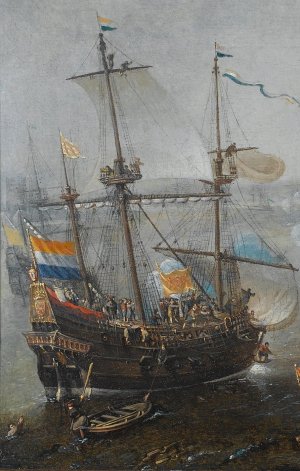
Returning to the Dutch context, one of the very few depictions of waist-trees, complete with a protective ‘deck’ above the midship section, is the structure rendered on one of the ships in a painting by Cornelis Claesz. van Wieringen from around 1620, i.e. three decades later. Incidentally, given that this structure could even support a group of combatants, it can be said that this little one was successfully transformed into a functional three-deck ship
:
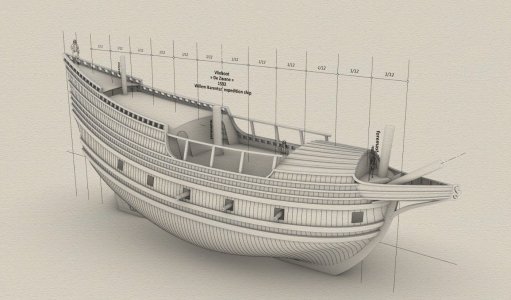
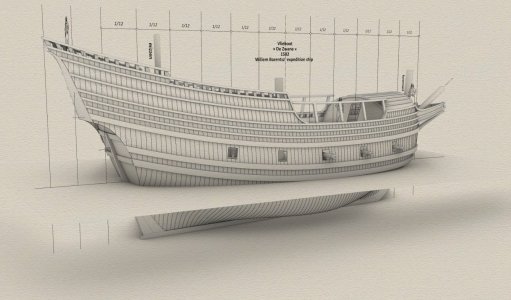
The attached reconstruction renderings show only the waist-trees (‘dolboom’) in their most likely position, and their stanchions, without any of the other elements that make up the ‘loos boevenet’. In previous reconstructions, this detail has been either omitted altogether or, in a single instance, interpreted in a completely implausible, fanciful manner.
.
Last edited:
- Joined
- Jan 9, 2020
- Messages
- 10,741
- Points
- 938
Oh boy ... I did not see this one coming! 
Dear friends, what you are looking at is history in the true sense of the word - no proverbial language, no exaggeration - simply, pure fact! Never before has the actual construction of a grating (bovenet, boevennet, bouchnet) been modeled.
In fact, I call this the X-Factor of the vlieboot!
Confused, let me explain. The vlieboot played a major role in the uprising of the Dutch against Alexander Farnese - the representative of the Spanish King in the Low Countries - during the 80-Years War. The vlieboot was largely campaigned by the Watergeuzen (aka the Sea Beggars) or Dutch rebels. These small and unlikely vessels with their few guns fought several heavy sea battles against the Spanish throne and were very successful in negating the blockade that the Spanish had imposed upon Antwerp.
It is important to note that these were not artillery fights with batteries of cannons like in later days. The guns did cause some havoc to the enemy while approaching each other, but the real fight was on deck, where the enemies fought each other bare-handedly with swords and pikes. This explains why the deck we see on the vlieboot was completely covered by a grating all over - anyone trying to get on board against the will of the captain and his crew would face a violent attack from below their feet.
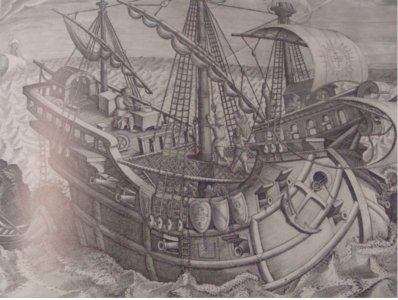
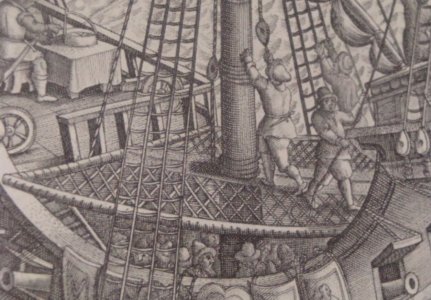
In the build contract though, the bovennet (grating) is described as:
"Voorts achter salmen maecken een Cajute, 2 voeten neertrappende, ofte daer ontrent, beneden den overloop, ende dat in forma ghelyck voorts de Boot van Cap. Cornelis Leynsz. ghetimmert is, achter met een vast bouchnet (at the rear/back a fixed bovennet)...
This is why @Waldemar says:
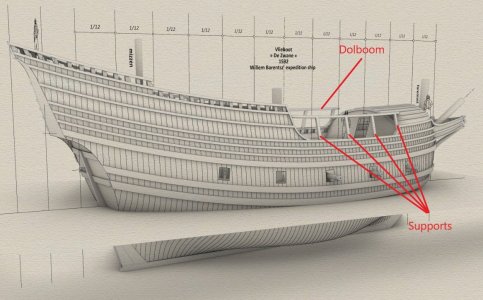
Of course, there is one question that remains and it all comes down to interpretation. Did the word "achter" (at the rear or at the back) refer to a bovennet as depicted in Gerrit de Veer's drawings (see below):
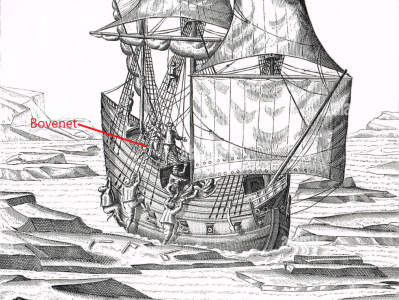
or to the rendering that Waldemar has shown us? Or to BOTH?
Dear friends, what you are looking at is history in the true sense of the word - no proverbial language, no exaggeration - simply, pure fact! Never before has the actual construction of a grating (bovenet, boevennet, bouchnet) been modeled.
In fact, I call this the X-Factor of the vlieboot!
Confused, let me explain. The vlieboot played a major role in the uprising of the Dutch against Alexander Farnese - the representative of the Spanish King in the Low Countries - during the 80-Years War. The vlieboot was largely campaigned by the Watergeuzen (aka the Sea Beggars) or Dutch rebels. These small and unlikely vessels with their few guns fought several heavy sea battles against the Spanish throne and were very successful in negating the blockade that the Spanish had imposed upon Antwerp.
It is important to note that these were not artillery fights with batteries of cannons like in later days. The guns did cause some havoc to the enemy while approaching each other, but the real fight was on deck, where the enemies fought each other bare-handedly with swords and pikes. This explains why the deck we see on the vlieboot was completely covered by a grating all over - anyone trying to get on board against the will of the captain and his crew would face a violent attack from below their feet.
Absolutely correct. It was also called a "vinkennet" or "finch's nest" as depicted in the two illustrations below:If this was a temporary structure, intended, for instance, solely for the duration of battle, it was known as a ‘loos boevenet’
In the build contract though, the bovennet (grating) is described as:
"Voorts achter salmen maecken een Cajute, 2 voeten neertrappende, ofte daer ontrent, beneden den overloop, ende dat in forma ghelyck voorts de Boot van Cap. Cornelis Leynsz. ghetimmert is, achter met een vast bouchnet (at the rear/back a fixed bovennet)...
This is why @Waldemar says:
The build contract specifies: "Next, on the upper side of the sheer plank, add a good and suitable oak beam (dolboom), 4 inches deep, 5 inches thick, to set in as many supports as the owner sees fit. This is exactly what Waldemar has depicted in his rendering.the fitting of so-called waist-trees (“a dolboom made of solid oak beams 4 inches thick and 5 inches wide”).
Of course, there is one question that remains and it all comes down to interpretation. Did the word "achter" (at the rear or at the back) refer to a bovennet as depicted in Gerrit de Veer's drawings (see below):
or to the rendering that Waldemar has shown us? Or to BOTH?
.
Many thanks, Heinrich, for your explanations, and for sharing this particularly fitting here reproduction of a ship portrait by
. Anyway, contrary to my original plans, I may decide to go a little further and present my interpretation of this structure in more detail and in a visual format.For now, at least, I’ll explain, in descriptive terms, that I interpret ‘vast bouchnet achter’ as a half-deck of a permanent grating construction, whilst ‘dolboom’ refers to horizontal supports for the ‘loos bouchnet’ (temporary netting or grating) amidships between the forecastle and the half-deck.
I think I’ve fallen into my own trap here
, as I originally intended merely to mention this element, given that it isn’t actually shown in any of the illustrations from the expedition anyway..
Last edited:
- Joined
- Jun 29, 2024
- Messages
- 2,169
- Points
- 488
I have read that the Sea Beggers also played a role in the eventual destruction of the Spanish Armada. When the Armada reached Gravelines on the English Channel they found that the Spanish Army that they were supposed to transport for the invasion had not arrived.
Venturing further along the shore of the Netherlands to try to make contact was not considered practical as the Dutch, especially the Sea Beggers controlled these waters. The strategy of a Fleet in Being.
Roger
Venturing further along the shore of the Netherlands to try to make contact was not considered practical as the Dutch, especially the Sea Beggers controlled these waters. The strategy of a Fleet in Being.
Roger
- Joined
- Jan 9, 2020
- Messages
- 10,741
- Points
- 938
I concur, Sir! It's amazing but when you have developed the "feel" for this little ship, what is sometimes not said in the build contract, is equally important to what is written - I am glad we are on the same wavelength!I interpret ‘vast bouchnet achter’ as a half-deck of a permanent grating construction, whilst ‘dolboom’ refers to horizontal supports for the ‘loos bouchnet’ (temporary netting or grating) amidships between the forecastle and the half-deck.
You will HAVE to! Now you have me hooked!I may decide to go a little further and present my interpretation of this structure in more detail and in a visual format.
- Joined
- Jan 9, 2020
- Messages
- 10,741
- Points
- 938
You are absolutely correct, Roger.I have read that the Sea Beggers also played a role in the eventual destruction of the Spanish Armada. When the Armada reached Gravelines on the English Channel they found that the Spanish Army that they were supposed to transport for the invasion had not arrived.
Venturing further along the shore of the Netherlands to try to make contact was not considered practical as the Dutch, especially the Sea Beggers controlled these waters. The strategy of a Fleet in Being.
Roger

.
‘Textbook’ proportions of De Zwane
Before continuing, it is worth returning to the question of De Zwane general proportions, and to this end once again refer to English-language sources. Ian Friel, in his 2009 lecture ‘Elizabethan Merchant Ships and Shipbuilding’, writes, amongst other things:
„The only general information on the relative proportions of Elizabethan ships comes from a paper written in 1592 by the Comptroller of the Navy, William Borough. The width or beam of the vessel at the midships section was the key dimension in ship design. The keel length and depth in hold (depth from a line taken across the widest point of the ship to the bottom of the keel) were expressed in relation to the beam. The shape of the midships section played a critical role in determining the shape of the ship.
The handful of surviving merchant ship dimensions from the period show proportions that lie mostly within Borough's first and second categories. It would appear that he was describing the real situation, rather than merely offering desirable objectives.”
* * *
What, then, were the general proportions of ships during that period, as recorded by Borough in 1592 — that is, precisely in the most likely year of De Zwane’s construction? Namely:
| 1. The shortest, broadest, and deepest order. This order is used in some merchant ships for most profit. | To have the length by the keel double the breadth amidships and the depth in hold half that breadth. |
| 2. The mean and best proportion for shipping for merchandise, likewise very serviceable for all purposes. | Length of keel two or two and a quarter that of beam. Depth of hold eleven-twentyfourths that of beam. |
| 3. The largest order for galleons or ships for the wars made for the most advantage of sailing. | Length of keel three times the beam. Depth of hold two-fifths of beam. |
Or the same in numerical format:
| Type | Keel : Beam | Depth in Hold |
| Merchant („most profit”) | 2 : 1 | 1/2 beam |
| Merchant („mean and best proportion”) | 2–2¼ : 1 | 11/24 beam |
| Warship / galleon | 3 : 1 | 2/5 beam |
As a reminder, the dimensions and proportions of De Zwane, as recorded in the earliest contracts for the construction of vlieboots dating from 1592 and the following few years, are as follows:
— Breadth: 24 feet
— Keel (touch; measured on the rabbet line): 2¼ x breadth = 54 feet (this very figure is given in the earliest contracts alongside the figure of 52 feet; the latter appears to refer to the ‘incomplete’, structural length of the keel without the scarf)
— Length between posts: 3 × breadth = 72 feet
— Depth (from the top of the keel to the deck): 10 feet, or:
— Depth (from the bottom of the keel to the deck): 11/24 × breadth = 11 feet
Indeed, it would be hard to find a closer match to the proportions given by Borough in 1592, specifically for merchantmen of ‘mean and best proportion’, highlighted in bold in the tables above.
It follows, then, that whilst historians may previously have had doubts about the reliability of the English official’s account regarding the extremely short (proportional) length of the commonly used vessels, they should no longer harbour such doubts in light of the indisputable data from Dutch contracts for the construction of vlieboots.
Perhaps even more significant, however, is the observation that the proportions generally referred to as ‘as–dos–tres’ (1 : 2 : 3), defining the basic proportions of ships, which have hitherto been widely associated almost exclusively with classical Iberian shipbuilding of that period, are in fact universal in nature, with a much wider scope of application, extending to the broadly defined north of the continent as well.
* * *
Incidentally, in this reconstruction of a ship of Dutch provenance, this is yet another instance of drawing parallels with data from non-Dutch sources. A completely opposite strategy — namely, the deliberate and consistent rejection of anything non-Dutch — was adopted by those responsible for the full-scale reconstruction of the early 17th-century Dutch ship Duyfken, regarded as the first European vessel to sail in Australian waters. Ironically, Dutch sources were also deemed ‘unhelpful’ by the Duyfken’s reconstructors, and as a result, a highly arbitrary vessel was ultimately created, with specifications and a general configuration that do not correspond to any sources, whether Dutch or non-Dutch
.Now, sadly, such modern, “museum” replicas are subsequently used by today’s experts as a model to be emulated, including model-makers of unrivalled practical experience or commercial manufacturers of model kits.
.
- Joined
- Jan 9, 2020
- Messages
- 10,741
- Points
- 938
This is uncanny accuracy, Waldemar. And the fact that a ship of Dutch origin corresponds this closely to the description in Borough's Paper, is almost beyond belief. And yet, there are those who claim that there were no actual sets of specifications according to which these ships were built and that everything was "eyeballed" by the shipwright. To me this is indicative of the sheer lazy and unprofessional manner in which "historical research" was conducted by these so-called authorities on Dutch shipbuilding of this era.As a reminder, the dimensions and proportions of De Zwane, as recorded in the earliest contracts for the construction of vlieboots dating from 1592 and the following few years, are as follows:
— Breadth: 24 feet
— Keel (touch; measured on the rabbet line): 2¼ x breadth = 54 feet (this very figure is given in the earliest contracts alongside the figure of 52 feet; the latter appears to refer to the ‘incomplete’, structural length of the keel without the scarf)
— Length between posts: 3 × breadth = 72 feet
— Depth (from the top of the keel to the deck): 10 feet, or:
— Depth (from the bottom of the keel to the deck): 11/24 × breadth = 11 feet
I suppose this is the easiest way out - if you can't find any build contracts or are too inept at interpreting them correctly, rather say they don't exist and that everything was built by eye - that way you skirt all possible responsibility.
Don't even get me started on this subject. Karl-Heinz Marquardt has destroyed any credence that the Duyfken replica might have had, while the less that is said about the Barentsz replica in Harlingen, the better.Now, sadly, such modern, “museum” replicas are subsequently used by today’s experts as a model to be emulated, including model-makers of unrivalled practical experience or commercial manufacturers of model kits.
.
while the less that is said about the Barentsz replica in Harlingen, the better.
Perhaps no one managed to warn them in time that Barents’ ships, after all, did not complete the entire voyage using their on-board diesel engines. I was at least fortunate enough to be kindly warned that “current-day US feet and inches” do not apply to 16th-century Netherlands.
What’s more, not so long ago I was subjected to rigorous competency tests, invented by scholars in the field, of the sort: ‘How is it possible that the long deck beams for the lower decks were inserted into the hull through the narrower sides of the upperworks?’, and similar issues. I shall be eternally grateful for all of this.
.