• Win a Free Custom Engraved Brass Coin!!!
    As a way to introduce our brass coins to the community, we will raffle off a free coin during the month of August. Follow link ABOVE for instructions for entering.
  • SUBSCRIBE TO SHIPS IN SCALE TODAY!

    The beloved Ships in Scale Magazine is back and charting a new course for 2026!
    Discover new skills, new techniques, and new inspirations in every issue.

    NOTE THAT OUR NEXT ISSUE WILL BE MARCH/APRIL 2026

What do you use as a sealer for rigging thread?

Joined
Nov 4, 2025
Messages
40
Points
58

Hey all,
Once I get a section of rigging done, I like to put some sort of sealer to keep the fibers of the various thicknesses of thread from fraying and to seal the knots. As an experiment, I used CA, but all it did was soak into the fibers, crystalized and weakened the thread and it just snapped/broke. I was thinking about using a water-based all purpose sealer. Saw "Masters Touch" at my Hobby Lobby. Fairly expensive at $7.49 for an 8-ounce bottle. Would that be safe? What do you guys use? Thanks!
 
Yep, and this seems like the same as the sealer I described. Thinned out white glue. Kind of like Mod Podge.
Thanks!
 
I am not a fan of PVA diluted in water for cementing rigging lines, or for anything else, for that matter. PVA takes quite a while to dry and when diluted with water, it takes even longer to dry. It's messy to work with, as well. The results receive mixed reviews. The post above isn't the first instance I've heard of it making thread brittle and weak. From an archival standpoint, PVA is perhaps the least "reversable" of all the "reversable" adhesives commonly seen in ship modeling and, as any restorationist or conservator will tell you, "reversibility" is of paramount importance in a adhesive because it makes it possible to disassemble things for repair and restoration without breaking them. This is doubly so for ship modelers because reversible adhesives make disassembly to correct errors a relatively simple matter. While it is claimed that isopropyl alcohol will reverse PVA by softening it, in my experience, it's not particularly easy to do, especially if the PVA has fully cured.

For some time, I used thinned clear nail polish, which was cheap, dried fast, its solvent being acetone, and it worked well for "whipping" thread ends to prevent fraying and fasten knots to prevent untying. It was reversable by applying liberal amounts of acetone to dissolve it, which is occasionally necessary when one makes an error belaying to the wrong pin or adjustments to rigging tension is necessary. It does have the drawback of drying to a high gloss if applied too thickly.

Similar to nail polish, or Duco nitrocellulose cement, for that matter, is "homebrew" polystyrene cement which can be made by dissolving "styrofoam" packing material (blocks or "peanuts") in acetone until a desired consistency is achieved. This can be stored indefinitely in a closed container.

I later came to use nothing but clear Zinsser "Bull's Eye" brand shellac right out of the can (3-pound cut), which is a staple in my paint locker for sealing all wooden parts, hardening card stock, and so on. If applied in a single coat, it will be absorbed and become virtually invisible when dry. Multiple coats will build, with a high gloss, though. Shellac is thinned with alcohol (not isopropyl rubbing alcohol, just regular alcohol from the paint store, but not the alcohol sold for stove fuel and dyed blue, for obvious reasons. I buy it by the gallon, which is a lot cheaper than pint cans. Like shellac, It's a stock item in my shop.

A touch of a knot with an alcohol charged brush will soak right into the knot and dry very quickly. (Blow on it and it will dry even faster.) It is much easier to reverse with an application of alcohol than will nail polish with acetone, and will less noxious fumes, if you are concerned about such things. (Note that shellac and alcohol are non-toxic. Both are produced in "food grades" for human consumption. Shellac dissolved in alcohol is used to put the shiny surface on jellybeans and fancy fruits, for example.) One nice property of shellac on rigging line is that when it is placed on a line and is partially dried, but before it is fully hard, the line can be formed by hand to create catenaries, form coils to desired shape, and even "stick" lines to a deck or whatever. I use shellac to form reefing lines and stick them to sails to obtain a realistic position. As anybody who has ever done them knows, it's impossible to get the reef lines to hang naturally against the sail without gluing them somehow. This technique is also very handy for rigging cannon tackles and such. Shellac which is thickened when the alcohol is partially evaporated is also an excellent adhesive.

At present, while I haven't used it as yet, I anticipate trying a relatively new adhesive material which has achieved widespread acceptance and endorsement from the professional conservators and restorationist in the art and science fields because it is stronger and harder than polyvinyl acetate without being extremely brittle and is easily reversible with acetone. This material is called Paraloid B-72 or just B-72. It is a thermoplastic resin that is sold in the form of clear plastic pellets which are suspended in a cheesecloth bag into a container of acetone and left to dissolve overnight. The material can be mixed to whatever consistency suits the user and, if desired, can be thickened with colloidal silica in a manner similar to thickening epoxy resin. Archaeologists, for example, used thinned B-72 to coat fossils to solidify them and prevent damage from handling and environmental exposure. China and glass restorers use it to put broken glass and pottery pieces back together. It is the main "go-to" for use in cementing clear glass as it is invisible when cured and any excess on the glass surface can be cleaned off with an acetone dampened cloth. B-72 is now being used by major maritime museum and private ship model collection private restorationists as a primary adhesive and sealer, particularly on rigging line. Some claim that it is even possible to reconnect broken rigging lines, avoiding the need to replace broken rigging lines which were part of the original fabric of a model which, especially in the case of very old models, they desire to preserve if at all possible. It is semi-flexible when dry and does not cause line to harden and break as other adhesives tend to do.

B-72 is not particularly expensive and is readily available online. There appear to be some particular techniques for preparing it that should be followed. There are a number of YouTube instructional videos on the preparation and use of B-72. See: https://en.wikipedia.org/wiki/Paraloid_B-72#References Rob Napier in his great book,
Caring for Ship Models: A Narrative of Thought and Application discusses B-72 at some length. https://seawatchbooks.com/products/...tive-of-thought-and-application-by-rob-napier Highly recommended reading for any ship modeler!
 
Last edited:
I am not a fan of PVA diluted in water for cementing rigging lines, or for anything else, for that matter. PVA takes quite a while to dry and when diluted with water, it takes even longer to dry. It's messy to work with, as well. The results receive mixed reviews. The post above isn't the first instance I've heard of it making thread brittle and weak. From an archival standpoint, PVA is perhaps the least "reversable" of all the "reversable" adhesives commonly seen in ship modeling and, as any restorationist or conservator will tell you, "reversibility" is of paramount importance in a adhesive because it makes it possible to disassemble things for repair and restoration without breaking them. This is doubly so for ship modelers because reversible adhesives make disassembly to correct errors a relatively simple matter. While it is claimed that isopropyl alcohol will reverse PVA by softening it, in my experience, it's not particularly easy to do, especially if the PVA has fully cured.

For some time, I used thinned clear nail polish, which was cheap, dried fast, its solvent being acetone, and it worked well for "whipping" thread ends to prevent fraying and fasten knots to prevent untying. It was reversable by applying liberal amounts of acetone to dissolve it, which is occasionally necessary when one makes an error belaying to the wrong pin or adjustments to rigging tension is necessary. It does have the drawback of drying to a high gloss if applied too thickly.

Similar to nail polish, or Duco nitrocellulose cement, for that matter, is "homebrew" polystyrene cement which can be made by dissolving "styrofoam" packing material (blocks or "peanuts") in acetone until a desired consistency is achieved. This can be stored indefinitely in a closed container.

I later came to use nothing but clear Zinsser "Bull's Eye" brand shellac right out of the can (3-pound cut), which is a staple in my paint locker for sealing all wooden parts, hardening card stock, and so on. If applied in a single coat, it will be absorbed and become virtually invisible when dry. Multiple coats will build, with a high gloss, though. Shellac is thinned with alcohol (not isopropyl rubbing alcohol, just regular alcohol from the paint store, but not the alcohol sold for stove fuel and dyed blue, for obvious reasons. I buy it by the gallon, which is a lot cheaper than pint cans. Like shellac, It's a stock item in my shop.

A touch of a knot with an alcohol charged brush will soak right into the knot and dry very quickly. (Blow on it and it will dry even faster.) It is much easier to reverse with an application of alcohol than will nail polish with acetone, and will less noxious fumes, if you are concerned about such things. (Note that shellac and alcohol are non-toxic. Both are produced in "food grades" for human consumption. Shellac dissolved in alcohol is used to put the shiny surface on jellybeans and fancy fruits, for example.) One nice property of shellac on rigging line is that when it is placed on a line and is partially dried, but before it is fully hard, the line can be formed by hand to create catenaries, form coils to desired shape, and even "stick" lines to a deck or whatever. I use shellac to form reefing lines and stick them to sails to obtain a realistic position. As anybody who has ever done them knows, it's impossible to get the reef lines to hang naturally against the sail without gluing them somehow. This technique is also very handy for rigging cannon tackles and such. Shellac which is thickened when the alcohol is partially evaporated is also an excellent adhesive.

At present, while I haven't used it as yet, I anticipate trying a relatively new adhesive material which has achieved widespread acceptance and endorsement from the professional conservators and restorationist in the art and science fields because it is stronger and harder than polyvinyl acetate without being extremely brittle and is easily reversible with acetone. This material is called Paraloid B-72 or just B-72. It is a thermoplastic resin that is sold in the form of clear plastic pellets which are suspended in a cheesecloth bag into a container of acetone and left to dissolve overnight. The material can be mixed to whatever consistency suits the user and, if desired, can be thickened with colloidal silica in a manner similar to thickening epoxy resin. Archaeologists, for example, used thinned B-72 to coat fossils to solidify them and prevent damage from handling and environmental exposure. China and glass restorers use it to put broken glass and pottery pieces back together. It is the main "go-to" for use in cementing clear glass as it is invisible when cured and any excess on the glass surface can be cleaned off with an acetone dampened cloth. B-72 is now being used by major maritime museum and private ship model collection private restorationists as a primary adhesive and sealer, particularly on rigging line. Some claim that it is even possible to reconnect broken rigging lines, avoiding the need to replace broken rigging lines which were part of the original fabric of a model which, especially in the case of very old models, they desire to preserve if at all possible. It is semi-flexible when dry and does not cause line to harden and break as other adhesives tend to do.

B-72 is not particularly expensive and is readily available online. There appear to be some particular techniques for preparing it that should be followed. There are a number of YouTube instructional videos on the preparation and use of B-72. See: https://en.wikipedia.org/wiki/Paraloid_B-72#References Rob Napier in his great book,
Caring for Ship Models: A Narrative of Thought and Application discusses B-72 at some length. https://seawatchbooks.com/products/...tive-of-thought-and-application-by-rob-napier Highly recommended reading for any ship modeler!
I have made up some B-72 and will experiment with using it as a sealer. It is inexpensive and I bought the plastic pellets which you can dissolve in Isopropyl alcohol or acetone. I have tried a 10% solution in acetone. It is a nice sealer and dries quickly. At the 10% concentration I did not find it a great adhesive (certainly not as strong as PVA). I will have to try to use a 20% solution.

I tried mixing in some colloidal silica (Cab-o-sil) to thicken it. You have to be very careful, I used a respirator mask and did it in my ventilated paint hood. The silica is so fine it makes dust look heavy. It does thicken it a bit but takes forever to mix (I still shake the bottle every now and then to mix it more.) I do think it will make a fine sealer. As Bob mentioned it is used extensively by people who preserve fossils.

I have been a bit side lined on other projects but will try using the B-72 in more applications soon.
 
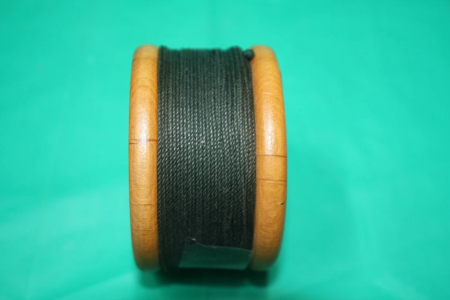
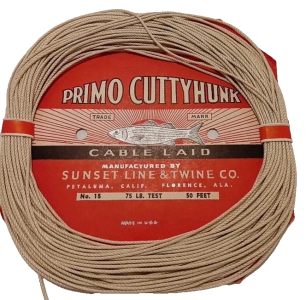
I don’t see the need to seal rigging lines if you use quality material. In my case it’s “hard twisted” Cuttyhunk linen fishing line. Watch EBay for new old stock.

Roger
 
It's too late for this dilemma, but hard twist linen thread which is coated can be purchased....no need to add anything to the lines. Similar in practice as Cuttyhunk.
 
@Bob Cleek informations provided is truly valuable.
for B-72, Is there a ready-made version of this that modelers can use?

Yes, there is, but it is somewhat expensive, compared to mixing your own. Note also that B-72 can be mixed with a variety of other solvents, such as alcohol (up to a point, owing to alcohol's hygroscopic properties which will affect curing times and perhaps clarity of the cured material.) It's apparently only sold pre-mixed in small quantities of thin material, rather than in the broad spectrum of viscosities available to anyone mixing their own. While techniques demonstrated in various YouTube videos do vary from the "manufacturer's recommendations," it seems a lot of users are happy with the results just "eyeballing" proportions of B-72 pellets and solvent(s). The main catch seems to be that it dissolves faster in higher concentrations of solvent to B-72 pellets (e.g., acetone) and much more slowly in lower combinations of B-72 to solvent. Hence, the recommended method of hanging pellets suspended in a cloth bag so that the pellets remain at the top of a container of solvent, keeps them up in the upper column of the solvent as the pellets "melt," and the B-72 "settles" to the bottom of the solvent column. The slow "melting rate" of B-72 makes dissolving it difficult by simply stirring because stirring does not accelerate the dissolving process much. Once the pellets are dissolved, however, stirring thicker material at the bottom of the solvent column can be evenly distributed throughout the mixture. Another important feature for ship modeling adhesive applications is that B-72 diluted in solvent can be thickened by the addition of colloidal ("fumed") silica (tradename: Cabosil,) a common adhesive additive (powdered clear silica) available anywhere epoxy resins are sold, as well as elsewhere.

See: https://www.amazon.com/s?k=paraloid+b-72&adgrpid=1344704442979917&hvadid=84044311487871&hvbmt=be&hvdev=c&hvlocphy=88716&hvnetw=o&hvqmt=e&hvtargid=kwd-84045080304778:loc-190&hydadcr=7696_13467801&mcid=7b90ea7172cd3024a8fc8e729c5bbb5f&msclkid=946119a87b5d180d02927066c2526fbf&tag=mh0b-20&ref=pd_sl_8scyomdkos_e

Here's B-72's Technical Data Sheet ("TDS") from the manufacturer, posted by Lawrence Livermore Labs. (It would seem the nuclear weapons scientists have found a use for this stuff as well!) Below that is the Materials Safety Data Sheet ("MSDS.")


Here's an instruction paper on mixing your own. It's quite simple, but, as the instructions indicate, there is a particular method of dissolving it that is important if proper consistencies are to result.

See: https://resources.culturalheritage....ontent/uploads/sites/8/2021/11/osg025-001.pdf

I can't say that B-72 is the greatest thing since sliced bread, but the more I read the literature, the more I see applications for this stuff for ship modeling. Below is a YouTube video demonstrating how to infuse thin B-72 in a pressure chamber to impregnate wood for turning pen blanks. I know I may sound like a medieval alchemist talking about turning base metals into gold, but it certainly looks like B-72 can be used to turn basswood into boxwood! Because B-72 is a thermoplastic, I'll bet B-72-impregnated wood would also bend well using heat alone. (Cured B-72 softens at about 165 degrees Fahrenheit.)

See also:

Do keep in mind that I've only researched B-72 for ship modeling applications after reading Rob Napier's book on ship model conservation and restoration. (Linked in post above.) I've yet to get my hands on it and play with it, so all of my comments are only a synthesis of available information. None of it is firsthand experience at this point. If anybody else is using it, I hope they post comments on the subject. Perhaps at some point even a separate thread would be of value if there is enough ship modeling experience available to justify that.
 
Last edited:
I have made up some B-72 and will experiment with using it as a sealer. It is inexpensive and I bought the plastic pellets which you can dissolve in Isopropyl alcohol or acetone. I have tried a 10% solution in acetone. It is a nice sealer and dries quickly. At the 10% concentration I did not find it a great adhesive (certainly not as strong as PVA). I will have to try to use a 20% solution.

I tried mixing in some colloidal silica (Cab-o-sil) to thicken it. You have to be very careful, I used a respirator mask and did it in my ventilated paint hood. The silica is so fine it makes dust look heavy. It does thicken it a bit but takes forever to mix (I still shake the bottle every now and then to mix it more.) I do think it will make a fine sealer. As Bob mentioned it is used extensively by people who preserve fossils.

I have been a bit side lined on other projects but will try using the B-72 in more applications soon.
Great information!
Actually, comparisons between B-72 and PVA in the scientific literature indicate that:

"The advantages that (B-72) presents over the polyvinyl acetate resins include strength and hardness without brittleness, and a higher glass transition temperature (B-72 has a Tg of40°C, PVA AYAT 28°C). Because of its higher Tg it has less of a tendency to cold flow. B-72 is not as hard (Tukon hardness 10-11) or as brittle as many of the adhesives previously used on archaeological ceramics (e.g. shellac, animal glue, cellulose nitrate), and it will tolerate stress and strain on a join better than the harder, more rigid and inflexible adhesives. The question of adhesive strength requirements will vary from object to object, and the resulting bond-strength will be affected by a variety of factors. Too often an adhesive is chosen which is too strong for the task at hand and damage to the object results when the join fails and the adhesive pulls away the surface of the object..." [THE USE OF PARALOID B-72 AS AN ADHESIVE: ITS APPLICATION FOR ARCHAEOLOGICAL CERAMICS AND OTHER MATERIALS, Stephen P. Koob, Studies in Conservation 31 (1986) 7-14. See: https://ia800108.us.archive.org/view_archive.php?archive=/24/items/wikipedia-scholarly-sources-corpus/10.1179.zip&file=10.1179%2Fsic.1986.31.1.7.pdf]

[Note: "Glass transition temperature" ("Tg") is the materials science term for the temperature at which a material transitions from a hard brittle state (like "hard glass") to a soft flexible state (like "melted glass.")]

A thin solution of acetone and B-72 can be thickened by simply adding more pellets and letting them dissolve until the desired thickness is reached. Note that only less than 1 percent by weight of colloidal silica may be added to the mixed material before it negatively affects the strength of the bond. Your mishap with the Cabosil in your paint exhaust hood had me chuckling. I've been using the stuff for decades in epoxy resin applications. I can only imagine that "disappearing act" in your exhaust hood! ROTF

 
Have I missed an answer to a key question? What is the material used for the rigging?
Linen - cotton - poly ?
Would not the answer be different between natural fibers and synthetic polymers?

Excellent point! In theory, any rigging material vulnerable to acetone would be threatened and should be subjected to a thorough testing before "soaking" it in any sort of "hot" solvent solution. Natural fibers would not. The negative effects of acetone on polyester fibers vary depending upon the amount, duration of exposure, and environmental temperature. I would expect that the amount of acetone on rigging thread would be sufficiently small that it would evaporate within seconds and could be shortened by blowing on it, such that exposure would not be long enough to inflict significant damage, if any at all. I'd expect that if polyester thread and fabric lacked sufficient resistance to acetone, acetone cans and polyester clothes would carry warning tags to beware of your clothing melting off your body in the event of a splash of acetone! Still and all, as always with unproved materials in modeling, test first to be sure.

That said, ethanol (alcohol) is an alternate solvent for B-72 which works as well as acetone but causes a slower curing rate due to alcohol's slower evaporation rate and the even slower evaporation rate of the amount of water in the is naturally highly hygroscopic alcohol. Alcohol in amounts less than 20% of acetone or other "hot" solvents (now often banned by environmental regulations) is indicated to regulate the curing (evaporation) time for B-72. Alcohol will have no adverse effect on your thread or clothing unless you drink too much of it. :D
 
I used to take paraffin shavings and put them in a jar to dissolve in acetone then added hard twist linen to soak overnight in the capped container. Next day I took the thread out and squeezed out excess moisture in a cotton cloth and hung threads to dry with a weight on the end.
 
I don’t see the need to seal rigging lines if you use quality material. In my case it’s “hard twisted” Cuttyhunk linen fishing line. Watch EBay for new old stock.

Roger

Well, lucky you! Aren't you special, outbidding the crazy fishermen collectors who'll pay ten or fifteen bucks for a cut out old magazine page fishing line advertisement or a buck a yard and up for a spool of old fishing line. I'll bet you drink nothing but top shelf call whiskey, too. ROTFROTF

Bless your heart. There was a time when cuttyhunk fishing line was made and available in multiple sizes in every bait and tackle shop. Like so many products that we just took for granted as always being available until all of a sudden, they weren't. Linen cuttyhunk line is "extinct in the wild" save for a few remnants from long ago that turn up on the collectors' market. While anybody can spin their own "cuttyhunk" three-strand scale line on their own scale rope making machine, linen thread of sufficient sizes and quality of finish isn't readily available anymore, either. Being a Luddite at heart, but unlike wise men like yourself who had the foresight to stock up on linen thread and fishing line before they became high-priced "collectables," I'm envious of your "stash." :D

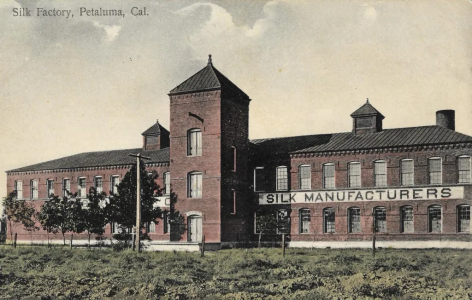
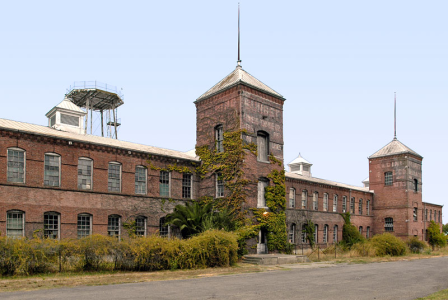
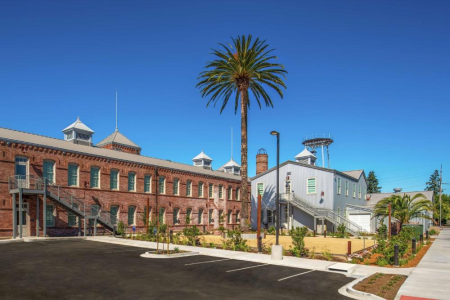
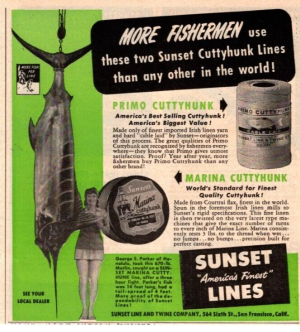
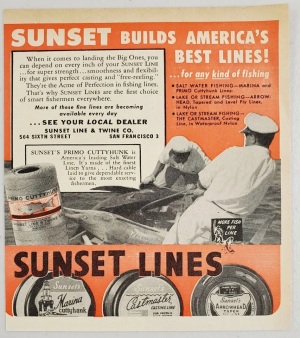
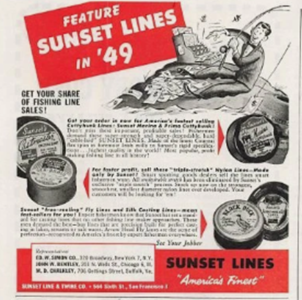
With apologies for a bit of thread drift, I'll drop an historical footnote on cuttyhunk fishing line. Here where I live just outside of Petaluma, California, near the town waterfront which was once a major port for scow schooners and paddlewheel riverboats hauling goods to San Francisco, stands what was once the Petaluma Silk Mill and, after about 1940, the Sunset Line and Twine Company's' factory. Built in 1892 as a silk spinning mill and, I've been told, it's one of the only examples of classic English and New England Victorian textile mill architecture west of the Mississippi River. It was originally built by local women entrepreneurs who created one of the first employment opportunities for local women with the purpose of creating a domestic silk production industry. Unfortunately, the labor-intensive hand unravelling of locally grown silkworm cocoons, while providing plenty of work, could not compete with raw silk imported from China, so the textile mill ended up spinning silk thread and fabric from raw silk imported from China. This continued until the early 1940's when the silk mill ceased production, and the mill was taken over by Sunset Line and Twine Company to handle their expanding production of fishing line and other specialty "line and twine" including eventually, famously, the custom-ordered shrouds for NASA's Apollo space capsules' recovery parachutes. The company was bought out by an outfit back East and manufacturing operations were relocated there in 2007.

The owner/manager of the Sunset Line and Twine Company, probably the largest of the cuttyhunk line manufacturers in the country, was an acquaintance of mine who showed me the place when it was in operation. It was a real antique! I don't think the interior had been painted in a hundred years. There was graffiti on the inside walls that I think dated back to the "silk mill days." The building was full of "wonderful things" for a machinery wonk like me, though. He showed me the amazing machines that turned out braided parachute cord and fly-fishing line and other fascinating belting and cordage. It was quite a tour. Unfortunately, I neglected to "stock up" on linen cuttyhunk in bulk when I had the chance. It just never occurred to me. I didn't see the end of good linen thread coming either. The most I can hope for is that somebody makes some good hemp sewing thread instead one of these days. Hemp is virtually identical to linen and, in fact, actually has longer fibers. They're starting to produce hemp fabric, but from what I hear, hemp clothing on the market is sewn up with synthetic thread.


Three photos of the Petaluma Silk Mill as the Silk Factory, Sunset Line and Twine, and in its third and present incarnation as the Hampton Inn, a very fancy boutique hotel catering to the tourists who come to the Wine Country, otherwise now known also as "Disneyland for Grownups." :)


1775177084880.png

1775177867408.png

1775178432879.png

1775176230207.png


1775176073513.png

1775175706700.png


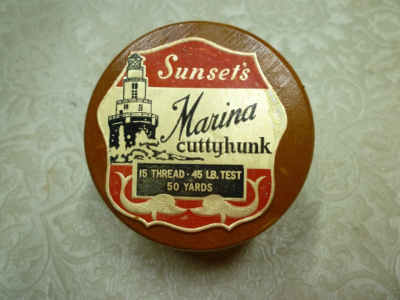
The lighthouse on the below label is "Mile Rocks" light, also known by old time local mariners as "the sparkplug" for an obvious reason. An engineering triumph in its day, as many lighthouses are, it was built in 1906 on a 40- by 30-foot rock a mile west of the Golden Gate. In the 1960's, the light was automated, the top three sections, traditionally painted white, were demolished, and a helicopter pad built on the flattened top of the base to land maintenance crews. Despite a lot of public protests, I think the formerly resident Coasties who had to jump from a small boat to a rope ladder to climb onto the lower platform in tides regularly running six or seven knots and breaking seas coming uninterrupted all the way from Hawaii, were probably glad to forego historic preservation for a chopper ride! :)

1775175827244.png

1775175874388.png

1775175927925.png
 
Last edited:
It's too late for this dilemma, but hard twist linen thread which is coated can be purchased....no need to add anything to the lines. Similar in practice as Cuttyhunk.

If so, don't keep it's source a secret! :) Please share the source. Cuttyhunk was actual three strand laid "rope" in fishing line sizes, not a simply twisted thread.
 
I used to take paraffin shavings and put them in a jar to dissolve in acetone then added hard twist linen to soak overnight in the capped container. Next day I took the thread out and squeezed out excess moisture in a cotton cloth and hung threads to dry with a weight on the end.

I believe this is essentially the same method actually used to waterproof the early waterproofed cuttyhunk fishing lines. I wouldn't think that a display model's rigging would require waterproofing, but I can see there may be advantage to doing that with a sailing model rigged with natural fiber cordage. Using a synthetic thread would be a better solution to the issue of the rigging of a sailing model getting wet.
 
Last edited:
Bob, No, I don’t outbid anybody on EBay. Back in their Yellow Box days I bought several sizes of rigging line from Model Shipways the supplied spools of Cuttyhunk line. I still have some left.

Roger
 
Model Shipways the supplied spools of Cuttyhunk line.
I may have dreamed it, but I remember reading that the relative who inherited the shop that made that linen line consigned the whole inventory to a dumpster.

When did sealing line get to be a thing?
I remember directions for treating fresh twisted linen line with a 50% solution of pH 7 PVA - while it was hung overnight with a heavy lead sinker tied to each end.
I think I recall some heated and rancorous discussions at MSW about using bees wax vs conservators wax. About yes or no does bee saliva have enzymes and acidic pH? Is wax now called a sealer?

While poly line is an eleven footer for me, I thought that it has a smooth surface. Does not take up water or a dye or really accept most adhesives - fixing a knot required heat but not too much? No advantageous point in any coating it at all- and that all a coating would do is be a dust magnet?
 
I may have dreamed it, but I remember reading that the relative who inherited the shop that made that linen line consigned the whole inventory to a dumpster.

I don't doubt it. Natural fiber fishing line was "dead in the water" as soon as synthetic monofilament fishing line came on the market, as anybody of a certain age who fished will remember. As I recall, the only non-monofilament fishing line Sunset Line and Twine was making after that was specialty line for fly-fishermen.

When did sealing line get to be a thing?

Got me. I think these days a lot of what we see on the internet about ship modeling is "monkey see, monkey do" information. Somebody writes it on a forum and then people start repeating it as if it were gospel. As Marshal McLuhan explained, true or not, the more something is repeated, the more people believe it. Social media in its own way is just a big "telephone game," if you remember that one from grade school. Presently, it seems everybody thinks the thing to do is soak everything in watered down PVA. Beats me why.

I've worked on a number of models older than I am, three-quarters of a century now, and I never detected any wax or sealer on any of the cordage on them. Somewhere along the line, cuttyhunk fishing line was "waterproofed," with a thin wax solution, I think, but I've never detected any residue on the stuff I've seen, either on a fishing reel or a ship model. Some books long ago recommended running cotton rigging thread across a block of bee's wax to give it a bit of body for catenaries and to flatten the fuzz. I tried it then but found "flaming" it was a better solution for the "fuzz," and most quality thread was "flamed" in the manufacturing process anyway. Bee's wax isn't acidic and is considered an archival material. It sure will collect dust though, if dust is allowed to land on it.

Now I use clear shellac to fix knots and form shapes with rigging line for things like hanging coils, reef lines on sails, and catenaries. It lasts forever, is invisible and easily reversible with an application of alcohol. I don't "seal" rigging material at all.


While poly line is an eleven footer for me, I thought that it has a smooth surface. Does not take up water or a dye or really accept most adhesives - fixing a knot required heat but not too much? No advantageous point in any coating it at all- and that all a coating would do is be a dust magnet?

Partially correct. Monofilament synthetic thread has a smooth surface, doesn't absorb anything, and accepts few adhesives. Multifilament synthetic thread, such as polyester Gutermann Mara, etc., is made up of very fine synthetic filaments (sometimes straight and sometimes "crinkled") which, while not absorbent, are spun the same as natural fibers to make thread and behave the same. (And sometimes natural and synthetic fibers are spun together as with "cotton/polyester blends.") Most adhesives don't stick well to that, either, but the synthetic spun filament thread will soak up adhesives such as shellac by capillary action between the spun filaments and, in essence, form a mechanical matrix with the filaments. Either way, there's no point to "coating" or "waxing." although shellac will create a somewhat rigid matrix to fix multifilament thread or knots and, according to the literature, Paraloid B-72 will also create a somewhat more flexible matrix due to the semi-flexibility of the cured material.
 
Last edited:
Back
Top