Follow along with the video below to see how to install our site as a web app on your home screen.
Note: This feature may not be available in some browsers.
Win a Free Custom Engraved Brass Coin!!!
As a way to introduce our brass coins to the community, we will raffle off a free coin during the month
of August. Follow link ABOVE for instructions for entering.
The beloved Ships in Scale Magazine is back and charting a new course for 2026!
Discover new skills, new techniques, and new inspirations in every issue.
I am in the process of building the Bluenose which I intend to paint. I have planked the hull and am now sanding the hull and applying wood filler. During the planking process I was also sanding and using wood filler as I went along. The hull has become notably smoother I am using 150 grit sandpaper. As I go along, I find finer and finer areas to apply the wood filler.
My question is when do I stop? I intend to use finer sandpaper until I get to 400 grit. How do most of you determine at what point is smooth enough smooth enough? I realize that this is very subjective, but your thoughts and expertise would be very appreciated.
If you intend to ultimately paint the model when you think that it is smooth enough spray it with a coat of white or light grey paint. This will highlight blemishes, rough spots, etc. This coat is sacrificial. You will wind up sanding most of it off.
How smooth? Perfectly smooth, that's how smooth. If you are sanding with 150 grit, you're not even close to the right zip code.
The number one flaw that turns what could have been a very good model into a piece of crap in most instances is always a bad paint job. Perhaps it's because so many people think they know how to paint. Painting models isn't like painting walls. It's like painting cars. Any imperfection in the surface will be enhanced by the finish coats. People think, "I've got it smooth enough, I guess." and then they slap the paint on, usually way too thick, and the hull immediately looks terrible.
The real question is "How smooth is it now?" The preliminary sanding using abrasive sheets in the 120-150 grit range is for extreme roughing in really, really gross roughness. 120 grit is generally much too coarse for fine work even for the average strip wood plank on frame kit which is terribly unfair in the beginning due to the construction method itself. It's a bunch of flat slats attached to a curved frame. They have to be sanded to shape so that on the outside, the plank faces are curved to the shape of the hull. This should be done using a "sanding board," a springy strip of wood, plastic, or metal that will bend to a fair curve, with abrasive paper glued to it. (Sometimes you can find fingernail "emery boards" at the drugstore that are springy enough to use for this purpose.) 120 grit is like driving a tack with a sledgehammer. I use 220 grit at the coarsest. If my work is so rough that it really needs "major surgery," it's time to get out the edged tools and start scraping and planing. (Another "tragic mistake" many modelers make is sanding parts to shape. Sanding is for smoothing surfaces or taking a tiny bit off an end to make something fit, not for shaping wood. If you want to shape wood, cut it with sharp edged tools.) A frequent mistake many make is to "chase" unfair areas by "spot sanding" with the paper in their hand. This almost always just creates a lot of "dips" and "humps" in the surface because a specific area is being sanded without regard to fairing it into the level of the entire surface.
Once the bare wood is fair, it should be sealed. I, and many others, use clear shellac for this purpose. It goes on very easily and dries very quickly. It is important to do this in order to provide a good foundation and connection between the bare wood and the coatings that follow. Shellac also soaks into wood surfaces and "hardens" them, so when they are sanded further in the finishing process, the sanding is much less likely to raise "fuzz" on the wood surface. (Basswood is famous for this annoying tendency.) Apply the shellac liberally, but do not permit it to dry and then add another coat because this will create a gloss finish which you don't want. You want the coatings to follow to stick to each other.
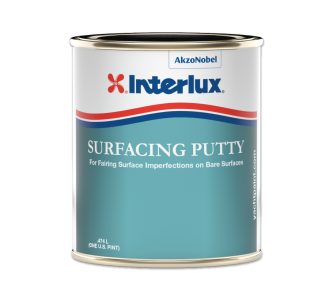
When the faired wood hull is sealed and the shellac dry (virtually in minutes), open seams and major imperfections can be addressed. There are specific materials for this. The best products are found in automotive paint stores where the local body shops get their materials or in well-stocked yacht chandleries (not the ones that are more interested in selling sunglasses and "yachting togs.") This stuff is called "surfacing putty." It is a creamy material made up of very fine "whiting" (powdered chalk) and acetone. It can be thinned with acetone. The acetone dries very fast and this stuff can be applied out of the can at the consistency of toothpaste to fill larger seams and divots. The acetone-based surfacing putties will harden in can quickly if you leave the top off, even while puttying. It is easily reconstituted by adding a tablespoon or three of acetone to the can at the end of using it and replacing the top tightly and then turning the can upside down and letting it sit overnight. No need to mix it in. The new acetone is simply absorbed by the material in the can. Apply the toothpaste thick material with a small flexible putty knife or better yet, a palette knife from the art store when working on scale models. (Cleaning your tools with acetone is a lot easier if you do so before the putty starts getting hard. a dirty putty knife isn't smooth and so is useless for the purpose for which it was intended.) When the putty is dry, and it will dry hard very quickly, sand it fair and smooth using 320 grit sandpaper on a sanding board. It's very important to sand curved areas with a curved base to your sandpaper. Otherwise, you will sand "lumps" and "bumps" into your surface.
Is my go-to surfacing putty, primarily because I've used it for decades finishing high-end yacht hulls, as has everybody else in that trade. There's other brands as well. They probably cost lest because anything "with a boat on the label" costs twice as much, it seems. The auto painting shops I think have surfacing putty from 3M that comes in a tube like toothpaste and in some sort of spray cans, too. Probably at less cost than Interlux from the chandlery or online. It does go a long way, though, and you can keep a can "healthy" by adding acetone as needed to maintain consistency. (I guess it's like taking care of sourdough starter. )
Needless to say, don't use acetone with a cigarette dangling from your lips. Use in a well-ventilated space. Read and follow the instructions on the can. Don't whine about the "fumes." Work smart and you'll live. Painters have been doing this for every.
The beauty of surfacing putty is that it is made to be sanded very easily. When using it, sanding becomes quite satisfying, rather than a nasty chore. Apply the surfacing putty conservatively. Fill the divots and dents to the level of the surface. There's no need to pile up gobs of it y9ou will only have to sand off later. If there are widespread areas of minor imperfections, you can thin some of the putty and spread it thinly with a brush. When it is dry, using a "sanding board" again, fair the hull overall using 220 grit abrasive if there are major areas which must be faired, then finish using 320 grit over the whole hull.
Dust the hull well and examine it as you work at this stage. Visible surface imperfections should be sanded down until they are invisible. Paint is not for covering surface imperfections that can be seen with the naked eye!
When your hull is smooth to the eye, if you have sanded through the shellacked wood, apply a light coat of shellac over those bare wood areas and sand very lightly.
Now, you must apply a "sanding base coat" to your hull. Sanding basecoat is a paint that is easily sanded (containing a fair bit of chalk) and contains a lot of solids (pigment) which will cover any color unevenness in the surface below the finish coats. Never forget: It is nearly impossible to cover color unevenness with topcoat finish paint. Don't try to do it. Use basecoat. Basecoat is sometimes called primer, although, usually, primer coatings simply "cover" color unevenness and don't contain solids intended for sanding. Basecoat is rather thick and difficult to apply with a brush without thinning it properly. I usually spray basecoat because it is easier. If you get a "curtain" or run or brushstrokes in your brush application, you will have to sand that all down fair again. Spraying avoids a lot of this. You can get basecoat in spray cans, and I'd advise that if you don't have spray gear yourself. Here again, the automotive paint supply store is your friend. (Don't mess with anything from the "hobby" paint companies. It's overpriced and under quality.) You must cover all unevenly colored areas on the hull with basecoat so that there's no visible difference in the color of the hull when covered with basecoat. Finish coats will not cover color differences! (Except maybe if your topsides are black, but it'll take a lot of it.)
With your basecoat on, your hull should appear completely smooth. If you notice a spot you missed, and you probably will, just like the rest of us, you must go back and address this as needed, whether by applying a tiny bit of surfacing putty, of or touch of basecoat, and when dry, sand again. This is very important, however: If you need to apply glazing putty to a spot, or your sand to bare wood, you must repeat the "coating schedule" buy sealing with shellacand then again with a coating of basecoat. If you apply your finish coat over anything other than basecoat, especially glazing putty, it will show up on your finish coat.
A general word about sanding: Many painters who haven't served a proper apprenticeship sand far too much and far too aggressively. If the proper grit is used, the paper should do the work, not the painter. When sanding between coats to build up a "coating system," as it's called these days. Don't sand more than is necessary. It is not uncommon for inexperienced painters who are sanding between coats to sand so much they sand off the coat they just put on, which is no way to build up a painted surface!
Now you finally get to make your hull smooth! Use something in the neighborhood 400 to 600 grit sandpaper and gently sand the entire hull, removing any imperfections (and repairing those you've missed along the way. Blow or vacuum dust off the surface. Then wipe the surface with a "tack cloth." This is a piece of muslin soaked in a partially polymerized oil and folded in such a way that it can be unfolded to expose a section at a time and is wiped over the dusted surface to pick up further dust. No matter how well you wipe the surface, a tack cloth will pick up more than you thought was there. Buy tack cloths at the paint store. They're cheap. Store them in ziplock plastic bags so they don't dry out. They have a long shelf life that way. Follow the instructions on the package for use.
Once you've got your basecoat finished and tacked, run your fingers over it and test the smoothness of the surface with your fingertips, which are far, far, better at testing for smoothness than your eyes. If it's smooth, you can then apply your finish coats. The thinner and fewer the better, because building up paint thickness that is thicker than scale, while practically impossible to avoid in practice, must be minimized. It's one of the real killers of "a compelling impression of reality," which is what scale modeling is all about. It's far bette to apply many thin coats than thick ones that run and "curtain" and ruin the entire job.
Some spray finish coats, which is the best of all possible worlds. I prefer it because it presents less chance of drips and runs and so on, but that's just me. I can brush a finish that most would not be able to tell from a sprayed one, but I grew up in a family with a bunch of professional painters and decorators and picked up a lot of the trade by osmosis. Use whatever you are best at and if you are uncertain, practice with the options on some scrap before you have a go at your hull. Don't forget to tack before you paint and to carefully sand lightly between finish coats.
When you've applied enough finish coats, which is usually a minimum of four or so, but often twice that, check your hull again for smoothness. I don't know anybody who has ever had a perfect finish at that time. Even the best painters have bugs landing on their finishes now and again. (Trade secret: Never try to remove a bug from wet paint. You will make a mess of it. When the paint is dry, you may get lucky and be able to brush the stuck bug off, leaving no visible sign of the bug's passing.)
All is not lost if you have some very minor imperfections, a speck of dust here or there, for instance. There are two products, rottenstone and pumice, rottenstone being the coarser, as I recall, although they are very close in abrasiveness. They are abrasive powders which for our purposes are applied to a damp soft cloth and hand-rubbed on the finish. The more you rub, the more glossy the surface becomes, but it takes a LOT of rubbing to go from flat to glossy, so don't sweat it. Start with the coarser and proceed to the finer. You will be able to remove the very finest of surface imperfections with this abrasive. It's what's used with oil instead of water to create the famously deep "French polish" finish on the very finest artisanal furniture.
Now it sounds a lot more complicated than it really is, but it really is a lot more complicated than rubbing it with 120 grit and painting hobby enamel on it, too. Many will say it's not necessary to spend a lot of time on painting a model but the one thing that all good models have in common is a good paint job.
Thank you Bob for your very complete feedback. I am starting with 150 grit sandpaper and plan on going up to 400. I construct my own sanding sticks using foam board that has a lot of flexibility to it. I cut a piece of foam board to the shape I desire and coat one side with rubber cement. I coat plain side of the sandpaper that I cut out also with rubber cement. You can then put the 2 together. If you want fresh or finer sandpaper the old one peels off easily and you can put a fresh piece on.
I do use sanding sealer before I put any paint or primer on. My first model dory had exactly the problem with raised grain that you mentioned before I used the sanding sealer. I do use tack cloths before painting to make sure the surface is as clean as can be. I will certainly be trying Bryan's suggestion for using automotive spray putty/primer. After everything is a smooth as I can make it, I will be using an airbrush to apply the paint.