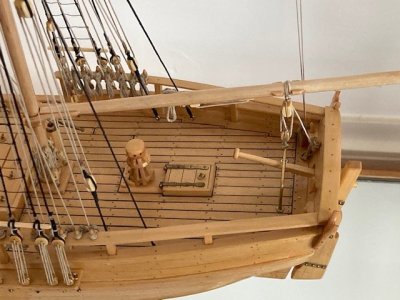
other than being too busy, why arent the spikes shown on every board across every deck joist. In the building of a house, every floor joist would be nailed into.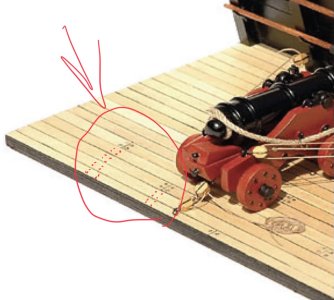

 |
The beloved Ships in Scale Magazine is back and charting a new course for 2026! Discover new skills, new techniques, and new inspirations in every issue. NOTE THAT OUR NEXT ISSUE WILL BE July/August 2026 |
|
 |
As a way to introduce our brass coins to the community, we will raffle off a free coin during the month of August. Follow link ABOVE for instructions for entering. |
|

While the planks were secured to every deck beam with spikes and covered with wooden plugs the wood was the same species as the deck planks so barely visible. At our scales, many feel it is better to show none at all rather than having them stand out because of the color contrast with the planking.why arent the spikes shown on every board across every deck joist.
That makes sense…I was going to mark many and after one column I really didnt like all that many…sand paper to the rescue!While the planks were secured to every deck beam with spikes and covered with wooden plugs The wood was the same species as the deck planks so barely visible. At our scales, many feel it is better to show none at all rather than having them stand out because of the color contrast with the planking.

The correct name is BEAM . There were two spikes in every beam - in a staggered formation. There were also spikes in every ledge - smaller than beams - same orientation - spanning the gap between carlings rather than across the whole width of the deck . All of the spikes were sealed over with water proofing and covered with an all but invisible plug. The plug was wood that was the same species and grain orientation as its planking. On warships the decks that were exposed to sun, weather, dripping rigging tar, and tar coated feet were sanded everyday.why arent the spikes shown on every board across every deck
Fills in a lot of gaps for me. Thank you.The correct name is BEAM . There were two spikes in every beam - in a staggered formation. There were also spikes in every ledge - smaller than beams - same orientation - spanning the gap between carlings rather than across the whole width of the deck . All of the spikes were sealed over with water proofing and covered with an all but invisible plug. The plug was wood that was the same species and grain orientation as its planking. On warships the decks that were exposed to sun, weather, dripping rigging tar, and tar coated feet were sanded everyday.
Visible deck fasteners is a popular kit convention. A convention that in no way reflects what an actual ship would look like from the distances that model scales represent. But that will hold true for much else with a kit.
I like the idea of using long dowels to secure both deck planking and hull planking - they are belt and suspenders and they can be excellent clamps for the building of it. The problem is that a useful dowel shows end grain. All end grain is too dark.

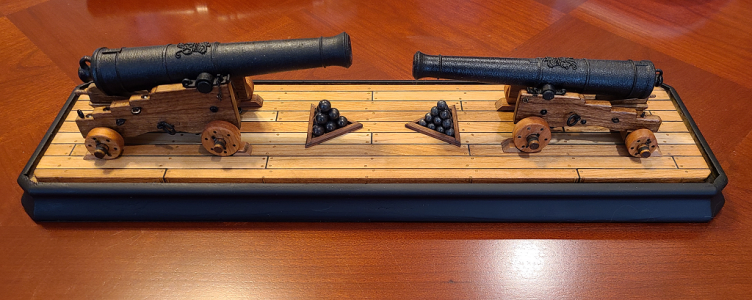
Visible deck fasteners is a popular kit convention. A convention that in no way reflects what an actual ship would look like from the distances that model scales represent. But that will hold true for much else with a kit.
I agree completely.I think the better word than "convention" to describe this present kit modeling fad is "affectation." (Affectation, n., "behaviour, speech, or writing that is pretentious and designed to impress:") As noted, it in no way reflects what an actual ship would look like from the viewing distance that modeling scales represent. The phenomenon isn't limited to deck planks. It's frequently seen in the case of hull planking and with similar affect in the case of most all copper hull plating encountered these days. There is no valid justification for it whatsoever. It's just flat out wrong by any conceivable objective modeling standard.
I disagree completely. IMHO kits as well as scratch built models displayed here and elsewhere which have well-done (if inaccurate) treenails is an indicator of very high quality and craftsmanship. I can't produce that kind of craftsmanship, but wish I could. Whether I want to or not, I'm not sure. But ALL of the latest Chinese kits in particular are completely treenailed by their manufacturer and shown that way in finished and/or build logs here. And those kits, again IMHO, are the highest quality kits available. I/you don't have to add the treenails, but they are great kits nonetheless.However, where the practice is evident from box cover photos or instructional materials, it does serve as a very accurate indicator of low quality and an excellent reason not to buy such a kit.

I build models for enjoyment. None of mine have treenails shown (except large scale gun displays), but I do envy them every time I see them. But I think we all hope our models display our craftsmanship as well. And is it historically inaccurate to highlight features that actually existed on ships, but is not normally visible?This is the debate that has been going on for some time on this and other forums. Do you build models to display your craftsmanship or to create something that is historically accurate? I fall on the side of historic accuracy.
Roger
No they don't. Kraum Batchvarov, the marine archeologist and husband of Olha Batchvarov (who does puts treenails in her models) explains is this video that treenails need to be about 30mm in diameter to hold well, regardless of ship size. In 1/48 scale that is 0.6mm, which is a common treenail size, although most builders seem to use 0.5mm.They have to be made overscale to be visible
That was done quite often on decking. As was using treenails only. In the case of hull planking, except for wales and areas needing more strength, treenails were used most often from the 17th century or so. Iron nails were always exposed on the hulls, and they corroded too quickly, whereas treenails got tighter. The most standard practice was to use an iron nail, clenched on the inside and exposed on the outside, at each end of a plank, and treenails at all other locations. Many modelers here model them exactly that way. And needless to say, the exposed part of treenails are /always/ end grain.They didn’t exist on the prototype. In the case of treenails, nails, etc to secure deck planks to hull structure, as Bob Cleek explains decks planking was secured with countersunk iron nails and the countersink hole was filled with a wooden plug not a treenail.
As mentioned above, they didn't always use iron nails with plugs. And we don't know that the plugs were cut to have exposed side grain rather than end grain. Cutting thousands of 30mm diameter plugs from a 1" slab would be a whole lot harder and more trouble than cutting 1" long pieces of a 30mm dowel. After all, the only purpose of the plug was to protect the nail, not for look. Now, I'm sure with Chris Craft boats, that's an entirely different story.What’s the difference? The grain of a plug runs crosswise to its longitudinal axis. The grain of a treenail runs parallel to it. And, in building a real boat, a good craftsman is careful to align the grain of the plug in the same direction as the grain of the wood surrounding it.
I disagree completely. IMHO kits as well as scratch built models displayed here and elsewhere which have well-done (if inaccurate) treenails is an indicator of very high quality and craftsmanship. I can't produce that kind of craftsmanship, but wish I could. Whether I want to or not, I'm not sure. But ALL of the latest Chinese kits in particular are completely treenailed by their manufacturer and shown that way in finished and/or build logs here. And those kits, again IMHO, are the highest quality kits available. I/you don't have to add the treenails, but they are great kits nonetheless.
And is it historically inaccurate to highlight features that actually existed on ships, but (are) not normally visible?
Oh, don't get me wrong. I agree with you that treenails can be an indicator of very high quality and craftmanship, not to mention patience and dedication. What I said was that visible treenails and nail heads weren't correct when not visible on the prototype at scale viewing distance which is pretty much the case for all but the largest scales, and thus they detract from the quality of a scale ship model and when seen in kits are a hallmark of poor-quality kits. If one wishes to demonstrate their craftsmanship, they can do that however they wish, but if they wish to build a high-quality scale ship model, their creative options are more constrained by the generally accepted definition of the thing:
"A high-quality scale ship model provides a compelling impression of an actual vessel within the constraints of historical accuracy."
"Historical accuracy" encompasses all the objective, or measurable, standards of technical exactness that might apply to a ship model. These embrace the obvious hull shape and fairness; precision in fittings, rigging, and colors; lack of anachronisms; and so forth. But it also encompasses all aspects of craftsmanship because the lack of craftsmanship creates unrealistic and, therefore, historically inaccurate blemishes on a model. ... The phrase "historically accurate" alone effectively replaces the intention of the now-vapid "museum quality."
"... (A "compelling impression") allows and encourages aesthetic interpretation of a vessel that will help propel the viewers to make the leap of faith that allows a model to work or to willingly suspend the disbelief that keeps a model from working. Both processes help viewers accept the invitation to visit a ship instead of a model. Compelling impression is the result of applying artistic and interpretive decision-making processes... to amplify a model beyond being a mere assemblage of parts.
Rob Napier, Caring for Ship Models - A Narrative of Thought and Application, (2022) Seawatch Books.
See: https://seawatchbooks.com/products/...tive-of-thought-and-application-by-rob-napier
In such a case, historicity doesn't enter into it. Making something visible on a model that is not visible on the prototype at scale viewing distance is, by definition, an error in scale. If you can see it on the model, but not on the prototype at scale viewing distance, it's too damn big or at least your eyes are going to tell your brain that when they see it. Seeing things on a model that you can't see in real life at scale viewing distance is a distraction that erodes, if not outright destroys, "a compelling impression of the actual vessel." It's one of the errors that make a model look like a toy rather than a scale model.
We "old grumps" don't make this stuff up. It's not a matter of opinion. It's all in the nature of what a "high-quality scale ship model" is, as formally defined many years ago by the ship modeling fraternity and written and printed many times over since. Unfortunately, a lot of newer ship modelers don't understand that: 1.) Each model speaks for itself and every serious modeler who sees it will evaluate for themselves whether and/or to what degree it "provides a compelling impression of an actual vessel within the constraints of historical accuracy." This is what determines whether and/or to what degree a model is a "high-quality scale ship model." 2. There is no reason why any modeler who wishes to do so can't build a ship model to suit their own standards and purposes or even their own whims without any regard for the classic standards of a "high-quality scale ship model." Such models may demonstrate high levels of craftsmanship, give the builder great enjoyment and satisfaction, and/or be pleasing to the eyes. But they aren't "high-quality scale ship models" unless they sufficiently meet the classic criteria.
Modelers who "highlight features that actually existed on ships but are not normally visible" based on the mistaken belief that they are making their model better are actually doing the opposite. If they want to do that, it's fine. They're entitled to do so, but if they want to build a "high-quality scale ship model," they don't have the liberty ignore the applicable conventions.
Nobody wants to hurt anybody's feelings. Most want to help others build better models. But when so many people keep making the same mistakes while telling each other how great their build is coming along, serious scale ship model builders are between a rock and a hard place. Nobody learns being told their work looks great when it really looks like a dog's breakfast. Or do we say nothing and watch the standards of the art form continue to spiral downward towards the lowest common denominator?
I can't give you a consensus with my one voice, but with that I can say you are absolutely correct. Do the math: How thick is the thread with which Bluenose's canvas sails were sewn? Divide that by 64. Seriously, don't waste the time figuring it out. Take my word for it. Actual sewn scale sails aren't really possible below about 1:12 scale. One of the most obvious scale failures in kit models is the use of grossly over-scale cloth sail material. Nothing ruins the compelling effect of reality in miniature like a grossly out-of-scale set of sails. There simply isn't any cloth available that is thin and finely woven enough to present an accurate scale representation of sail cloth. Therefore, scale ship modelers must employ various artistic techniques to produce accurately scaled miniature sails. Stitching lines and similar details in scale sails are usually "faked" with various artistic techniques, such as fine light pencil lines to suggest properly scaled and historically correct seam stitching.Not to digress from nails and trenails, but regarding historical accuracy, I’m a relative newbie and I would like to get the opinions from some of you experienced builders. I am working on the sails for my Bluenose schooner at 1:64 scale. I sewed the seam lines on them as many or most builders show on their build logs etc. However before mounting them I started thinking that at scale viewing distance there is no way anyone could see the seam lines even if the thread contrasted with the color of the sail material. Also, I don’t know exactly when sewing machines (especially big heavy duty ones necessary for large ship sails) were invented but I assume that the seams in the Age of Sail had to have been sewed by hand making sails by sewing machine for period models historically inaccurate. (Not to mention how tedious it would be). What is the consensus among expert builders: should I sew the seams or not?