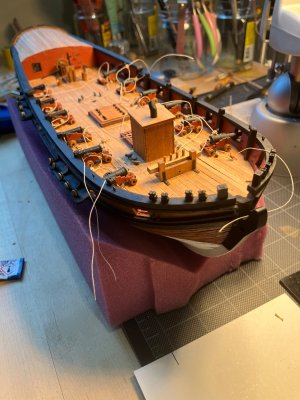


My last effort..AL Soleil Royal
First fully painted kit which was a bit daunting at first…but in the end pleased with the result
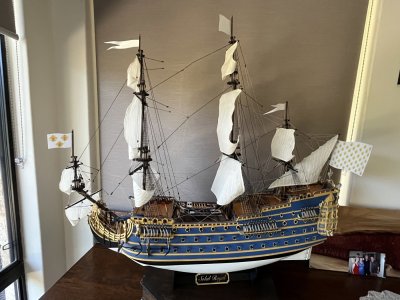
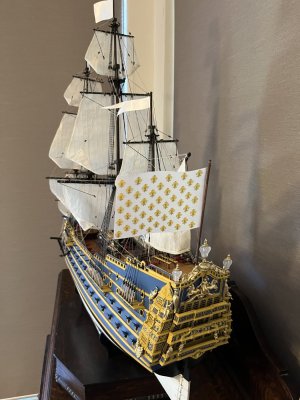
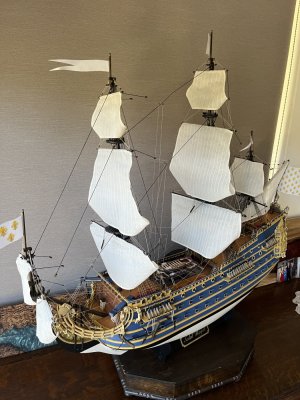
First fully painted kit which was a bit daunting at first…but in the end pleased with the result

 |
The beloved Ships in Scale Magazine is back and charting a new course for 2026! Discover new skills, new techniques, and new inspirations in every issue. NOTE THAT OUR NEXT ISSUE WILL BE July/August 2026 |
|
 |
As a way to introduce our brass coins to the community, we will raffle off a free coin during the month of August. Follow link ABOVE for instructions for entering. |
|


Thank you ---Nice work on the individual shields. Your model will present beautifully.
 I also intend to add some shoulder straps - or at least all the needed buckles. (To do on a later list) -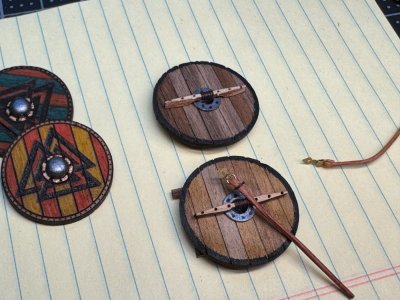
Someone who knows how roundshields are designed! NICE. A rare treat for an armourer like me to see.Thank you ---
View attachment 610320

Good morning, the cannon blocks are 3mm. Following the Caldercraft plan.It is really good to see you rigged two single blocks instead of a double and single which we often see on kit models even though a single and double was not used on guns smaller than 32 pounders on English ships according to Caruana. What size are the blocks they provided for the rigging?
Tx
Allan

Is this the Artesania Latina kit? How was building it without any drawings?My last effort..AL Soleil Royal
First fully painted kit which was a bit daunting at first…but in the end pleased with the result
View attachment 610235View attachment 610235View attachment 610236View attachment 610237

I just completing my build of the A/L kit Juan Sebastian de Elcano and, while it was a Level 1 (easy) kit, it had a fairly complicated rigging plan for an entry level kit. The rigging job involved 19 sails, 4 masts with topsails and stay sails, and 30 blocks. I found the videos to be very basic, contained incorrect directions at times (on the videos, all 4 stay sails were attached backwards), and the lack of any narration was a real shortcoming. It would have been better, for a relative beginner like me, to at least explain the difference between standing rigging and running rigging. Without a rigging plan, I had to look at the box top to see where all the rigs were attached atop decks. I understand that it's a beginner's kit, and they have to keep the cost of the kit lower for beginners, but I don't think I'll be building another A/L kit. My next build will be a Corel kit, which has 6 pages of ship design plans and a full (printed) rigging plan.Yes it is Artesania Latina
The kit came with a CD of very comprehensive instructions…however the rigging instructions were at times hard to follow but overall better than previous (older) AL kits
Be advised that a Corel kit's instructions are minimal becuase they assume the builder has lots of experience building wooden model ships. The text for the steps in the instructions is minimal. However, the drawings are plentiful, detailed, and contain few errors. If you think you've found an error, make a post about it on the forum with pictures of the problem area on the drawing, and members will help you sort it out. Corel assumes you already know how to plank a hull and have skills shaping parts from primitive blocks of wood for things like parts of the stern gallery, and there is rarely much leftover planking material when you are done, so be careful to use your materials efficiently. Corel kits are smaller in size, typically 1:100 scale and have quality hardwood in the kit. If you build a Corel model of a large ship, like HMS Victory at 1:100 scale, it will be more difficult to keep the level of detail up, especially compared to a model at 1:48 scale. Adding lots of extra small details with scrap wood can add a lot to the appearance of the model, but details will be very tiny. for example, to make gun tackles for cannon carriages, you will need to acquire 1.5mm blocks so that that tackles are not grossly oversized and ruin the appearance of scale. Most people opt to leave out the gun tackles.I just completing my build of the A/L kit Juan Sebastian de Elcano and, while it was a Level 1 (easy) kit, it had a fairly complicated rigging plan for an entry level kit. The rigging job involved 19 sails, 4 masts with topsails and stay sails, and 30 blocks. I found the videos to be very basic, contained incorrect directions at times (on the videos, all 4 stay sails were attached backwards), and the lack of any narration was a real shortcoming. It would have been better, for a relative beginner like me, to at least explain the difference between standing rigging and running rigging. Without a rigging plan, I had to look at the box top to see where all the rigs were attached atop decks. I understand that it's a beginner's kit, and they have to keep the cost of the kit lower for beginners, but I don't think I'll be building another A/L kit. My next build will be a Corel kit, which has 6 pages of ship design plans and a full (printed) rigging plan.
What have been your bigger challenges with this one?I’ve been building a the Mt Washington side paddle wheeler by Dumas kit for a client.
Difficult build to say the least.
View attachment 533694
View attachment 533695
View attachment 533696
Darius - I totally agree. My experience building the Corel Mayflower has been a much better experience than building the Artesania Latina kit J.S. Elcano. I don't think I'll ever build another A/L kit.Be advised that a Corel kit's instructions are minimal becuase they assume the builder has lots of experience building wooden model ships. The text for the steps in the instructions is minimal. However, the drawings are plentiful, detailed, and contain few errors. If you think you've found an error, make a post about it on the forum with pictures of the problem area on the drawing, and members will help you sort it out. Corel assumes you already know how to plank a hull and have skills shaping parts from primitive blocks of wood for things like parts of the stern gallery, and there is rarely much leftover planking material when you are done, so be careful to use your materials efficiently. Corel kits are smaller in size, typically 1:100 scale and have quality hardwood in the kit. If you build a Corel model of a large ship, like HMS Victory at 1:100 scale, it will be more difficult to keep the level of detail up, especially compared to a model at 1:48 scale. Adding lots of extra small details with scrap wood can add a lot to the appearance of the model, but details will be very tiny. for example, to make gun tackles for cannon carriages, you will need to acquire 1.5mm blocks so that that tackles are not grossly oversized and ruin the appearance of scale. Most people opt to leave out the gun tackles.
When it comes to Artesania Latina, The kits vary in historical accuracy and quality of instructions. Their beginner kit San Francisco II is excellent for beginners, and details are basic as far as historical accuracy goes. The A/L J.S. Elcano is fairly basic in parts detail but has a LOT of complexity in rigging due to the number of sails. For advanced kits, I have no experience building them. They look pretty good. I had my eye on the Santa Ana, myself. If you want to stress historical accuracy, you lean toward Vanguard Models, but the prices are expectedly higher. You really have to judge a kit on an individual basis for each manufacturer. There are some general trends which we have identified, but it's a good idea to read forum build logs to get a feel for what's really in the box before spending hundreds of dollars for a kit, all the while taking into account you current skill level.Darius - I totally agree. My experience building the Corel Mayflower has been a much better experience than building the Artesania Latina kit J.S. Elcano. I don't think I'll ever build another A/L kit.