


Dankjewel, Johan. Thanks!Schitterend!
Regards, Peter

 |
The beloved Ships in Scale Magazine is back and charting a new course for 2026! Discover new skills, new techniques, and new inspirations in every issue. NOTE THAT OUR NEXT ISSUE WILL BE July/August 2026 |
|
 |
As a way to introduce our brass coins to the community, we will raffle off a free coin during the month of August. Follow link ABOVE for instructions for entering. |
|
Dankjewel, Johan. Thanks!Schitterend!


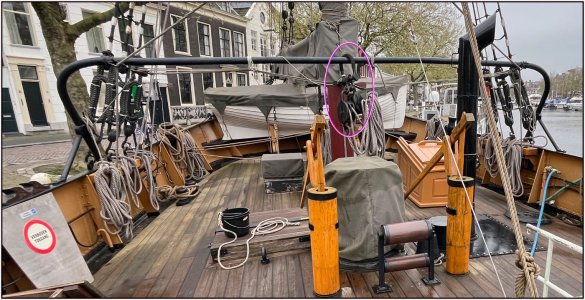
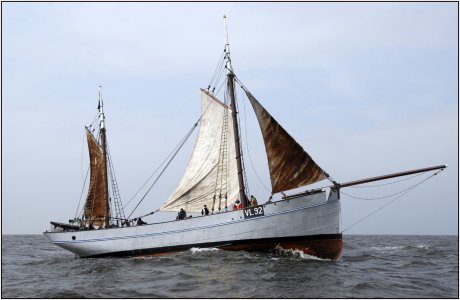
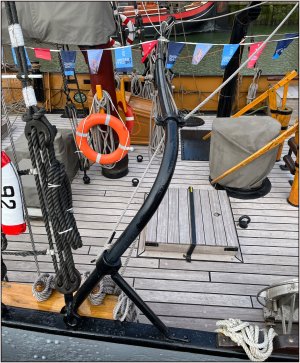
Ingenious solution for the traveler.To continue working from front to back, it was now time to tackle the traveler for the jib sheet.
I've had plenty of time to think about this, as it's secured to both the port and starboard sides.
View attachment 560858
Both ends pass through the deck and are secured to the watertight bulkhead below.
View attachment 560859
The jib sheet is attached to this. It can't move completely freely when tacking. The sheet then has to be guided over the lantern and the entrance to the forepeak.
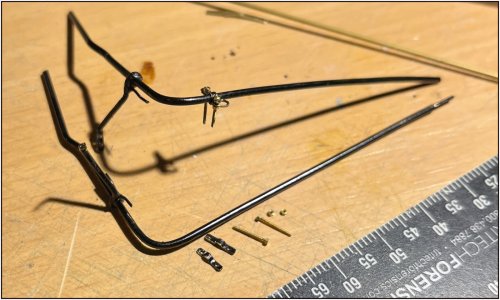
If I were to secure this in the usual way, I wouldn't be able to separate the two parts. So I decided to make it from a tube, saw it in half, and attach a pin as a connection between the two.
The traveler is 50 mm thick, so to scale, I had to work with a 1 mm tube. I found one with an inside diameter of 0.5 mm. With 0.5 mm wire. With the wire inside the tube I was also able to bend the tube without deforming it in the bends.
This is the result:
View attachment 560860
The blue arrow points to the traveler that runs between the mast tube and the lantern.
View attachment 560861
Halfway behind the mast tube, I made the connection.
Here are the two parts separated:
View attachment 560862
The blue arrows point to the two parts of the traveler.
It's almost insignificant, so a few "unforgivable macros" are necessary.
The two parts with the pin in the port side:
View attachment 560863
So, the tube is 1.0 mm and the pin is 0.5 mm.
View attachment 560864
With some trial and error, the pin was slid into the other part. And I can now slide everything together more evenly.
That's another trigger point solved.
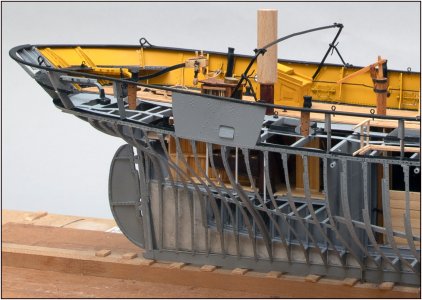
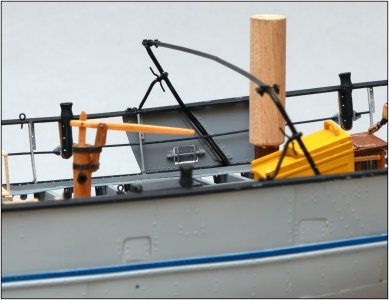
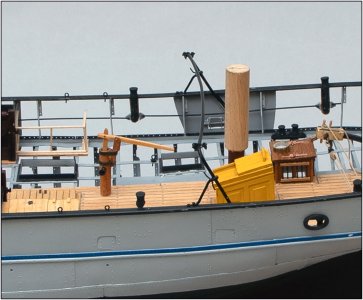
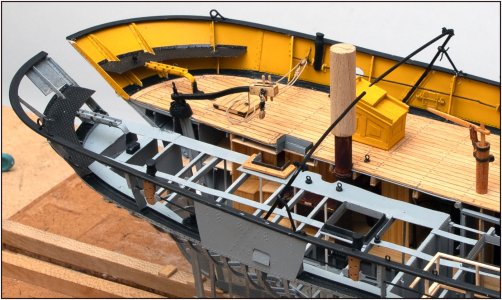
There's also a traveler for the mainsail sheet. It's partially attached to the bulwark, near the mizzen mast's chainplates. I need to add a piece of hull plating to the open section of the frame, otherwise, it won't be secured there.
Regards, Peter
Thanks, Johan. It took some effort to get both parts aligned properly so they could slide back together 'relatively' easily. But a 1mm tube doesn't have much room to maneuver.Ingenious solution for the traveler.
Having used these tube and pin diameters on my Kolibrie model, I know how painfully accurate one must locate the parts relative to one another. Luckily it wouldn't be a daily occurrence (I hope).

Ek stem saamSchitterend!

Baie dankie, Grant.Ek stem saam

Thanks, Maarten. A new ‘gob-smacker’ is always welcome.All these details are just a treat to the eye. You just knock my socks off and leave me gobsmacked.




Thanks, Günther, for this very nice words and compliments. You made me blush a bit ……Hey Peter,
I haven't written anything about your build in a long time. But now I have to!
When I see your build report, I feel transported back to when I was a little boy. You are building the model that I used to stand outside the toy shop window marvelling at, begging my father to buy it for me or Santa Claus to bring it to me for Christmas. I am in love with your model and completely lost in it. I could spend hours looking at it, turning it this way and that, delighting in the incredible details. The construction alone would keep me busy for a long time.
What a ship! You build at a level I would love to be able to achieve. I am your student and you are my grand master! World class! I have rarely seen such a complex, coherent model. I take my hat off to you!
Thank you for showing me!


I'm glad you specified which windows you were staring at as a little boy - hopefully not those other Amsterdam windows...staring at the toy windows
……. And what your reference is for ‘Toys for Boys’ …………I'm glad you specified which windows you were staring at as a little boy - hopefully not those other Amsterdam windows...



Thanks for the compliment and the confirmation, Roger. Sometimes I need the translation-app, but it goes often wrong with the nautical term.Very nice work! Here in the USA we do call it a Traveler.
Roger
Hey Peter,Thanks, Günther, for this very nice words and compliments. You made me blush a bit ……
Got some deja-vu’s from the time I was a little boy, staring at the toy windows. Thanks for bringing up those memories.
Regards, Peter
Good morning Peter. Legendary. A quick question: when you solder do you use flux and a burner or the traditional soldering iron ?The mainsail sheet traveler (or is the correct name: tack rail?):
View attachment 561570
In the middle hangs a large shackle with two large 2-sheave blocks attached to it. One of these two goes to the mainsail clew. On either side are two small metal 2-sheave blocks to move the whole thing to port and starboard and secure it in the desired position.
View attachment 561571
The mainsail sheet is clearly visible here. The traveler is also quite large, allowing you to walk underneath it.
On both sides are also two brackets to which the two side pulleys are attached. Two other lines also run through an eyelet. (This will be clarified later.)
View attachment 561572
The traveler also has a curvature equal to the radius out off the mainmast. The mainsail can follow its course within this radius when tacking.
After a lot of bending and fitting, I soldered the two parts and side supports:
View attachment 561573
Now with 1.4 mm tubing and 0.8 mm internal thread to brace the tubing without denting and for the pin.
I made both brackets from 1 mm brass strip and using the M0.6 bolts and nuts.
This is how it looks on the model:
View attachment 561574
Using AL-FI, I made a piece of hull plate to secure the traveler on the starboard side as well. There's a water valve in that spot, so I added that as well. I also added all the rivets that are there.
The necessary piece of hull plate.
View attachment 561575
With the radius.
View attachment 561576
It looks slightly different than the photo of the original Balder. I can't get a close-up with the camera here because then I wouldn't have any depth of field.
This one can also be taken apart and reassembled using the pin in the tube.
View attachment 561577
I think I now have 5 or 6 places I need to keep an eye on regarding the positioning to slide the two parts back together...
Regards, Peter
Thanks Grant.Good morning Peter. Legendary.
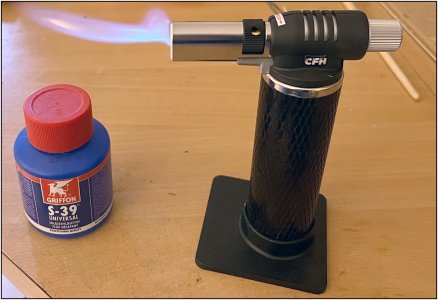
I am now using a small burner with old-fashion S39:A quick question: when you solder do you use flux and a burner or the traditional soldering iron ?
Cheers Grant
Thanks Peter.Thanks Grant.
I am now using a small burner with old-fashion S39:
View attachment 561690
With the flame a little yellow so it's not too hot. For me, the wet S-39 has the advantage that I can stick a small piece of solder wire to the wet area to be soldered. This prevents any movement during soldering, and the solder melts very quickly. This prevents the heat from spreading too quickly to other parts that may already be soldered. This also allows me to work on several areas simultaneously and distribute the flame across them all. With flux paste, the solder pieces naturally stick together as well.
Regards, Peter
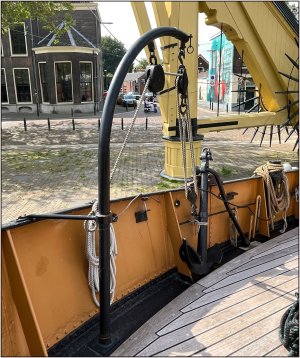
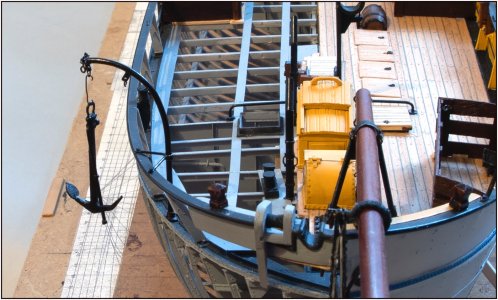

Hi Peter, impressive as usual.Continued bending and soldering the brass. The anchor davit:
View attachment 562129
I noticed they used metal two-sheave blocks and a wooden single-sheave block. The stock anchor is secured to the lashing rail.
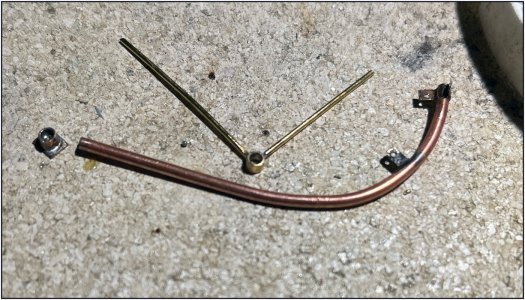
The basic components:
View attachment 562130
The base for the davit to rotate and the support for the bulwark, which still needs to be widened and holes drilled.
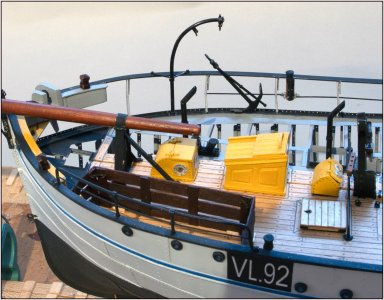
On the deck:
View attachment 562131
In my stash, I found a stock anchor that's reasonably true to scale. Perhaps shorten the arm and stock a bit.
The anchor can be moved outboard:
View attachment 562132
On my next visit to the Balder, I'll inquire about the purpose of the two eyebolts on the side of the end.
Regards, Peter