

• Win a Free Custom Engraved Brass Coin!!!
    As a way to introduce our brass coins to the community, we will raffle off a free coin during the month of August. Follow link ABOVE for instructions for entering.
  • PRE-ORDER SHIPS IN SCALE TODAY!

    The beloved Ships in Scale Magazine is back and charting a new course for 2026!
    Discover new skills, new techniques, and new inspirations in every issue.

    NOTE THAT OUR FIRST ISSUE WILL BE JAN/FEB 2026

Build log for Muscongus Bay Lobster Smack by Don Ricardo

Joined
Jul 20, 2020
Messages
607
Points
198

Location
New England
Trying log again.
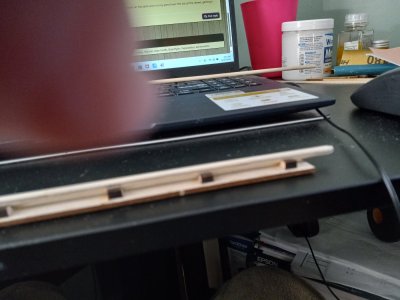
I bought some dowels for masts and spars, laid them on the spar holder, held them steady with tape and ran a pencil atop the dowels. This gave me a nice straight line for attachments. Rolling the dowel over, centering the drawn line on the V of the spar holder and drawing a second line preps both sides of the spars for fore and aft. Now I will drill whatever holes I need for the eyebolts. When the smack arrives the spars should be ready to go. This also works if you need to divide your spars into quarters. If you will notice, since the spar holder blocks fit so snugly, I had not glued them, and to mark the dowels, I inserted the blocks into what the directions would consider inverted.

20251127_083350.jpg
 
Last edited:
I have my drill clamped into my vise, ready to round off the mast with the proper taper. Then add the lines, fore and aft for placement of eyebolts and cleats. At 82, going up and down stairs is problematic, and the Captain will not allow me to bring the vise upstairs.
When she pulls out the vacuum cleaner though, I get down there fast or she will vacuum the floor, and any fallen parts are gone forever. And she will collect more dollars!
After morning coffee, I will resume work on the mast spars.
 
Last edited:
The first thing to do is to check for pieces falling from the sheets, one way I lost some pieces on my first attempt. A roll of scotch tape will cure that.
Is it advisable to lacquer the sheets before starting? The water in the acrylic paint seems to affect some of the balsa parts. Do you paint parts before assembly, or after?
My Captain is a dustoholic, and vacuums every thing, so this time, unless I am actually working with a part, it stays in the box.
 
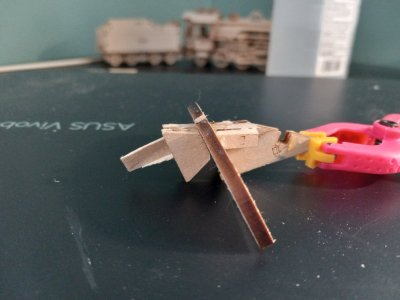
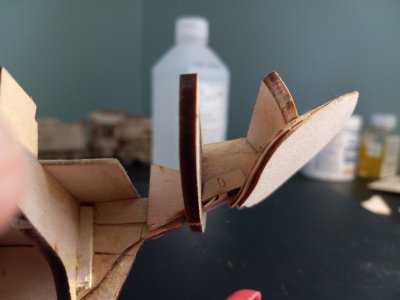
If you are going to try this kit for the first time, there is a very weak point at the stern that is very easy to break during the stem assembly.
The second breaking point is also at the stem at the reinforcing pieces C and D. The breakage will occur when you try to add the bulkhead frames 9 and 10. If they are too tight, sand them before sliding them into the slot...these two bulkheads slide in from the bottom and will snap the stem if they are too tight, and you will have alignment problems with the stern, deck, and planking. Don't ask how I know.
So watch the grain pattern on the stem.
Also make sure the bulkheads will clear the reinforcing pieces A and B. You may want to lightly sand these reinforcing pieces to make sure you have adequate room for the bulkheads...what ever you do, DO NOT FORCE the bulkheads. That stem is to the Smack as your skeleton is to your body. Hug it, kiss it cuss at it, but don't break it.
You have two options on this kit for the centerboard, moveable or fixed. I always use fixed because moveable parts attract curious finger as a light attracts moths. But younhave that option.
 
Last edited:
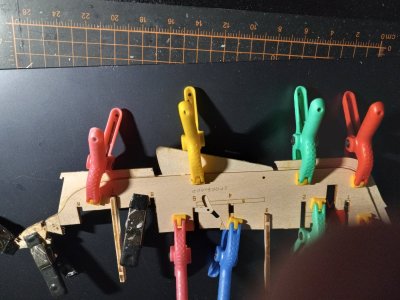
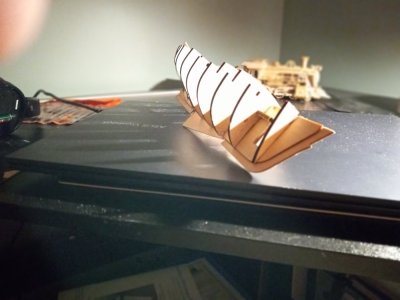
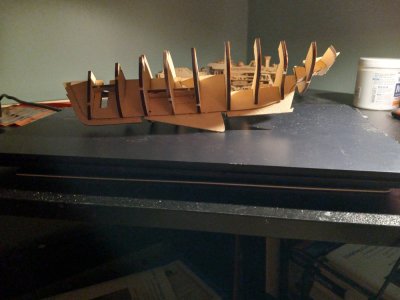
The number 4 bulk head goes on first, it's tricky and you will have to work it to get it onto the stem properly, at least on this kit, the slot that slides over the reinforcing part B is too small and had to be enlarged. Make sure it is square to the stem.
These photos are of the test fit. Today they will be set square to the stem and glued in. glued in.
The number 7 bulkhead is not seated all the way, will have to unglue anmd seat properly.


20251203_204849.jpg

20251203_205115.jpg
 
Last edited:
I wouldn't wish the frustration of easily snapped bits on anyone, but at least I know it's not just me! In some cases I've taken to hardening the wood with extra thin CA soaked in. It may not be elegant, but it can same some irritation...
 
I wouldn't wish the frustration of easily snapped bits on anyone, but at least I know it's not just me! In some cases I've taken to hardening the wood with extra thin CA soaked in. It may not be elegant, but it can same some irritation...
I pay my Captain a dollar for each cuss word and she's quite contented! I'll try hardening with CA. Thanks
 
I think when the deck is glued down, it will line up properly. I can move it into correct position very easily by hand. The keel is straight, just worried about the planking.
 
Is that a wooden Locomotive in the back round of you project photo? Darryl
 
The first thing to do is to check for pieces falling from the sheets, one way I lost some pieces on my first attempt. A roll of scotch tape will cure that.
Is it advisable to lacquer the sheets before starting? The water in the acrylic paint seems to affect some of the balsa parts. Do you paint parts before assembly, or after?
My Captain is a dustoholic, and vacuums every thing, so this time, unless I am actually working with a part, it stays in the box.
I usually paint the parts after assembly. The model is probably basswood, not balsa. Balsa is a lighter wood and softer. I find that if you paint the basswood with acrylic it will “raise the grain” and make the surface “fuzzy”. I use a few coats of sanding sealer ( you can find it at Ace hardware and other places). Before using acrylic paint to avoid that problem.

Rob
 
Is that a wooden Locomotive in the back round of you project photo? Darryl
Yes. I have a n scale layout. I purchased used locomotives and passenger and stock cars and built my own buildings out of cardstock (empty cereal boxes). That is a wooden model of a 2-6-2 generic loco.
We were raised on a farm and the Western Maryland RR ran coal trains against the southern border of the farm. They used 2-8-0s with 2 up front pulling, 2 in the middle, and a pusher on the back...100 to150 cars, pulling through the Allegheny Mountains. The pusher was to help relieve the pressure on the couplers of the train.
As a youngster watching those coal trains thunder by, I wanter to be a steam loco engineer.
 
Last edited:
I usually paint the parts after assembly. The model is probably basswood, not balsa. Balsa is a lighter wood and softer. I find that if you paint the basswood with acrylic it will “raise the grain” and make the surface “fuzzy”. I use a few coats of sanding sealer ( you can find it at Ace hardware and other places). Before using acrylic paint to avoid that problem.

Rob
Thanks, Rob. Got the sanding sealer.
Opps. broke the stern section again, unglued and repaired. Seems to be ok, not sure if 100% square. Also reset the number 7 bulkhead.

View attachment 562021

View attachment 562022
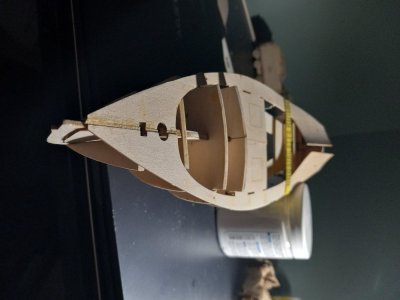
Got the deck on, the curly back is from wetting the deck. I had a problem lining the deck halfs up, but if you look closely you will see the pieces that were between the deck on the sheet, adding those fore and midships gave me a much better fit. With out adding those pieces, the seams were open either at the stern ot at the bow. I need to reinforce the deck at the stern section where I broke it. Once that is done, ready to plank...(groan).

20251208_161735.jpg
 
I usually paint the parts after assembly. The model is probably basswood, not balsa. Balsa is a lighter wood and softer. I find that if you paint the basswood with acrylic it will “raise the grain” and make the surface “fuzzy”. I use a few coats of sanding sealer ( you can find it at Ace hardware and other places). Before using acrylic paint to avoid that problem.

Rob
Hoping the sanding sealer is water/acrylic based if @11320 Titanic is using acrylic paint. If not, then I advise using oil-based paint (enamel).
 
Back
Top