
-

SUBSCRIBE TO SHIPS IN SCALE TODAY!
The beloved Ships in Scale Magazine is back and charting a new course for 2026!
Discover new skills, new techniques, and new inspirations in every issue.
NOTE THAT OUR NEXT ISSUE WILL BE July/August 2026 -

Win a Free Custom Engraved Brass Coin!!!
As a way to introduce our brass coins to the community, we will raffle off a free coin during the month of August. Follow link ABOVE for instructions for entering.


You are using an out of date browser. It may not display this or other websites correctly.
You should upgrade or use an alternative browser.
You should upgrade or use an alternative browser.


 !"
!"


To help anyone building such a cutter, here's the layout of the floorboards and gratings. It's taken from Diana's anatomy, but they all had this layout. It's a shame it's rarely specified anywhere, so you have to guess. I'll be building the same one for my Alert in the future.
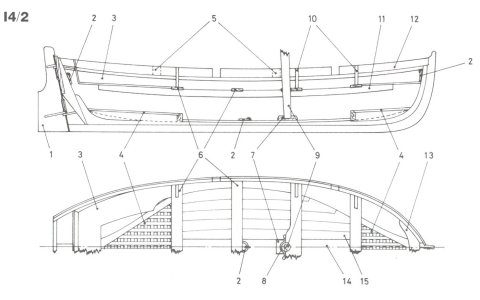
but they all had this layout.
I have not seen footwaling like David White shows in his drawing on any contemporary drawings or models. Do you know of any contemporary sources that show footwaling done this way?
Thanks Serikoff!
Allan
I have not seen footwaling like David White shows in his drawing on any contemporary drawings or models. Do you know of any contemporary sources that show footwaling done this way?
Thanks Serikoff!
Allan
Last edited:
You're right, it's not the same everywhere... in fact, it's very different everywhere. I've reviewed all the anatomies I have (and there are many) and here are the options. And it's up to each individual to choose which one to use (depending on the level of detail in the specific drawings).but they all had this layout.
I have not seen footwaling like David White shows in his drawing on any contemporary drawings or models. Do you know of any contemporary sources that show footwaling done this way?
Thanks Serikoff!
Allan
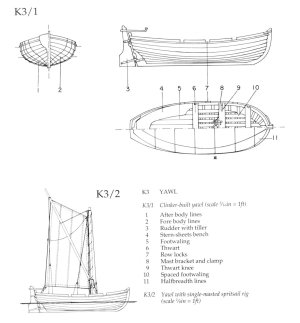
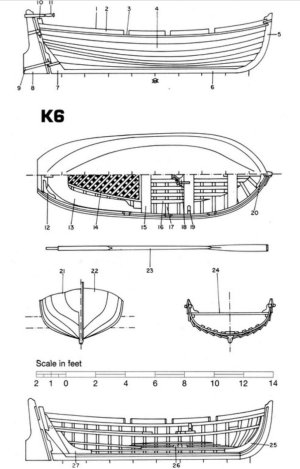
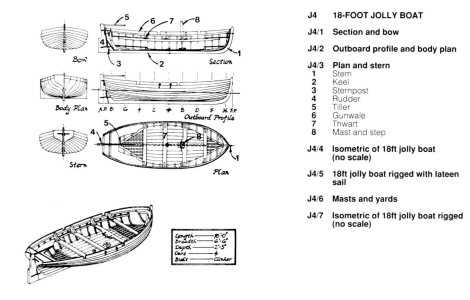
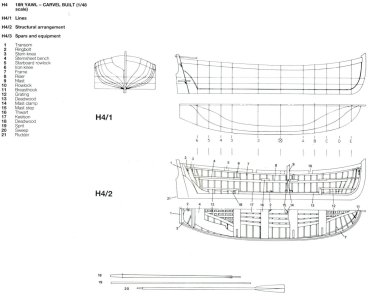
When I get around to building boats for Alert, I'll examine this issue in detail, because there's a major error in the Alert anatomy for the second boat. There are quite a few errors, but this one is particularly jarring. In short, an 18-foot cutter is realistic, but a 16-foot longboat is simply a scaled-down version of a larger boat, or even a larger one. Since it's simply impossible for a small boat to have eight benches, it's simply an mistake.

- Joined
- Apr 21, 2018
- Messages
- 975
- Points
- 353

Having the complete set of the 'Anatomy' series of books I collated all the small boat drawings into a smart little 'book'; each of the drawings were re-sized to a common 1:48 scale.
Can't believe the publishers haven't done the same, it seems such a simple but useful thing to do.
Can't believe the publishers haven't done the same, it seems such a simple but useful thing to do.
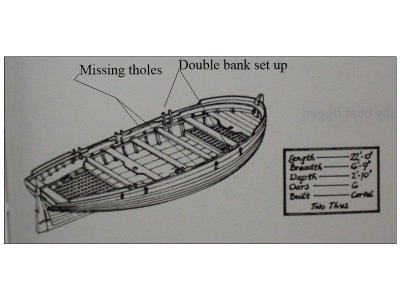
Thanks Serikoff for posting these drawings. They are very well done but I was actually hoping for contemporary plans rather than modern day plans like in the AOTS series of books which are not always realistic as you point out. I would hope the drawings in these books are based on contemporary plans, but as you point out, they cannot be trusted without proper research to be sure. Another example of a gross error is the pinnace drawing in the AOTS book on the Pandora. They show the pinnace with a pair of tholes for every other thwart so half the thwarts are without any tholes at all so would have no rowers on those. Pinnaces were commonly, if not always, single banked and launches and long boats were usually double banked if the breadth was sufficient for two rowers on a thwart. Their drawing is neither single banked nor double banked. This mistake is not uncommon and is likely not knowing how to read contemporary drawings which sometimes show only one side in a cutaway view. This same mistake is found on many of the boat kits from Vanguard Models so the book mistake is not a lone case. Thanks again.
Allan
Allan
Last edited:


I’m just guessing here, but it seems like small boats possibly were not built to a specified contract, like the ship was, but rather the details were left to the expertise of the boatwright at whatever small boat shop was available at the time and place. Thus, I think it would be likely there was a lot of variety amongst the thousands of ships boats across the fleet. Am I wrong in that?
Last edited:
- Joined
- Apr 21, 2018
- Messages
- 975
- Points
- 353
That hit the nail on the head! Standardization of ships boat design came very late in the game.I’m just guessing here, but it seems like small boats possibly were not built to a specified contract, like the ship was, but rather the details were left to the expertise of the boatwright at whatever small boats possibly were shop was available at the time and place. Thus, I think it would be likely there was a lot of variety amongst the thousands of ships boats across the fleet. Am I wrong in that?
EDIT...
I have a comprehensive collection of relevant reliable books; have read them all over many years, so please forgive me not remembering exactly where I gleaned that boats were built in lots of small boat yards, by craftsmen who built from experience.
I suspect most of these builders were illiterate but knew what a 30 foot longboat (as an example) empirically required.
So I stand by my original comment.
I think 99% of modellers would be content and proud if their efforts were successfully based on the drawings above.
The 1% who disagree may well be correct, but I'm sure the average competent modeller would feel these contentions border on pedantry.
Last edited:
I totally agree that probably was the case. But, why build any boat with thwarts that could not be used to help row? I am convinced the drawings are as shown only because whoever did them did not know how to interpret the old cutaway drawings and did no research on which boats were single banked and which were double banked. In the end I may dead wrong (wouldn't be a first, I think it would be likely there was a lot of variety amongst the thousands of ships boats across the fleet.
 ) but barring information based on contemporary sources to the contrary I do not believe pinnaces were ever configured like in the AOTS book. Another thing that might be a point of some interest, on the drawing posted in post #148, the thwarts with the support for the masts have no knees. There is no way those two thwarts would be loose thwarts. The aft one actually has hole which makes no sense, especially when the forward one is shown as was normally done.
 Allan
When you say late, when do you mean? 17th, 18th, `9th century? The scantlings I have found from the 17th and into the 18th century do not vary much. There were contracts given to the yards as well. One example for a pinnace and a yawl is below. They do not give scantlings but you may find this interesting. Spelling, grammar and punctuation are as in the contract.Standardization of ships boat design came very late in the game.
Allan
Contracted the 9th of 7ber [September ] 1790 with the Honoble Tho[mas] Willshaw, Esqre one of the Principall Officers & Commrs of their Majties Navy, for and behalf of their Maties, by me Tho[mas] Oxford of Gosport Shipwright and I doe hereby oblige my self to deliver into their Majties Stores at Portsmouth, by ye end of 8ber [October] next ensueing the Pinnace and Yawle undermentioned of the Dimensions and Scantlings folling (viz)
Long Broad Deep
Pinnace of 32ft: ----- 6ft: ------ 2ft: 7ins ------- One
Depth of the Keel: 5 ins breadth 4 ins, Scantlings of the timbers 1 ½ ins Roome and space 13 ins, depth of the Gunwales up & down 4½: ins in and out 2 ins & 1½ in, Scarph of ye Timber 18 ins, breadth of ye Stem thwartships 3½ ins fore and aft 7 ins, Stern post 3ins, Rising 4½ in, footwales 4½ ins and one inch in and out, Keelson 8 ins X 1½ in thick, to be fitted with 12 Iron Knees 5 bound thwarts wth Iron Knees & two Transom Knees, with gang boards and Scarr boards [Wash boards], benches three lynings, Grounds & mouldings, plankshires turn[e]d off, back board one, bottome boards two, Keel band 22 ft Ring bolts two, Rother iron two paire, Rother one, once primed at the Rate of fourteen shillings per foot.
Yawle of Long Broad Deep
23 ft 5 ft 7 ins 2ft 5 ins One
Railes for the upper strake to be made out of ye whole wood up & down Gunwales stuck,
3 thaurts bound with Iron knees, & ye transoms with two Iron knees.
The State Room (stern sheets, or officers’ seating area) stuck (presumably meaning ‘struck’) with an O:G. & plansheer for the Gunnwales with pannels on each side the back board, a locker under the after bench & lynings under the benches, keel thwart shipps 4 ins up and downe, 4 ½ ins X 4 ins Keelson 6 ins broad of 1 ½ ins planck timbers of 1 ½ ins with 13 ins roome and space and 18 ins Scarph, the flower [floor] timber heads to Naile to ye lower edge of ye binding strake, with bottom boards, & shear boards, Keelbands and Iron bolts and Rings for stem and stern, to row with six Oars to be graved and primed to the water line and paid with stuff in the inside to ye Riseing att 12s per foot

- Joined
- Sep 10, 2024
- Messages
- 1,154
- Points
- 443

But, why build any boat with thwarts that could not be used to help row?
Well, the Officer in Command needed a place to sit and what better place than in the middle of the boat surrounded by oarsmen (i.e. meat shields) to help protect him from enemy fire?

That would be my plan if I was the guy in charge, but might be frowned uponOfficer in Command needed a place to sit and what better place than in the middle of the boat surrounded by oarsmen
Last edited:

I want to wish you a Happy Birthday, Allan. Enjoy this day!
Regards, Peter
Regards, Peter

Hi Allan,
It really interesting to follow your though processes though this thread, especially as it is all so well illustrated and producing an attractive and tangible result.
It really interesting to follow your though processes though this thread, especially as it is all so well illustrated and producing an attractive and tangible result.
Thanks Richard. I think a lot of the benefits from this string of posts came from the contribution from other members. The more pairs of eyes on the subject, the more we all learn. Thanks again.It really interesting to follow your though processes though this thread, especially as it is all so well illustrated and producing an attractive and tangible result.
Allan

- Joined
- Oct 23, 2018
- Messages
- 1,015
- Points
- 443
Happy birthday, Allan

Best wishes on your birthday, Allan! I hope you have a great day celebrating!