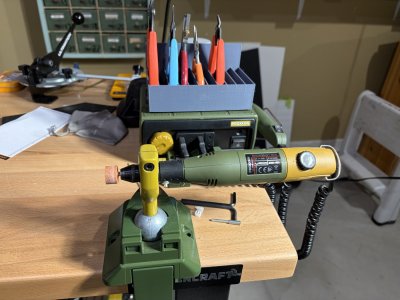
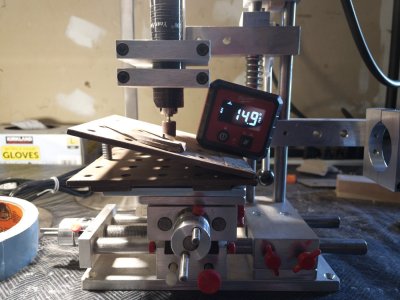
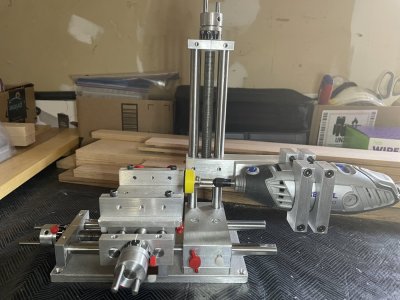
.
Admittedly, it was not my intention to get overly involved in this already settled issue, but perhaps it is worth mentioning other, usually overlooked issues, hopefully for the benefit of others.
Below is a selection from my personal hobbyist toolkit for small and very small scale model making. Not because I intend to get into some kind of bidding war over who has what, but to clearly show that all the rotary tools from one manufacturer shown here are completely compatible with all the accessories from the same manufacturer (apart from the already mentioned possibility of trivially easy making such self-made holders). This is precisely thanks to the “magical” metal neck with a uniform diameter of 20 mm for all Proxxon rotary tools (whether corded or cordless; however, like Roger, I have been avoiding battery-powered variants like the plague for a long time

). This metal neck provides a secure, rigid, stable grip, and replacing any rotary tool in any holder is quick and easy (in Dremel, it was a plastic thread, unscrewable flanges, and some equally plastic washers, and all of this could be in quite different sizes for different Dremel models; honestly – an engineering and practical nightmare). Incidentally, all the essential components in Proxxon accessories of this type are made of metal, unlike Dremel, where even strategically important components (in terms of their stability and rigidity) are regularly made of plastic.
Apart from these features, I think that in addition to the quality and precision of the devices themselves (Proxxon lacks nothing in this respect for our DIY projects), it is also worth considering features such as versatility and universality (interchangeability of components) in systems offered by different manufacturers, as well as, if necessary, the possibility of easily and quickly expanding one's own set with new system components through subsequent purchases, as well as the possible replacement and servicing of system components one's already own. As it happens, Proxxon meets all these conditions very well, selling its products and servicing them “all over the world.” On the other hand, apart from some really successful deals, I have also had bad and very bad experiences when buying used items of this kind, and besides, they usually don't fit with anything else one already have (particularly when it comes to the device-holder interface).
For example, one can start by buying a specific model of rotary tool and just leave it at that. Or, one can gradually expand the arsenal with additional accessories, knowing that they are always available or at least will be in the foreseeable future. And, once a larger arsenal in one system is already accumulated , even the failure of, say, the base rotary tool will not be a disaster, since one can always have it serviced or instantly buy another, replacement one.
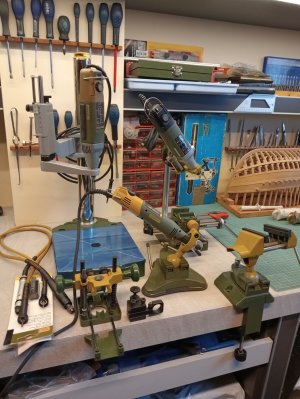
.