• Win a Free Custom Engraved Brass Coin!!!
    As a way to introduce our brass coins to the community, we will raffle off a free coin during the month of August. Follow link ABOVE for instructions for entering.

Rotary Tool - Recommendation Request

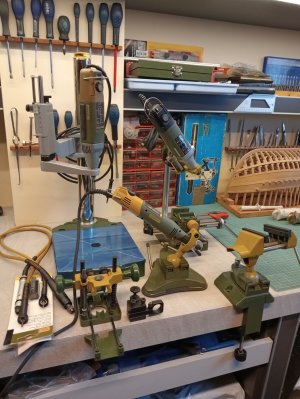
Quite true about Proxxon's quality compared to Dremel. However, Proxxon remains a "speed" rather than "torque" dependent tool and is much larger and less ergonomic than the smaller handpiece rotary tools. Holders as you've pictured are readily available in the U.S. for both the Dremel mototool and for the one-inch diameter Foredom handpieces. The one I have for my Dremel is threaded to match the threads on the neck of the Dremel mototools, while the one I have for my Foredom handpieces clamps down with cap screws. Both are styled as the one for the Proxxon, identical to 1/2" lathe tool holders so that they can be mounted on the cross-slide of my 12" lathe and used as highly accurate X-Y micro tool post grinders and mills.
I’m getting a Dremel with a clamp designed for the model I chose. I’m just waiting to see how it goes once I start using it.
 
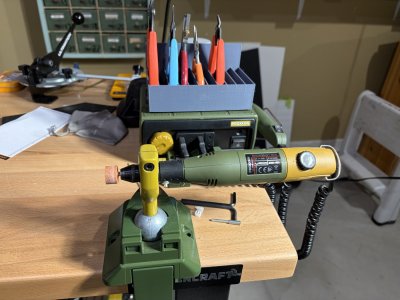
I have the Proxxon Micromot 60/E. It replaced my Dremel and there's no looking back. It's easier to hold than the old (really old) Dremel. I quite like the speed control - two actually as there's another on the power supply. I have a bench mount for it and use it all the time. It's really easy to remove from the bench mount too. Here's a pic of that setup.

Cheers,

Todd

proxxon.JPG
 
.​
Quite true about Proxxon's quality compared to Dremel. However, Proxxon remains a "speed" rather than "torque" dependent tool and is much larger and less ergonomic than the smaller handpiece rotary tools. Holders as you've pictured are readily available in the U.S. for both the Dremel mototool and for the one-inch diameter Foredom handpieces. The one I have for my Dremel is threaded to match the threads on the neck of the Dremel mototools, while the one I have for my Foredom handpieces clamps down with cap screws. Both are styled as the one for the Proxxon, identical to 1/2" lathe tool holders so that they can be mounted on the cross-slide of my 12" lathe and used as highly accurate X-Y micro tool post grinders and mills.

Oh, this is all fine, yet, since the decision on the choice of a specific manufacturer has already been made, continuing to compare the advantages and disadvantages of different options would essentially be rather akin to an academic debate, perhaps :).

.​
 
I’m sure this question has been asked many times, but here I am again: I’m looking to add a rotary tool to my growing tool arsenal, and I’m not entirely sure which brand or model would be the best fit. There are plenty of great options out there—Dremel, Foredom, Proxxon, and more—so it can get a bit overwhelming.

From Dremel alone, I’m considering the 300, 3100, and 4300 models. On the Proxxon side, the FBS 115/E and the IBS/E both look like solid contenders. Foredom is also an excellent alternative, but its price point is a bit high for me right now since I’m still learning and trying to spend wisely.

As always, I’ll appreciate any feedback. My daughters asked me for a Christmas present, and I need to get Santa ready for delivery!
I have been trying different brands from very inexpensive to overpriced. They all have a wobble at various rpm's.
The only one that works great, at least what I have tried was Proxxon. More expensive than Dremel but way worth it.
I have two different Dremels, one old Sears brand (decades old but still works) and a real cheap Chinese one from Amazon. From now on, all my power tools will be Proxxon without a doubt. Well worth the price!
 
I've always used a Dremel, but, and I'm sure some will laugh, but Harbor Frieght carries several, with accessories, from $10 to $80. I do have the cheap one, if you're on a tight budget, it should do what you need, and if not, not much to lose.
 
I've always used a Dremel, but, and I'm sure some will laugh, but Harbor Frieght carries several, with accessories, from $10 to $80. I do have the cheap one, if you're on a tight budget, it should do what you need, and if not, not much to lose.
No laughing here—Harbor Freight actually has some surprisingly decent tools. For light to moderate use, those cheaper rotary tools can get the job done just fine, and like you said, at that price there’s not much risk. If it ends up not meeting your needs, you’re only out a few bucks, and if it does, even better.
 
.​


Oh, this is all fine, yet, since the decision on the choice of a specific manufacturer has already been made, continuing to compare the advantages and disadvantages of different options would essentially be rather akin to an academic debate, perhaps :).

.​

As to the original poster perhaps, but I intended the post for those who may be using Foredom or Dremel rotary tools. The holders are handy accessories to have if you have jobs to do with them. Truth be told, unless one is doing a fair bit of miniature carving and metal grinding, buffing, and polishing, a rotary tool is about the least necessary electrically powered ship modeling tool of them all. People buy them thinking they are necessary, but there are actually no ship modeling tasks that require them, and very few which are much easier with them, while most jobs done by rotary tools can be done much better by a more specialized tool. This isn't to say that they aren't handy from time to time, but I've found the importance many modelers seem to place upon them is exaggerated.
 
Last edited:
.​
As to the original poster perhaps, but I intended the post for those who may be using Foredom or Dremel rotary tools [...].

Yes, you are absolutely right. I myself use these rotary tools to a moderate extent, mainly because most jobs are better suited to slow-speed machines such as lathes or milling machines. But when they are needed for a specific task, they are simply irreplaceable. In addition to the tasks you have already mentioned, for example, for making hundreds and thousands of holes when treenailing. But how can one hit the right spot when the tip of the drill bit mounted in the Dremel spins in circles "as big as a Neolithic Stonehenge" and the rotary tool itself slips out of the hand due to the enormous vibrations? On the other hand, the Dremel bits themselves are good, very good. I would also add that Proxxon's quality and precision is good enough that one no longer need to look for expensive and ultra-expensive offers.

.​
 
Hey, something I can comment about! Most rotary tools are bulky and really require a corded hand piece. That is where your fit comes in. I have a Dremel and a Foredom, both with hand pieces. Problem for me is I am getting the hand piece to cooperate with where I want it is difficult, because of the diameter of the cord. I have ordered a Dremel Stylo because it looks like it may alleviate the problem. The wood on ship models is usually bass and easy to carve. Admittedly, my use has been in wood carving on harder woods, so you might not have this concern. Anyway, good luck with your search and let us know what you decide on and how well it works for you!!
 
I use a Certa rotary tool, it is corded and rated a bit higher than many others for power, it is also reasonably priced, maybe hard to find depending on where you are.
I am so pleased with it I have bought another identical machine as a spare just in case. I fitted it with a cheap Chinese 3 jaw chuck.
Excellent.

Doug Hey NZ.
 
I really love the feedback and the discussions here—both the pros and cons, the practical experiences and the more academic perspectives. This kind of exchange is really the foundation of the forum: sharing, agreeing and disagreeing respectfully, and helping others form their own experience through thoughtful input from friends we may not know personally, but who share the same passion. Thanks All and Happy Holidays !!
 
I have had a Sears Dremel clone; single speed, corded, since the 1970’s and found it to be unnecessary and useless for the ship models that I built prior to my present project. It’s too fast for drilling and can remove way too much material in an instant. Instead, I have tried to improve my skills with hand tools. Its main use is turning an abrasive disc for cutting metals.

Several years ago, a friend gave me a Dremel two speed rechargeable rotary tool. It’s more useful as I have been making many brass parts for my current project. It’s particularly useful with a tiny dental bit for cleaning up soldered joints. Like most battery powered tools, the battery is discharged when I want to use it.

I also have a Proxxon engraving tool that drives a tiny ball ended tool. It is variable speed driven by a separate power supply. As posted above, my impression is that it’s a much better built tool than the Dremel product. It’s primary use is also solder cleanup.

Roger
 
I've been getting a lot of use out of a Chinese "Nail drill" or "nail machine". It has a corded handpiece with a quick change collet for smaller than 1/8" 2.35mm shank bits. Lots of bits in this size are available. Variable speed and has been working well for a couple of years now for rotary engraving and most things I use the Dremel for. It was phenomenally inexpensive! There are several styles available from all of the usual sources. Here's a link to one on Temu:
 
Last edited:
Proxxon's quality and precision is good enough that one no longer need to look for expensive and ultra-expensive offers.

Ageed! However, over the many years I've been around, I've always kept my eyes open for used top shelf tools in good shape and I've been able to accumulate a nicely equipped shop of "the good stuff" for a lot less than the "good enough" at retail. There were a lot of years that went by while I was hoping and wishing and waiting for those good used tools deals to come along, but I got all the tools I needed and somebody will still be using them long after I'm gone.
 
Last edited:
I’m sure this question has been asked many times, but here I am again: I’m looking to add a rotary tool to my growing tool arsenal, and I’m not entirely sure which brand or model would be the best fit. There are plenty of great options out there—Dremel, Foredom, Proxxon, and more—so it can get a bit overwhelming.

From Dremel alone, I’m considering the 300, 3100, and 4300 models. On the Proxxon side, the FBS 115/E and the IBS/E both look like solid contenders. Foredom is also an excellent alternative, but its price point is a bit high for me right now since I’m still learning and trying to spend wisely.

As always, I’ll appreciate any feedback. My daughters asked me for a Christmas present, and I need to get Santa ready for delivery!
I had a Dremel, but found it awkward to use, so sold it & replaced it with a Proxxon kit including a flexi drive & added a foot switch to make life easier.
 
Back
Top