I know this feeling. It is the best therapy ever.There were plenty of jokes this holiday along the lines of: will someone help dad please; he only has one eye you know...

 |
The beloved Ships in Scale Magazine is back and charting a new course for 2026! Discover new skills, new techniques, and new inspirations in every issue. NOTE THAT OUR NEXT ISSUE WILL BE July/August 2026 |
|
 |
As a way to introduce our brass coins to the community, we will raffle off a free coin during the month of August. Follow link ABOVE for instructions for entering. |
|
I know this feeling. It is the best therapy ever.There were plenty of jokes this holiday along the lines of: will someone help dad please; he only has one eye you know...


After about 80 patients daily...


Most orthodontists operate this way80 patients per day?!?!
How many hours do you work in a day? When do you have time to sleep, let alone work on those beautiful ships you create?!?
 . 80 is the slowest I have ever worked (now in my dotage
  ) - when I was young and strong it used to be quite a bit more. It certainly makes the day pass by quickly.
Most orthodontists operate this way


Thanks, Dirk. I bet Christmas was very special with your four-year-old!


Thanks, Marc. I've actually had a rough week with regards to eyesight. My post-op experience after the Christmas Eve surprise surgery has not been what was hoped for. My modeling has been reduced to applying a finish to the work previously completed. Bummer, because I was looking forward to having extra time in the shipyard during the holidays... Then again, I've been postponing getting a finish on this model for too long.You know Paul - I leave you to your own devices for TWO SWITCHES of the Cat-O-9 tails, and look at all that has happened!
For any man or woman not undergoing corrective eye surgery, your “good enough” is our Sunday best. The work is and remains at the highest standards. Really beautiful lines!
And, speaking of beautiful, what a lovely family in your fold! I will say the same for you, Gilbert!
(too cold to apply a finish out in the garage).

Right back at you, Jim. May 2026 be your best year ever!Get well soon, mon ami — and Happy New Year to you and yours! May it start on a brighter note!
All in all, it's just another brick in the wall
View attachment 567571
Praying things take a better turn as you enter this new year! I'm sure you will adapt and overcome, no matter the challenge. Be well.Thanks, Marc. I've actually had a rough week with regards to eyesight. My post-op experience after the Christmas Eve surprise surgery has not been what was hoped for.
My thanks, Brad. Onward we go...Praying things take a better turn as you enter this new year! I'm sure you will adapt and overcome, no matter the challenge. Be well.
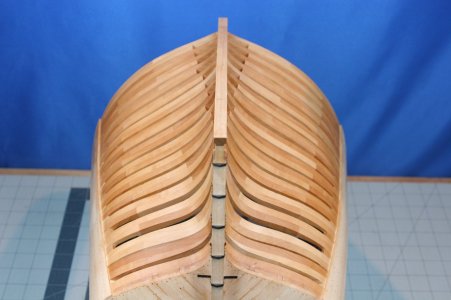
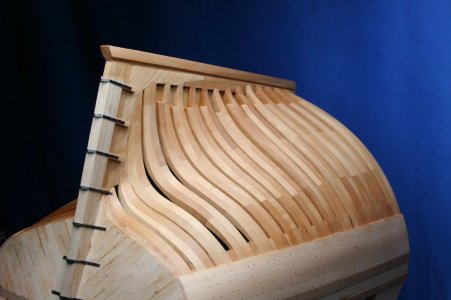
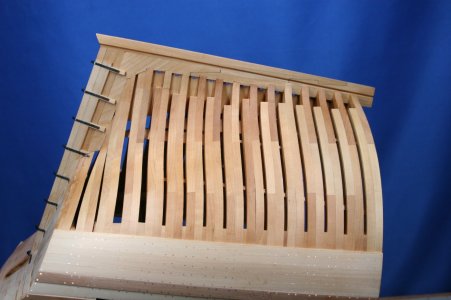
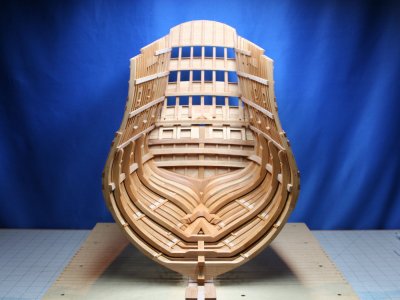
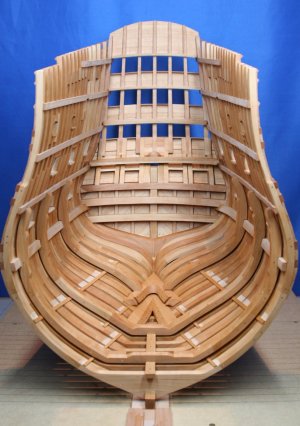
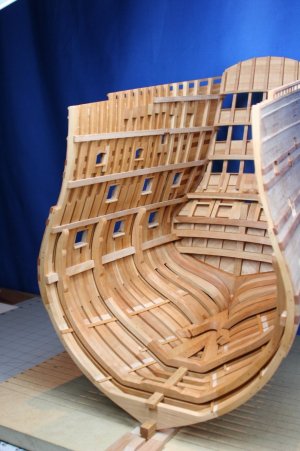
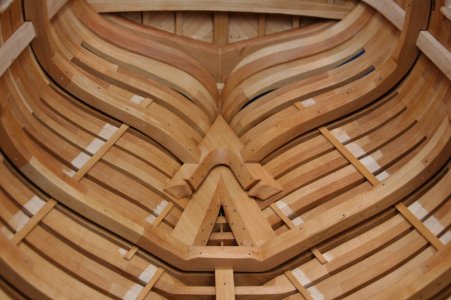
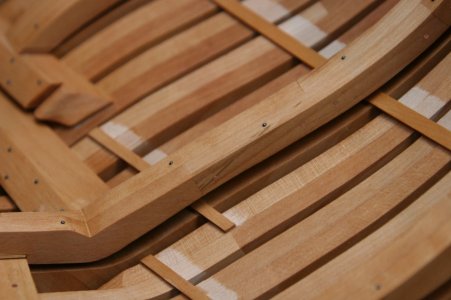
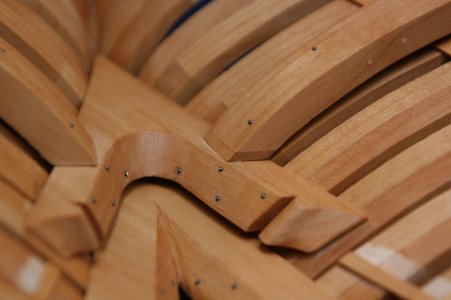
Good morning Paul. I have that feeling that 2026 will be a brilliant year. If not we will just have to make it so.Hello Friends,
Some time ago I began wondering what sort of finish I should put on this stern section model. I looked at a lot of other builds and did all kinds of trials with all manner of materials. I happen to have real Bitumen of Judea (banned in the US) from when I was tinting ropes for my version of the Vasa and noted how some of the models I am aesthetically drawn to incorporate that to create an aged look. Michele Padoan and several of the Russian/Ukranian/Polish masters use this. I believe Sergey (@serikoff) will be finishing his current project in that aged style. There is a lot to like in this approach, and it is always what I envisioned for the Saint Philippe.
Well, I didn't end up doing any of that. I ended up using a concoction 'invented' by fellow forum member Russ (@RussF). In equal proportions I mixed pure tung oil, a gloss marine varnish, and a solvent (I used turps, but others worked just as well).
Here is why I went with this mixture: pear wood reacts beautifully to oils. I used polymerized linseed oil on my Vasa (my avatar). Tung oil is even more impressive but takes FOREVER to set (does it ever really set?). By mixing tung oil with varnish the set time was dramatically reduced. But those two things alone create a mix that is sort of thick. The solvent corrects that problem. As mixed you can literally see the concoction soaking into the wood.
BUT!!! Unlike straight (well, cut with a solvent but nothing else) linseed or tung oil this mixture only penetrates a short way. I have samples with straight linseed oil that soaked through 8 mm of pear wood! I do not view this as an advantage. All finishes impede bond strength. You literally cannot scrape or sand away enough wood to get past straight linseed or tung oil. But this concoction only penetrates a short way. If I need to scrape it away in the future I can get down to relatively raw wood (I suppose there is still some oil in it, but it looks very much like untreated pear wood). I love this possibility.
Enough talking. The following images show where I am at today... I did tape off the deck clamps, larger gun ports, and some locations where light beams will be placed in the lower part of the hold. I also did not apply finish to the exterior planking or the stern post (and probably won't until I am much further along with that part of the build).
View attachment 567729
View attachment 567727
View attachment 567728
View attachment 567730
View attachment 567731
View attachment 567732
View attachment 567733
View attachment 567734
View attachment 567735
One small downside to this concoction is that it cannot be reapplied (for example, 24 hours later). Unlike a pure oil finish reapplication just sits on top of the cured surface (it no longer soaks into the wood). Indeed, it ends up being shiny and I am not a fan of shiny of a ship model.
Oh, by the way, I have also done some recent trials by dissolving Bitumen of Judea into microcrystalline wax. That paste can then be applied to what you see above if I want to add some aging after all. We'll see...
Sorry about the lengthy narrative...

Excellent color and stunning work!Hello Friends,
Some time ago I began wondering what sort of finish I should put on this stern section model. I looked at a lot of other builds and did all kinds of trials with all manner of materials. I happen to have real Bitumen of Judea (banned in the US) from when I was tinting ropes for my version of the Vasa and noted how some of the models I am aesthetically drawn to incorporate that to create an aged look. Michele Padoan and several of the Russian/Ukranian/Polish masters use this. I believe Sergey (@serikoff) will be finishing his current project in that aged style. There is a lot to like in this approach, and it is always what I envisioned for the Saint Philippe.
Well, I didn't end up doing any of that. I ended up using a concoction 'invented' by fellow forum member Russ (@RussF). In equal proportions I mixed pure tung oil, a gloss marine varnish, and a solvent (I used turps, but others worked just as well).
Here is why I went with this mixture: pear wood reacts beautifully to oils. I used polymerized linseed oil on my Vasa (my avatar). Tung oil is even more impressive but takes FOREVER to set (does it ever really set?). By mixing tung oil with varnish the set time was dramatically reduced. But those two things alone create a mix that is sort of thick. The solvent corrects that problem. As mixed you can literally see the concoction soaking into the wood.
BUT!!! Unlike straight (well, cut with a solvent but nothing else) linseed or tung oil this mixture only penetrates a short way. I have samples with straight linseed oil that soaked through 8 mm of pear wood! I do not view this as an advantage. All finishes impede bond strength. You literally cannot scrape or sand away enough wood to get past straight linseed or tung oil. But this concoction only penetrates a short way. If I need to scrape it away in the future I can get down to relatively raw wood (I suppose there is still some oil in it, but it looks very much like untreated pear wood). I love this possibility.
Enough talking. The following images show where I am at today... I did tape off the deck clamps, larger gun ports, and some locations where light beams will be placed in the lower part of the hold. I also did not apply finish to the exterior planking or the stern post (and probably won't until I am much further along with that part of the build).
View attachment 567729
View attachment 567727
View attachment 567728
View attachment 567730
View attachment 567731
View attachment 567732
View attachment 567733
View attachment 567734
View attachment 567735
One small downside to this concoction is that it cannot be reapplied (for example, 24 hours later). Unlike a pure oil finish reapplication just sits on top of the cured surface (it no longer soaks into the wood). Indeed, it ends up being shiny and I am not a fan of shiny of a ship model.
Oh, by the way, I have also done some recent trials by dissolving Bitumen of Judea into microcrystalline wax. That paste can then be applied to what you see above if I want to add some aging after all. We'll see...
Sorry about the lengthy narrative...

The coloring looks very promising, Paul. The woodgrain got a nice warm color.Hello Friends,
Some time ago I began wondering what sort of finish I should put on this stern section model. I looked at a lot of other builds and did all kinds of trials with all manner of materials. I happen to have real Bitumen of Judea (banned in the US) from when I was tinting ropes for my version of the Vasa and noted how some of the models I am aesthetically drawn to incorporate that to create an aged look. Michele Padoan and several of the Russian/Ukranian/Polish masters use this. I believe Sergey (@serikoff) will be finishing his current project in that aged style. There is a lot to like in this approach, and it is always what I envisioned for the Saint Philippe.
Well, I didn't end up doing any of that. I ended up using a concoction 'invented' by fellow forum member Russ (@RussF). In equal proportions I mixed pure tung oil, a gloss marine varnish, and a solvent (I used turps, but others worked just as well).
Here is why I went with this mixture: pear wood reacts beautifully to oils. I used polymerized linseed oil on my Vasa (my avatar). Tung oil is even more impressive but takes FOREVER to set (does it ever really set?). By mixing tung oil with varnish the set time was dramatically reduced. But those two things alone create a mix that is sort of thick. The solvent corrects that problem. As mixed you can literally see the concoction soaking into the wood.
BUT!!! Unlike straight (well, cut with a solvent but nothing else) linseed or tung oil this mixture only penetrates a short way. I have samples with straight linseed oil that soaked through 8 mm of pear wood! I do not view this as an advantage. All finishes impede bond strength. You literally cannot scrape or sand away enough wood to get past straight linseed or tung oil. But this concoction only penetrates a short way. If I need to scrape it away in the future I can get down to relatively raw wood (I suppose there is still some oil in it, but it looks very much like untreated pear wood). I love this possibility.
Enough talking. The following images show where I am at today... I did tape off the deck clamps, larger gun ports, and some locations where light beams will be placed in the lower part of the hold. I also did not apply finish to the exterior planking or the stern post (and probably won't until I am much further along with that part of the build).
View attachment 567729
View attachment 567727
View attachment 567728
View attachment 567730
View attachment 567731
View attachment 567732
View attachment 567733
View attachment 567734
View attachment 567735
One small downside to this concoction is that it cannot be reapplied (for example, 24 hours later). Unlike a pure oil finish reapplication just sits on top of the cured surface (it no longer soaks into the wood). Indeed, it ends up being shiny and I am not a fan of shiny of a ship model.
Oh, by the way, I have also done some recent trials by dissolving Bitumen of Judea into microcrystalline wax. That paste can then be applied to what you see above if I want to add some aging after all. We'll see...
Sorry about the lengthy narrative...

I used wipe-on-poly on the Kingfisher because I wanted the wood to stay light. Poly doesn't change the color of the wood as much as other options so that aspect is nice (can be nice). But regular polyurethane builds up and becomes a layer on top of the wood that looks weird to me on a ship model.Good morning Paul. I have that feeling that 2026 will be a brilliant year. If not we will just have to make it so.
The oil mix really brings out the wood colour beautifully. I’m going to move away from poly on my ship for everything above the wales so I appreciated the lengthy post. In SA we don’t get Tung oil so boiled linseed it is.
Good luck with your eye and may 2026 “see” a complete recovery.
Cheers Grant
Thank you, Mirek!Witaj
Uzyskałeś piękny kolor gruszy ,piękna praca i zdjęcia Pawle. Pozdrawiam Mirek
Well, I am certainly going to tune in for your upcoming bitumen tutorial...Excellent color and stunning work!
Regarding the oil... I made new samples and will be applying Danish oil to the upper deck of the first hull so that its color is lighter and differentiates it from the lower deck, making the lower deck more visible. I coated the hull skeleton with tung oil, and I have mixed feelings about it. It seems okay, but it's a little darker than I expected. And the fact that it took a long time to dry is putting it mildly... And now I'm wondering what to do with the second hull... Before fixing the planks, I coated them with tung oil, and I really liked the color... but I'll still try Danish oil on samples and see if it makes a difference. I just like the baby oil; it dries very quickly, applies perfectly, and has a pleasant smell. But I'll still be evaluating the color; it's more important. But experience is important; I'll be coating with bitumen later, so that's also important... which option will be better after it's applied. So I understand you... this is a very important aspect of construction and it is very easy to screw everything up and very difficult or even impossible to fix everything. Therefore, I wish you to find your ideal solution and then be happy that you did exactly that!
Thanks, Peter. I made no effort at selecting matching billets of pear so there is quite a lot of tonal variation. Sometimes I like what it looks like and sometimes I wish it was more uniform. We'll see if additional treatments will happen or not...The coloring looks very promising, Paul. The woodgrain got a nice warm color.
Regards, Peter
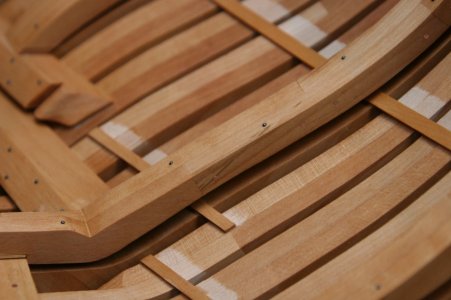
I agree, Daniel. Oil just makes the magic happen on pear. Look at the contrast between where I taped off along the edge of the cleats and the treated area next to it. Amazing how the wood tone changes!Your research of finishes has really paid off! The rich warm wood tones are spectacular.
Thank you kindly, Stephan. And I appreciate the prayers for my eye. It has been a discouraging week given my normal positive worldview...I agree with Peter, the olour of the wood is looking great, the woodgrain looks very good.
A happy 2026 and let's pray that your eye will be a lot better soon.