
-

SUBSCRIBE TO SHIPS IN SCALE TODAY!
The beloved Ships in Scale Magazine is back and charting a new course for 2026!
Discover new skills, new techniques, and new inspirations in every issue.
NOTE THAT OUR NEXT ISSUE WILL BE July/August 2026 -

Win a Free Custom Engraved Brass Coin!!!
As a way to introduce our brass coins to the community, we will raffle off a free coin during the month of August. Follow link ABOVE for instructions for entering.


You are using an out of date browser. It may not display this or other websites correctly.
You should upgrade or use an alternative browser.
You should upgrade or use an alternative browser.



Thank you Kurt! I have been shrouded, but now doing better since they were rat lined.We are no longer shrouded in mystery on how you got all this done so nice and neat.
Great work, and I will for sure copy and print your build log for review before I begin my cross section.
 This kit has been fun! One thing I keep thinking is that I am only doing 1/3rd the rat lining that would be required on a full size ship. That alone is enough to humble one.
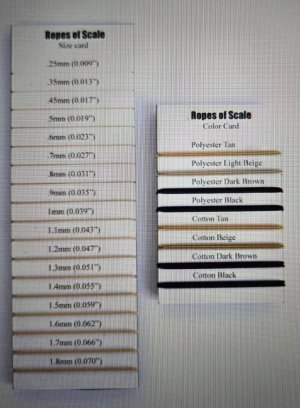
Mike I am using a mixture of lines. The cannon lines were all from the kit. I then bought line from Ropes of Scale and Syren model kit. The lower shrouds were from the kit but served with sewing line I picked up at Michaels. The upper set of shrouds were done with 0.5mm (0.019)" lines from Ropes of scales because I wanted something thinner for the upper shrouds. The rat lines were done from the lines included in the kit. The running rigging will be mostly from Ropes of Scale and Syren. I think the Ropes of Scale and Syren line are clearly superior to what the kit offers and probably easier to handle.Rob, is the rigging line you are using mostly supplied in the kit or are you using "after market" line also?
Hit back when you can.
Cheers
Mike
The blocks on the cannons were from the kit, I then got Beautiful blocks from Model Expo and blocks from Syren. I think I would give the Syren blocks (which are actually 3D printed) an edge over the beautiful blocks. Both are clearly superior to what is included in the kit. If you look at post #169 I have a picture of the 3 different blocks for comparison.
Rob


Very nice Rob.I attached the preventer sling to the main yarn wrapping line through both thimbles. I also attached the 2 triple blocks along side the preventer sling. These all wrap inside the sling cleats in the front of the yarn and the lines are wrapped under the jackstay wire. In case you are interested these blocks are from Syren models and they are really well made and, as you can see, look great.
The instructions, I believe have incorrectly labeled these. The one labeled sling should be called the preventer sling. It was there, I gather, to hold the main yarn up in case the other 2 slings (properly called Jeers) were to fail. The other two slings that do the main lifting of the yard were called Jeers.
View attachment 566979
There will still be more lines wrapped in this tight space between the cleats for the truss tackle. These are lines used to hold the yard tight to the mast. This small area is full of blocks and lines going this way and that. It is a bit difficult to figure exactly where things go, but looking at other build logs is a big help.
Grant thank you again for your kind comments and great input!Very nice Rob.

Kurt Konrath
Kurt Konrath
I am also working on my Santissima Trinidad cross section, and have the lower shrouds done and slowing working the upper level now, but very slowly with other holiday taskings, I need to get back to work and finish that so I can start another project, or better finish another project I have started.Thank you Kurt! I have been shrouded, but now doing better since they were rat lined.
Thank you Rob, your build log is invaluable to me and others. Thanks for the hard work on this!Mike I am using a mixture of lines. The cannon lines were all from the kit. I then bought line from Ropes of Scale and Syren model kit. The lower shrouds were from the kit but served with sewing line I picked up at Michaels. The upper set of shrouds were done with 0.5mm (0.019)" lines from Ropes of scales because I wanted something thinner for the upper shrouds. The rat lines were done from the lines included in the kit. The running rigging will be mostly from Ropes of Scale and Syren. I think the Ropes of Scale and Syren line are clearly superior to what the kit offers and probably easier to handle.
The blocks on the cannons were from the kit, I then got Beautiful blocks from Model Expo and blocks from Syren. I think I would give the Syren blocks (which are actually 3D printed) an edge over the beautiful blocks. Both are clearly superior to what is included in the kit. If you look at post #169 I have a picture of the 3 different blocks for comparison.
Rob
Mike
Thank you Mike. Luckily I find the build log fun to do and it really helps me with the build. Happy New years to you and your family.Thank you Rob, your build log is invaluable to me and others. Thanks for the hard work on this!
Mike
After procrastinating for a bit I fixed the royal yard into place.
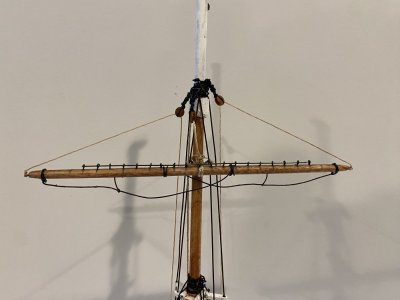
I was not pleased with the slightly eccentric look due to one of the lift blocks on the mast that is higher than the other. I will remedy that. The lift lines run from each end of the yard up to small blocks tied to either side of the mast, then down to the pin rail where they are belayed. The halyard is looped through the yoke and around the middle of the yard, up to the front block on the mast, and down the starboard side to a block and tackle to be hooked onto an eyebolt installed at the aft end of the starboard channel. Once again make sure the halyard is looped below and in back of the jackstay wire. These halyard block and tackles are referred to as jig tackles.
I was not pleased with the slightly eccentric look due to one of the lift blocks on the mast that is higher than the other. I will remedy that. The lift lines run from each end of the yard up to small blocks tied to either side of the mast, then down to the pin rail where they are belayed. The halyard is looped through the yoke and around the middle of the yard, up to the front block on the mast, and down the starboard side to a block and tackle to be hooked onto an eyebolt installed at the aft end of the starboard channel. Once again make sure the halyard is looped below and in back of the jackstay wire. These halyard block and tackles are referred to as jig tackles.
Happy New years all!

- Joined
- Aug 14, 2018
- Messages
- 922
- Points
- 403

Happy New Year Rob
JJ..
JJ..

And to you as well, Rob!Happy New years all!

I shortened one of the leads on the lift block located on the mast so the lift line look more symmetric.
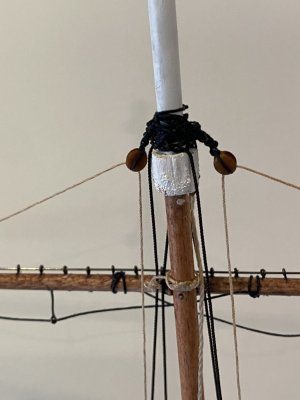
When you are bringing these lines down, be careful that they do not go behind the shroud lines and are going where you want. The lift lines who down to the pin rail. There is a diagram in the plans that locate each line where it goes on the pin rail or fife rails.
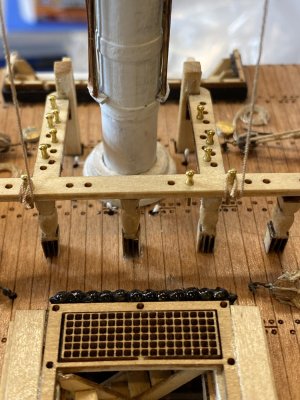
You may notice I did not paint the belaying pins. I really likes the brass look of these and kept them as they were. I am aware they are not historically correct, but this is my cross section so...
The instructions have you strop the end of the halyard with a double block at the level of the pendents. I, of course, mistakenly made them at the end of the upper pendent. If I were to do it again I'd make it even with the lower pendent. At this point I am not going to reline the royal yard with a new halyard line.
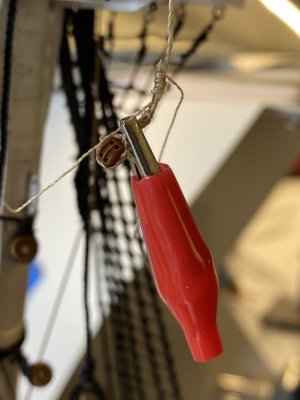
To make the jig tackle the instructions say to strop a small hook and then a double block on the jig tackle line. This is a mistake, it should be a single block. Later on in a picture it refers to a single block. Be it what it may be a jig tackle line was made and attached to the double block at the end of the royal halyard.
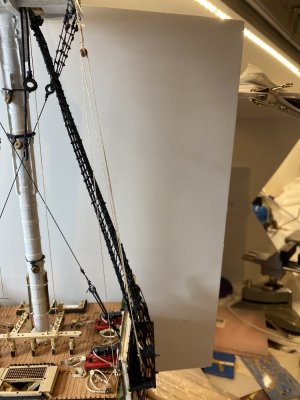
The end with the single block and hook is hooked to an eyebolt on the starboard channel. The end of the jig halyard is belayed to the nearby fife rail.
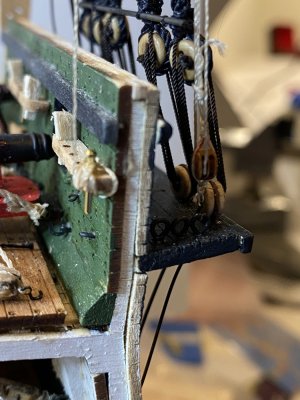
That's it for the royal yard. The simplest one. Next up is the topgallant yard.
When you are bringing these lines down, be careful that they do not go behind the shroud lines and are going where you want. The lift lines who down to the pin rail. There is a diagram in the plans that locate each line where it goes on the pin rail or fife rails.
You may notice I did not paint the belaying pins. I really likes the brass look of these and kept them as they were. I am aware they are not historically correct, but this is my cross section so...
The instructions have you strop the end of the halyard with a double block at the level of the pendents. I, of course, mistakenly made them at the end of the upper pendent. If I were to do it again I'd make it even with the lower pendent. At this point I am not going to reline the royal yard with a new halyard line.
To make the jig tackle the instructions say to strop a small hook and then a double block on the jig tackle line. This is a mistake, it should be a single block. Later on in a picture it refers to a single block. Be it what it may be a jig tackle line was made and attached to the double block at the end of the royal halyard.
The end with the single block and hook is hooked to an eyebolt on the starboard channel. The end of the jig halyard is belayed to the nearby fife rail.
That's it for the royal yard. The simplest one. Next up is the topgallant yard.
Last edited:
Kurt Konrath
Kurt Konrath
I am also working on my Santisima Trinidad cross section, and have the lowere shrouds done and slowing working the upper level now, but very slowly with other holiday taskings, I need to get back to work and finish that so I can start another project, or better finish another project I have started.Thank you Kurt! I have been shrouded, but now doing better since they were rat lined.
Working on the topgallant yard is a bit more complicated. There are 5 lines total to deal with. Two lines are for setting out and retracting the Studding sails (auxiliary sails that extend past the yards when there is a light breeze to catch). Two lines are topgallant lift lines, and one is the togallant halyard. The Studding sail halyards have a small hook on one end that is hooked to one end or the other of the boom to extend or retract it. The line runs under the topgallant yard along two single blocks on each side of the yard and then forward of the topsail cross tree and down the space inside the fighting top and to the forward part of the fife rail.
The topgallant lift lines are seized on one end to a single block that is attached to the mast. It then runs trough a single block on the top outside of the yard (left and right) back to the single block and down behind the topsail cross tree, through the posterior space of the fighting top and are belayed right next to the belayed royal lift lines.
The topgallant halyard is also seized on one end to a single block attached to the mast. It runs to a single block that is part of a sling on the center of the topgallant yard. It then tuns back through the single block on the mast it was seized to and then down parallel to the royal halyard ending in a double block attached to a jig tackle.
All this sounds complicated but when you break it down to separate units it becomes easier. I found the instructions hard to understand, but luckily, Tom Culb in his build log has a wonderful, concise explanation and great pictures that help tremendously.
Before we get to that I thought I would show you a method for seizing lines that I have been using the I like. It is certainly not my idea. I found it on several different you tube videos. It is fairly simple and I like the results.
First off I take the line I want to seize (here attached to a block) and secure it with a clamp. (if you have three hands this is probably not necessary) I take a piece of the seizing line and form a loop. One end of the loop I tape to the clamp. I hold the loop and line to be seized with my hand.
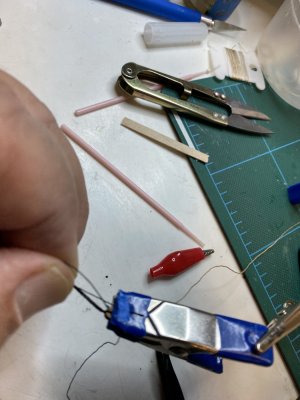
I twist the free end of the seizing line around the line I want seized, usually taking 8-12 turns.
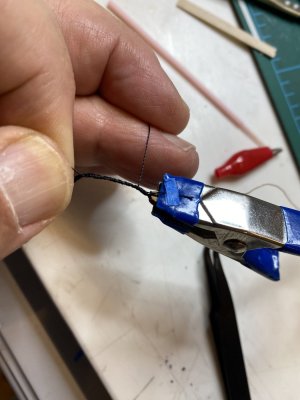
After that is done I take the free end that I have been twisting around and thread it through the loop.
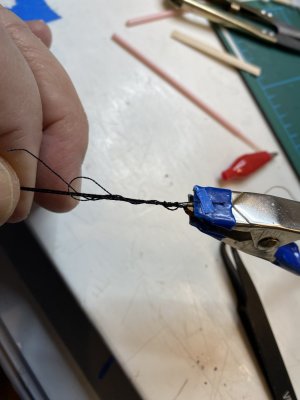
I then pulll on both ends of the seizing line to tighten it up and make it neat.
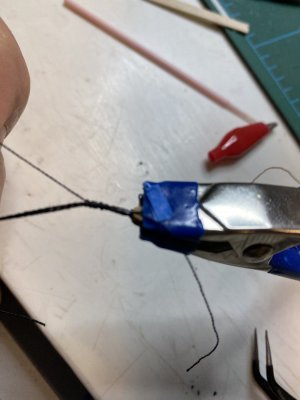
Before you tighten it too much you can slide the seizing along the line to the position you want. I then fix it in place with a dab of CA
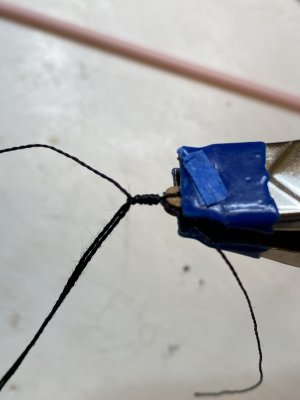
Cut off the excess line and you are all done.
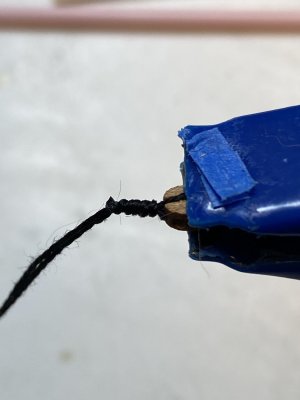
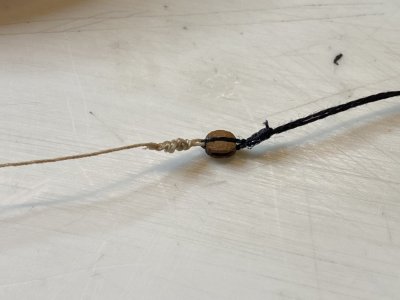
The topgallant lift lines are seized on one end to a single block that is attached to the mast. It then runs trough a single block on the top outside of the yard (left and right) back to the single block and down behind the topsail cross tree, through the posterior space of the fighting top and are belayed right next to the belayed royal lift lines.
The topgallant halyard is also seized on one end to a single block attached to the mast. It runs to a single block that is part of a sling on the center of the topgallant yard. It then tuns back through the single block on the mast it was seized to and then down parallel to the royal halyard ending in a double block attached to a jig tackle.
All this sounds complicated but when you break it down to separate units it becomes easier. I found the instructions hard to understand, but luckily, Tom Culb in his build log has a wonderful, concise explanation and great pictures that help tremendously.
Before we get to that I thought I would show you a method for seizing lines that I have been using the I like. It is certainly not my idea. I found it on several different you tube videos. It is fairly simple and I like the results.
First off I take the line I want to seize (here attached to a block) and secure it with a clamp. (if you have three hands this is probably not necessary) I take a piece of the seizing line and form a loop. One end of the loop I tape to the clamp. I hold the loop and line to be seized with my hand.
I twist the free end of the seizing line around the line I want seized, usually taking 8-12 turns.
After that is done I take the free end that I have been twisting around and thread it through the loop.
I then pulll on both ends of the seizing line to tighten it up and make it neat.
Before you tighten it too much you can slide the seizing along the line to the position you want. I then fix it in place with a dab of CA
Cut off the excess line and you are all done.
Last edited:
So back to the topgallant yard. Like I said before the halyard goes from a single block on the mast and threads through a single block sling in the halyard.
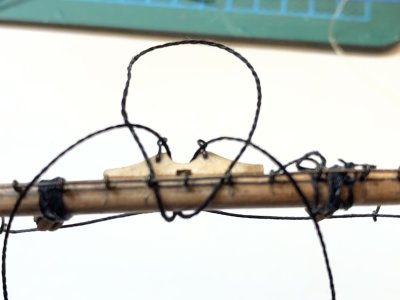
There is a slot in the cleat that holds the yard against the mast to thread the sling through.
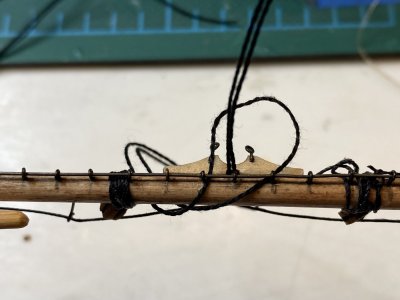
Make sure to thread the line so it goes under the jackstays and winds up behind the jackstays.
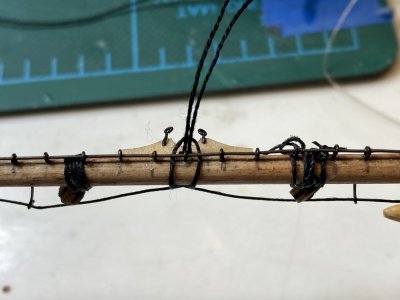
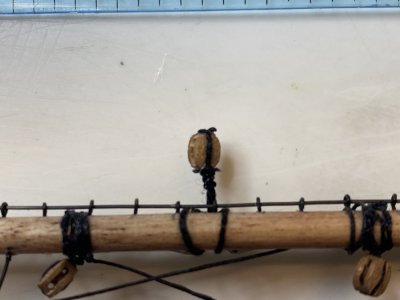
There is a slot in the cleat that holds the yard against the mast to thread the sling through.
Make sure to thread the line so it goes under the jackstays and winds up behind the jackstays.
Last edited:
After seizing small hooks to then end of the line, I attached the hooks the the inner eyebolt on the studding sail and threaded the line through the two lower blocks on each side.
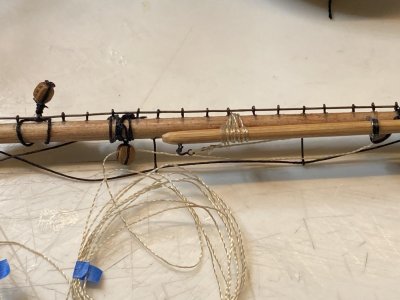
I then seized tan line to some black standing rigging line that was stropped to a single block.
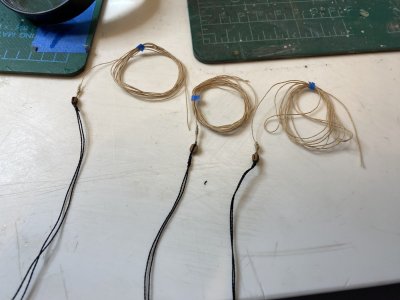
These were then attached to the mast just above the topgallant shroud lines.
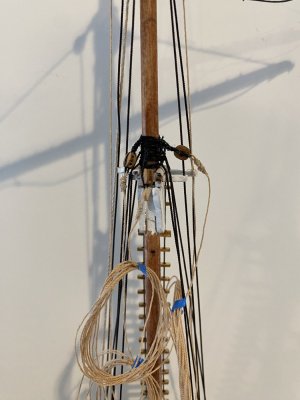
These were then attached to the mast just above the topgallant shroud lines.
Love the inclusion of these details, Rob! Bravo!