


• Win a Free Custom Engraved Brass Coin!!!
    As a way to introduce our brass coins to the community, we will raffle off a free coin during the month of August. Follow link ABOVE for instructions for entering.
  • PRE-ORDER SHIPS IN SCALE TODAY!

    The beloved Ships in Scale Magazine is back and charting a new course for 2026!
    Discover new skills, new techniques, and new inspirations in every issue.

    NOTE THAT OUR FIRST ISSUE WILL BE JAN/FEB 2026

Le Saint Philippe 1693 after Jean-Claude Lemineur (Ancre) in scale 1:48

I wish I could take credit for inventing the "Old Timers' Finish" I told you about Paul, but it was handed down to me by one of my woodturning mentors. I'm so happy it worked out for you. She looks beautiful! I also happen to like the differences in wood coloration because it subtly highlights the intricate construction details of the individual frames and shows off your exquisite craftsmanship. You really have an eye for beauty. Ooh, too soon? :oops:

Seriously, eye surgery has advanced by leaps and bounds. For both my cataract surgeries, the prep time was longer than the surgery itself, which was only about 10 minutes. The Admiral has had all the vitreous humor (the fluid in your eyeball) sucked out and replaced with saline to get rid of floaters. She also had laser surgery to correct -15 (yes, -15!) vision to about -1.5. The surgeon said it was the largest correction he had done to date. These types of things could only be dreamed about when we were young men. Things may look bleak now (okay, another stupid dad pun), but I have faith that, in the hands of a competent ophthalmologist, your vision will be better soon, possibly even better than before. Keep your optimism my friend, Lord knows we all need a hefty dose of it in these trying times. :)
 
I wish I could take credit for inventing the "Old Timers' Finish" I told you about Paul, but it was handed down to me by one of my woodturning mentors. I'm so happy it worked out for you. She looks beautiful! I also happen to like the differences in wood coloration because it subtly highlights the intricate construction details of the individual frames and shows off your exquisite craftsmanship. You really have an eye for beauty. Ooh, too soon? :oops:

Seriously, eye surgery has advanced by leaps and bounds. For both my cataract surgeries, the prep time was longer than the surgery itself, which was only about 10 minutes. The Admiral has had all the vitreous humor (the fluid in your eyeball) sucked out and replaced with saline to get rid of floaters. She also had laser surgery to correct -15 (yes, -15!) vision to about -1.5. The surgeon said it was the largest correction he had done to date. These types of things could only be dreamed about when we were young men. Things may look bleak now (okay, another stupid dad pun), but I have faith that, in the hands of a competent ophthalmologist, your vision will be better soon, possibly even better than before. Keep your optimism my friend, Lord knows we all need a hefty dose of it in these trying times. :)

Thanks, Russ. No worries about the eye-based dad jokes - my family has been stringing them together this entire holiday season (more will be coming today as we celebrate some birthdays).

You make a good point with the wood coloration distinctives. Either way - nothing is going to change at this point!
 
Love what you achieved with the finish! It's amazing how much oils enrich the tones and grain! Not a fan of varnish but by cutting it with the solvent, you can't tell it's there!!

I bet over time, it will really age richly.
Thanks, Brad. I wiped off anything that didn't soak in, so the varnish is really only there to help the tung oil set. There is nothing visible on the surface of the wood and you only feel wood grain. It will be interesting to see how it ages...
 
Hi Paul,

Looks great ! - basically you took the three ingredients (tung or linseed oil), vanish and solvent which is commonly canned as Danish Oil or Tung Oil Finish off the shelf - difference being you're able to create your own custom mix with the three elements to control the penetration, shine etc.

If you do want to use pure tung oil on its own - cut it 50 percent with solvent and it cures in a day or so.
 
Hello Friends,

Some time ago I began wondering what sort of finish I should put on this stern section model. I looked at a lot of other builds and did all kinds of trials with all manner of materials. I happen to have real Bitumen of Judea (banned in the US) from when I was tinting ropes for my version of the Vasa and noted how some of the models I am aesthetically drawn to incorporate that to create an aged look. Michele Padoan and several of the Russian/Ukranian/Polish masters use this. I believe Sergey (@serikoff) will be finishing his current project in that aged style. There is a lot to like in this approach, and it is always what I envisioned for the Saint Philippe.

Well, I didn't end up doing any of that. I ended up using a concoction 'invented' by fellow forum member Russ (@RussF). In equal proportions I mixed pure tung oil, a gloss marine varnish, and a solvent (I used turps, but others worked just as well).

Here is why I went with this mixture: pear wood reacts beautifully to oils. I used polymerized linseed oil on my Vasa (my avatar). Tung oil is even more impressive but takes FOREVER to set (does it ever really set?). By mixing tung oil with varnish the set time was dramatically reduced. But those two things alone create a mix that is sort of thick. The solvent corrects that problem. As mixed you can literally see the concoction soaking into the wood.

BUT!!! Unlike straight (well, cut with a solvent but nothing else) linseed or tung oil this mixture only penetrates a short way. I have samples with straight linseed oil that soaked through 8 mm of pear wood! I do not view this as an advantage. All finishes impede bond strength. You literally cannot scrape or sand away enough wood to get past straight linseed or tung oil. But this concoction only penetrates a short way. If I need to scrape it away in the future I can get down to relatively raw wood (I suppose there is still some oil in it, but it looks very much like untreated pear wood). I love this possibility.

Enough talking. The following images show where I am at today... I did tape off the deck clamps, larger gun ports, and some locations where light beams will be placed in the lower part of the hold. I also did not apply finish to the exterior planking or the stern post (and probably won't until I am much further along with that part of the build).

View attachment 567729

View attachment 567727

View attachment 567728

View attachment 567730

View attachment 567731

View attachment 567732

View attachment 567733

View attachment 567734

View attachment 567735

One small downside to this concoction is that it cannot be reapplied (for example, 24 hours later). Unlike a pure oil finish reapplication just sits on top of the cured surface (it no longer soaks into the wood). Indeed, it ends up being shiny and I am not a fan of shiny of a ship model.

Oh, by the way, I have also done some recent trials by dissolving Bitumen of Judea into microcrystalline wax. That paste can then be applied to what you see above if I want to add some aging after all. We'll see...

Sorry about the lengthy narrative...
Looking wonderful Paul
Happy New Year my friend
 
Hi Paul,

Looks great ! - basically you took the three ingredients (tung or linseed oil), vanish and solvent which is commonly canned as Danish Oil or Tung Oil Finish off the shelf - difference being you're able to create your own custom mix with the three elements to control the penetration, shine etc.

If you do want to use pure tung oil on its own - cut it 50 percent with solvent and it cures in a day or so.
Thanks, Chris. I did try some 'off the shelf' tung oil but liked this custom mix better - it seemed to penetrate a bit more (or maybe I just fancied making something on my own ROTF).
 
Hello Friends,

I'll wrap up my holiday break with a report on the progress that has been made on the next stage of construction: the deck beams. The SP has seven 'decks' if you count the small (tiered) platform in the hold.

The light beams of this lowest platform are the easier to fabricate in the sense that they have no round-up (no camber). Above this lowest platform is a larger platform (I think it is for the bread room), but the beams of this larger structure are cambered (which will be true for all of the formal decks above it).

Getting cambered beams to match is something that can be challenging. For the Kingfisher I used a combination of disc sander and my small mill. But the way I was using the mill was a bit dangerous - and the beams on the Kingfisher were quite a bit smaller (dimensionally) than what I will be building for the SP. I doubted if my small mill could handle the work without making multiple repeated passes on each beam.

Anyway, doubting my ability to safely complete that task, here is my primitive solution for this stern section model:

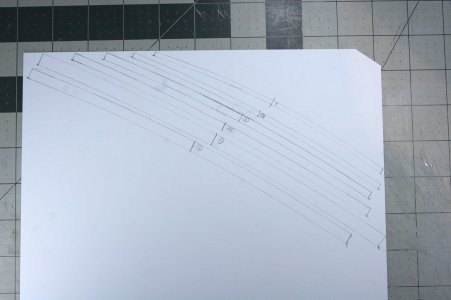
I cut beam templates from Evergreen sheet stock:

IMG_1678.JPG

I then used the appropriate template, traced it to a dimensionally accurate billet of pear wood, and then roughly cut beams using my scroll saw. I then used an oscillating spindle sander to bring the concave surface to its pencil line, and a disc sander to bring the convex surface to its pencil line.

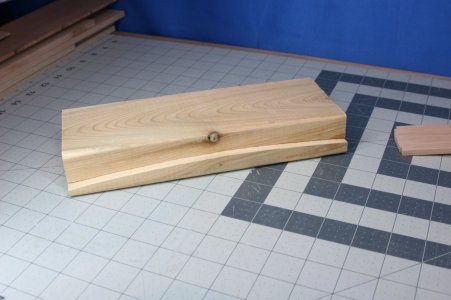
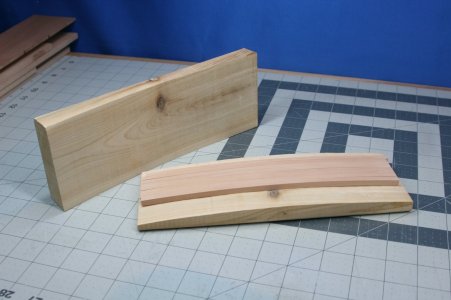
In order to get these beams to be identical I then created a custom sanding jig cut from a scrap of pine:

IMG_1681.JPG

IMG_1679.JPG

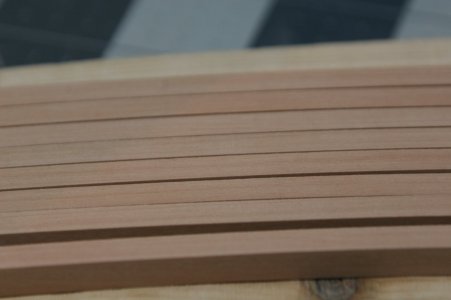
This allowed me to refine/smooth the convex and concave surfaces of the beams:

IMG_1680.JPG

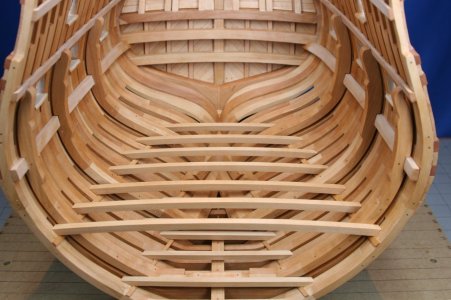
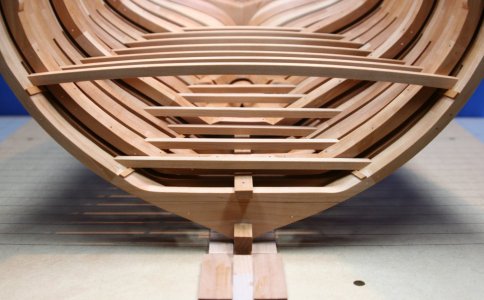
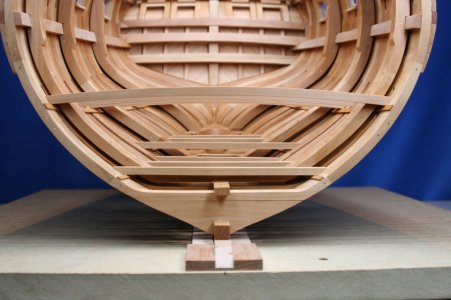
I have now installed the lower (tiered) platform as well as the beams for the bread room:

IMG_1687.JPG

IMG_1684.JPG

IMG_1688.JPG

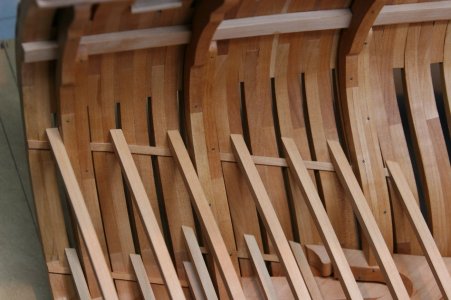
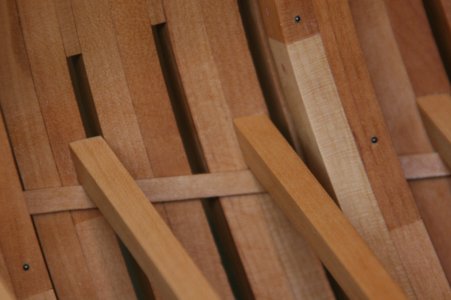
The joinery was no joke because of the curvature of the lower hull and the narrowing stern:

IMG_1690.JPG

IMG_1689.JPG

I believe this approach has passed the proof-of-concept stage and I'll now be repeating this process as I build the five remaining decks. These, of course, will be much more involved as they include all of the expected carlings, ledges, knees, etc., etc.

Thanks for stopping by!
 
Hello Friends,

I'll wrap up my holiday break with a report on the progress that has been made on the next stage of construction: the deck beams. The SP has seven 'decks' if you count the small (tiered) platform in the hold.

The light beams of this lowest platform are the easier to fabricate in the sense that they have no round-up (no camber). Above this lowest platform is a larger platform (I think it is for the bread room), but the beams of this larger structure are cambered (which will be true for all of the formal decks above it).

Getting cambered beams to match is something that can be challenging. For the Kingfisher I used a combination of disc sander and my small mill. But the way I was using the mill was a bit dangerous - and the beams on the Kingfisher were quite a bit smaller (dimensionally) than what I will be building for the SP. I doubted if my small mill could handle the work without making multiple repeated passes on each beam.

Anyway, doubting my ability to safely complete that task, here is my primitive solution for this stern section model:

I cut beam templates from Evergreen sheet stock:

View attachment 568374

I then used the appropriate template, traced it to a dimensionally accurate billet of pear wood, and then roughly cut beams using my scroll saw. I then used an oscillating spindle sander to bring the concave surface to its pencil line, and a disc sander to bring the convex surface to its pencil line.

In order to get these beams to be identical I then created a custom sanding jig cut from a scrap of pine:

View attachment 568377

View attachment 568375

This allowed me to refine/smooth the convex and concave surfaces of the beams:

View attachment 568376

I have now installed the lower (tiered) platform as well as the beams for the bread room:

View attachment 568379

View attachment 568378

View attachment 568380

The joinery was no joke because of the curvature of the lower hull and the narrowing stern:

View attachment 568382

View attachment 568381

I believe this approach has passed the proof-of-concept stage and I'll now be repeating this process as I build the five remaining decks. These, of course, will be much more involved as they include all of the expected carlings, ledges, knees, etc., etc.

Thanks for stopping by!
I thought, "Yes, Paul is switching to Evergreen.";)
But as part of developing your proof-of-concept, you clearly demonstrate that your approach works. A beautiful alignment of the beams, each with its own dimensions.:)
Regards, Peter
 
Hello Friends,

I'll wrap up my holiday break with a report on the progress that has been made on the next stage of construction: the deck beams. The SP has seven 'decks' if you count the small (tiered) platform in the hold.

The light beams of this lowest platform are the easier to fabricate in the sense that they have no round-up (no camber). Above this lowest platform is a larger platform (I think it is for the bread room), but the beams of this larger structure are cambered (which will be true for all of the formal decks above it).

Getting cambered beams to match is something that can be challenging. For the Kingfisher I used a combination of disc sander and my small mill. But the way I was using the mill was a bit dangerous - and the beams on the Kingfisher were quite a bit smaller (dimensionally) than what I will be building for the SP. I doubted if my small mill could handle the work without making multiple repeated passes on each beam.

Anyway, doubting my ability to safely complete that task, here is my primitive solution for this stern section model:

I cut beam templates from Evergreen sheet stock:

View attachment 568374

I then used the appropriate template, traced it to a dimensionally accurate billet of pear wood, and then roughly cut beams using my scroll saw. I then used an oscillating spindle sander to bring the concave surface to its pencil line, and a disc sander to bring the convex surface to its pencil line.

In order to get these beams to be identical I then created a custom sanding jig cut from a scrap of pine:

View attachment 568377

View attachment 568375

This allowed me to refine/smooth the convex and concave surfaces of the beams:

View attachment 568376

I have now installed the lower (tiered) platform as well as the beams for the bread room:

View attachment 568379

View attachment 568378

View attachment 568380

The joinery was no joke because of the curvature of the lower hull and the narrowing stern:

View attachment 568382

View attachment 568381

I believe this approach has passed the proof-of-concept stage and I'll now be repeating this process as I build the five remaining decks. These, of course, will be much more involved as they include all of the expected carlings, ledges, knees, etc., etc.

Thanks for stopping by!
I know exactly how difficult it is to produce the tight fit up of those multiangled end sections. Great results Paul.
 
Good morning Paul. I was thinking the same thing, well more along the lines of how on earth did you achieve those joins with the changing variation. Kudos. Cheers Grant
Thanks, Grant. Mostly an exercise in patience. I only got into trouble when I started cutting and sanding out of frustration (why won't this #$%^&* part fit!?!?!).
 
Whatever eye issues you're having, your work is still inspiring to us all!!

The custom sanding jig is the best solution for deck camber! I stumbled upon the same solution during my tour in Bahrain (a tiny island in the Persian Gulf) in the 1990s.

Love this build log!!! Keep on sharing!
I'm not surprised to learn I did not invent that custom sanding jig. Before CNC and mills there must have been a way for the masters to create matching beams. I have seen a couple of approaches but this one was best for the scale of my project and the scale of my workshop. The only scary bit for me (I have a really unhealthy fear of cutting machines) was having 3 1/2 inches of band saw blade thinking it would be fun to cut off my fingers while cutting the 2x4 pine board...
 
Back
Top