I agree with the others Bill, a very impressive and effective outcome.

![]() |
As a way to introduce our brass coins to the community, we will raffle off a free coin during the month of August. Follow link ABOVE for instructions for entering. |
![]() |
![]() |
The beloved Ships in Scale Magazine is back and charting a new course for 2026! Discover new skills, new techniques, and new inspirations in every issue. NOTE THAT OUR FIRST ISSUE WILL BE JAN/FEB 2026 |
![]() |
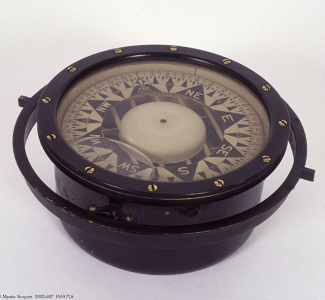
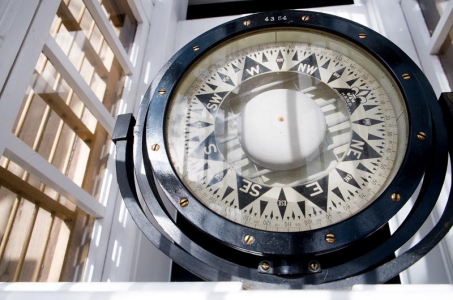
Bob - Is the compass in the skylight?
Bill

I can see more detail that I can add to the skylight.
The pictures you included have not only given me more information on the skylight, but I can also see additional detail on the hurricane house.

Bob, similar to you I have thought of doing a Morgan build, but something different, like her original configuration. To this end I have conducted research over the years. For approximately two years I was a shipyard volunteer at Mystic Seaport. In addition to helping out on "grunt" restoration work on bad weather days I also worked in the ships plan and research building. This building housed all the historical documentation for the Museum ship exhibits. There are literally thousands of documents and photos spanning the history of each exhibit to include an historical highly documented record of any restoration work. I spent many hours going through Morgan documentation with the thought in mind of finding material to identify differences between original build versus changes resulting from damage or restoration. Structurally I could find nothing. Nor could I verify paint color. I never found any documentation from her launch to compare with. Actually, could not find any details prior to when the Seaport got the Morgan. I got to know a number of shipwrights and volunteers that worked on the most recent restoration.Exquisite skylight, typical of your crisply detailed workmanship on this kit build. It's a joy to behold!
Did the MS Charles W. Morgan kit originally supply a casting for the skylight or did they expect the modeler to build it from scratch? You've certainly produced a skylight with more detail than what was provided in MS's plans! I don't see how anybody could build a skylight from the MS drawings that was an accurate rendition of the prototype. You did a good job trying to meet that challenge. There's no way anybody could have known that the metal protective bars were set in separate frames from the glass from the MS plans. See photos of the prototype below. I have found similar issues with the 1939 plans, drawn a couple of years prior to her transfer to Mystic Seaport's ownership, and revised in 1957, by Marine Models Co. Mystic Seaport's plans library offers copies from a set of Morgan plans drawn more recently at a substantial price. Mystic's library has construction drawings of the skylight done in 1981. See: http://mobius.mysticseaport.org/detail.php?module=objects&type=related&kv=331331
On and off, I've long been conducting research for a Morgan model. I do not include the Morgan among "models that should be built" by Howard I. Chapelle's measure. (See: https://thenrg.org/resource/articles/ship-models-that-ought-to-be-buillt and https://thenrg.org/resource/articles/ship-models-that-should-not-be-built) There are surely more than enough Morgan models in the world by now and there's little point, other than to produce one's own decorator model, for adding another unless there might be something that sets a further Morgan apart from it's predecessors. To that end, I've been researching the Morgan's "as launched" appearance with an eye to building a model of her as of her 1841 launching. While I have certainly not exhausted known available historical resources, I would like to enquire whether anybody has anything to add to a couple of questions I haven't as yet been able to find answered with academically acceptable citations to authority. The first question is "Was the Morgan's "hurricane shed" part of her original build, or added later?" The second question is whether or not, "When she was launched, was her windlass mounted abaft the foremast where the forward companionway is now located and the forward companionway located before the foremast, or not? I'm just taking a long shot and hoping maybe some Morgan fan who's following this great build log may know. If not, I'll talk to an acquaintance who's worked on Mystic's conservation staff rebuilding the Morgan who ought to know the answers. As far as I know, there are no extant documentation of the Morgan's original configuration as of her launch. (I am aware, of course, that she was ship rigged when launched.)
View attachment 563044
View attachment 563043
View attachment 563031
View attachment 563033
View attachment 563035


I am currently doing the same build, same manufacturer, and running into the same problems I to the point of laying down the decking. I don't think I'll be doing continuous strips from one to the other. I think I'll break them up into threes. So far, I'm not disappointed in the instructions nor in the parts they gave us to assemble. It seems to be a common thread among all manufacturers. It really doesn't matter to get to the point and figure out how to get around it and get on with the project. I have to admit I do enjoy it.

Thank you for your advice, it’s kind of funny. I was thinking the same thing and I put my deck like a dirty colored tan thinking of what they did being a whaler probably would’ve been better. Maybe if it was a dirty gray I guess anyway, thank you for your comment on the length of the planks. this is the first model I tried doing a continuous length figuring there were many pieces that laid on top of it that you would not notice the butts. I promise I won’t do it again. Thank you for your for your advice.You may wish to do some research on how decks were actually planked in 1841. Deck planks are laid out in various "schedules" which dictate the separation and placement of butts in order to maximize the structural strength of the decking. (No continuous runs of butt joints adjacent to one another!) At least, a deep dive on the internet to collect as many pictures of her deck currently as is possible is in order. When she was built, standardized "dimensioned lumber'" that we know today wasn't being produced. Each plank was gotten out of a tree individually. They would be of generally equal widths, but of different lengths, as long as possible, because how the tree grew dictated how much clear stock could be sawn from any given log. Transportation limitations applied as well and must be taken into account so that planking lengths on a model are to scale. It was unlikely that planks longer than about 25 feet would have been available to the Morgan's builders. A check with someone at Mystic, or a visit there to take lots of photos yourself and actually see and feel the model you are building are highly advisable but, I realize, not always practical.
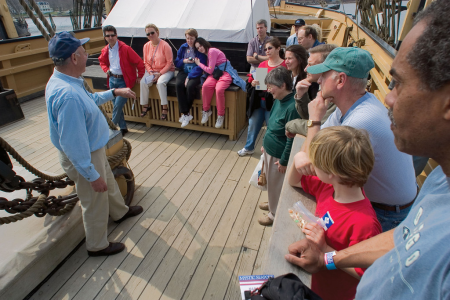
Present-day photo of the Morgan's deck. Note that when she was in actual use as a whaler, her decks would have been considerably darker, perhaps black, from the greasy whale oil soaked into them during the trying-out process. This can be researched as well. All of this sort of information is available to the modeler and the Morgan is certainly the most well-documented vessel of her type in the world today. The serious modeler doesn't just "make it up" as he goes along if he really wants to produce a good model.
View attachment 573734