

• Win a Free Custom Engraved Brass Coin!!!
    As a way to introduce our brass coins to the community, we will raffle off a free coin during the month of August. Follow link ABOVE for instructions for entering.
  • PRE-ORDER SHIPS IN SCALE TODAY!

    The beloved Ships in Scale Magazine is back and charting a new course for 2026!
    Discover new skills, new techniques, and new inspirations in every issue.

    NOTE THAT OUR FIRST ISSUE WILL BE JAN/FEB 2026

Charles Morgan Bark 1:64 POB - By Bill-R

Thanks Bob and Roger for the kind words.

Bob - Thanks for the great picture. I can see more detail that I can add to the skylight. As for the MS Charles Morgan kit, other than the ply bulkheads and a few other ply pieces, the building material supplied is wood strip. I would say that the kit is definitely not for a newbie like me. I am enjoying the challenge and learning a lot with the help from everyone here on SOS.

Bill
 
Bob - Is the compass in the skylight?

Bill
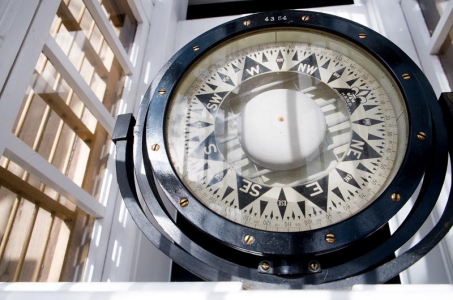
Indeed it is, as pictured below. It's barely visible in the second picture above, at the inside aft end of the skylight. The compass gimbal is fastened to the inside upper square frame of the skylight on the midship line at the aft end of the skylight so that it can be read by the helmsman through the skylight.

. The pointed top of the skylight is above the compass. The deck planking can be seen outside the window. This compass is apparently not original to the vessel and of modern vintage. I can't make out the manufacturer's name on the card, but I would guess that it was installed in contemplation of her 2014 post-restoration "voyage" under sail. The original installation would almost certainly have been in an oil lamp illuminated binnacle of some sort, probably wooden.

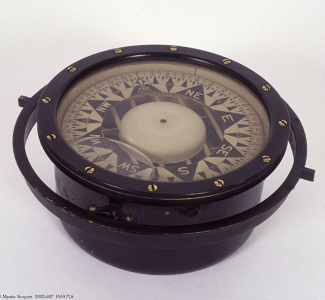
In fact, this compass appears to be a relatively modern "telltale compass" mounted upside down. Telltale compasses are designed to be mounted above the head of the captain's or navigator's berth with the card facing downward so that the officer sleeping in the berth can simply look upward to check the vessel's course without leaving their bunk if they wake up during their off-watch sleeping time and want to check the vessel's course.

1765496557288.png

Here's another one just like it found online. It's of relatively modern manufacture. They both have relatively the same size bubbles in them which generally indicates a need for routine servicing. However, as telltale compasses intended to be mounted with the card down, bubbles (caused by leakage of the dampening fluid) would rise above the card and not be visible as they are in the two pictures shown here and ignored until they were significantly larger before sent ashore to the instrument shop. In earlier times, every port had an instrument shop where vessels making port could get their navigational instruments adjusted, repaired, or new ones purchases. These shops were often also outlets for the purchase of official navigational charts.

1765498138959.png


I can see more detail that I can add to the skylight.

If you want to "add more detail to the skylight," I'd encourage you to do so. Your craftsmanship is excellent and the skylight is one of the features of this model that "draws the eye," so the time spent doing a super job on it will be well spent.

Note the skylight construction on the left side of the picture. The skylight is double framed on the sides and top. (Not sure of the arrangement on the ends.) The outer hinged frames have metal rods run through them, but no glass. The rods are to protect the glass from breakage. The inner muntins are glazed. It is difficult to determine exactly how the skylight is constructed. I can't tell if the sides be opened to the air for ventilation or only the top, or even whether or not the top can and only the frames holding the rods open for cleaning the glazing. The MS drawings are "cartoons" and obviously lacking in essential details. If you want to replicate the real skylight, I suggest you order the plan page from the Morgan plan set at Mystic which has the complete and accurate measured construction drawings of the skylight. (See: http://mobius.mysticseaport.org/detail.php?module=objects&type=related&kv=331331) It's just a single page and shouldn't cost all that much.
 
Hi Bob,
Thanks for the information on the Morgan plans at the Mystic Seaport. I will check them out. The pictures you included have not only given me more information on the skylight, but I can also see additional detail on the hurricane house.

Thanks
 
The pictures you included have not only given me more information on the skylight, but I can also see additional detail on the hurricane house.

There are a tremendous number of photos of the Morgan online. Google "images" and start a file of downloaded pictures for research purposes! You don't have to rely on the kit instructions alone, but expect to find discrepancies between the kit instructions and the real thing. From my research, Mystic Seaport's Morgan plans collection is the best around, being done well with state-of-the-art digital measuring technology in around 2008, I believe. Mystic's plans library has 113 sheets of plans for the Morgan. For modeling purposes, I doubt one would need more than a half dozen sheets to really get the detail necessary to do a really great model. A lot of the 113 sheets look like structural engineering stuff that you can's see in a model, and you already have the hull lines, so you're in good shape. I don't know what they charge for copying, so you'll have to call them and see. I don't know if they will send PDF or TIFF files via email or will send papers copies only. Good luck! (See: http://mobius.mysticseaport.org/detail.php?module=objects&type=related&kv=455002 )
 
Thanks for the kind words Bruce. I have been involved with some kind of model building for most of my life. Ship building is my newest and most interesting passion.

Bill
 
I am currently doing the same build, same manufacturer, and running into the same problems I to the point of laying down the decking. I don't think I'll be doing continuous strips from one to the other. I think I'll break them up into threes. So far, I'm not disappointed in the instructions nor in the parts they gave us to assemble. It seems to be a common thread among all manufacturers. It really doesn't matter to get to the point and figure out how to get around it and get on with the project. I have to admit I do enjoy it.

 
Thank you Ronald for the very kind words. The encouraging words from you and everyone else helps keep the fire going on this build.

Bill
 
When I decided on the planking, I chose to do continuous strips. The reason is because the deck will be painted and there is a lot of furniture that covers up the planking.

Bill
 
I am currently doing the same build, same manufacturer, and running into the same problems I to the point of laying down the decking. I don't think I'll be doing continuous strips from one to the other. I think I'll break them up into threes. So far, I'm not disappointed in the instructions nor in the parts they gave us to assemble. It seems to be a common thread among all manufacturers. It really doesn't matter to get to the point and figure out how to get around it and get on with the project. I have to admit I do enjoy it.

You may wish to do some research on how decks were actually planked in 1841. Deck planks are laid out in various "schedules" which dictate the separation and placement of butts in order to maximize the structural strength of the decking. (No continuous runs of butt joints adjacent to one another!) At least, a deep dive on the internet to collect as many pictures of her deck currently as is possible is in order. When she was built, standardized "dimensioned lumber'" that we know today wasn't being produced. Each plank was gotten out of a tree individually. They would be of generally equal widths, but of different lengths, as long as possible, because how the tree grew dictated how much clear stock could be sawn from any given log. Transportation limitations applied as well and must be taken into account so that planking lengths on a model are to scale. It was unlikely that planks longer than about 25 feet would have been available to the Morgan's builders. A check with someone at Mystic, or a visit there to take lots of photos yourself and actually see and feel the model you are building are highly advisable but, I realize, not always practical.

Present-day photo of the Morgan's deck. Note that when she was in actual use as a whaler, her decks would have been considerably darker, perhaps black, from the greasy whale oil soaked into them during the trying-out process. This can be researched as well. All of this sort of information is available to the modeler and the Morgan is certainly the most well-documented vessel of her type in the world today. The serious modeler doesn't just "make it up" as he goes along if he really wants to produce a good model.

1769628656858.png
 
You may wish to do some research on how decks were actually planked in 1841. Deck planks are laid out in various "schedules" which dictate the separation and placement of butts in order to maximize the structural strength of the decking. (No continuous runs of butt joints adjacent to one another!) At least, a deep dive on the internet to collect as many pictures of her deck currently as is possible is in order. When she was built, standardized "dimensioned lumber'" that we know today wasn't being produced. Each plank was gotten out of a tree individually. They would be of generally equal widths, but of different lengths, as long as possible, because how the tree grew dictated how much clear stock could be sawn from any given log. Transportation limitations applied as well and must be taken into account so that planking lengths on a model are to scale. It was unlikely that planks longer than about 25 feet would have been available to the Morgan's builders. A check with someone at Mystic, or a visit there to take lots of photos yourself and actually see and feel the model you are building are highly advisable but, I realize, not always practical.

Present-day photo of the Morgan's deck. Note that when she was in actual use as a whaler, her decks would have been considerably darker, perhaps black, from the greasy whale oil soaked into them during the trying-out process. This can be researched as well. All of this sort of information is available to the modeler and the Morgan is certainly the most well-documented vessel of her type in the world today. The serious modeler doesn't just "make it up" as he goes along if he really wants to produce a good model.

View attachment 573734

Thank you for your advice, it’s kind of funny. I was thinking the same thing and I put my deck like a dirty colored tan thinking of what they did being a whaler probably would’ve been better. Maybe if it was a dirty gray I guess anyway, thank you for your comment on the length of the planks. this is the first model I tried doing a continuous length figuring there were many pieces that laid on top of it that you would not notice the butts. I promise I won’t do it again. Thank you for your for your advice.
 
Hi Bob,
I agree that a serious modeler would want to make their model as correct as possible, if they were planning to have it judged. I spent many decades building scale r/c aircraft for competition and understand the importance of building a model based on the best information. I also like to build models just for enjoyment.

Bill
 
Back
Top