



A friend showed me his Byrnes table saw, and I was immediately impressed by its size, weight, quality design and construction.
I like to make tools and machinery, and since I could find no examples for sale, decided to make one along similar lines to be used in future model ship building.
My friend extolled the virtues of the saw, but he had 2 criticisms. The motor was underpowered, and the table was too short. I watched Olha Batchvarov's video assessing the saw and could see that the table is indeed too short, with the sliding attachment almost falling off at the end of cutting strokes. So I made my table 100mm longer, at 400mm.
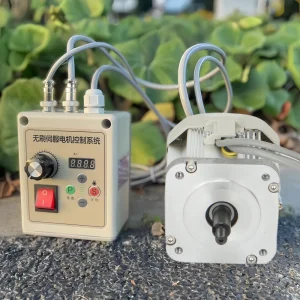
Also, I am using a 750w speed controlled AC Servo motor, which is small enough to fit inside the box/carcass. That is a considerable increase from the Byrnes 200w motor. It also has automatic braking and soft start. And matches the motors which I have used for my drum sander and disk sander.
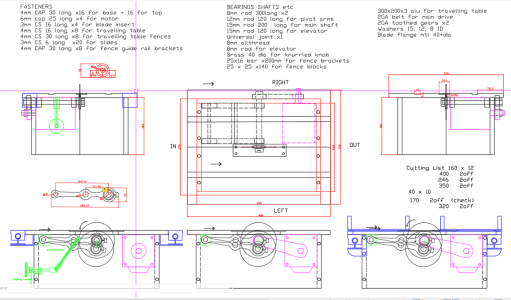
I started by drawing up the intended construction on AutoCAD (2D) and SolidWorks (3D) see photos. Some aspects were revised as construction proceeded.
And now I well into the construction. I am an amateur metalworker, but have accumulated various skills in the past 2 decades, including lathe work, mill work, CNC machining, silver soldering, welding, metal casting etc. My icon shows a cannon which I made, along with several others in recent years.
My design is strongly influenced by the Byrnes table saw, but is not a copy, and I trust that no intellectual or legal rights have been infringed. It is for my personal use, and I do not intend to make more than one. However, if there is interest I will make my design, plans, specifications available.
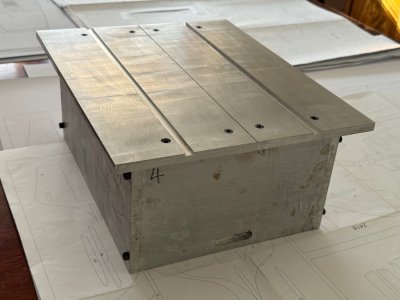
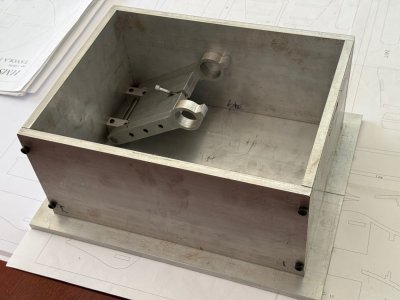
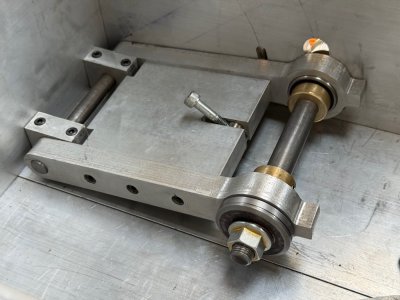
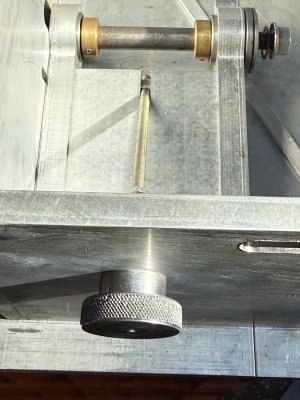
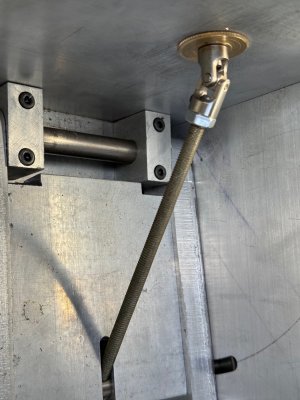
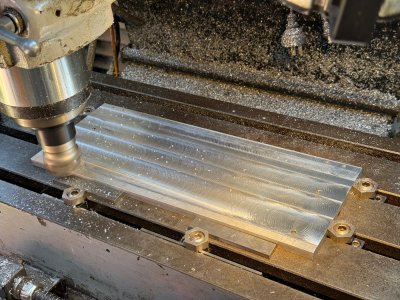
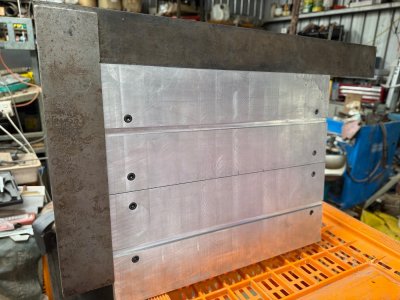
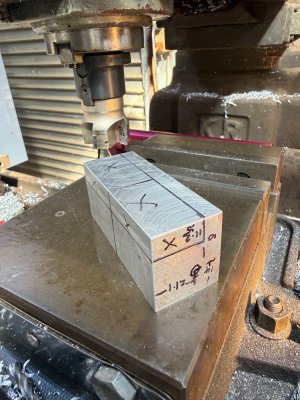
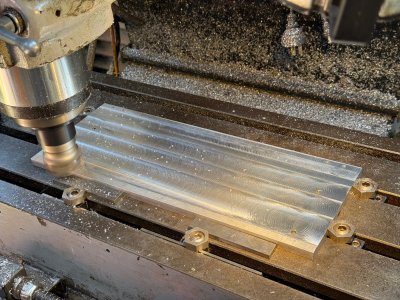
The case and table top are made from 12mm aluminium. The main shaft arms are from 16mm alu.
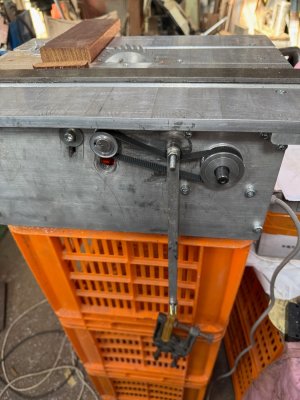
The 3rd photo is a genuine Byrnes.
This project is paused, while waiting for parts to arrive from OS.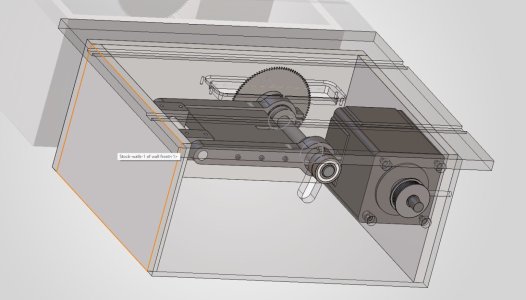
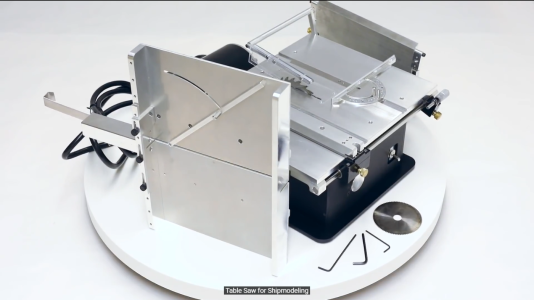
I like to make tools and machinery, and since I could find no examples for sale, decided to make one along similar lines to be used in future model ship building.
My friend extolled the virtues of the saw, but he had 2 criticisms. The motor was underpowered, and the table was too short. I watched Olha Batchvarov's video assessing the saw and could see that the table is indeed too short, with the sliding attachment almost falling off at the end of cutting strokes. So I made my table 100mm longer, at 400mm.
Also, I am using a 750w speed controlled AC Servo motor, which is small enough to fit inside the box/carcass. That is a considerable increase from the Byrnes 200w motor. It also has automatic braking and soft start. And matches the motors which I have used for my drum sander and disk sander.
I started by drawing up the intended construction on AutoCAD (2D) and SolidWorks (3D) see photos. Some aspects were revised as construction proceeded.
And now I well into the construction. I am an amateur metalworker, but have accumulated various skills in the past 2 decades, including lathe work, mill work, CNC machining, silver soldering, welding, metal casting etc. My icon shows a cannon which I made, along with several others in recent years.
My design is strongly influenced by the Byrnes table saw, but is not a copy, and I trust that no intellectual or legal rights have been infringed. It is for my personal use, and I do not intend to make more than one. However, if there is interest I will make my design, plans, specifications available.
The case and table top are made from 12mm aluminium. The main shaft arms are from 16mm alu.
The 3rd photo is a genuine Byrnes.
This project is paused, while waiting for parts to arrive from OS.
Last edited:











![IMG_6951[1].JPG](https://shipsofscale.com/sosforums/data/attachments/569/569958-2cee05864816a279b773fb08a5250400.jpg?hash=dOcDBPJpbG "IMG_6951[1].JPG")
![IMG_6970[1].JPG](https://shipsofscale.com/sosforums/data/attachments/569/569959-0d04213a603d3302f314acb7fca8853f.jpg?hash=NKMJ45xZRQ "IMG_6970[1].JPG")
![IMG_6961[1].JPG](https://shipsofscale.com/sosforums/data/attachments/569/569960-be605e6797c98ab5c726e52b80979679.jpg?hash=rHpOwdldJC "IMG_6961[1].JPG")
![IMG_6962[1].JPG](https://shipsofscale.com/sosforums/data/attachments/569/569961-05063e28bcc774f08d484e9bb9c9043d.jpg?hash=rtgZvdU5Cs "IMG_6962[1].JPG")
![IMG_6963[1].JPG](https://shipsofscale.com/sosforums/data/attachments/569/569962-23a7136d7eda564736c51ab017a7c6b7.jpg?hash=12wassdyRs "IMG_6963[1].JPG")