

• Win a Free Custom Engraved Brass Coin!!!
    As a way to introduce our brass coins to the community, we will raffle off a free coin during the month of August. Follow link ABOVE for instructions for entering.
  • SUBSCRIBE TO SHIPS IN SCALE TODAY!

    The beloved Ships in Scale Magazine is back and charting a new course for 2026!
    Discover new skills, new techniques, and new inspirations in every issue.

    NOTE THAT OUR NEXT ISSUE WILL BE MARCH/APRIL 2026

Making a Byrnes style Bench Saw

  • Thread starter Thread starter johnv
  • Start date Start date
  • Watchers Watchers 8
Joined
May 30, 2024
Messages
195
Points
143

Location
Geelong, Australia
A friend showed me his Byrnes table saw, and I was immediately impressed by its size, weight, quality design and construction.
I like to make tools and machinery, and since I could find no examples for sale, decided to make one along similar lines to be used in future model ship building.
My friend extolled the virtues of the saw, but he had 2 criticisms. The motor was underpowered, and the table was too short. I watched Olha Batchvarov's video assessing the saw and could see that the table is indeed too short, with the sliding attachment almost falling off at the end of cutting strokes. So I made my table 100mm longer, at 400mm.
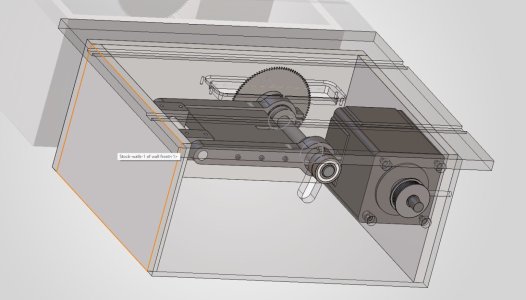
Also, I am using a 750w speed controlled AC Servo motor, which is small enough to fit inside the box/carcass. That is a considerable increase from the Byrnes 200w motor. It also has automatic braking and soft start. And matches the motors which I have used for my drum sander and disk sander.
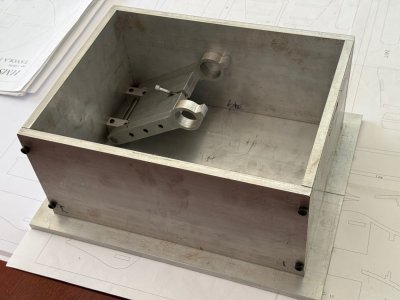
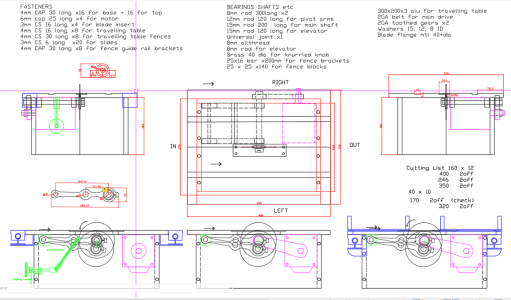
I started by drawing up the intended construction on AutoCAD (2D) and SolidWorks (3D) see photos. Some aspects were revised as construction proceeded.
And now I well into the construction. I am an amateur metalworker, but have accumulated various skills in the past 2 decades, including lathe work, mill work, CNC machining, silver soldering, welding, metal casting etc. My icon shows a cannon which I made, along with several others in recent years.
My design is strongly influenced by the Byrnes table saw, but is not a copy, and I trust that no intellectual or legal rights have been infringed. It is for my personal use, and I do not intend to make more than one. However, if there is interest I will make my design, plans, specifications available.
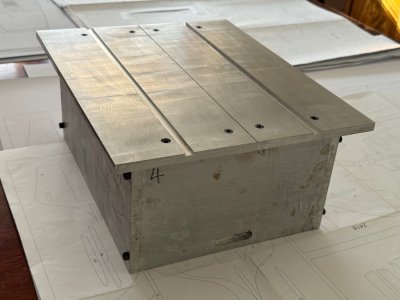
The case and table top are made from 12mm aluminium. The main shaft arms are from 16mm alu.
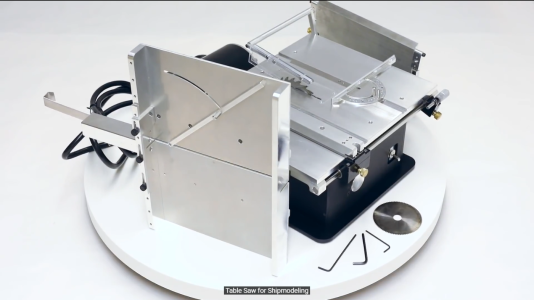
The 3rd photo is a genuine Byrnes.
This project is paused, while waiting for parts to arrive from OS. Screenshot 2026-02-16 212750.jpgIMG_6844.jpegIMG_6845.jpegScreenshot 2026-01-18 083542.pngScreenshot 2026-02-03 132257.png
 
Last edited:
Congratulations on solving the small tablesaw availability problem.

Just a comment on the two criticisms of the Jim saw:
If by too short, you mean not wide enough, there is an upgrade to an 18" wide table. It allows the fence to remain when the sliding table is in use.

The power provided by the motor, I just take a situation where that occurs as meaning that I am asking the Jim saw to do a job better and more safely done by a larger and more often different type machine.
I think that the best use for the saw is with relatively thin stock and slicing off scale boards, keels, beams.
Using it as part of a sawmill operation to get large billets to at least be one dimension in scale is pushing it.
It is probably an exercise in futility or frustration or just dealing with a complaining machine to ask a 4" tablesaw to save having to have the use of a full size bandsaw, 10" tablesaw, thickness sander.

My most challenging factor with the saw is matching the job with an efficient blade for it. The number of sources for 3" and 4" blades is decreasing also.
 
Byrnes table saw limits are not its length but the sturdiness of the blade which gets better as kerf (thickness) and diameter of blades increases. Blade must be sturdy on the shaft to make consistent wood cuts. Larger blade diameter calls for more powerful motor and so on. Just buy a 8" or 10" blade diameter commercially available table saw for quarter price and enjoy.

Byrnes saw is not for 2" x 4" lumber. It is for slicing tiny thickness wood sheets not thicker that 4 to 5 mm high.
 
Congratulations on solving the small tablesaw availability problem.

Just a comment on the two criticisms of the Jim saw:
If by too short, you mean not wide enough, there is an upgrade to an 18" wide table. It allows the fence to remain when the sliding table is in use.

The power provided by the motor, I just take a situation where that occurs as meaning that I am asking the Jim saw to do a job better and more safely done by a larger and more often different type machine.
I think that the best use for the saw is with relatively thin stock and slicing off scale boards, keels, beams.
Using it as part of a sawmill operation to get large billets to at least be one dimension in scale is pushing it.
It is probably an exercise in futility or frustration or just dealing with a complaining machine to ask a 4" tablesaw to save having to have the use of a full size bandsaw, 10" tablesaw, thickness sander.

My most challenging factor with the saw is matching the job with an efficient blade for it. The number of sources for 3" and 4" blades is decreasing also.
Thanks for the congrats!

The criticism from the Byrnes saw owner was that there is not enough table behind the blade, not with the width. And watching the Batchvarov video I could see that the sliding work table tended to overbalance at the completion of a cutting pass. I expect that the extra 100mm behind the blade will avoid that tendency. The extra space in the saw carcass allows the motor to be situated inside the carcass, which I think is also an advantage.
Re power. I am sure that 200w is plenty for cross cutting model ship planks etc, but ripping will be easier with more power. And I expect that my saw will be used for thicker material as well, not just model ship building.
But I guess that we will see. I will show further progress in this thread, and a final report when all is finished.
Byrnes table saw limits are not its length but the sturdiness of the blade which gets better as kerf (thickness) and diameter of blades increases. Blade must be sturdy on the shaft to make consistent wood cuts. Larger blade diameter calls for more powerful motor and so on. Just buy a 8" or 10" blade diameter commercially available table saw for quarter price and enjoy.

Byrnes saw is not for 2" x 4" lumber. It is for slicing tiny thickness wood sheets not thicker that 4 to 5 mm high.
I have designed for timber up to 25mm thick, using a blade of 100 to 110mm diameter.
I have a 3hp table saw already for anything bigger than that.
 
Thanks for the congrats!

The criticism from the Byrnes saw owner was that there is not enough table behind the blade, not with the width. And watching the Batchvarov video I could see that the sliding work table tended to overbalance at the completion of a cutting pass. I expect that the extra 100mm behind the blade will avoid that tendency. The extra space in the saw carcass allows the motor to be situated inside the carcass, which I think is also an advantage.
Re power. I am sure that 200w is plenty for cross cutting model ship planks etc, but ripping will be easier with more power. And I expect that my saw will be used for thicker material as well, not just model ship building.
But I guess that we will see. I will show further progress in this thread, and a final report when all is finished.

I have designed for timber up to 25mm thick, using a blade of 100 to 110mm diameter.
I have a 3hp table saw already for anything bigger than that.
It’s fascinating to see this version of the Byrnes table saw brought to life. The original design was clearly a masterclass in intelligent compromise — built with lighter gauge materials and a modest motor so it could be manufactured economically and made accessible to a wide range of modelers. That balance between performance and cost is no small achievement.


What makes this new build so impressive is that it isn’t constrained by those same production realities. By stepping up to heavier aluminum plate and a more powerful motor, you’ve explored what the design can become when durability and performance are allowed to lead the conversation. The added mass alone should translate into excellent stability and smoother operation.


Just as noteworthy is the way you’ve listened carefully to users of the original saw. Rather than simply copying a respected tool, you’ve thoughtfully addressed the small frustrations and limitations people experienced, and refined them in your build. That kind of iterative improvement shows real respect for both the original design and the modeling community.


Your strengths as a draughtsman and machinist are evident throughout. The precision, proportion, and finish reflect not only technical skill, but careful planning and execution. It’s one thing to admire a design — it’s another to reinterpret it with this level of craftsmanship and insight.


This isn’t just a remake; it’s a considered and beautifully executed evolution.

Regards. Ridley.
 
Some more progress on the saw.
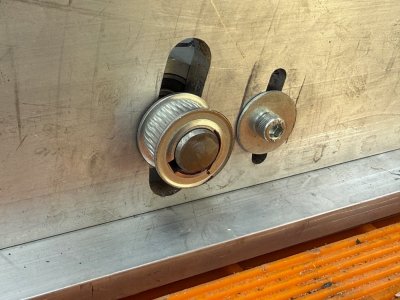
Curved slots were CNC milled into the case for the main shaft and the blade height lock.
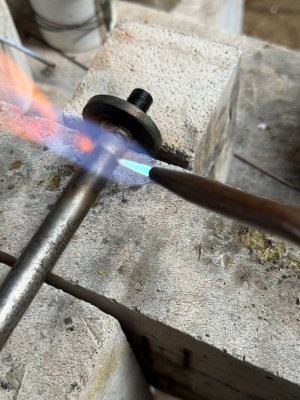
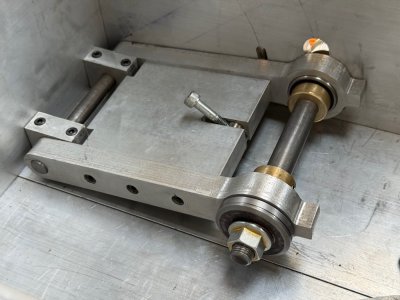
The main shaft itself was finished by lathe cutting a 12mm x 1.25mm thread, silver soldering the blade backing plate to the shaft, making and fitting the blade washer, then fitting the shaft assembly to the large height adjusting hinge assembly.
IMG_6856.jpeg
The curved slots milled into the box sides. The blade height lock hex screw will be replaced with a brass knurled knob.

IMG_6854.jpeg
Silver soldering the blade backing plate to the main shaft, taking care to not distort the lathe cut thread. The plate was finished in the lathe after the steel had cooled.


IMG_6855.jpeg
The main shaft installed, ready for the blade. The blade will cut its own slot into the top plate (underneath in this photo) after the height adjusting mechanism is in place. The brass collars prevent the main shaft from moving laterally. At this time the bearings are just pressed into the arms. If there is any tendency for them to move I will convert the arm ends to clamps.

I do realize that this level of metal machining is not for most model ship builders, but I am documenting the process here for interest, and maybe to stimulate similar activities in others.

Next I will install the blade height adjusting mechanism.
 
Have to call it what it is ! Be humble enough to accept failures.
Well, I imagine that all ship modelers have models or parts that are less than perfect. I certainly have. I have the crankshaft of a triple expansion steam engine sitting on a shelf of my workshop to remind myself to always measure twice cut once. I had to discard it and make another one. The replacement crankshaft worked well, and the triple is still working on steam at exhibitions several times each year.
So overcoming mistakes is part of the hobby. And trashing parts or even whole models is too.
But if I have mistakes which I have not corrected in a model I do not usually point them out. If mistakes are noticed I admit the error(s), possibly explain how it/they occurred, and move on.
I believe that I am sufficiently honest to admit my deficiencies/mistakes to myself, and that is the main thing.
Still considering whether to add a "Failures" category to my list of model builds. I am just starting my first scratch build of a model wooden ship (HMS Bellerophon). It is daunting. I do hope that it does not feature on my "Failures" list.
 
Last edited:
Byrnes Inspired Saw - the height adjusting mechanism
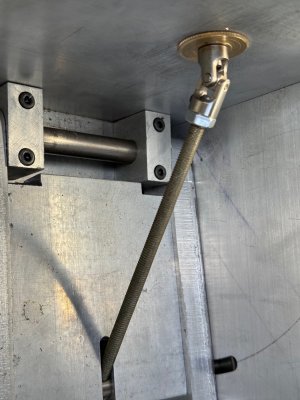
After considering several alternatives, I decided that the Byrnes method was the best fit for the purpose of adjusting the height of the sawblade above the worktop.
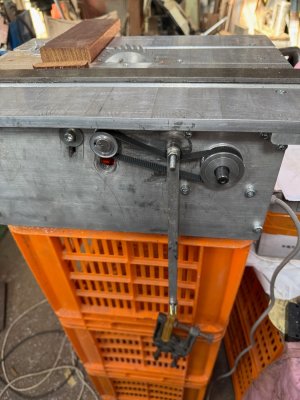
It does require a universal joint, which I purchased from AliExpress, but has proved to be the weak point of the mechanism. The pins in the joint are fairly loose in their holes, and they make a noticeable creak in some positions. Quite disconcerting. I am considering removing the pins and installing larger, better fitting ones. Also, the "Allthread" rod needs to be changed for some silver steel, lathe threaded only at the main spindle end, because the Allthread is a bit undersized, and is a bit eccentric in the universal joint socket. . (This confession is in the spirit of my previous comment about admitting difficulties and failures.)
The mechanism works OK. It is just not as smooth as I would like.
The photos show the upside down saw bench.
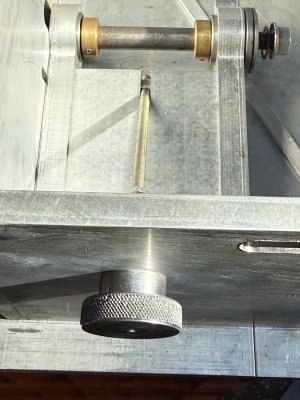
The locking mechanism works really well, and I think that it is a better method than than the original.
The close up photos reveal that my knurling is a bit rough, but I can live with that.
IMG_6868.jpegIMG_6867.jpeg
 
I have solved the problem of the noisy universal loose joint, by squeezing it quite forcibly in my vice and squeezing the loose fittings . Possibly a temporary fix, but it has almost eliminated the noisy clicky click when the mechanism is activated. I will buy a more expensive universal in future. This was obviously a cheapy.
 
A progress report.
First, I have been waiting 6 weeks for the motor to arrive from China, and it did finally arrive 2 days ago.
s-l1600.webp
It is a 750w/1hp AC servo, with controller for speeds 200-4500rpm, soft start, electronic brake, and choice of forward/reverse. It is very quiet and quite compact enough to fit inside the box base of the saw unit. I will use a GA2 10mm wide toothed belt, which my AI confirms will be adequate for the job.
Because the motor is in a fixed position inside the base I will need a belt tensioner arrangement and I am still considering options for that. Something spring loaded I expect.
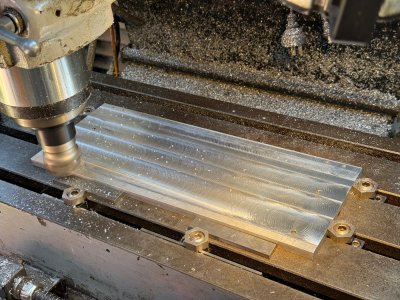
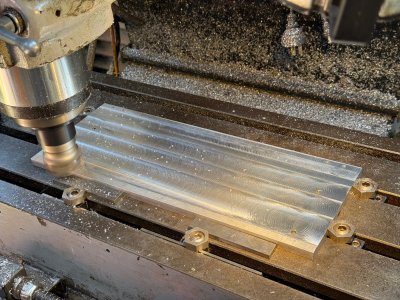
Meanwhile I have machined both sides of the aluminium saw bench top. The top side was easy. I machined the top and bottom edges of the base, then attached the the top and machined it in position. But the underside was more difficult. It needed to be attached to the milling machine table without obstructing the milling cutter. Then I found these T slot cam locks in my small tools drawer...
IMG_6926.jpeg
I forget who makes them. They are only 8mm high and held the workpiece quite firmly without any drama.
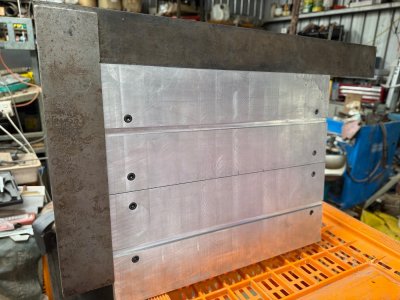
I have also made brackets for the fence rods, and installed them and the rods. The parts were simple to make and bolt on, but quite a few hours were spent making sure that they were parallel, square to the saw top, and moved freely. I used this 500x300mm square to check squareness of the components.
IMG_6873.jpeg
IMG_6924.jpeg
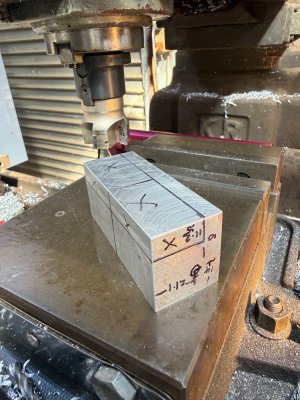
Plastic crates make good temporary workbenches when the main work bench is too cluttered to use. And the block of alu was machined into the brackets to which the parallel fence will be attached.
So hopefully I will install the motor in the next day or so.
Still have to design and make the belt tensioner, the parallel fence, the protractor fence, then maybe I can start to rip some planking for my current build of HMS Bellerophon.
IMG_6935.jpeg
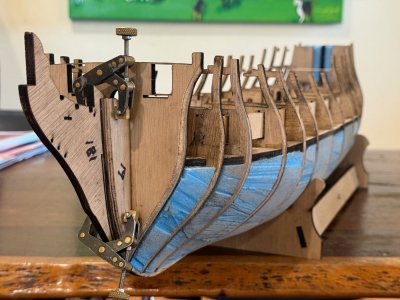
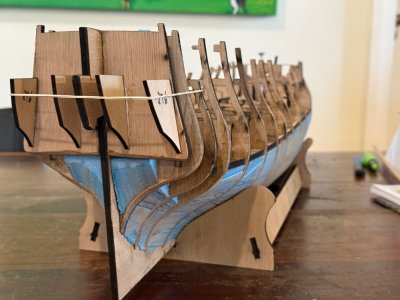
It is a scratch build, sort of, using kit plans (Victory Models/Amati), laser cutting the false keel and bulkheads. They are cut from marine plywood which is 6mm thick, whereas the plans call for 5mm ply. So far no major dramas, although I was a bit critical of the laser cutting surface burns. In future I will do my own laser cutting with a just purchased Creality Falcon2 40w machine. More about that later.
Still deciding whether to use a single planking layer, since the bulkheads and extruded polystyrene look as if they will provide quite a good base, although some extra smoothing with Spakfiller or similar will be required.
Incidentally, the two tiny clamps were made by me some years ago. They were invaluable for my Constitution build last year.
But sometimes I prefer low tech methods of clamping..

IMG_6936.jpeg
 
Last edited:
Back
Top