• Win a Free Custom Engraved Brass Coin!!!
    As a way to introduce our brass coins to the community, we will raffle off a free coin during the month of August. Follow link ABOVE for instructions for entering.
  • PRE-ORDER SHIPS IN SCALE TODAY!

    The beloved Ships in Scale Magazine is back and charting a new course for 2026!
    Discover new skills, new techniques, and new inspirations in every issue.

    NOTE THAT OUR FIRST ISSUE WILL BE JAN/FEB 2026

What Makes a Ship Model Valuable to Others?

C'mon guys. It's getting a bit personal here. The direct or implied assignment of personal motive or intention is out of place. You may not like the views of those who oppose your position, but they don't deserve your derision or condemnation.
100% agree. I think it is time to keep this thread on the original topic!!!!
 
Rob Napier is by no means alone in defining quality. The famous naval architect L. Francis Herreshoff has written that a poorly made ship model is an “evil” thing as it will distort history for future generations.
Invoking L. Francis Herreshoff and his use of the word “evil” needs context. Herreshoff was speaking about models that distort history while pretending to represent it faithfully; that’s a documentary concern, not a moral indictment of hobbyists enjoying their craft. A model presented as historical evidence carries responsibility. A model built for personal enjoyment does not suddenly become a threat to civilization (in the context of 'evil')
If someone wants a respected voice that balances this perspective, consider David Pye. In The Nature and Art of Workmanship, Pye argues that craftsmanship is about the relationship between maker, process, and result; not about rigid hierarchies of moral virtue. He distinguishes between workmanship of risk and workmanship of certainty, but nowhere does he frame imperfect work as “evil.” He treats making as a human activity with varying intentions and outcomes.
If we’re going to quote authorities, then let’s also remember that craft has always existed on a spectrum of intention, from archival precision to personal expression. Calling imperfect work “evil” outside of its original context stretches the rhetoric beyond usefulness. Building for enjoyment does not distort history. It simply acknowledges that not every model is trying to be an artifact for museums, and that’s perfectly fine, IMHO
 
so do you build for clients free of charge, giving away the models? or do you charge a fee for your work? one is considered a hobby and the other when money changes hands it is a profession.
as a client who commissioned a piece of work and is told "for me this is just a hobby and i have no standards so you get whatever i build like it or not" or are there double standards at play?
There is no double standard, only a misunderstanding you keep insisting on. When I take a commission, I agree to specific expectations with a client, and I meet them. That is called professionalism. It has nothing to do with whether I personally define my modeling as a hobby.
When I build for myself, I build to my own standards and for my own satisfaction. That does not mean “no standards,” and it certainly does not mean I hand clients random results and shrug. You’re inventing that scenario to make a point that doesn’t exist.

Money changes obligation, not integrity. The presence of a fee does not magically elevate the craft into something morally superior, and the absence of one does not reduce it to carelessness. You keep trying to force this into a binary, hobby versus profession, standards versus none. The reality is simpler: context defines responsibility. That’s it. If that still reads as a contradiction to you, the issue isn’t double standards. It’s a misinterpretation.

Sorry, Paul @dockattner, I can't resist responding.
 
Hello, my name is Fred and I built models personally and professionally for more than 60 years. Some years ago I retired for lack of ability; I can no longer build to a standard necessary for either personal satisfaction or the demands of my clients. My son is a member of this forum and I have been following the build reports for many years though I have never posted before. My son says I am a "lurker". Recently, he helped me apply for membership and that has now been granted by a gentleman named Donald. Thank you, Donald.

I applied to be a member so I could pose a respectful question for Paul who started this conversation. I know your work and have followed it with admiration for several years. I confess that if I had your skill and craftsmanship I would have been able to charge double for my commissioned and sold models. I am curious about an apparent inconsistency. You seem to reject the application of standards, yet you meet the accepted standards I have always applied to my own work and has been defended by several others. How are we to reconcile this? Why do you apply the clear standards of ship model construction to your own work while simultaneously suggesting they need not apply?

I do not mean this disrespectfully. I am simply trying to understand your viewpoint on this subject.

Thank you for indulging an old man's curiosity.

Fred
 
There is no double standard, only a misunderstanding you keep insisting on. When I take a commission, I agree to specific expectations with a client, and I meet them. That is called professionalism. It has nothing to do with whether I personally define my modeling as a hobby.
When I build for myself, I build to my own standards and for my own satisfaction. That does not mean “no standards,” and it certainly does not mean I hand clients random results and shrug. You’re inventing that scenario to make a point that doesn’t exist.

Money changes obligation, not integrity. The presence of a fee does not magically elevate the craft into something morally superior, and the absence of one does not reduce it to carelessness. You keep trying to force this into a binary, hobby versus profession, standards versus none. The reality is simpler: context defines responsibility. That’s it. If that still reads as a contradiction to you, the issue isn’t double standards. It’s a misinterpretation.

Sorry, Paul @dockattner, I can't resist responding.

no further comment
 
Hello everyone,

Wow, what an interesting topic Paul @dockattner brought up! One question that has always fascinated me is: What exactly do we mean by "museum quality"? Well, "museum quality" is, in many ways, simply a term for an object that is displayed in a museum. The correct term would then no longer be "quality," but "object." When we visit a museum today, we see objects on display. Yes, of course, some by famous artists, but they are still objects. If we visit a maritime museum today, we also see very interesting things, including various ship models. From well-built ships to ships that fathers carved for their young sons from a single piece of wood. Yes, but these are also worth displaying. And why? Because they were grave goods of a pharaoh, king, or Viking. But let's be honest, is that what we call "museum quality"? No, but probably priceless because of their historical value. What I'm really trying to say, and what we should all be thinking about, is that in my opinion, there's no such thing as "museum quality."

This isn't just my opinion, but also that of many colleagues you know from this or other forums. I've even spoken with some of them personally, including gold, silver, and bronze medalists, European and world champions, and none of them use the term "museum quality." None of them would sell one of their ships. Years of work, day after day after work, on days off, and so on. Such a ship would cost over €100,000; not even a museum would pay that. I know that some colleagues, including some here in the forum, do commissioned work. What they get paid for it, I don't know. Who they work for, well... let's not go there. In Germany, it wouldn't be enough to live on. Are these models high-quality, historically accurate, kits, or scratch-built from plans? Are they made to POB or POF specifications, in the style of the Navy or the Admiralty/Arsenal? I think none of that really matters. It's been said before, and I'm repeating myself, but that's just how it is. Beauty, as they say, is in the eye of the beholder. If someone can afford a model for €10,000, €20,000, €30,000 or more these days, and none of the above points are important to them, then go for it.

I'm pretty sure a lot of people spend a lot of money on finished models that might not even be worth it, or that should actually be much more expensive. How can you even appreciate something like that? Well, I think each of you can judge and value your own work. Jim @Jimsky put it very well in one of his posts. Often it's worth much more because my grandfather built it for me, priceless because it's from my partner, because it was made with love. These are the values that count, because our hobby brings us joy, some find it a balance to their work, and there are a thousand other reasons.

So, Paul, what do you think, is your Kingfisher worth more or less than your Vasa? Or is the stern of the Saint Philip more valuable? Or is my Le Rochefort worth more, or Ondra's Red Lion, which won a silver medal? Exactly, every single model has its own value, and that lies solely in the eye of the beholder.

Personally, I would never buy a Vasa. Why not? It's a type of boat I don't like, and besides, it couldn't even float ROTF . Nevertheless, the Vasa built by Paul is absolutely fantastic craftsmanship. I'm quite sure that my little harbor yacht isn't for everyone either, which I can completely understand.

I don't think there's a right or wrong answer to this. It's about what is valuable and what isn't. Everyone should decide that for themselves.

Terrific post, Tobias. Thank you for weighing in.
 
Hello, my name is Fred and I built models personally and professionally for more than 60 years. Some years ago I retired for lack of ability; I can no longer build to a standard necessary for either personal satisfaction or the demands of my clients. My son is a member of this forum and I have been following the build reports for many years though I have never posted before. My son says I am a "lurker". Recently, he helped me apply for membership and that has now been granted by a gentleman named Donald. Thank you, Donald.

I applied to be a member so I could pose a respectful question for Paul who started this conversation. I know your work and have followed it with admiration for several years. I confess that if I had your skill and craftsmanship I would have been able to charge double for my commissioned and sold models. I am curious about an apparent inconsistency. You seem to reject the application of standards, yet you meet the accepted standards I have always applied to my own work and has been defended by several others. How are we to reconcile this? Why do you apply the clear standards of ship model construction to your own work while simultaneously suggesting they need not apply?

I do not mean this disrespectfully. I am simply trying to understand your viewpoint on this subject.

Thank you for indulging an old man's curiosity.

Fred
Greetings, Fred. I thank you very much for choosing this time and place to join the forum. And I thank you as well for your generous review of my work. I understand your question to be sincere, so I'll do my best to answer it.

You are correct in observing that I apply a rigorous building standard to my own work. What I lack in knowledge and experience I try to make up for with effort through research and craftmanship. I rather enjoy the challenge of this hobby and honestly try to do the best I can. On my build reports I welcome courteous critique of my work and fellow modelers have taken the opportunity to correct and encourage me as my efforts deserve. As I am sure you have observed, there are many other modelers who share this particular approach to modeling on the forum.

While I was personally unfamiliar with the oft-quoted Napier definition (as well as the history behind it) I resonate with it. I suppose it was even guiding my own work without me being aware of it - if that makes sense. Further, the historic position of the NRG as described on these pages is also something I resonate with (though I have not taken the time to further investigate these standards). Personally, I find standards of excellence to be helpful. Indeed, I know many others share this viewpoint: we truly want to become better modelers as more experienced and skilled modelers walk alongside us. Honestly, it's the reason I'm still here despite some of the things that have been asserted about me and my motivations on this thread and elsewhere.

And now I'm finally getting to an answer to your question: all of this is my own choice and personal preference. I would never apply my goals to another modeler's work - nor insist/suggest they should adopt my goals - particularly when we are talking about the hobby lane of ship modeling (which I believe covers most every participant on this forum with a few exceptions). Professional modelers like yourself are an important part of this avocation, but 99% of us are just here to share an interesting diversion from the challenges of life (colleagues, please insert your own preferred reason for being here in this space).

I refuse to adopt the suggestion that external standards (even those I might personally prefer) be applied universally. To that end, there is no contradiction to resolve. I'm happy to see others fulfill whatever goals they may have for building a model ship and if the opportunity arises, I will support them as they strive for those goals

Here is a post that was made only minutes ago on another thread I happen to follow: Guys... I really appreciate very much all your likes. I know I am just a standard model kit builder, nevertheless I appreciate you like my build. This gentleman deserves our respect and kindness. I can't tell you why he is here, or what his goals might be - but he should be welcomed for whatever motivates him to be here. His chosen goals should be respected (even honored). For myself, I will not sit in the judge's seat vis a vis his goals, and I will defend him if others do.

Fred (also MY dad's name - God rest his soul), I do sincerely thank you for reaching out.
 
When I take a commission, I agree to specific expectations with a client, and I meet them.

If a client requested you build them a "high-quality scale ship model" and you agreed to do so, what specific expectations would the client have and what specific standard(s) for meeting those expectations would you apply to your work for them?

When I build for myself, I build to my own standards and for my own satisfaction. That does not mean “no standards,” and it certainly does not mean I hand clients random results and shrug.

When you build to your own standards for your own satisfactions, which doesn't mean "no standards," specifically what standards do you apply?

Invoking L. Francis Herreshoff and his use of the word “evil” needs context. Herreshoff was speaking about models that distort history while pretending to represent it faithfully; that’s a documentary concern, not a moral indictment of hobbyists enjoying their craft. A model presented as historical evidence carries responsibility. A model built for personal enjoyment does not suddenly become a threat to civilization (in the context of 'evil')

The moment a modeler puts a name on a ship model, especially a well-done one, or, arguably, identifies the model as representative of a particular ship or class of ships in any other way, they are "pretending to represent it faithfully." Every model "speaks for itself" and, if anyone considers it "historical evidence" at any point in its existence, it becomes the "evil" L. Francis Herreshoff was talking about (somewhat hyperbolically.) Today's ship modeling community (and especially the kit makers) generally rely on surviving seventeenth- and eighteenth-century contemporary models such as the Navy Board models, many of which are now in the RMG collection, as historical evidence without the slightest hesitation. How do we know some modeler three hundred years ago didn't build a model in the "Navy Board style" for just for fun and so wasn't all that concerned with accuracy. There could even be contemporary models built on private contract for people who wanted "one just like Sam Pepys has" and ended up with an inaccurate copy, but didn't know the difference. (Much like today's the results of many ship model kits!) I don't know if I'd say those faux Admiralty models are "evil," but they sure played a whole lot of today's "cannons and gold leaf" crowd for fools, wouldn't they have?

In The Nature and Art of Workmanship, Pye argues that craftsmanship is about the relationship between maker, process, and result; not about rigid hierarchies of moral virtue.

Quite so. This is the distinction between craft and art. Craft is about the relationship between maker, process, and result. Art is about soul, for want of a better term meaning the same thing as "rigid hierarchies of moral virtue." This is why a banana duct taped to a wall can be art, without requiring a bit of craftsmanship, and craftsmanship conversely requires no art. And as the price paid for the banana taped to the wall so well illustrates, art is often far more highly valued monetarily than craftsmanship is. Art is always unique, craftsmanship is not.
 
If a client requested you build them a "high-quality scale ship model" and you agreed to do so, what specific expectations would the client have and what specific standard(s) for meeting those expectations would you apply to your work for them?


When you build to your own standards for your own satisfactions, which doesn't mean "no standards," specifically what standards do you apply?


The moment a modeler puts a name on a ship model, especially a well-done one, or, arguably, identifies the model as representative of a particular ship or class of ships in any other way, they are "pretending to represent it faithfully." Every model "speaks for itself" and, if anyone considers it "historical evidence" at any point in its existence, it becomes the "evil" L. Francis Herreshoff was talking about (somewhat hyperbolically.) Today's ship modeling community (and especially the kit makers) generally rely on surviving seventeenth- and eighteenth-century contemporary models such as the Navy Board models, many of which are now in the RMG collection, as historical evidence without the slightest hesitation. How do we know some modeler three hundred years ago didn't build a model in the "Navy Board style" for just for fun and so wasn't all that concerned with accuracy. There could even be contemporary models built on private contract for people who wanted "one just like Sam Pepys has" and ended up with an inaccurate copy, but didn't know the difference. (Much like today's the results of many ship model kits!) I don't know if I'd say those faux Admiralty models are "evil," but they sure played a whole lot of today's "cannons and gold leaf" crowd for fools, wouldn't they have?


Quite so. This is the distinction between craft and art. Craft is about the relationship between maker, process, and result. Art is about soul, for want of a better term meaning the same thing as "rigid hierarchies of moral virtue." This is why a banana duct taped to a wall can be art, without requiring a bit of craftsmanship, and craftsmanship conversely requires no art. And as the price paid for the banana taped to the wall so well illustrates, art is often far more highly valued monetarily than craftsmanship is. Art is always unique, craftsmanship is not.
No further comments.... read my posts.
 
You may not like the views of those who oppose your position, but they don't deserve your derision or condemnation.

That's a very nice sentiment, but it overlooks the fact that "derision" and "condemnation" are two of the most important components of social pressure which operate as the governor that keeps society from taking off like a runaway steam engine. They've become unpopular of late, perhaps due to the soapbox social media has provided those to which they were frequently deservingly directed and... well... here we are!
 
Good morning everyone,
well, I think from my perspective I'll just be a silent reader in this interesting discussion from now on. @Bob Cleek , just so you know, I read the entire report yesterday—seven pages. So I'm quite familiar with the content, which in large part has nothing to do with the introduction of Paul's first post. I was simply referring to the term "museum quality." What I would also like to see is that we treat each other with the necessary respect.
I think that's something we owe to our fellow human beings.

One more thing: @Dave Stevens (Lumberyard) mentioned the saying "Money doesn't buy happiness."
We say, "Money alone doesn't buy happiness."
It's the word "alone" that puts the saying in a completely different light.
To quote the proverb from the German-speaking world in full: "Money alone does not make you happy, but it is incredibly reassuring."
 
Last edited:
Money changes obligation, not integrity. The presence of a fee does not magically elevate the craft into something morally superior, and the absence of one does not reduce it to carelessness.
Well said Jim.
In keeping with your comment, I am currently researching a ship model project for the National Parks and they have no money for the project. Even so, considering the recipient, I think I am actually doing MORE research than usual and will be as diligent as ever on the build.
Allan
 
.​

To keep the fire burning :), here is something else with hopefully a still different perspective.
As in all other social categories, it seems that it is not the original intention of an act that matters most, but its ultimate effect on the environment. At most, the former may be (but does not necessarily have to be) only one of the many factors that influence the latter. In particular, the inevitable passage of time, with all its consequences, seems to justify and further emphasise this way of looking at the issue.

But let's get to the point. In the context of model building, the damage caused by mediocre and even worse models is unfortunately real, if only because it is not always possible to know later what the intentions and actual competences of the builders of these models (or possibly the authors of the reconstruction plans) were.

For example, nowadays, many model builders who even aspire to greater historical accuracy are simply misled by models made ‘just for fun’, ‘pleasure’ or ‘whatever similar’ (here exclusively in the sense of ‘without due diligence’, and to be sure: please do not overinterpret). To put it bluntly, unaware model makers, including those with greater ambitions in this area, simply copy each other notoriously and, sadly, often quite unreflectively. This phenomenon is real, ubiquitous and visible at every turn, whether we like it or not.

A more subtle variant of the above phenomenon is that some models (or just some images of ships) must necessarily change their character or status — from popular, so to speak, to historical evidence. There are countless examples of this (ancient models of Egyptian boats, late medieval models from Ebersdorf and Mataró, early modern models of ships from Italy, etc., etc.). While it is perfectly clear that they were not made according to criteria of technical accuracy, or at least made only to a minimal degree, now they must serve the purposes of such exploratory research.

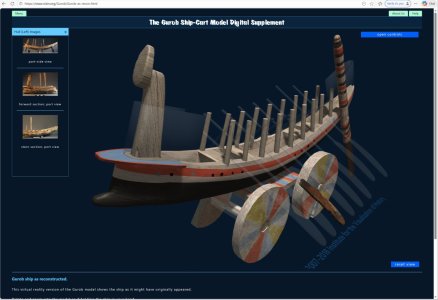
This state of affairs is particularly well illustrated by the case of an ancient model, identified as representing a ship of the so-called Sea Peoples. Originally, it was a simple, even primitive children's toy, probably without any pretensions to a ‘compelling impression’ or cognitive value, but now it is the focal point of scientific studies on shipbuilding techniques and ship architecture in general from that period (see in particular: The Gurob Ship-Cart Model and its Mediterranean Context by Shelley Wachsmann). The ancient parent of this child would probably be quite amused now. Quite perverse and hilarious, isn't it?

To be clear, the above is not even about evaluating the phenomenon itself, but rather a statement of the existing state of affairs.

And, just to enhance the visual appeal of the thread, below is an image of the reconstruction of the Gurob Ship-Cart Model (the entire graphic material can be found at the address shown in the screenshot):


Gurob ship-cart model.jpg

.​
 
.​

To keep the fire burning :), here is something else with hopefully a still different perspective.

As in all other social categories, it seems that it is not the original intention of an act that matters most, but its ultimate effect on the environment. At most, the former may be (but does not necessarily have to be) only one of the many factors that influence the latter. In particular, the inevitable passage of time, with all its consequences, seems to justify and further emphasise this way of looking at the issue.

But let's get to the point. In the context of model building, the damage caused by mediocre and even worse models is unfortunately real, if only because it is not always possible to know later what the intentions and actual competences of the builders of these models (or possibly the authors of the reconstruction plans) were.

For example, nowadays, many model builders who even aspire to greater historical accuracy are simply misled by models made ‘just for fun’, ‘pleasure’ or ‘whatever similar’ (here exclusively in the sense of ‘without due diligence’, and to be sure: please do not overinterpret). To put it bluntly, unaware model makers, including those with greater ambitions in this area, simply copy each other notoriously and, sadly, often quite unreflectively. This phenomenon is real, ubiquitous and visible at every turn, whether we like it or not.

A more subtle variant of the above phenomenon is that some models (or just some images of ships) must necessarily change their character or status — from popular, so to speak, to historical evidence. There are countless examples of this (ancient models of Egyptian boats, late medieval models from Ebersdorf and Mataró, early modern models of ships from Italy, etc., etc.). While it is perfectly clear that they were not made according to criteria of technical accuracy, or at least made only to a minimal degree, now they must serve the purposes of such exploratory research.

This state of affairs is particularly well illustrated by the case of an ancient model, identified as representing a ship of the so-called Sea Peoples. Originally, it was a simple, even primitive children's toy, probably without any pretensions to a ‘compelling impression’ or cognitive value, but now it is the focal point of scientific studies on shipbuilding techniques and ship architecture in general from that period (see in particular: The Gurob Ship-Cart Model and its Mediterranean Context by Shelley Wachsmann). The ancient parent of this child would probably be quite amused now. Quite perverse and hilarious, isn't it?

To be clear, the above is not even about evaluating the phenomenon itself, but rather a statement of the existing state of affairs.

And, just to enhance the visual appeal of the thread, below is an image of the reconstruction of the Gurob Ship-Cart Model (the entire graphic material can be found at the address shown in the screenshot):


.​
A substantive post, Waldemar. My thanks for your contribution.
 
That's a very nice sentiment, but it overlooks the fact that "derision" and "condemnation" are two of the most important components of social pressure which operate as the governor that keeps society from taking off like a runaway steam engine. They've become unpopular of late, perhaps due to the soapbox social media has provided those to which they were frequently deservingly directed and... well... here we are!
This post makes me really sad for you, Bob. And I also think you're wrong.
 
That's a very nice sentiment, but it overlooks the fact that "derision" and "condemnation" are two of the most important components of social pressure which operate as the governor that keeps society from taking off like a runaway steam engine. They've become unpopular of late, perhaps due to the soapbox social media has provided those to which they were frequently deservingly directed and... well... here we are
I really apologize, Paul @dockattner, but if I don't respond, I won't respect myself, sorry, mon ami.

Bob, when you openly describe derision and condemnation as necessary tools of social control, you are no longer defending standards; you are defending intimidation.
Standards in any serious discipline do not require humiliation to survive. They endure because they are persuasive, demonstrable, and worth aspiring to; if excellence must be enforced through ridicule, that suggests insecurity, not strength.

Let me remind you, this is a forum about ship modeling. It is not a tribunal, and no one here has been elected as its moral governor. Disagreement over definitions does not justify contempt, and elevating contempt to a civic virtue does not make it so.

If your position is as solid as you believe (I really regret if this is true), it should stand on clarity and example, not on social pressure, perhaps not in this forum, please.

To the readers and the original poster, I apologize that this thread shifted from substance to personal friction. In my role as moderator, I take responsibility for not intervening earlier (at least I tried...)
 
Several months ago I stopped visiting SoS and moved on with another 'hobby'. Unfortunately I recently returned hoping things had calmed down. Apparently not. The rambling diatribe from such as Mr Cleek posts are still prevalent. It's unfortunate that we cannot have a civil discussion among ship model builders but, the Wild West is what 'Social Media' has become these days. I don't choose to live in that world and I feel for those who do.
 
Dear Paul,

Thank you for taking the time to carefully answer my question. I admit that I come from a different era in ship modeling. The community was smaller - and we gathered in person rather frequently (at least several times each year). When we critiqued each others work it was done from a place of relationship. That must be much harder today. Let me close by once again offering you my personal encouragement: you are a gifted ship modeler and I hope you continue to develop your skills.

My best to you,

Fred
 
Back
Top