Hello everyone,
Wow, what an interesting topic Paul
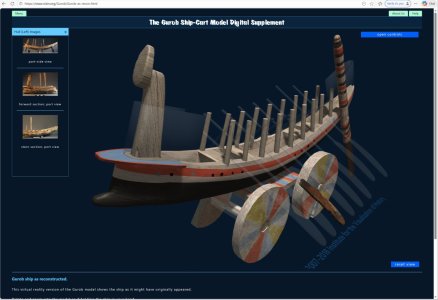
@dockattner brought up! One question that has always fascinated me is: What exactly do we mean by "museum quality"? Well, "museum quality" is, in many ways, simply a term for an object that is displayed in a museum. The correct term would then no longer be "quality," but "object." When we visit a museum today, we see objects on display. Yes, of course, some by famous artists, but they are still objects. If we visit a maritime museum today, we also see very interesting things, including various ship models. From well-built ships to ships that fathers carved for their young sons from a single piece of wood. Yes, but these are also worth displaying. And why? Because they were grave goods of a pharaoh, king, or Viking. But let's be honest, is that what we call "museum quality"? No, but probably priceless because of their historical value. What I'm really trying to say, and what we should all be thinking about, is that in my opinion, there's no such thing as "museum quality."
This isn't just my opinion, but also that of many colleagues you know from this or other forums. I've even spoken with some of them personally, including gold, silver, and bronze medalists, European and world champions, and none of them use the term "museum quality." None of them would sell one of their ships. Years of work, day after day after work, on days off, and so on. Such a ship would cost over €100,000; not even a museum would pay that. I know that some colleagues, including some here in the forum, do commissioned work. What they get paid for it, I don't know. Who they work for, well... let's not go there. In Germany, it wouldn't be enough to live on. Are these models high-quality, historically accurate, kits, or scratch-built from plans? Are they made to POB or POF specifications, in the style of the Navy or the Admiralty/Arsenal? I think none of that really matters. It's been said before, and I'm repeating myself, but that's just how it is. Beauty, as they say, is in the eye of the beholder. If someone can afford a model for €10,000, €20,000, €30,000 or more these days, and none of the above points are important to them, then go for it.
I'm pretty sure a lot of people spend a lot of money on finished models that might not even be worth it, or that should actually be much more expensive. How can you even appreciate something like that? Well, I think each of you can judge and value your own work. Jim
@Jimsky put it very well in one of his posts. Often it's worth much more because my grandfather built it for me, priceless because it's from my partner, because it was made with love. These are the values that count, because our hobby brings us joy, some find it a balance to their work, and there are a thousand other reasons.
So, Paul, what do you think, is your Kingfisher worth more or less than your Vasa? Or is the stern of the Saint Philip more valuable? Or is my Le Rochefort worth more, or Ondra's Red Lion, which won a silver medal? Exactly, every single model has its own value, and that lies solely in the eye of the beholder.
Personally, I would never buy a Vasa. Why not? It's a type of boat I don't like, and besides, it couldn't even float

. Nevertheless, the Vasa built by Paul is absolutely fantastic craftsmanship. I'm quite sure that my little harbor yacht isn't for everyone either, which I can completely understand.
I don't think there's a right or wrong answer to this. It's about what is valuable and what isn't. Everyone should decide that for themselves.















 , here is something else with hopefully a still different perspective.