
-

SUBSCRIBE TO SHIPS IN SCALE TODAY!
The beloved Ships in Scale Magazine is back and charting a new course for 2026!
Discover new skills, new techniques, and new inspirations in every issue.
NOTE THAT OUR NEXT ISSUE WILL BE July/August 2026 -

Win a Free Custom Engraved Brass Coin!!!
As a way to introduce our brass coins to the community, we will raffle off a free coin during the month of August. Follow link ABOVE for instructions for entering.


You are using an out of date browser. It may not display this or other websites correctly.
You should upgrade or use an alternative browser.
You should upgrade or use an alternative browser.
Oseberg 1/32nd from Pavel Nikitin - With hopefully also many added details.

Russ,
Thanks so much for your nice comments, as well as your very helpful images and inputs.
Your work Oseberg log has also been a real pleasure to follow. Went back through your log to again - read your notes about where to locate the mast and the Unimus image reference….., for moving the mast step one frame forward - that was a LOT of work on your part.….Need to consider that as well..
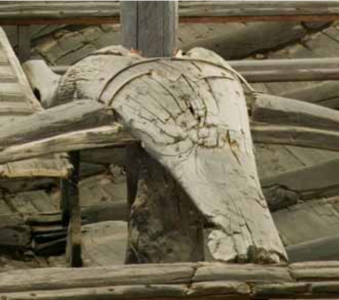
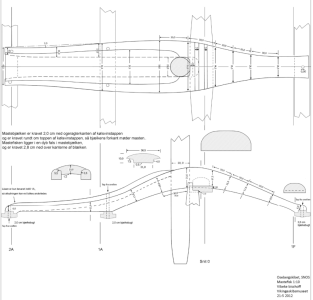
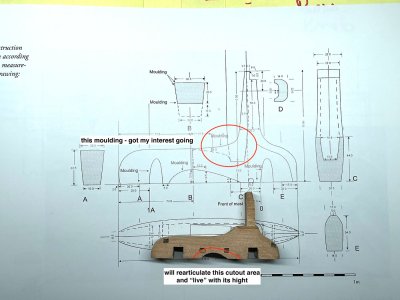
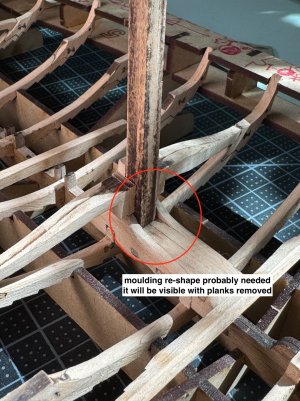
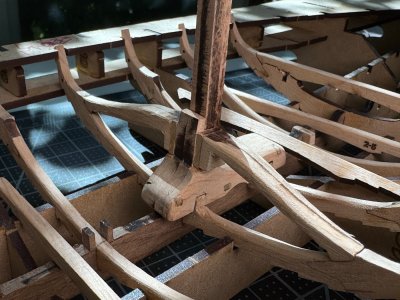
Yes, the partner needs to be shape adjusted - still on my list. That said, I’m not sure - either way - if the deck planking also did continue slightly under the partner on each side of the mast?
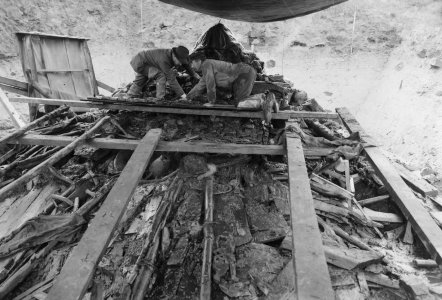
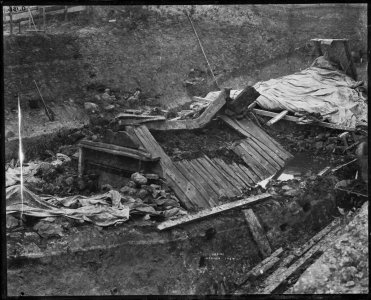
Though most early 1900s images, from the dig site, don’t seem to support that conclusion…Nor do current images of the ship. Need to read more…TBD
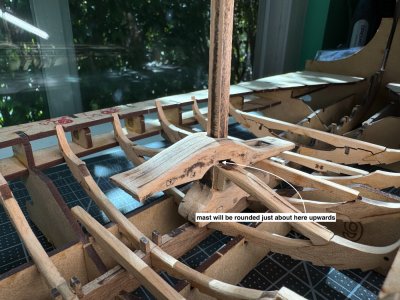
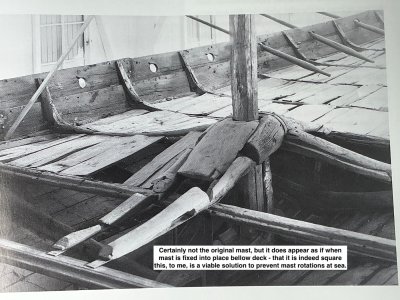
Regarding the mast, I intend on leaving it square shaped at it fits into the keelson - then round it just before it fits through the partner.
The other issue is the size of Pavel’s provided keelson - seems too big. I will do some slight reshaping there as well. Lots of learning (for me) about a ship from 2000 years ago. Enjoying the is new learning adventure.
As I learn more, I have also been so astonished about Viking ship building; So excellent
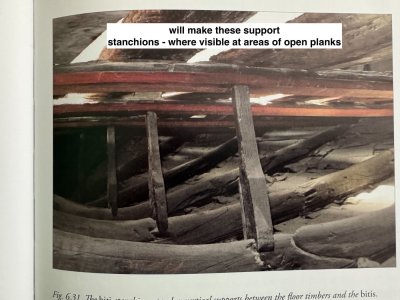
Thanks so much for your nice comments, as well as your very helpful images and inputs.
Your work Oseberg log has also been a real pleasure to follow. Went back through your log to again - read your notes about where to locate the mast and the Unimus image reference….., for moving the mast step one frame forward - that was a LOT of work on your part.….Need to consider that as well..
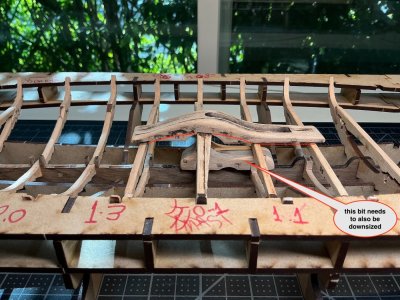
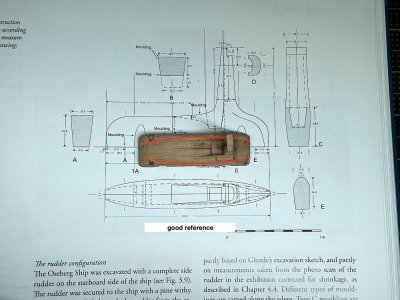
Yes, the partner needs to be shape adjusted - still on my list. That said, I’m not sure - either way - if the deck planking also did continue slightly under the partner on each side of the mast?
Though most early 1900s images, from the dig site, don’t seem to support that conclusion…Nor do current images of the ship. Need to read more…TBD
Regarding the mast, I intend on leaving it square shaped at it fits into the keelson - then round it just before it fits through the partner.
The other issue is the size of Pavel’s provided keelson - seems too big. I will do some slight reshaping there as well. Lots of learning (for me) about a ship from 2000 years ago. Enjoying the is new learning adventure.
As I learn more, I have also been so astonished about Viking ship building; So excellent

- Joined
- Sep 10, 2024
- Messages
- 1,147
- Points
- 443

That said, I’m not sure - either way - if the deck planking also did continue slightly under the partner on each side of the mast?
That's really hard to say, John. What we would call thwarts (the uppermost crossmember at each frame) are called biti. If you examine the cross section I sent you, the deck ledge on the aft biti is just below the mast partner, and it is conceivable that the decking could have slid under the partner. The forward ledge, however, is arranged differently, and there doesn't appear to be room for a deck plank under it. Unfortunately, the mast biti was not drawn with the deck ledges, so your guess is as good as mine. I plan on not making the curve on the bottom of the partner arc so high and just butting the planks up against the side of it. If I were doing what you are, I would probably approach it differently, as well as make the mast step more authentic.
My reasoning for not, however, is that all evidence points to all the deck planks being nailed down with the exception of the rooms adjacent to the mast and (if I remember correctly) a room or two at the stems. If I were to leave a room open as you are, it would be one of those, but given, as you say, the incorrect keel as well as the incorrect frames, I decided to leave it as is and fasten the deck down.
Having the decks fastened down is somewhat unusual for a longboat, which is why archaeologists believe the Oseberg was not a typical ocean-going raiding vessel, but rather a ceremonial boat or inland private transport for the apparent high-ranking women who were found buried with her. There would be no need for much storage space below decks and without cargo and supplies, there would need to be more ballast. Dr. Bischoff talks in her book about trimming the reproduction boat by shifting ballast - sometimes this might need to be done at sea. Again, given the role they assume the Oseberg played, there would not really be a need for that, hence no need to access the bilge.
That's really hard to say, John. What we would call thwarts (the uppermost crossmember at each frame) are called biti. If you examine the cross section I sent you, the deck ledge on the aft biti is just below the mast partner, and it is conceivable that the decking could have slid under the partner. The forward ledge, however, is arranged differently, and there doesn't appear to be room for a deck plank under it. Unfortunately, the mast biti was not drawn with the deck ledges, so your guess is as good as mine. I plan on not making the curve on the bottom of the partner arc so high and just butting the planks up against the side of it. If I were doing what you are, I would probably approach it differently, as well as make the mast step more authentic.
My reasoning for not, however, is that all evidence points to all the deck planks being nailed down with the exception of the rooms adjacent to the mast and (if I remember correctly) a room or two at the stems. If I were to leave a room open as you are, it would be one of those, but given, as you say, the incorrect keel as well as the incorrect frames, I decided to leave it as is and fasten the deck down.
Having the decks fastened down is somewhat unusual for a longboat, which is why archaeologists believe the Oseberg was not a typical ocean-going raiding vessel, but rather a ceremonial boat or inland private transport for the apparent high-ranking women who were found buried with her. There would be no need for much storage space below decks and without cargo and supplies, there would need to be more ballast. Dr. Bischoff talks in her book about trimming the reproduction boat by shifting ballast - sometimes this might need to be done at sea. Again, given the role they assume the Oseberg played, there would not really be a need for that, hence no need to access the bilge.
This has indeed created a slight conundrum - wanting to make the Oseberg a bit more representative generically speaking of a fully going ocean-going ship, but understanding that she was apparently not built with that intent. And of course, the knowledge that the Oseberg’s place in Viking history was as a preserved tomb for the deities who were buried aboard.
I may create a very slightly abridged version of this ship being motivated to include ballast rocks.
Russ you are rightfully dedicated to accurately building your example as closely as possible to the original ship’s look even moving the mast forward to its correct location. Good idea…There is also definitive evidence that Oseberg was found with remnants of a sail in addition to wood barrels, an iron tripod cooking pan, along with other related items thankfully Pavel's kit included those bits.
So, the issue for me would be to whether or not to add rock ballasts at my intended open deck locations.
She was however found with a massive number of rocks, with nearly 180 tons of stone placed inside and on top of the vessel to seal the burial mound. Non were noted to be used for earlier ballast.
Oh regarding deck planking - I will just butt up against the stem - not under thanks for your post.
Regards,
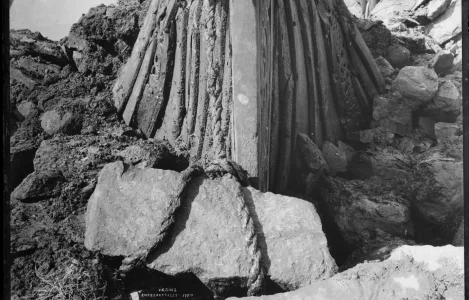
Hi all,
Here is another work in progress update.
PS: Russ THANKS - re: your excellent mast relocation
Regards,
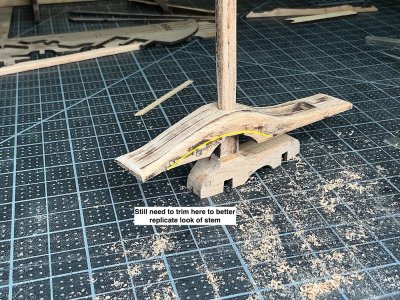
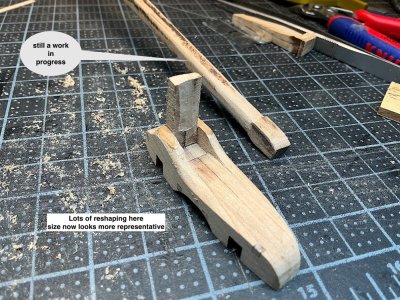
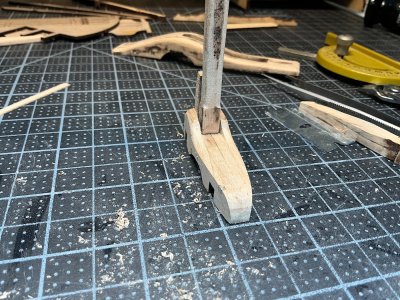
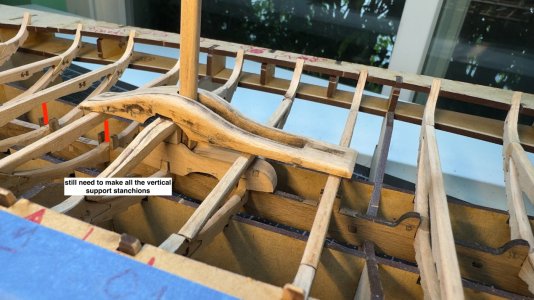
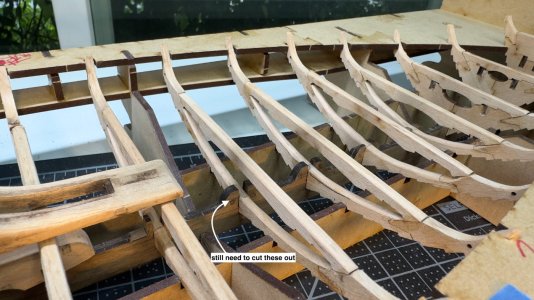
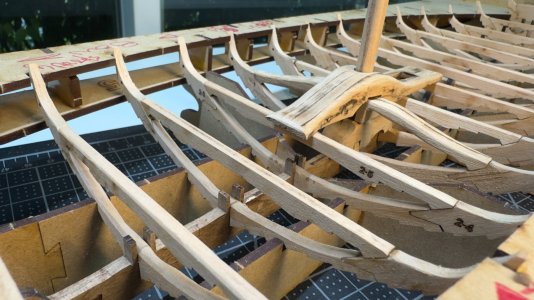
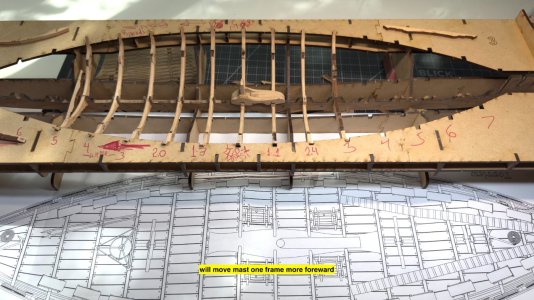
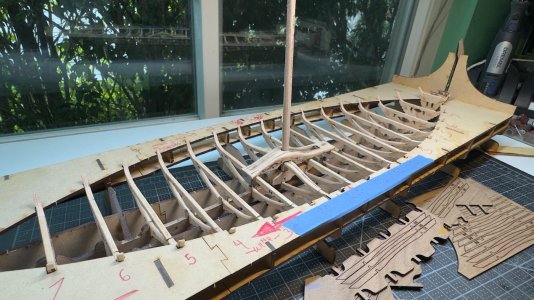
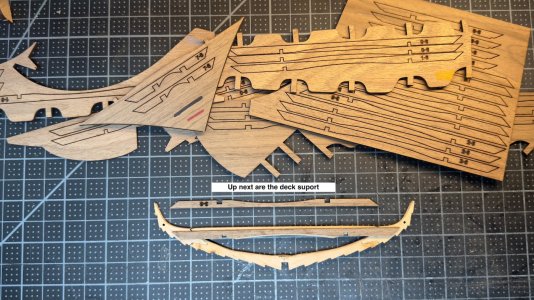
Here is another work in progress update.
PS: Russ THANKS - re: your excellent mast relocation
Regards,
Last edited:


OK had to bookmark this one, looks like a major mod trimming on the yellow line.Hi all,
Here is another work in progress update.
PS: Russ THANKS - re: your excellent mast relocation location
Regards,
View attachment 584474View attachment 584475View attachment 584476View attachment 584477View attachment 584478View attachment 584479View attachment 584480View attachment 584481View attachment 584482
Daniel,
Yes RussF discovered that was certainly needed. In both our cases (you and I) a simple enough adjustment. Russ needed to do a lot of re-fixing in his log
to get his mast position properly changed.
Thanks for dropping by....
Yes RussF discovered that was certainly needed. In both our cases (you and I) a simple enough adjustment. Russ needed to do a lot of re-fixing in his log
to get his mast position properly changed.
Thanks for dropping by....


Greetings, John. Lots of thinking happening here...please don't cause yourself an injury  .
.
.
Yup Russ is the go to alright. I have several of his post bookmarked for future use when I finally get to my Oseberg.Daniel,
Yes RussF discovered that was certainly needed. In both our cases (you and I) a simple enough adjustment. Russ needed to do a lot of re-fixing in his log
to get his mast position properly changed.
Thanks for dropping by....

Good morning John. Some nice corrections to the kit.....as you do. I love the WIP pics. Cheers GrantHi all,
Here is another work in progress update.
PS: Russ THANKS - re: your excellent mast relocation
Regards,
View attachment 584474View attachment 584475View attachment 584476View attachment 584477View attachment 584478View attachment 584479View attachment 584480View attachment 584481View attachment 584482
Daniel,Yup Russ is the go to alright. I have several of his post bookmarked for future use when I finally get to my Oseberg.
I don't remember if you mentioned having received your Oseberg yet. The situation in Kiev just seems to be getting worse.
PS: Your current build is awesome!!
Cheers,
Paul,Greetings, John. Lots of thinking happening here...please don't cause yourself an injury
Hmmm, trying my best -
 My wrist is back to 100% so that in-and-of-itself is a welcome relief (carpal tunnel procedure)...
Cheers,
Grant,Good morning John. Some nice corrections to the kit.....as you do. I love the WIP pics. Cheers Grant
Thanks - always so nice with your posts
Regards,
Hello John, yes, I have it on the shelf ready to go but it will be a while before I start it. I also have the mast upgrade.I don't remember if you mentioned having received your Oseberg yet.
Hi all,
Finally starting hull planks. Wanted to better replicate original that had etched cuts along each plank.
This solution, so far, is working out better than I had imagined with a Slight variation - very curved part was a bit beyond my skill set.
NEED to think about how to add, in scale, the 1000s of cleats yikes TBD
TBD
Thanks for dropping by,
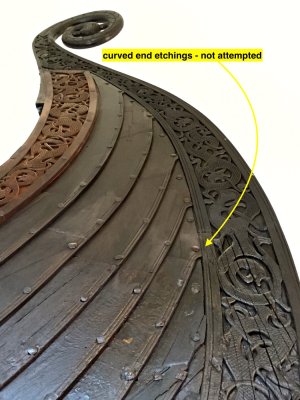
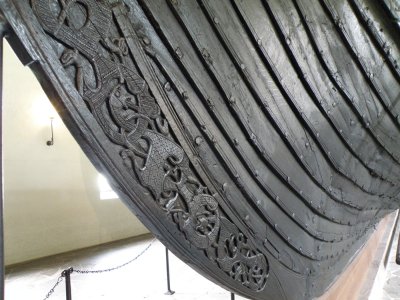
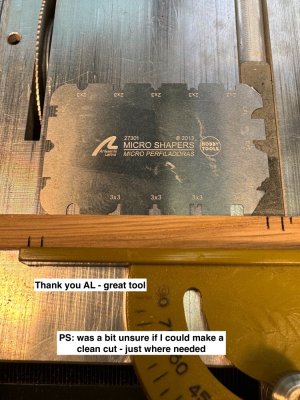
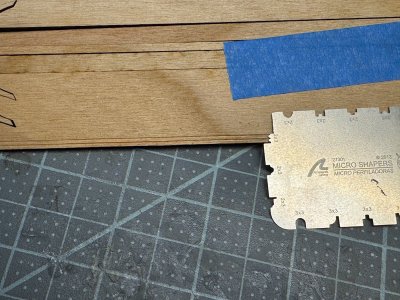
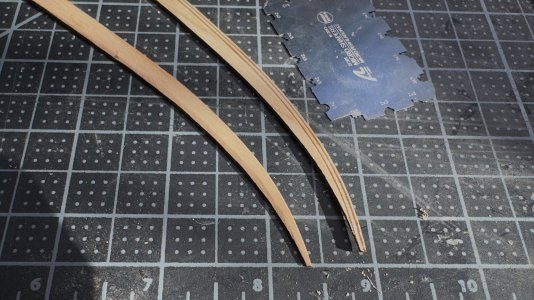
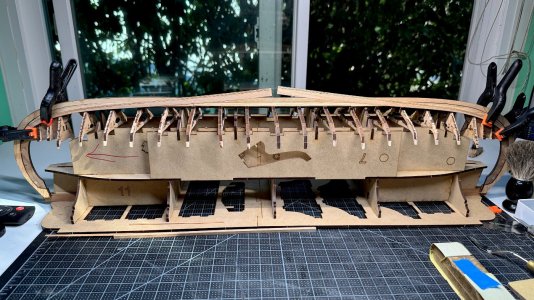
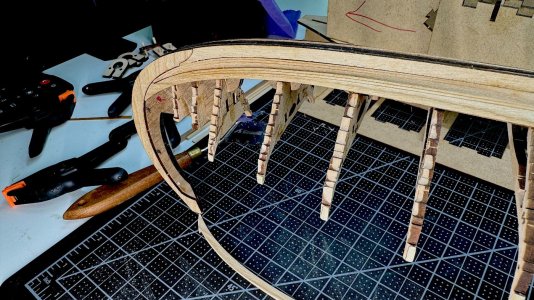
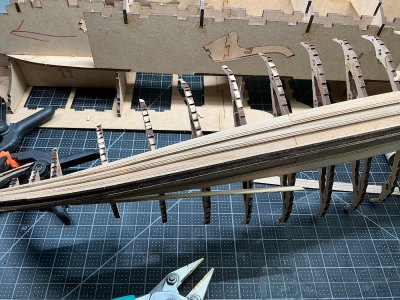
Finally starting hull planks. Wanted to better replicate original that had etched cuts along each plank.
This solution, so far, is working out better than I had imagined with a Slight variation - very curved part was a bit beyond my skill set.
NEED to think about how to add, in scale, the 1000s of cleats yikes
TBD Thanks for dropping by,
Pretty fancy! Will you add the nails? (that wasn't a challenge - just a question)
I could be overly sensitive and view your comment as a challenge (you've unfortunately just had one or two - such unnecessary stress)
PS: Thanks for not challenging me Yes,
I want to also add the nails - TBD -- I think that @Willbor237 win's the trophy in that regard - will revisit his brilliant Oseberg work. AND his deck work as well!
Regards,
PS: Thanks for not challenging me
Yes,I want to also add the nails - TBD -- I think that @Willbor237 win's the trophy in that regard - will revisit his brilliant Oseberg work. AND his deck work as well!
Regards,
Good morning John. You got those just right- those little details make a difference. I always love looking at pics of the real thing as us modellers always strive for that perfect finish but the real ships never are. Gives me an excuse for my inconsistency’sHi all,
Finally starting hull planks. Wanted to better replicate original that had etched cuts along each plank.
This solution, so far, is working out better than I had imagined with a Slight variation - very curved part was a bit beyond my skill set.
NEED to think about how to add, in scale, the 1000s of cleats yikes
Thanks for dropping by,
View attachment 585737View attachment 585738View attachment 585739View attachment 585740View attachment 585741View attachment 585742View attachment 585743View attachment 585744
. Cheers Grant
What a great idea for cutting in the profile on those planks. One that I will be copying too!