



Thank you all for your kind comments! Now off to my next adventure an 18th century longboat.

 |
The beloved Ships in Scale Magazine is back and charting a new course for 2026! Discover new skills, new techniques, and new inspirations in every issue. NOTE THAT OUR NEXT ISSUE WILL BE July/August 2026 |
|
 |
As a way to introduce our brass coins to the community, we will raffle off a free coin during the month of August. Follow link ABOVE for instructions for entering. |
|

Thank you so much.Wow, nicely done. A pleasure to read your build log.
Jan

Yes you are correct in beveling the planks that you show in figure one so then it abuts up to the previous plank it is a bit tilted as it were. The ends of the planks were also beveled to fit better along the keel as you may be able to see in this picture.Good Afternoon Rob444
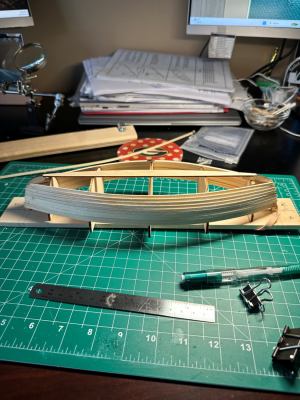
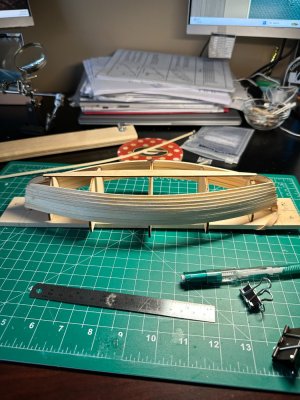
Excellent build log, Your tips and technqigues have saved me from disaster (I think). I am attempting to build the Maine Peapod. My first boar build. I am still confused about planking. Specifically, beveling and trimming. I am struggling to get the planks along the curve of the bulkheads to get them to touch and also to avoid spaces with the preceding plank. I think I may be too late to correct given the last plank I put on. Here is the current status.
View attachment 584948
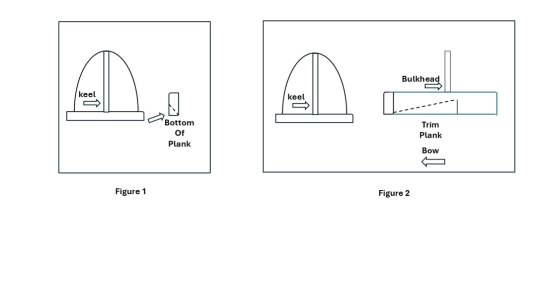
After soaking and putting in place I am not sure what to do with beveling. In Figure 1 below I think I have to round the the bottom edge (really the top edge if in the water) Is this Correct? Also when I am trimming the edges of the plank do I follow whats in Figure 2. Help!!
View attachment 584949
View attachment 584941
The planks will lie better if you mix straight the parallel edged planks with some that are tapered each way from the middle. Fair winds!I am struggling to get the planks along the curve of the bulkheads to get them to touch and also to avoid spaces with the preceding plank.
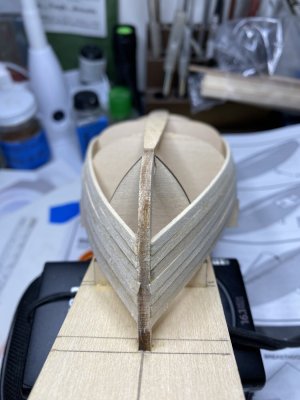
Yes you are correct in beveling the planks that you show in figure one so then it abuts up to the previous plank it is a bit tilted as it were. The ends of the planks were also beveled to fit better along the keel as you may be able to see in this picture.
View attachment 584950
As I discussed, the planks do want to twist as you get closer to the keel. I found soaking them in hot water for 5-10 minutes really helped. After soaking I clamped them into place and let them dry. Wiping on ammonia (I used windex which has ammonia in it) helps also. Just take the wet plank before you clamp it into place and wipe on some windex. If I understand figure 2 you are notching the planks where they go against the various bulkheads? That I did not do, nor have I heard of it.
When you clamp them in place, I used the clamps to "push" the plank against the preceding plank. So far from what I see of your planking, it looks very similar to mine. I think you are off to a great start. If you have any other questions I am more than willing to help. There are many advanced "tutorials" on planking on this site, you tube and model ship world. But I don't think you need them for this build.
Rob
I wanted to get your advice on whether I should redo one plank that has a huge gap (see below). I used super glue for the ends but wood glue for the rest so It maybe tricky to remove. I will probably need to use dremel to remove. The other idea was to cut the plank on a angle move it to close the gap and re glue. If I am removing it I have nothing to loose.Thanks for the bevel confirmation and the windex tip. I will try that. Also, I did review your build log before I started planking and beveled the ends of the plank as it attaches to keel..
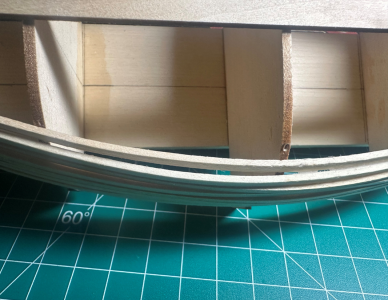
I would redo the plank. Water or alcohol will usually loosen wood glue. Let it soak in and pry it with a blade. It should not (hopefully) be attached to the bulkheads. The ends you can take off with careful cutting with an x-acto blade.I wanted to get your advice on whether I should redo one plank that has a huge gap (see below). I used super glue for the ends but wood glue for the rest so It maybe tricky to remove. I will probably need to use dremel to remove. The other idea was to cut the plank on a angle move it to close the gap and re glue. If I am removing it I have nothing to loose.
Has anyone done this?
View attachment 584970