• Win a Free Custom Engraved Brass Coin!!!
    As a way to introduce our brass coins to the community, we will raffle off a free coin during the month of August. Follow link ABOVE for instructions for entering.
  • SUBSCRIBE TO SHIPS IN SCALE TODAY!

    The beloved Ships in Scale Magazine is back and charting a new course for 2026!
    Discover new skills, new techniques, and new inspirations in every issue.

    NOTE THAT OUR NEXT ISSUE WILL BE MARCH/APRIL 2026

Purchased shortly ago / sthg new in your workshop -> present it here

You could do that if the bar will fit in the hole. You would have to take the moving clamp end (that slides on the bar) off and feed it though the hole and then slide the clamp end back on. Then you would have to get to it to clamp it.
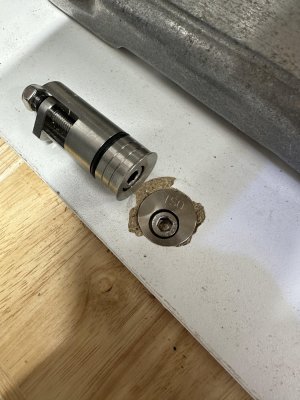
This is what I use:
Dog posts.jpg
They go through the dog hole and then you tighten the allen screw to attach it tightly. These are by TSO. Of course, they require not only a hole in the base of the tool mount, but also holes in your workbench as well. :) This one is holding my tabletop drill press on the bench. But I also have the same mount for a tabletop sander and a drill press that uses my Dremel tool.
Note, there are multiple sizes of dog holes and they have to match the bench dogs. :) Here is a link where you can get them:
TSO Products
 
You could do that if the bar will fit in the hole. You would have to take the moving clamp end (that slides on the bar) off and feed it though the hole and then slide the clamp end back on. Then you would have to get to it to clamp it.
This is what I use:
View attachment 590049
They go through the dog hole and then you tighten the allen screw to attach it tightly. These are by TSO. Of course, they require not only a hole in the base of the tool mount, but also holes in your workbench as well. :) This one is holding my tabletop drill press on the bench. But I also have the same mount for a tabletop sander and a drill press that uses my Dremel tool.
Note, there are multiple sizes of dog holes and they have to match the bench dogs. :) Here is a link where you can get them:
TSO Products
Thanks Corsair - What do you think about the Dremel drill press? What do you use it for? Can you use that Dremel drill press as a sort of router?
 
Dremel router. The short answer is NO! It may work and Dremel does sell router type tools to fit it BUT it is a Light duty hobby quality tool that almost certainly does not have bearings designed to accept repeated side loads involved with routing.

Roger
 
Dremel router. The short answer is NO! It may work and Dremel does sell router type tools to fit it BUT it is a Light duty hobby quality tool that almost certainly does not have bearings designed to accept repeated side loads involved with routing.

Roger
Agree Roger. I want to learn how to use the Bosch router I just purchased on a small scale for solid hull building and removing excess wood in the solid hull. I am going to ask a contractor in my model club to help me mount the pro router onto a bench or a sturdy sawhorse table.
 
Looks like you have a good setup and basis for making your own modelling lumber for your future ship project. I would suggest adding a desktop bandsaw. I tried using a scroll saw for cuttihng details in thin wood or tiny parts, but the oscillating blade could catch the wood on the upstroke and risked splitting the thin piece along the grain, and the cut was not as smooth and clean as with a band saw. Even a cheap bandsaw (less than $200 worth) may be an improvement. The scrollsaw may better serve some cutting applications, but the bandsaw has been my most flexible and precise cutting tool.
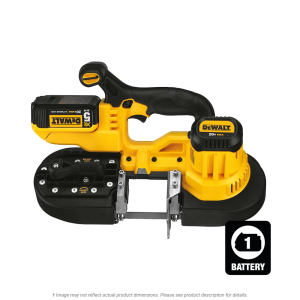
Darius - I have a couple of Dewalt tools and I'm going to check out the Dewalt compact portable bandsaw, which looks like it would be perfect for wood boat modeling at the larger scales that I want to build in now that I have some useful power tools. It goes for about $225 at the Home Depot nearby. And forgot to mention that I am looking to sharpen my chisels and fine wood carving tools on the new bench grinder. I need to watch a ton of YouTube videos on scroll saws, grinding, routers, etc.
 
Last edited:
Darius - I have a couple of Dewalt tools and I'm going to check out the Dewalt compact portable bandsaw, which looks like it would be perfect for wood boat modeling at the larger scales that I want to build in now that I have some useful power tools. It goes for about $225 at the Home Depot nearby. And forgot to mention that I am looking to sharpen my chisels and fine wood carving tools on the new bench grinder. I need to watch a ton of YouTube videos on scroll saws, grinding, routers, etc.
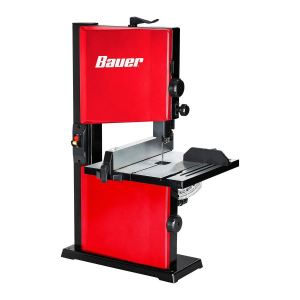
I wasn't referring to this type of bandsaw...
1775447880329.png

But THIS type:
1775447937259.png

The former isn't much good for modelling except for cutting tree log sections into timbers, and forget about making deck planking strips and small parts with that clumsy monster. The latter can precisely cut planking strips or make tiny cannon carriages among hundreds of other uses.

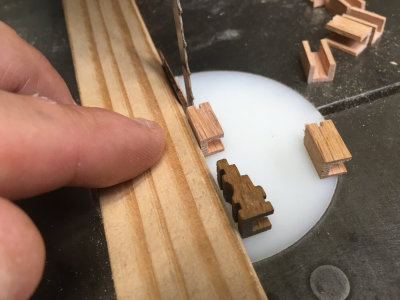
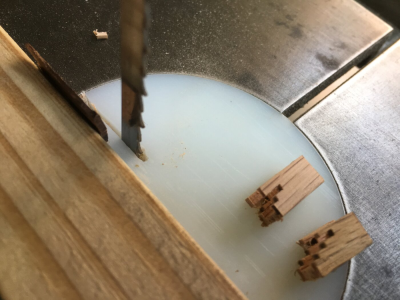
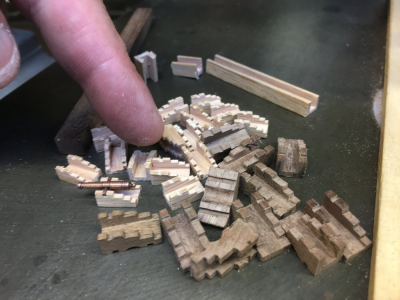
Example: making copies of one-piece kit cannon carriages, only smaller, for use as 6-pound saker chase guns. The fence is made from a strip of wood that has a stop glued to it in order to set the depth of cut. 1:100 scale carriages were mass produced for the lower decks instead of using false cannon half-barrels
1775448361972.png

1775448501122.png

1775448580978.png
 
Last edited:
Thanks Corsair - What do you think about the Dremel drill press? What do you use it for? Can you use that Dremel drill press as a sort of router?
I do not use it for routing. That's what I have the Bosch in the table for. :)
I honestly don't use it very much. occasionally for some very light milling.
 
I do not use it for routing. That's what I have the Bosch in the table for. :)
I honestly don't use it very much. occasionally for some very light milling.
Thanks Corsair! For the Bosch router, how small are the bits you use? Can you use a bit smaller than 1/4 inch? I'm asking a contractor in my model club to help mount the Bosch router on a solid wooden bench.
 
Thanks Corsair! For the Bosch router, how small are the bits you use? Can you use a bit smaller than 1/4 inch? I'm asking a contractor in my model club to help mount the Bosch router on a solid wooden bench.
No. It only has 1/4” and 1/2” collets. I’ve never looked for others, so they may be out there, but I don’t know of them.
 
Ignatius, with these acquisitions from your friend you’re starting to equip a workshop. I know that you’re anxious to buy more power tools but let me suggest a more budget friendly direction that will also improve your craftsmanship. Buy quality hand tools as your projects require them and learn how to use them. More power tools can come as you find good deals and as your budget increases.

You have bought a solid hull kit. I would not let that router get near the hull of this model. It can destroy it in an instant! Instead buy a quality small hand plane and a spokeshave. Both of these, especially the spokeshave are used to shape solid hull models. Chisels are used too and you apparently already have some. To sharpen, buy a sharpening guide and a sharpening stone (oil or water as you prefer). There are guides on line and several good books available about sharpening edged tools. DO NOT try to sharpen edged tools on that powered grinder! Like the router it is too aggressive.

The University of Michigan operates a 450 ft long “towing tank” for testing models of ship hull to determine resistance. As a student there in the 1960’s, I watched professional model makers sculpt highly accurate models to be towed in the tank from clear white pine. Although the laminations to build these models were sawed on a bandsaw, shaping was done by hand. I still have and use a set of three miniature spoke shaves bought back then for a student project.

Power tools have their uses building models but first develop skill with hand tools.

Roger.
 
The collet shanks are only ¼ or ½ inch. But the cutting edges come in multiple sizes from pin-point to large…
Just search for “CNC router bits 1/4 inch shank” in google or your favorite search engine. ;)
OlivierF - Thanks! I took a look online at the CNC router bits on the 1/4 inch shanks. Looks like you can do some very fine routing (down to 0.5 mm) with the gradual pinpoint tool and remove alot of surface wood evenly with the spoilboard surfacing bit. So perfect for carving upper deck levels on a solid hull.
 
OlivierF - Thanks! I took a look online at the CNC router bits on the 1/4 inch shanks. Looks like you can do some very fine routing (down to 0.5 mm) with the gradual pinpoint tool and remove alot of surface wood evenly with the spoilboard surfacing bit. So perfect for carving upper deck levels on a solid hull.
sorry, I misunderstood your question. :)
 
Ignatius, with these acquisitions from your friend you’re starting to equip a workshop. I know that you’re anxious to buy more power tools but let me suggest a more budget friendly direction that will also improve your craftsmanship. Buy quality hand tools as your projects require them and learn how to use them. More power tools can come as you find good deals and as your budget increases.

You have bought a solid hull kit. I would not let that router get near the hull of this model. It can destroy it in an instant! Instead buy a quality small hand plane and a spokeshave. Both of these, especially the spokeshave are used to shape solid hull models. Chisels are used too and you apparently already have some. To sharpen, buy a sharpening guide and a sharpening stone (oil or water as you prefer). There are guides on line and several good books available about sharpening edged tools. DO NOT try to sharpen edged tools on that powered grinder! Like the router it is too aggressive.

The University of Michigan operates a 450 ft long “towing tank” for testing models of ship hull to determine resistance. As a student there in the 1960’s, I watched professional model makers sculpt highly accurate models to be towed in the tank from clear white pine. Although the laminations to build these models were sawed on a bandsaw, shaping was done by hand. I still have and use a set of three miniature spoke shaves bought back then for a student project.

Power tools have their uses building models but first develop skill with hand tools.

Roger.
Roger -- This is wise advice. Building boats is more about the hands that use the tools, rather than the tools themselves. What you are seeing is the 7-year old kid in me experiencing Christmas in April - not someone who was only introduced to wooden ship modeling 8 months ago! I am lucky enough to have all these new toys from my friend's generosity that I want to learn how to use and to start using them, but to be honest, I'm probably 5 or 6 months away from starting to work with any of the power tools. After the initial buzz settles down, I will be back to working my current build, the Juan Sebastian de Elcano / Esmeralda, with no power tools but a cheap Chinese table saw, a 1/4 inch drill, a heat gun, and plenty of manual dexterity.

If you've seen any of my build logs I'm a pretty methodical person and I started doing my builds 7-8 months ago in a specific order to learn fundamental skills for wooden shipcraft and build off that: a couple of Midwest kits to get exposed to working with wood, a hull-only build of the HMS Victory 1/150 from a cheap internet kit, my first scratch boats "re-doing" the Maine Peapod and the Sea Bright Dory using only the ship plans and the strongbacks from those kits. I did a 20-oar dragon boat to learn how to paint wood and use Titebond instead of Superglue on every joint. And now the Juan Sebastian Elcano to learn simple rigging, masts and sailmaking. I've covered that much ground in 8-months, but really not in a rush to start carving futtocks with the scroll saw at the moment. It's just good to know that when I'm ready (after I get a handle on the 3 standard design drawings for every boat plan, the sheer profile, the half-breadth and the body plan), the scroll saw will be there whenever I need it, but just not now. I'm looking at 3-drawing plans for the Golden Hind and the Philadelphia Gunboat to try and figure out how the 3 drawings work together, but it will be weeks-to-months until I get there.

I try not to think too far ahead and focus on the present -- okay, maybe my dream build is the windjammer Nippon Maru 1/80 scale kit from Woody Joe -- but as you know my next build is the Mayflower 1620 1/140 kit from Corel with a solid hull. I've been very excited to start because the rigging is an order of magnitude more complex than the JSE and I want to see how planking and decking over a solid hull works.

After that, the next boat in the queue will probably be a scratch paper model from Ab & Emiel Hoving's "Dutch 17th Century Ship Models in Paper" book from SeaWatch Books. I tried my hand at paper modeling last year (right before I started wood modeling) with bad results as I started and did not finish the tugboat Centaur II, tugboat Cyclon, and the armed cargo freighter Graf Goetzen. Ab Hoving's scratch paper model building method looks light years ahead of the cheap eastern European paper kits, and I'm excited to build a 17th century Dutch pinnace on par with the Duykfen, the Papegojan and the Kalmar Nyckel based off Ab Hoving's own plans. So there is a method to my (boat model building) madness!

As for my chisels, planer and other woodworking tools I've used them sparingly so far, so probably some months before they need sharpening. So far I've carved a partial duck model out of a block of spare balsa wood. Now that I have some real wood stock I can start carving ducks out of poplar!

 
Last edited:
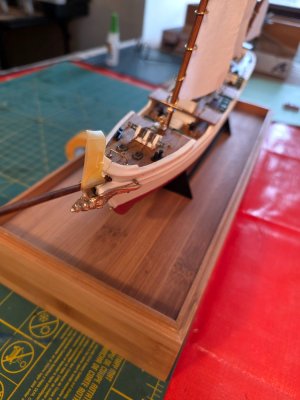
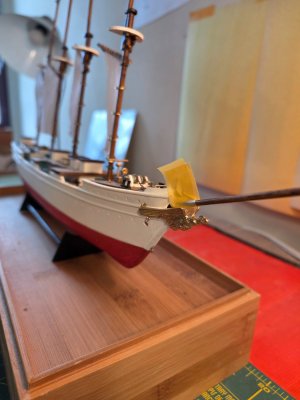
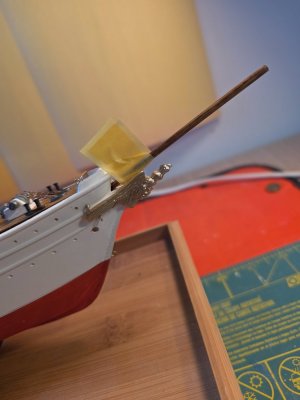
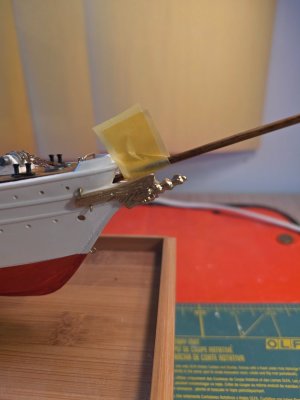
Progress pics of the Juan Sebastian de Elcano / Esmeralda. I decided to go with the Esmeralda with the Golden Bird figurehead carrying the lone star of Chile. That way I don't have to repaint the hull!

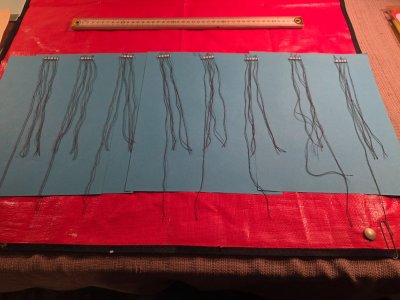
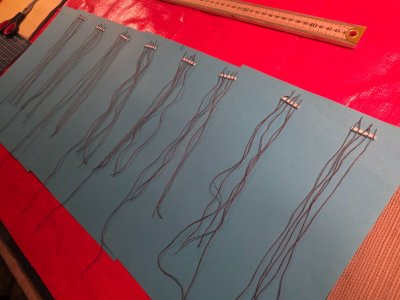
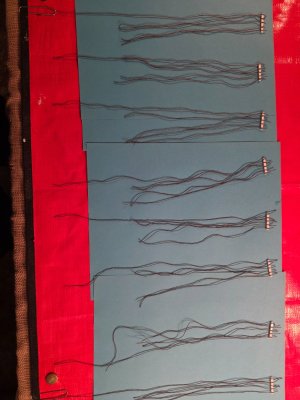
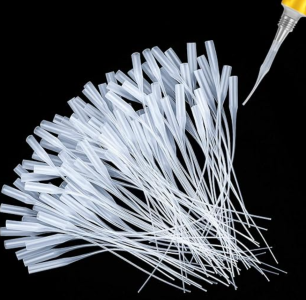
Got into fabricating the 8 sets of shrouds and I'm finding that CA superglue is not your friend when building shrouds. I might be on the lookout for an eyedropper to apply the CA glue to the shrouds.

Tomorrow the shrouds go up. Then the 3 jibs and foremast stay sails. And the bowsprit rigging and mounting the figurehead. Will probably start sewing the square sails onto the foremast spars if I have time.

20260406_215750.jpg

20260406_215334.jpg

20260406_165034.jpg

20260406_165012.jpg

20260406_164956.jpg

20260406_164945.jpg

20260406_215314.jpg

20260407_081213.jpg

20260407_081155.jpg
 
Last edited:
As for my chisels, planer and other woodworking tools I've used them sparingly so far, so probably some months before they need sharpening. So far I've carved a partial duck model out of a block of spare balsa wood. Now that I have some real wood stock I can start carving ducks out of poplar!

For chisels and knives and #11 blades a piece of scrap leather and a green, gold, or rouge crayola sharpening compound stick to color it - strop a cutting edge frequently and you may never need go near a stone - unless you nick the edge.
 
For chisels and knives and #11 blades a piece of scrap leather and a green, gold, or rouge crayola sharpening compound stick to color it - strop a cutting edge frequently and you may never need go near a stone - unless you nick the edge.
Jaager -- Thanks for the suggestion. I found the green sharpening compound for next to nothing online and will pick up some leather bands next time at the hobby store. Is there a way for keeping serrated edge knives sharp? I've got a Japanese hacksaw that I use in my miter box that I use alot and will eventually need to re-sharpen the serrated teeth. Any suggestions on this score would be appreciated.
 
Back
Top