• Win a Free Custom Engraved Brass Coin!!!
    As a way to introduce our brass coins to the community, we will raffle off a free coin during the month of August. Follow link ABOVE for instructions for entering.
  • SUBSCRIBE TO SHIPS IN SCALE TODAY!

    The beloved Ships in Scale Magazine is back and charting a new course for 2026!
    Discover new skills, new techniques, and new inspirations in every issue.

    NOTE THAT OUR NEXT ISSUE WILL BE MARCH/APRIL 2026

Making your own Ropes

you are a fast learner, that 1 mm rope looks real good.
Just some advice:
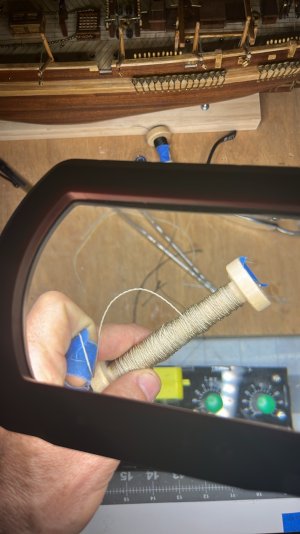
I wouldn’t use those little black things to wind the rope. This polyester thread tends to hold its shape, especially in a warm climate. That will cause kinks in your rope. The old wooden spools for thread are better. Or, like I do, a small cardboard tube that used to hold aluminum foil or plastic wrap.
 
I don't want to argue. I refrained from adding the opinion i had prepared.
But, he want truth...

Maybe you're the ones who are insisting and trying to hype him up, saying it's good, when the truth is a bit different?
You even use Domanoff's table for rope diameters and thread thickness to make these ropes? He's the author, right?
Is this deliberately misleading people into thinking it can't be done on another ropewalk?Reading this thread, I'm simply deceived because it hasn't shown anything else that can be done on the Domanoff ropewalk.
Just as you think it's weak, i too can have my own opinion and not accept another solution.Saying something "can't be done" on a Domanoff treadmill and then doing essentially the same thing on another machine is simply hypocrisy. You can have your preferences and not like the machine – but presenting it as the absolute truth is a completely different matter
.
So far, it hasn't performed any better than a typical rope from a planetary ropewalk.
I understand that you have to keep an eye on your customer, but let's not exaggerate.
Perhaps it would be appropriate to say that this rope is bad, too melted on individual strands?
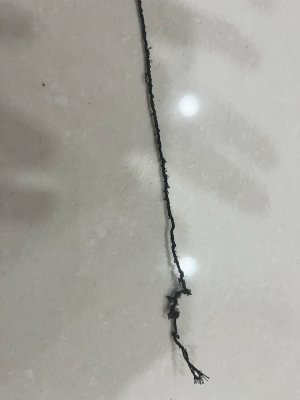
It has been tightened several times, as evidenced by the strand failures?

Let's give people honest information and freedom of choice, instead of imposing a single narrative.
View attachment 590415
Hi Kuba,

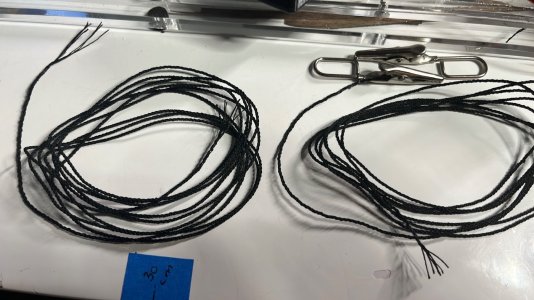
I’m new to this forum and this is my first post. I’ve been trying to make ropes for the past two weeks, but it’s been a complete disaster. So far, I’ve only managed to waste thread and time with the PL4-3 machine from Mr. Aleksei Domanov.
As you can see in the photos, the ropes come out badly twisted and lose almost all their tension. When I tried twisting them in the opposite direction, they turned into a massive tangle, forcing me to stop the machine.

Honestly, for the price I paid, I expected something much better. At this point, I don’t think it’s good for anything at all. Now the main issue will be the return process, since I live in the USA and Mr. Domanov is in Poland.

I’m writing in English in case someone else here owns the same machine and might be able to help. I’d really appreciate the chance to connect with you and hear about your experience using it. I bought a PL4-3, and so far, all I’ve accomplished is wasting thread.
To be honest, I’ve felt like throwing it in the trash—but after reading your posts, I see you speak very highly of it. If you don’t mind, I would greatly appreciate any advice you can share. You can even reply in Polish, or send a private message if you prefer.

I’ve attached some photos so you can see the kind of "ropes" the machine is producing for me. Any help would be greatly appreciated.

Thanks in advance,
Jacek Castro

IMG_0170.jpg

IMG_0148.JPG

tempImageHfYzf0.png
 
Last edited:
you are a fast learner, that 1 mm rope looks real good.
Just some advice:
I wouldn’t use those little black things to wind the rope. This polyester thread tends to hold its shape, especially in a warm climate. That will cause kinks in your rope. The old wooden spools for thread are better. Or, like I do, a small cardboard tube that used to hold aluminum foil or plastic wrap.
Hi Steff66
I have carefully read almost all the comments on this topic, and I believe the best thing Phillip could have done was buy that other machine; that is why the ropes are now turning out exactly as they should. It is not only a different method, but actually the most common one of all time.
Cheers from Florida US "The Sunny State"
 
Hi Kuba,

I’m new to this forum and this is my first post. I’ve been trying to make ropes for the past two weeks, but it’s been a complete disaster. So far, I’ve only managed to waste thread and time with the PL4-3 machine from Mr. Aleksei Domanov.
As you can see in the photos, the ropes come out badly twisted and lose almost all their tension. When I tried twisting them in the opposite direction, they turned into a massive tangle, forcing me to stop the machine.

Honestly, for the price I paid, I expected something much better. At this point, I don’t think it’s good for anything at all. Now the main issue will be the return process, since I live in the USA and Mr. Domanov is in Poland.

I’m writing in English in case someone else here owns the same machine and might be able to help. I’d really appreciate the chance to connect with you and hear about your experience using it. I bought a PL4-3, and so far, all I’ve accomplished is wasting thread.
To be honest, I’ve felt like throwing it in the trash—but after reading your posts, I see you speak very highly of it. If you don’t mind, I would greatly appreciate any advice you can share. You can even reply in Polish, or send a private message if you prefer.

I’ve attached some photos so you can see the kind of "ropes" the machine is producing for me. Any help would be greatly appreciated.

Thanks in advance,
Jacek Castro

View attachment 591925

View attachment 591926

View attachment 591936

Hi.
I'm glad you joined the forum, but due to the heavily saturated threads of toxic positivity and the pretense that everything is great, I've decided not to comment on any construction-related issues or single-minded topics.

I encourage you to send a message to Aleksei Domanov. He has an excellent website and has been very helpful with machine setup and rope selection for many years. Regarding rope making itself, I recommend other threads on the forum that will allow you to make a rope from scratch.

I wish you all the best, and I’ll step back from any further discussion on any topic. I’ll focus on keeping a positive mindset and my own well-being. I wish everyone the best of luck in their journey on the forum.
 
Hi.
I'm glad you joined the forum, but due to the heavily saturated threads of toxic positivity and the pretense that everything is great, I've decided not to comment on any construction-related issues or single-minded topics.

I encourage you to send a message to Aleksei Domanov. He has an excellent website and has been very helpful with machine setup and rope selection for many years. Regarding rope making itself, I recommend other threads on the forum that will allow you to make a rope from scratch.

I wish you all the best, and I’ll step back from any further discussion on any topic. I’ll focus on keeping a positive mindset and my own well-being. I wish everyone the best of luck in their journey on the forum.
I understand your position. Thank you for your kind wishes. However, I believe this forum exists so that we can help one another. The reason I’m asking here is that, in my experience, Mr. Domanov has not shown much interest in providing support.

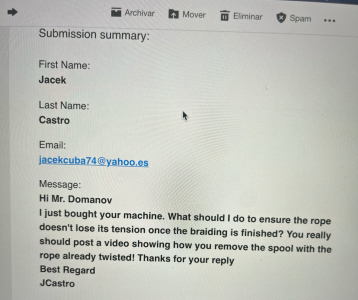
As a customer who purchased his machine, I feel he could be more responsive and helpful. For example, I politely suggested that he upload clearer and more informative videos on YouTube, as the current ones are outdated and don’t explain much—but his response was not very encouraging.

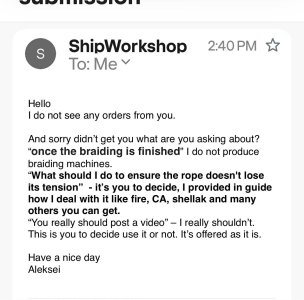
Attached 2 photos one photo was my request, and the other was the response from the manufacturer, Aleksej Domanov. Do you think this constitutes proper treatment of a customer who purchases your product? I find it a bit offensive—perhaps it’s just my imagination.

I do appreciate you taking the time to reply to me. If you’d prefer not to continue the conversation, I completely understand, and we can leave it here, that you don't feel overwhelmed by someone asking you for help!

Thank you again, and I wish you an excellent day and good luck in your life.
Jacek Castro

tempImagehuIrgc.png

att.BS1mmrhUOXxSQQIoHzl9r8xDDJV4hrwi1jLLKb7vq7Y.JPG
 
I highly recommend this simple device.it gave me complete control of rope making. save me lots of money.it is very simple to operate.I own it for many years.

Y.T. I had initially considered purchasing that machine, although I was somewhat hesitant due to its relatively low price. In the end, I decided on the PL4-3; however, unfortunately, my experience so far has been disappointing. Not to say that that machine is a piece of junk, perhaps it simply takes months to understand how it works.

At this stage, I am simply trying to connect with someone on the forum who already owns this model and might be able to help me better understand how to use it effectively, as I may be overlooking something. I am also uncertain about the possibility of returning the machine and obtaining a refund.

Based on my personal experience, I would advise exercising some caution with the website, particularly in terms of customer support. That said, if the machine is working well for you, I am genuinely pleased to hear that.
Kind Regards
 
I'm quite happy with my Domanoff/Shipworkshop PL4: https://www.shipworkshop.com/product-page/pl4-series-endless-rope-making-machines-with-traverse There's a learning curve to using it, but its compact size and versatility is a real advantage. This is also the only commercial machine I'm aware of which permits laying up four-strand rope with a core running down the middle of the lay which is essential to preventing the strands from collapsing in upon the center of the lay. I use Gutermann Mara thread which comes in many sizes and colors and is, I believe, sold internationally. In the U.S., I get it from WAWAK online: https://www.wawak.com/thread/thread...-wrapped-poly-core-thread-tex-30/#sku=gtda800 This thread on the PL4 produces any type of line anybody could want to use on a model and it is indistinguishable from any of the good aftermarket specialty model rigging threads I've seen. I "cook" the polyester thread after layup to "fix" the tension and prevent unraveling.

Note that it is extremely difficult to obtain linen thread in the sizes and quality required to make scale rope these days. The market demand necessary to warrant manufacturing it simply ceased to exist as synthetic fibers took over. The major museum curators and restorationists are now using quality polyester thread which, from all indications, possess archival qualities as good or better than linen or any of the other natural fibers. Additionally, the extruded polyester fibers are far longer than the natural fibers and so are far better for making strong, evenly spun thread. "Lumpy" natural fiber thread isn't suitable for making scale rope.

The rope making posts on SoS and MSW forums are goldmines of information on the subject. Learning from others' mistakes saves a lot of time! You will also find many recipes there for making up various scale sizes of rope which can save you trying to figure out the right combination of thread sizes to yield the scale rope sizes you will want to make.
At the moment, I find myself torn between simply liking your post and making a genuine appeal for help, in the hope that I might finally succeed in producing usable rope. I have been waiting for the machine—and attempting to make ropes for over a month now, but unfortunately, every attempt so far has been unsuccessful. I’ve ended up wasting a considerable amount of thread, time, and patience.

I’m very glad to hear that the machine you purchased from Mr. Aleksei Domanov has worked well for you. However, based on my experience with the PL4-3 model, I have not had the same success, and it has been quite frustrating.

I have already shared some details on the forum regarding the poor quality of the ropes produced by my machine, as well as my attempt to contact Mr. Domanov and the response I received, which I found somewhat discouraging.

I would be extremely grateful if you could offer any guidance to help me better understand how these machines work—particularly with regard to the “S” and “Z” twists. I have a suspicion that my machine may not be functioning correctly in the “Z” direction. Additionally, I am unsure how to maintain proper tension toward the end of the process, as well as after removing the rope from the original spool, where it seems to lose a significant amount of tension.

I realize this may be quite a lot to ask in a first message, so I truly appreciate any time or advice you may be willing to share.

Thank you very much in advance.
 
The reason I’m asking here is that, in my experience, Mr. Domanov has not shown much interest in providing support.

As a customer who purchased his machine, I feel he could be more responsive and helpful. For example, I politely suggested that he upload clearer and more informative videos on YouTube, as the current ones are outdated and don’t explain much—but his response was not very encouraging.

I have one of Aleksei's PL4 ropemaking machines and have corresponded with him in the past. I've found him to be very responsive and helpful. I consider his ropemaking machines to be the best available on the market at present. (There are, of course, some limited-production, custom-built ropemaking machines that are mentioned now and again, about which I have no personal information.)

I will be the first to admit that I have also found operating instructions for the Domanoff machines to be somewhat difficult to follow, but they are far from inadequate. They just take some thought to understand. I believe this is simply because they are manufactured for sale to a limited customer base that is spread all over the known world. To produce instructions in every language, rather than simply videos and pictorial explanations, would be a tremendously difficult task.

That said, although I can understand your frustration, I do not believe your expectations of Aleksei are reasonable. A ropemaking machine is a tool. Aleksei manufactures those tools. Tool manufacturers are not customarily expected to teach their customers how to use their tools. Ridiculously extensive "instructions" and "cautions," which do accompany some tools are more often designed to help the manufacture avoid civil liability for the stupidly careless use of their tools than for instructional purposes. Like many machine and tool manufacturers, ShipWorkshop sells tools and machines with the expectation that the customers who buy them know how to use the tool or they wouldn't be buying it, or, alternately, are able to figure it out on their own since most customers do.

I'm no expert on diagnosing ropemaking problems and the pictures you've posted are probably insufficient to say for sure what is causing your poor results, but I can suggest that you take a look at the following potential problem areas:

1. MULTIPLE STRANDS: I suggest you master three strand (thread) layups in the beginning before you attempt laying up six or nine or however many more multi-threaded strand layups.

2. CONSIDER THE DIRECTION OF THE LAY: I'm not saying you don't, but trying to layup rope by twisting it in the wrong direction will cause a lot of grief.

3. CONSIDER THE EVENNESS OF THREAD TENSION: The threads coming off the planetary bobbins must be tensioned equally to each other so that the strands are evenly tensioned as they are twisted by the machine. If not, the layup will be uneven. Tension adjustment of individual bobbins is done by turning the wing nuts on the bobbin axles on the planetary wheel. Thread must be wound on the bobbins with equal tension, as well. Using a sewing machine, or better yet, a stand-alone, bobbin winder to load thread on the bobbins ensures even bobbin winding tension.

4. MOST ALL LAYED ROPE HAS SOME TENDENCY TO UNRAVEL: If you are using polyester thread, its twist tension can be permanently "baked in" using heat. This process, which requires some care not to melt the plastic fibers, is explained in most posts about ropemaking. Other methods of preventing unraveling is to A.) whip the ends of the rope, B.) cement the ends of the rope with shellac, CA adhesive, clear nail polish, or Duco cement, and C.) tie a knot in the end of the rope.

5. USE THE ANGLE OF THE CUNTLINE TO DETERMINE THE SUFFICIENCY OF THE STRAND TWIST: The cuntline should lay at an approximately 45 degree angle to the stretched rope. If it is not, the twist in the strands is incorrect. More often than not, the problem will be that the strands are not twisted tightly enough. The rate of strand twist is controlled by the speed of the bobbins spinning on the planetary wheel relative to the speed of the finished rope being wound on the take-up spool. Twisting the parts of laid rope must always be done in the direction opposite to the direction the material was twisted previously. If you are using right-hand-laid thread for strands to start, it must be twisted to the left to make three-strand rope. If you want to then make three strand cable with it, that resulting left-hand-laid rope must be twisted to the right to make right-hand-laid cable. There's no mystery to the direction of the lay. I find the "S" and "Z" designations to be unnecessarily confusing. One need only grab a length of line and hold it so that it hangs vertically and observe the cuntline, which should run about 45 degrees to the hanging rope. If the cuntline points up to the right, the rope is "right-hand-laid." If the cuntline points upward to the left, the rope is "left-hand--laid." Simple as that.

It may be helpful to step back and take a different approach. Do this without thinking about your machine at all. Starting from ground zero, completely familiarize yourself with the basic principles of laid rope making. be sure you are completely familiar with how rope is made generally. Be sure you understand how the twist that is put into a strand operates to create the tension necessary to make the rope hold itself together. When you feel you really know how rope "works," Then return to your machine and identify by experimentation just what things your machine accomplishes and how it accomplishes them. Then try using your machine to do the things necessary to make good scale rope. You will probably not get a good result at first. Observe and analyze what's wrong and identify what operation of the machine isn't doing its part to make good rope. Make adjustments to the machine controls and try again. You will eventually figure it out. In my experience, most of my problems in the beginning were the result of loose and uneven winding on the bobbins and inadequate twisting of the strands.

Scale ropemaking is a somewhat refined skill that requires an understanding of the mechanics of the process and the properties of the materials involved. It does take some study, practice, and experience to master. Not everything one might do in this world can be learned by watching YouTube videos. It seems there's someone trying to change that fact for practically everything anybody might think of doing, but the simple fact of the matter is that until somebody does, we have to teach ourselves by reading, experimenting, practicing and discovering on our own like we did it before there ever was an internet.
 
Last edited:
In my opinion and experience you will never get really good rope with a planetary ropewalk, it is limited by design, you never get the tension to get tight rope or a bigger cable. It's an interesting machine but limited and hard to handle.
I disagree. I don't think the design limits the planetary ropemaking machine, but rather that it's design simply imposes different operating requirements. Strand tension is critical and it is much easier to obtain proper strand tension on a ropewalk than on a planetary ropemaking machine because on the planetary machine, the tension must be applied evenly when the strands are wound on the bobbins and that really requires that a mechanical bobbin winder be used to load the bobbins.
 
In my opinion and experience you will never get really good rope with a planetary ropewalk, it is limited by design, you never get the tension to get tight rope or a bigger cable. It's an interesting machine but limited and hard to handle.
Have to agree here, You’d be amazed how much tension is required to get the yarns and threads to lock together.
 
I have one of Aleksei's PL4 ropemaking machines and have corresponded with him in the past. I've found him to be very responsive and helpful. I consider his ropemaking machines to be the best available on the market at present. (There are, of course, some limited-production, custom-built ropemaking machines that are mentioned now and again, about which I have no personal information.)

I will be the first to admit that I have also found operating instructions for the Domanoff machines to be somewhat difficult to follow, but they are far from inadequate. They just take some thought to understand. I believe this is simply because they are manufactured for sale to a limited customer base that is spread all over the known world. To produce instructions in every language, rather than simply videos and pictorial explanations, would be a tremendously difficult task.

That said, although I can understand your frustration, I do not believe your expectations of Aleksei are reasonable. A ropemaking machine is a tool. Aleksei manufactures those tools. Tool manufacturers are not customarily expected to teach their customers how to use their tools. Ridiculously extensive "instructions" and "cautions," which do accompany some tools are more often designed to help the manufacture avoid civil liability for the stupidly careless use of their tools than for instructional purposes. Like many machine and tool manufacturers, ShipWorkshop sells tools and machines with the expectation that the customers who buy them know how to use the tool or they wouldn't be buying it, or, alternately, are able to figure it out on their own since most customers do.

I'm no expert on diagnosing ropemaking problems and the pictures you've posted are probably insufficient to say for sure what is causing your poor results, but I can suggest that you take a look at the following potential problem areas:

1. MULTIPLE STRANDS: I suggest you master three strand (thread) layups in the beginning before you attempt laying up six or nine or however many more multi-threaded strand layups.

2. CONSIDER THE DIRECTION OF THE LAY: I'm not saying you don't, but trying to layup rope by twisting it in the wrong direction will cause a lot of grief.

3. CONSIDER THE EVENNESS OF THREAD TENSION: The threads coming off the planetary bobbins must be tensioned equally to each other so that the strands are evenly tensioned as they are twisted by the machine. If not, the layup will be uneven. Tension adjustment of individual bobbins is done by turning the wing nuts on the bobbin axles on the planetary wheel. Thread must be wound on the bobbins with equal tension, as well. Using a sewing machine, or better yet, a stand-alone, bobbin winder to load thread on the bobbins ensures even bobbin winding tension.

4. MOST ALL LAYED ROPE HAS SOME TENDENCY TO UNRAVEL: If you are using polyester thread, its twist tension can be permanently "baked in" using heat. This process, which requires some care not to melt the plastic fibers, is explained in most posts about ropemaking. Other methods of preventing unraveling is to A.) whip the ends of the rope, B.) cement the ends of the rope with shellac, CA adhesive, clear nail polish, or Duco cement, and C.) tie a knot in the end of the rope.

5. USE THE ANGLE OF THE CUNTLINE TO DETERMINE THE SUFFICIENCY OF THE STRAND TWIST: The cuntline should lay at an approximately 45 degree angle to the stretched rope. If it is not, the twist in the strands is incorrect. More often than not, the problem will be that the strands are not twisted tightly enough. The rate of strand twist is controlled by the speed of the bobbins spinning on the planetary wheel relative to the speed of the finished rope being wound on the take-up spool. Twisting the parts of laid rope must always be done in the direction opposite to the direction the material was twisted previously. If you are using right-hand-laid thread for strands to start, it must be twisted to the left to make three-strand rope. If you want to then make three strand cable with it, that resulting left-hand-laid rope must be twisted to the right to make right-hand-laid cable. There's no mystery to the direction of the lay. I find the "S" and "Z" designations to be unnecessarily confusing. One need only grab a length of line and hold it so that it hangs vertically and observe the cuntline, which should run about 45 degrees to the hanging rope. If the cuntline points up to the right, the rope is "right-hand-laid." If the cuntline points upward to the left, the rope is "left-hand--laid." Simple as that.

It may be helpful to step back and take a different approach. Do this without thinking about your machine at all. Starting from ground zero, completely familiarize yourself with the basic principles of laid rope making. be sure you are completely familiar with how rope is made generally. Be sure you understand how the twist that is put into a strand operates to create the tension necessary to make the rope hold itself together. When you feel you really know how rope "works," Then return to your machine and identify by experimentation just what things your machine accomplishes and how it accomplishes them. Then try using your machine to do the things necessary to make good scale rope. You will probably not get a good result at first. Observe and analyze what's wrong and identify what operation of the machine isn't doing its part to make good rope. Make adjustments to the machine controls and try again. You will eventually figure it out. In my experience, most of my problems in the beginning were the result of loose and uneven winding on the bobbins and inadequate twisting of the strands.

Scale ropemaking is a somewhat refined skill that requires an understanding of the mechanics of the process and the properties of the materials involved. It does take some study, practice, and experience to master. Not everything one might do in this world can be learned by watching YouTube videos. It seems there's someone trying to change that fact for practically everything anybody might think of doing, but the simple fact of the matter is that until somebody does, we have to teach ourselves by reading, experimenting, practicing and discovering on our own like we did it before there ever was an internet.
Very good advice
 
In my opinion and experience you will never get really good rope with a planetary ropewalk, it is limited by design, you never get the tension to get tight rope or a bigger cable. It's an interesting machine but limited and hard to handle.
I disagree. I don't think the design limits the planetary ropemaking machine, but rather that it's design simply imposes different operating requirements. Strand tension is critical and it is much easier to obtain proper strand tension on a ropewalk than on a planetary ropemaking machine because on the planetary machine, the tension must be applied evenly when the strands are wound on the bobbins and that really requires that a mechanical bobbin winder be used to load the bobbins.

I have one of Aleksei's PL4 ropemaking machines and have corresponded with him in the past. I've found him to be very responsive and helpful. I consider his ropemaking machines to be the best available on the market at present. (There are, of course, some limited-production, custom-built ropemaking machines that are mentioned now and again, about which I have no personal information.)

I will be the first to admit that I have also found operating instructions for the Domanoff machines to be somewhat difficult to follow, but they are far from inadequate. They just take some thought to understand. I believe this is simply because they are manufactured for sale to a limited customer base that is spread all over the known world. To produce instructions in every language, rather than simply videos and pictorial explanations, would be a tremendously difficult task.

That said, although I can understand your frustration, I do not believe your expectations of Aleksei are reasonable. A ropemaking machine is a tool. Aleksei manufactures those tools. Tool manufacturers are not customarily expected to teach their customers how to use their tools. Ridiculously extensive "instructions" and "cautions," which do accompany some tools are more often designed to help the manufacture avoid civil liability for the stupidly careless use of their tools than for instructional purposes. Like many machine and tool manufacturers, ShipWorkshop sells tools and machines with the expectation that the customers who buy them know how to use the tool or they wouldn't be buying it, or, alternately, are able to figure it out on their own since most customers do.

I'm no expert on diagnosing ropemaking problems and the pictures you've posted are probably insufficient to say for sure what is causing your poor results, but I can suggest that you take a look at the following potential problem areas:

1. MULTIPLE STRANDS: I suggest you master three strand (thread) layups in the beginning before you attempt laying up six or nine or however many more multi-threaded strand layups.

2. CONSIDER THE DIRECTION OF THE LAY: I'm not saying you don't, but trying to layup rope by twisting it in the wrong direction will cause a lot of grief.

3. CONSIDER THE EVENNESS OF THREAD TENSION: The threads coming off the planetary bobbins must be tensioned equally to each other so that the strands are evenly tensioned as they are twisted by the machine. If not, the layup will be uneven. Tension adjustment of individual bobbins is done by turning the wing nuts on the bobbin axles on the planetary wheel. Thread must be wound on the bobbins with equal tension, as well. Using a sewing machine, or better yet, a stand-alone, bobbin winder to load thread on the bobbins ensures even bobbin winding tension.

4. MOST ALL LAYED ROPE HAS SOME TENDENCY TO UNRAVEL: If you are using polyester thread, its twist tension can be permanently "baked in" using heat. This process, which requires some care not to melt the plastic fibers, is explained in most posts about ropemaking. Other methods of preventing unraveling is to A.) whip the ends of the rope, B.) cement the ends of the rope with shellac, CA adhesive, clear nail polish, or Duco cement, and C.) tie a knot in the end of the rope.

5. USE THE ANGLE OF THE CUNTLINE TO DETERMINE THE SUFFICIENCY OF THE STRAND TWIST: The cuntline should lay at an approximately 45 degree angle to the stretched rope. If it is not, the twist in the strands is incorrect. More often than not, the problem will be that the strands are not twisted tightly enough. The rate of strand twist is controlled by the speed of the bobbins spinning on the planetary wheel relative to the speed of the finished rope being wound on the take-up spool. Twisting the parts of laid rope must always be done in the direction opposite to the direction the material was twisted previously. If you are using right-hand-laid thread for strands to start, it must be twisted to the left to make three-strand rope. If you want to then make three strand cable with it, that resulting left-hand-laid rope must be twisted to the right to make right-hand-laid cable. There's no mystery to the direction of the lay. I find the "S" and "Z" designations to be unnecessarily confusing. One need only grab a length of line and hold it so that it hangs vertically and observe the cuntline, which should run about 45 degrees to the hanging rope. If the cuntline points up to the right, the rope is "right-hand-laid." If the cuntline points upward to the left, the rope is "left-hand--laid." Simple as that.

It may be helpful to step back and take a different approach. Do this without thinking about your machine at all. Starting from ground zero, completely familiarize yourself with the basic principles of laid rope making. be sure you are completely familiar with how rope is made generally. Be sure you understand how the twist that is put into a strand operates to create the tension necessary to make the rope hold itself together. When you feel you really know how rope "works," Then return to your machine and identify by experimentation just what things your machine accomplishes and how it accomplishes them. Then try using your machine to do the things necessary to make good scale rope. You will probably not get a good result at first. Observe and analyze what's wrong and identify what operation of the machine isn't doing its part to make good rope. Make adjustments to the machine controls and try again. You will eventually figure it out. In my experience, most of my problems in the beginning were the result of loose and uneven winding on the bobbins and inadequate twisting of the strands.

Scale ropemaking is a somewhat refined skill that requires an understanding of the mechanics of the process and the properties of the materials involved. It does take some study, practice, and experience to master. Not everything one might do in this world can be learned by watching YouTube videos. It seems there's someone trying to change that fact for practically everything anybody might think of doing, but the simple fact of the matter is that until somebody does, we have to teach ourselves by reading, experimenting, practicing and discovering on our own like we did it before there ever was an internet.
Thank you, Bob, for taking the time to share your experience with your machine. I appreciate your detailed explanation, and I understand your points well, even if I may see a few aspects a little differently. My intention here is not to debate, but simply, the goal is to learn from the experiences of other modelers who have purchased this type of machine, in this case, you are one of them..

As a general contractor, architect, and engineer, I’m fairly comfortable with the technical side of machinery, and I’m always learning something new each day to have the opportunity to expand my knowledge. As I explained in another post, I have encountered several setbacks during the attempt, and I have run into a few challenges that I’m still trying to work through. For instance, I had a bobbin come loose while the machine was running, and I’ve also noticed that the wheel holding the three bobbins seems to wobble from side to side rather than rotating smoothly on its axis. This appears to affect how the gears engage, as they sometimes feel like they are slipping and the noise becomes unbearable.

It’s possible that some of these issues come down to my setup or technique, so I’m continuing to experiment and learn. I decided to purchase this machine because there don’t seem to be many alternatives for making “walk-ropes,” and I also don’t have the space like 10' for a larger, fixed setup.

In any case, since I already have this machine, I’ll follow your advice step by step and see how things improve. I’m still figuring out how best to maintain consistent tension across the smaller bobbins, especially without specialized equipment like sewing machine, not all of us have sewing machines at home and to be honest with you, the last one I saw was at my grandmother's house in Poland more than 20 years ago hahaha, but your suggestions give me a good direction to try. I will also pay closer attention to the adjustment of the screws that tighten the 3 bobbins you mentioned earlier.. Up to now, I’ve been winding the bobbins with a power drill, which may not be ideal.

Please do not assume that I have not done my homework on this subject. In fact, I have paused the entire construction of my model at the stage where rigging ropes are required, as I cannot proceed further without resolving this issue. It simply appears that I will need to invest considerably more time to achieve my objective namely, producing ropes that resemble proper rope rather than loosely twisted threads.

Thank you again for your guidance!!!!!I truly appreciate it.
Kind Regards
Jack


I also had difficulty with using the Domanoff planetary rope walk. I ended up giving it away.
Hi Bryian
That may ultimately be the conclusion I come to. In the meantime, I’m going to try everything that’s been recommended to me so far. I’m even planning to purchase the well-known Gütermann thread to rule out whether the issue might be related to the material itself—although I suspect it may not be.

If none of these approaches resolve the problem, I’ll likely step back from Domanov’s method and avoid investing further time or resources into it.
I’ll simply take that machine and throw it off my balcony into the swimming pool.
Best regards
Jack
 
At the moment, I find myself torn between simply liking your post and making a genuine appeal for help, in the hope that I might finally succeed in producing usable rope. I have been waiting for the machine—and attempting to make ropes for over a month now, but unfortunately, every attempt so far has been unsuccessful. I’ve ended up wasting a considerable amount of thread, time, and patience.

I’m very glad to hear that the machine you purchased from Mr. Aleksei Domanov has worked well for you. However, based on my experience with the PL4-3 model, I have not had the same success, and it has been quite frustrating.

I have already shared some details on the forum regarding the poor quality of the ropes produced by my machine, as well as my attempt to contact Mr. Domanov and the response I received, which I found somewhat discouraging.

I would be extremely grateful if you could offer any guidance to help me better understand how these machines work—particularly with regard to the “S” and “Z” twists. I have a suspicion that my machine may not be functioning correctly in the “Z” direction. Additionally, I am unsure how to maintain proper tension toward the end of the process, as well as after removing the rope from the original spool, where it seems to lose a significant amount of tension.

I realize this may be quite a lot to ask in a first message, so I truly appreciate any time or advice you may be willing to share.

Thank you very much


My Honest Experience with the PL4-4 Rope Making Machine (and What I Wish I Knew First)


Hi everyone,

I wanted to share my honest experience with the PL4-4 rope making machine, especially for those who are just starting out or considering buying one. I’ve seen some great advice from John Cleek on here, and it lines up very closely with what I’ve personally gone through.


Why I Bought the PL4-4

To be completely upfront — when I first bought the PL4-4, I knew absolutely nothing about rope making.

  • I didn’t understand S twist vs Z twist
  • I didn’t know the difference between yarns, threads, and rope lay
  • I had no idea how rope diameter was actually built up

Like many, I thought:

“Load up some bobbins, press go, and out comes perfect scale rope.”

That couldn’t have been further from the truth.


The Reality Check

Very quickly, I ran into the same problems many beginners face:

  • Rope twisting into a mess
  • Inconsistent lay
  • Thin, unusable rope
  • Poor tension control

At the time, I didn’t understand why it was happening — which made it even more frustrating.


The Big Learning Curve

Everything started to change when I began learning the fundamentals:

  • Rope is made from yarns → twisted into threads → twisted into rope
  • To get thicker rope, you don’t just twist more — you must:
    • Increase the number of yarns per thread

  • The direction matters:
    • Threads twisted one way (say S)
    • Rope formed in the opposite direction (Z)

Once this clicked, things finally started to make sense.


The Problem I Was Trying to Solve

I build large-scale model ships (some up to 2 metres long), so I needed:

  • ~1.3mm rope
  • ~1.8mm rope
  • Even 2mm+ in some cases

This is where the PL4-4 started to show its limitations for my needs.


Where the PL4-4 Became Difficult

To get thicker rope, I tried:

  1. Twisting multiple yarns together to make a thicker thread
  2. Winding those onto bobbins
  3. Then combining those threads into rope

Sounds simple… but in practice:
  • It took hours of preparation
  • After ~2 hours work… I ended up with about 1 metre of rope
That’s just not practical when you’re rigging large models.


The Bobbin Limitation

The biggest issue I ran into:

The bobbins limit both capacity and workflow

  • You can only fit so much thread onto each bobbin
  • Thicker threads = even less capacity
  • Constant rewinding becomes necessary
  • It severely limits rope length

For large-scale builds, this becomes a major bottleneck.


Tension — The Make or Break Factor


One of the most critical things I discovered:

Tension is EVERYTHING in rope making


With the PL4-4, I found:

  • Each bobbin must feed at equal tension
  • The thread must come off with controlled resistance
    • Too loose → messy, loose rope
    • Too tight → breakage or mechanical stress

  • The take-up spool tension must be just right

On top of that:

  • Machine speed must be carefully set
  • The rotation speeds between:
    • The bobbin assembly
    • The take-up spool
…must be precisely set


Mechanical Stress & Failure


To get proper rope formation, I had to apply significant tension.


This eventually led to:
  • A stripped gear in the yellow gear assembly


I ended up:

  • Measuring it
  • 3D printing a replacement
  • Installing a stronger gear

That solved the issue, but it highlighted how hard I was pushing the machine to achieve what I needed.


The Turning Point — Rope Walk

After all this, I moved to a traditional rope walk setup.


And honestly…

It completely changed everything.


Why a Rope Walk Works Better (for my needs)
  • Allows long rope lengths (meters, not centimeters)
  • No bobbin limitations
  • Easier to:
    • Apply consistent tension
    • Control twist
    • Scale up rope diameter

  • Much more suited to:
    • 1.5mm+
    • 2mm+ rope sizes

Most importantly:

You can properly “lock” the structure of the rope under tension — something that was much harder to achieve with the PL4-4.


Final Thoughts on the PL4-4

I want to be fair here — the PL4-4 does have its place.

It’s good for:
  • Small-scale models
  • Fine rope (≤ 1mm)
  • Limited workspace setups
  • People willing to invest time learning the machine

But…

For large-scale ship builders, especially those needing thicker rope:

It becomes very time-consuming


Limited by bobbin capacity


Requires significant tuning and patience


What I Wish I Did Differently


If I could go back:

  1. Learn rope making fundamentals first
  2. Understand:
    • Yarn count
    • Thread formation
    • S vs Z twist
  3. Then choose the right tool for the job
Instead of assuming one machine could do everything.


Final Advice

If you’re struggling right now — you’re not alone.


I went through:
  • The same frustration
  • The same confusion
  • The same messy results

But once it clicks… it’s incredibly rewarding.

And there’s something pretty special about:

Using the same rope-making principles that were used 300–400 years ago on the real ships we’re modelling.

 
Last edited:
Have to agree here, You’d be amazed how much tension is required to get the yarns and threads to lock together.
Phillip, believe me, I apply the CA glue before it even starts rotating. When it finishes, you have to be right there, ready to turn it off and catch the three threads so you can apply CA to the very end of the rope, and even with all that effort, they still turn out looking like the ones in the photos I posted. Honestly, you don't need much experience to see that the result is absolute garbage.
Best regards Mate;)
 
Hi Bryian
That may ultimately be the conclusion I come to. In the meantime, I’m going to try everything that’s been recommended to me so far. I’m even planning to purchase the well-known Gütermann thread to rule out whether the issue might be related to the material itself—although I suspect it may not be.

If none of these approaches resolve the problem, I’ll likely step back from Domanov’s method and avoid investing further time or resources into it.
I’ll simply take that machine and throw it off my balcony into the swimming pool.
Best regards
Jack
May I suggest if your going to use Gutermann thread in your machine get the thicker E352
 
My Honest Experience with the PL4-4 Rope Making Machine (and What I Wish I Knew First)


Hi everyone,

I wanted to share my honest experience with the PL4-4 rope making machine, especially for those who are just starting out or considering buying one. I’ve seen some great advice from John Cleek on here, and it lines up very closely with what I’ve personally gone through.


Why I Bought the PL4-4

To be completely upfront — when I first bought the PL4-4, I knew absolutely nothing about rope making.

  • I didn’t understand S twist vs Z twist
  • I didn’t know the difference between yarns, threads, and rope lay
  • I had no idea how rope diameter was actually built up

Like many, I thought:

“Load up some bobbins, press go, and out comes perfect scale rope.”

That couldn’t have been further from the truth.


The Reality Check

Very quickly, I ran into the same problems many beginners face:

  • Rope twisting into a mess
  • Inconsistent lay
  • Thin, unusable rope
  • Poor tension control

At the time, I didn’t understand why it was happening — which made it even more frustrating.


The Big Learning Curve

Everything started to change when I began learning the fundamentals:

  • Rope is made from yarns → twisted into threads → twisted into rope
  • To get thicker rope, you don’t just twist more — you must:
    • Increase the number of yarns per thread

  • The direction matters:
    • Threads twisted one way (say S)
    • Rope formed in the opposite direction (Z)

Once this clicked, things finally started to make sense.


The Problem I Was Trying to Solve

I build large-scale model ships (some up to 2 metres long), so I needed:

  • ~1.3mm rope
  • ~1.8mm rope
  • Even 2mm+ in some cases

This is where the PL4-4 started to show its limitations for my needs.


Where the PL4-4 Became Difficult

To get thicker rope, I tried:

  1. Twisting multiple yarns together to make a thicker thread
  2. Winding those onto bobbins
  3. Then combining those threads into rope

Sounds simple… but in practice:
  • It took hours of preparation
  • After ~2 hours work… I ended up with about 1 metre of rope
That’s just not practical when you’re rigging large models.


The Bobbin Limitation

The biggest issue I ran into:

The bobbins limit both capacity and workflow

  • You can only fit so much thread onto each bobbin
  • Thicker threads = even less capacity
  • Constant rewinding becomes necessary
  • It severely limits rope length

For large-scale builds, this becomes a major bottleneck.


Tension — The Make or Break Factor


One of the most critical things I discovered:

Tension is EVERYTHING in rope making


With the PL4-4, I found:

  • Each bobbin must feed at equal tension
  • The thread must come off with controlled resistance
    • Too loose → messy, loose rope
    • Too tight → breakage or mechanical stress

  • The take-up spool tension must be just right

On top of that:

  • Machine speed must be carefully set
  • The rotation speeds between:
    • The bobbin assembly
    • The take-up spool
…must be precisely set


Mechanical Stress & Failure


To get proper rope formation, I had to apply significant tension.


This eventually led to:
  • A stripped gear in the yellow gear assembly


I ended up:

  • Measuring it
  • 3D printing a replacement
  • Installing a stronger gear

That solved the issue, but it highlighted how hard I was pushing the machine to achieve what I needed.


The Turning Point — Rope Walk

After all this, I moved to a traditional rope walk setup.


And honestly…

It completely changed everything.


Why a Rope Walk Works Better (for my needs)
  • Allows long rope lengths (meters, not centimeters)
  • No bobbin limitations
  • Easier to:
    • Apply consistent tension
    • Control twist
    • Scale up rope diameter

  • Much more suited to:
    • 1.5mm+
    • 2mm+ rope sizes

Most importantly:

You can properly “lock” the structure of the rope under tension — something that was much harder to achieve with the PL4-4.


Final Thoughts on the PL4-4

I want to be fair here — the PL4-4 does have its place.

It’s good for:
  • Small-scale models
  • Fine rope (≤ 1mm)
  • Limited workspace setups
  • People willing to invest time learning the machine

But…

For large-scale ship builders, especially those needing thicker rope:

It becomes very time-consuming


Limited by bobbin capacity


Requires significant tuning and patience


What I Wish I Did Differently


If I could go back:

  1. Learn rope making fundamentals first
  2. Understand:
    • Yarn count
    • Thread formation
    • S vs Z twist

  3. Then choose the right tool for the job
Instead of assuming one machine could do everything.


Final Advice

If you’re struggling right now — you’re not alone.


I went through:
  • The same frustration
  • The same confusion
  • The same messy results

But once it clicks… it’s incredibly rewarding.

And there’s something pretty special about:

Using the same rope-making principles that were used 300–400 years ago on the real ships we’re modelling.

Dear Phillip,
I can only imagine how much time and effort you must have invested in writing this post, and I want to sincerely thank you for taking the time to share your experience. Your post gives me a great deal of hope—even at a point where it sometimes feels like there may be very little left.

I fully intend to save your entire explanation, print it out, and follow your recommendations step by step. While I can’t speak for how others may respond, I can say that, in my view, you’ve presented a clear and thoughtful perspective on the PL4 issue.

Most importantly, your conclusions have given me renewed motivation to keep trying.
A thousand thanks! I truly appreciate it AMIGO
Kind regards
Jack
 
Back
Top