• Win a Free Custom Engraved Brass Coin!!!
    As a way to introduce our brass coins to the community, we will raffle off a free coin during the month of August. Follow link ABOVE for instructions for entering.
  • SUBSCRIBE TO SHIPS IN SCALE TODAY!

    The beloved Ships in Scale Magazine is back and charting a new course for 2026!
    Discover new skills, new techniques, and new inspirations in every issue.

    NOTE THAT OUR NEXT ISSUE WILL BE MARCH/APRIL 2026

NHI Kolibri N-3, scale 1:48, scratch build

As mentioned before, I am spending quite a few hours in trying to get a more or less realistic1:24 3D-model.
I also hinted earlier that that's easier said than done. Now, a few weeks in the process, I can confidently say that the learning curve is steep, very steep. Moving away from the high-end, professional modeling software to the freeware modeling software remains a huge step. Actions, like projecting 3D elements to sketches, or vice versa became a tedious job. That doesn't mean the freeware is inferior or not good, it's just written differently and one simply cannot expect the same capabilities with freeware.
Still, FreeCad is a very competent piece of software.
Also my starting points are not particularly unambiguous; the few drawings I have were already scanned and sized down from A0 to A4 and scanned again, resulting in al kinds of unwanted deformations and distortions. To make matters worse, the 3 view drawings I use are from three different drawings or even a brochure, meaning the three views don't necessarily agree with one another. The side view shows the least deformation/distortion, leading to the assumption that this view is the most reliable one.
The above reinforces my view on recreating history, based on historical documents, drawings, sketches, etc, namely that what I recreate is not and cannot be historical correct, but merely an expression of my interpretation of the available data.
Still, the emerging 3D-model somewhat start to resemble the Kolibrie and more, I enjoy the results.

The first picture shows the side view, with the 3D-model in front of a scan of an original drawing. As can be seen my 3D-model closely matches the scanned and resized drawing.
View attachment 571754

The next picture shows the top view, taken from a brochure. It's rather evident that there are quite some deviations, especially the windshield frame differs significantly.
View attachment 571755

Then there is the front view. The scan is heavily distorted and even manipulations of the original didn't yield a trustworthy picture:View attachment 571756

The picture below shows the current status of the model, with the spec tree. That spec tree grows like crazy and I haven't even started modeling the complex parts. Yet.
View attachment 571759

And finally two 3D views of the helicopter model. Still a lot of details need to be added, but, once home, my main focus will be on actual building again and 3D-modeling will have to take the back burner.
View attachment 571757

View attachment 571758
That looks very impressive, Johan. The earlier copiers sometimes had significant deviations, especially towards the sides and corners. I remember when we chose a new copier for our office, we discovered that the standard reduction was 0.5%. Some deviations can be explained, but you still have to take them into account.
In appearance, you have a convincing 3D representation of your model. I would say you have a strong knowledge base with Free CAD to come as far as you have. I know with my TurboCAD, every so often I will pick some complex part off the internet such as an engine governor or U-joint PDF that has dimensions and draw it up in 3D just to keep up my drawing skills.
You made a good point, Dan; keeping your 3D-modeling routine up-to-date is essential to stay current. There are many options, hidden in the software, allowing various approaches for modeling specific details. For instance there are various methods creating a solid feature. Developing your own preferred method is quite helpful in getting up to speed.
A while ago, I received a question via PM about how I'd done certain things while developing the line drawing for the Balder. Suddenly, I had to dig really deep again to figure out how I'd done it. It's a volatile medium up there in that brain chamber...;)
Regards, Peter
 
Last edited:

Obviously it’s best to have a dimensional drawing so the scale doesn’t matter. Otherwise you find yourself trying to determine a scale with a known dimension, and using the conversion factor derived from that, and measuring everything on the drawing! Not a fun way to work.
I had to do that on the light house I scratch built. I had a 2d drawing I found online and the article mentioned the overall height. That was my only known dimension. But if you have distortion on your hard copy, that’s no good. :(
 
That looks very impressive, Johan. The earlier copiers sometimes had significant deviations, especially towards the sides and corners. I remember when we chose a new copier for our office, we discovered that the standard reduction was 0.5%. Some deviations can be explained, but you still have to take them into account.
In copying a lot can and will go wrong. Normal copying could result in way more than 0,5% and different variations in X- and Y directions could be significantly different.
The only difference for us were the Full Scale (FS) drawings; they were supposed to be accurate.

I highly suspect some of the copies I used were not taken perpendicular to the original, that'll give a person quite the headache and a challenge.
 
Obviously it’s best to have a dimensional drawing so the scale doesn’t matter. Otherwise you find yourself trying to determine a scale with a known dimension, and using the conversion factor derived from that, and measuring everything on the drawing! Not a fun way to work.
I had to do that on the light house I scratch built. I had a 2d drawing I found online and the article mentioned the overall height. That was my only known dimension. But if you have distortion on your hard copy, that’s no good. :(
Ouch, having just the one dimension is more than challenging...
For the current model I made an overview of basic materials and of the dimensions I knew and took it from there.
Once the main structure was complete it became a matter of best educated guesses.
 
After returning from our little break in Spain and preparing my fourth article on this build for the NLR-periodic, I had no other choice but to focus on the windshield again. Before we left for Spain I had the basic hardware available and fit checked, so it was just a matter of making things permanent and primer and paint the resulting assembly.
For the top center piece I was able to use thin copper sheet, made available by @Peter Voogt. It was the perfect application for this sheet; easy to cut and easy to apply.
Needless to say I'm rather please with the results sofar:

IMG_1866.jpeg

However, here is the next challenge: installing the transparancies.
Making the templates for the developed acryl and using those to cut the acryl was a breeze. The challenge is in finding the most effective way to bond the windshields to the frame.
A year and a half ago I tried using CA adhesive for this purpose on my 1:48 first try at this model. Needless to say that that didn't end well. Positive control over the addition and flow is very poor with CA and any spill gives a distortion of the transparancy.
I did some research on the all-knowing internet, where I found a tip to use wood glue, since that cures to an almost invisible layer. Tried that and disregarded it almost straight away, the wood glue doesn't provide any adhesion whatsoever, nor to the brass frame, nor to acryl.

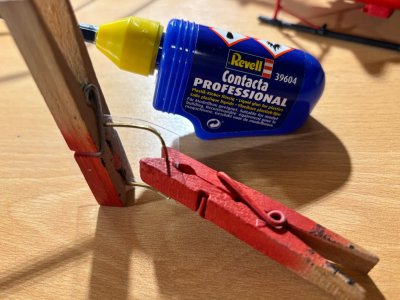
The latest tests involve a Revell plastic adhesive with a very low viscosity, almost waterlike.
The initial result is promising, but need more testing before I'm convinced, plus I might be tempted to try other adhesives as well.
The picture below shows the Revell adhesive used and the very simple test specimen:

IMG_1869.jpeg

IMG_1867.jpeg

IMG_1868.jpeg
 
After returning from our little break in Spain and preparing my fourth article on this build for the NLR-periodic, I had no other choice but to focus on the windshield again. Before we left for Spain I had the basic hardware available and fit checked, so it was just a matter of making things permanent and primer and paint the resulting assembly.
For the top center piece I was able to use thin copper sheet, made available by @Peter Voogt. It was the perfect application for this sheet; easy to cut and easy to apply.
Needless to say I'm rather please with the results sofar:

View attachment 575619

However, here is the next challenge: installing the transparancies.
Making the templates for the developed acryl and using those to cut the acryl was a breeze. The challenge is in finding the most effective way to bond the windshields to the frame.
A year and a half ago I tried using CA adhesive for this purpose on my 1:48 first try at this model. Needless to say that that didn't end well. Positive control over the addition and flow is very poor with CA and any spill gives a distortion of the transparancy.
I did some research on the all-knowing internet, where I found a tip to use wood glue, since that cures to an almost invisible layer. Tried that and disregarded it almost straight away, the wood glue doesn't provide any adhesion whatsoever, nor to the brass frame, nor to acryl.

The latest tests involve a Revell plastic adhesive with a very low viscosity, almost waterlike.
The initial result is promising, but need more testing before I'm convinced, plus I might be tempted to try other adhesives as well.
The picture below shows the Revell adhesive used and the very simple test specimen:

View attachment 575622

View attachment 575620

View attachment 575621
Looking great Johan.
Finding the right glue for a job can be frustrating. I know when building plastic models, the use of PE parts and clear plastic parts can call for different applications.
I know when bonding PE or metal on plastic, I can use CA or wood glue. When bonding plastic to plastic I use the Revell liquid glue for tiny parts and the tube glue for large areas that need a strong bond. On clear parts (like canopies) I use wood glue because it dries clear and doesn’t melt the plastic like CA or Plastic model glue. But you are correct the initial bond of wood glue is not strong and needs to be clamped or held in place.
Your biggest obstacle is if you are going to be bending the acrylic and using the glue to overcome the tension of bending, that is going to be problematic.
I would suggest trying to bend a piece of acrylic over the frame and heat it with a hair dryer to try to get it to remain in the correct shape prior to gluing. Then you can use wood glue like Weldbond. Similar to pre bending wood on a hull. The other obstacle is you would need a second frame just to form your acrylic on.
In conclusion, trying to glue straight pieces on a curve will be a challenge. :(
Best of luck in finding a solution.
 
One last thing, you could try wrapping the acrylic around a coke can or something similar and heating it with a hair dryer or heat gun to get it to stay curved. Just a thought. Short of using a vacuform machine, you will have to be creative. ;)
 
It would seem as long as the glue bonds to the paint and plastic window and the paint stays bonded to the brass/copper frame you would achieve success. Have you considered some form of mechanical coupling devices to positively clamp the poly to the frame. I know that is an idea way easier said than done.
 
After returning from our little break in Spain and preparing my fourth article on this build for the NLR-periodic, I had no other choice but to focus on the windshield again. Before we left for Spain I had the basic hardware available and fit checked, so it was just a matter of making things permanent and primer and paint the resulting assembly.
For the top center piece I was able to use thin copper sheet, made available by @Peter Voogt. It was the perfect application for this sheet; easy to cut and easy to apply.
Needless to say I'm rather please with the results sofar:

View attachment 575619

However, here is the next challenge: installing the transparancies.
Making the templates for the developed acryl and using those to cut the acryl was a breeze. The challenge is in finding the most effective way to bond the windshields to the frame.
A year and a half ago I tried using CA adhesive for this purpose on my 1:48 first try at this model. Needless to say that that didn't end well. Positive control over the addition and flow is very poor with CA and any spill gives a distortion of the transparancy.
I did some research on the all-knowing internet, where I found a tip to use wood glue, since that cures to an almost invisible layer. Tried that and disregarded it almost straight away, the wood glue doesn't provide any adhesion whatsoever, nor to the brass frame, nor to acryl.

The latest tests involve a Revell plastic adhesive with a very low viscosity, almost waterlike.
The initial result is promising, but need more testing before I'm convinced, plus I might be tempted to try other adhesives as well.
The picture below shows the Revell adhesive used and the very simple test specimen:

View attachment 575622

View attachment 575620

View attachment 575621
Painted in color it’s looking very nice, Johan. Be sure the transparent parts are in complete shape. Because you will glue on painted parts. With a bit of tension it will rip of the paint.
Regards, Peter
 
Looking great Johan.
Finding the right glue for a job can be frustrating. I know when building plastic models, the use of PE parts and clear plastic parts can call for different applications.
I know when bonding PE or metal on plastic, I can use CA or wood glue. When bonding plastic to plastic I use the Revell liquid glue for tiny parts and the tube glue for large areas that need a strong bond. On clear parts (like canopies) I use wood glue because it dries clear and doesn’t melt the plastic like CA or Plastic model glue. But you are correct the initial bond of wood glue is not strong and needs to be clamped or held in place.
Your biggest obstacle is if you are going to be bending the acrylic and using the glue to overcome the tension of bending, that is going to be problematic.
I would suggest trying to bend a piece of acrylic over the frame and heat it with a hair dryer to try to get it to remain in the correct shape prior to gluing. Then you can use wood glue like Weldbond. Similar to pre bending wood on a hull. The other obstacle is you would need a second frame just to form your acrylic on.
In conclusion, trying to glue straight pieces on a curve will be a challenge. :(
Best of luck in finding a solution.

It would seem as long as the glue bonds to the paint and plastic window and the paint stays bonded to the brass/copper frame you would achieve success. Have you considered some form of mechanical coupling devices to positively clamp the poly to the frame. I know that is an idea way easier said than done.

Painted in color it’s looking very nice, Johan. Be sure the transparent parts are in complete shape. Because you will glue on painted parts. With a bit of tension it will rip of the paint.
Regards, Peter

Basically we're all on the same page here, the transparencies need to be formed, prior to attachment.
The issue with any adhesive is that it does not take tension loads very well or at all. We used the term peel stresses, that is what's happening when you fold flat acrylic sheet over a curved surface. In shear a bonding layer exhibits excellent properties, but that's not the issue here.

Initially I planned on rebuilding the windshield frame closely reassembling the original, which is a frame made from tube, the transparancies and attachment strips on top. That mean two adhesive layers and double the risk of mucking up.
The current plan is to insert the transparancies from the inside out and see whether or not that solution will be to my liking.
 
Just thinking out loud here Johan. You have enough 3D info of the windscreen to have a 3D block printed with the windscreen shape on one of the block's sides. From there you lay on the transparencies and apply heat to conform to the correct shape. I am making an assumption here that the transparent material readily lends itself to heat molding and good retention of its final shape.
 
Not really an update, but more a notice: I will not be updating anytime soon. I ran head first in a wall called windshield.
The idea I had about the build sequence didn't yield the results I was aiming for, the main issue being the combination of transparancies and adhesive. I tried various adhesives, which either didn't hold or resulted in ruined transparancies. So it's back to the drawing board and the prototyping phase. Basic idea now is to come up with a design concept and a build sequence eliminating the use of adhesives on the transparencies. Until I have something to show for, I won't bother y'all with idle talk.
 
Not really an update, but more a notice: I will not be updating anytime soon. I ran head first in a wall called windshield.
The idea I had about the build sequence didn't yield the results I was aiming for, the main issue being the combination of transparancies and adhesive. I tried various adhesives, which either didn't hold or resulted in ruined transparancies. So it's back to the drawing board and the prototyping phase. Basic idea now is to come up with a design concept and a build sequence eliminating the use of adhesives on the transparencies. Until I have something to show for, I won't bother y'all with idle talk.
One thing you can consider is making the windshield frame in halves (front and back) that have recessed borders that trap the pieces so you don't glue them to the frame. So a sandwich design is in order. ;) This could be done easier in CAD and printed.
 
Not really an update, but more a notice: I will not be updating anytime soon. I ran head first in a wall called windshield.
The idea I had about the build sequence didn't yield the results I was aiming for, the main issue being the combination of transparancies and adhesive. I tried various adhesives, which either didn't hold or resulted in ruined transparancies. So it's back to the drawing board and the prototyping phase. Basic idea now is to come up with a design concept and a build sequence eliminating the use of adhesives on the transparencies. Until I have something to show for, I won't bother y'all with idle talk.

I'm guessing that the wind screen on the original, full scale vehicle was not glued on, but was instead, mechanically fastened. Looking at your photos above, it's difficult to tell just how easy it is to remove the wind screen frame from the model, but if you can, you could possibly clamp a piece of acetate in place and drill some very small holes around the frame, through the acetate. Subminiature screws (M0.6 or even M0.3) are somewhat readily available. You would not need to tap the holes, just a tiny drop of epoxy in the hole should hold the screw in place. Just spit-ballin' here.
 
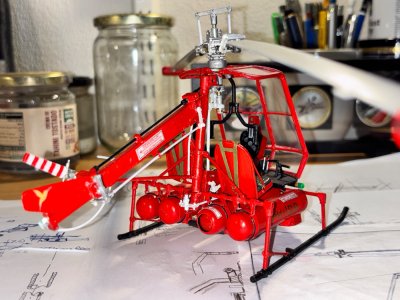
This will be the last contribution about the construction of the Kolibrie model; The model is now ready and is proudly displayed (for the time being) in our living room. Before I present some pictures of the model as it stands now, first something about one of the last major components: the windshield.
In the past months I had to conclude that the solution for the frame I chose initially, although reasonably similar to the large example, was still too fragile and offered too little support for applying the transparent parts. The thin frame, combined with the use of the wrong glue, see below, eventually led to having to make a second frame, significantly more robust than the first model.
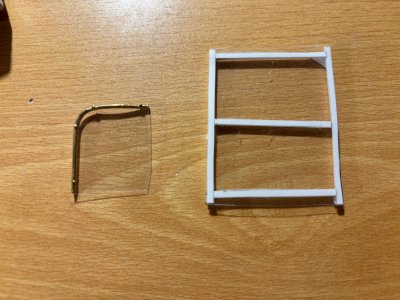
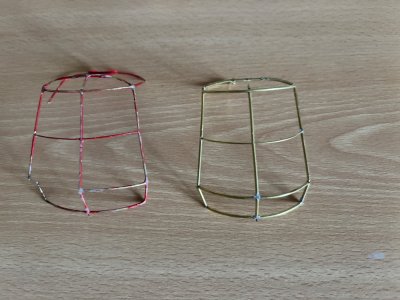
Figure 1 below clearly shows the difference between the two frames, with the first and now demolished prototype on the left and the final used frame on the right. Again I used different semi-finished products and joining methods. It has remained a brass frame, where I have used both tube and rod. Where possible, pin and eye connections have been used, which are either soldered or connected with superglue

Another big issue was the attachment method of the transparent parts on the frame: the adhesives I experimented with do not adhere (wood glue) or leave stains too easily on the acrylic, superglue. A friend of mine looked at whether chloroform offered a way out, but that didn't yield the desired result either. Figure 2 shows two tests, in which I used different methods to confirm the "transparencies" on the framework. These options were loosely based on @Dean62's idea of two backing frames and @RussF's proposal to use bolts or pins. I did start on implementing Russell's idea, but having pins in certain areas blocked this option: drilling the holes became near to impossible.

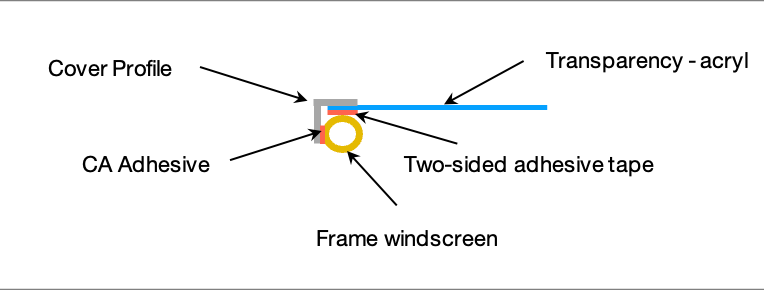
In the end, double-sided adhesive tape offered the solution; The first layer of adhesive is used to attach the tape to the frame and the second layer of adhesive then bonds the acrylic to the frame.
This solution did mean that a cover strip was needed to hide the tape from view. Also, I could only use superglue between the cover profile and the frame of the windshield, to prevent glue from getting on the acrylic.
I used brass for the frame, acrylic for the transparent parts and extruded polystyrene for the cover profiles.
See Figure 3 for the construction details

IMG_1952.jpegIMG_1960.jpeg
Figure 1 Figure 2

Afbeelding.png
Figure 3

The acrylic for the transparent parts turned out to be relatively easy to apply, it turned out that it was not necessary to shape the parts in advance by heating them; a test showed that it was not really necessary. During this test, it also turned out that heating parts, covered with masking tape, which I had used to prevent scratches, with a hair dryer led to irregular deformations. It also became clear that free, i.e. unsupported, heating also resulted in uneven deformations. During a conversation with @Peter Voogt it turned out that this is also his experience with polystyrene profiles; he eventually proceeded to manually heat and form the parts in question.
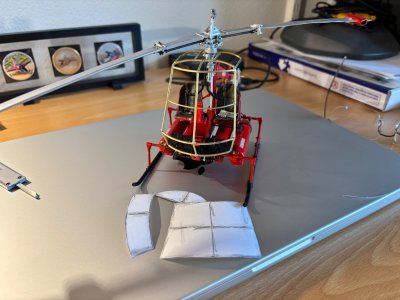
Figure 4 shows the (temporary) installation of the windscreen frame, with part of the paper templates for the transparent parts.
I used tape on the acryl sheet and traced the shapes of the templates with a soft pencil on the acryl/tape.

IMG_1954.jpeg
Figure 4

The windshield took an undue amount of time: a) at a bad moment I was no longer motivated to finish the model, in fact, the project was in danger of ending up in the trascan and it was at the insistence of my wife that the model was spared this fate and b) it took a lot of effort to think out and try the right construction methods. All in all, a large number of parts have been made two or three times...
The model is now ready, after more than a year and a half, from the visits to the archives of the Aviodrome and the NLR to the finalization of the model.

I cannot and will not pretend to have made an exact or correct copy in scale 1:24 of the Hummingbird; the available information is not sufficient to accomplish that feat.
Also, in my humble opinion, making an exact copy is virtually impossible, regardless of whether or not one has a complete specification of the full-scale example.
For example, if you look at the cross-section of the rotor head, it is clear that this cannot be replicated in scale 1:24, with all the bearings, sealing rings, slip rings, bolts, nuts, et cetera in this assembly. Or take a bolt in the large example with for instance a diameter of 8mm. This will be 0.34mm in this scale, which is way beyond my capabilities, I'm not a watchmaker, not to mention the availability of these small nuts and bolts. By the way, bolts with a diameter of 0.8mm and 0.6mm have been used, but this has really reached my limits; in particular, installing nuts is very time-consuming and often not possible due to the limited space. In those cases I cut of small bits of tube of the appropriate diameter and used those as nuts. Not as it should be, but a feasible solution.

Summarizing, my model is a bit cartoonesk at best; it resembles a Hummingbird, but differs from the great example in many ways.
By the way, don't think I'm dissatisfied with the end result; the contrary is true, I am pleasantly surprised and consider the model as a fitting tribute to my father and his colleagues, who together designed, manufactured and certified this helicopter in the fifties of the last century.

At the moment I don't have any definite plans for the next model. I do plan to complete the digitization of the Hummingbird model and have a somewhat disturbing idea to make a second Hummingbird model, but at the same time I also find the Fokker “Zilvermeeuw” (Herring Gull) and the Boeing Clipper, model 314, interesting candidates...

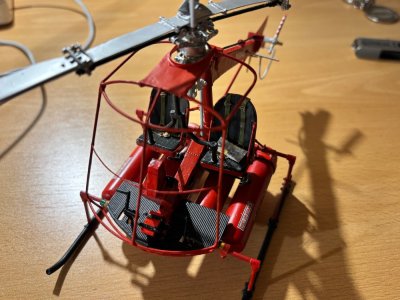
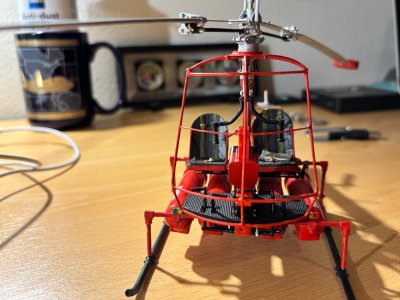
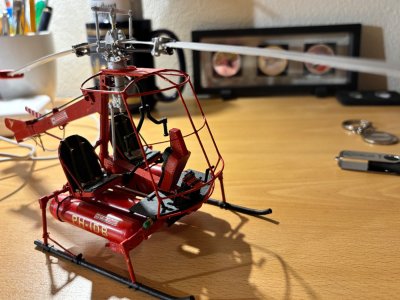
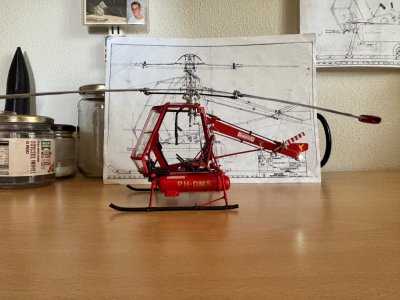
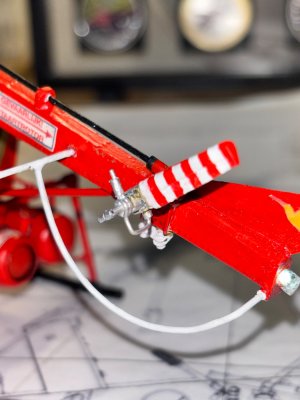
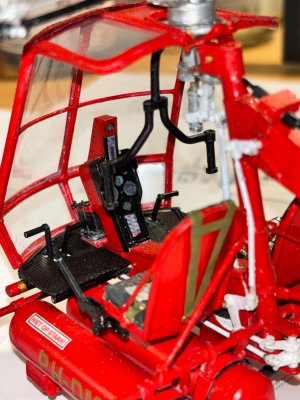
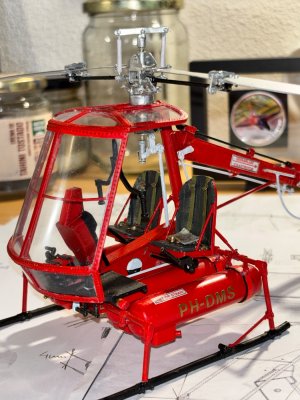
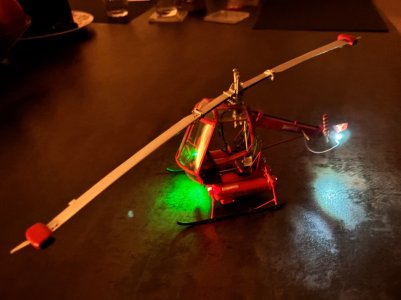
Below a couple of pictures of the finished model:

IMG_2022.jpeg

IMG_2020.jpeg

IMG_2019.jpeg

IMG_2018.jpeg

IMG_2017.jpeg

IMG_1995.jpeg
 
This will be the last contribution about the construction of the Kolibrie model; The model is now ready and is proudly displayed (for the time being) in our living room. Before I present some pictures of the model as it stands now, first something about one of the last major components: the windshield.
In the past months I had to conclude that the solution for the frame I chose initially, although reasonably similar to the large example, was still too fragile and offered too little support for applying the transparent parts. The thin frame, combined with the use of the wrong glue, see below, eventually led to having to make a second frame, significantly more robust than the first model.
Figure 1 below clearly shows the difference between the two frames, with the first and now demolished prototype on the left and the final used frame on the right. Again I used different semi-finished products and joining methods. It has remained a brass frame, where I have used both tube and rod. Where possible, pin and eye connections have been used, which are either soldered or connected with superglue

Another big issue was the attachment method of the transparent parts on the frame: the adhesives I experimented with do not adhere (wood glue) or leave stains too easily on the acrylic, superglue. A friend of mine looked at whether chloroform offered a way out, but that didn't yield the desired result either. Figure 2 shows two tests, in which I used different methods to confirm the "transparencies" on the framework. These options were loosely based on @Dean62's idea of two backing frames and @RussF's proposal to use bolts or pins. I did start on implementing Russell's idea, but having pins in certain areas blocked this option: drilling the holes became near to impossible.

In the end, double-sided adhesive tape offered the solution; The first layer of adhesive is used to attach the tape to the frame and the second layer of adhesive then bonds the acrylic to the frame.
This solution did mean that a cover strip was needed to hide the tape from view. Also, I could only use superglue between the cover profile and the frame of the windshield, to prevent glue from getting on the acrylic.
I used brass for the frame, acrylic for the transparent parts and extruded polystyrene for the cover profiles.
See Figure 3 for the construction details

View attachment 593884View attachment 593883
Figure 1 Figure 2

View attachment 593888
Figure 3

The acrylic for the transparent parts turned out to be relatively easy to apply, it turned out that it was not necessary to shape the parts in advance by heating them; a test showed that it was not really necessary. During this test, it also turned out that heating parts, covered with masking tape, which I had used to prevent scratches, with a hair dryer led to irregular deformations. It also became clear that free, i.e. unsupported, heating also resulted in uneven deformations. During a conversation with @Peter Voogt it turned out that this is also his experience with polystyrene profiles; he eventually proceeded to manually heat and form the parts in question.
Figure 4 shows the (temporary) installation of the windscreen frame, with part of the paper templates for the transparent parts.
I used tape on the acryl sheet and traced the shapes of the templates with a soft pencil on the acryl/tape.

View attachment 593885
Figure 4

The windshield took an undue amount of time: a) at a bad moment I was no longer motivated to finish the model, in fact, the project was in danger of ending up in the trascan and it was at the insistence of my wife that the model was spared this fate and b) it took a lot of effort to think out and try the right construction methods. All in all, a large number of parts have been made two or three times...
The model is now ready, after more than a year and a half, from the visits to the archives of the Aviodrome and the NLR to the finalization of the model.

I cannot and will not pretend to have made an exact or correct copy in scale 1:24 of the Hummingbird; the available information is not sufficient to accomplish that feat.
Also, in my humble opinion, making an exact copy is virtually impossible, regardless of whether or not one has a complete specification of the full-scale example.
For example, if you look at the cross-section of the rotor head, it is clear that this cannot be replicated in scale 1:24, with all the bearings, sealing rings, slip rings, bolts, nuts, et cetera in this assembly. Or take a bolt in the large example with for instance a diameter of 8mm. This will be 0.34mm in this scale, which is way beyond my capabilities, I'm not a watchmaker, not to mention the availability of these small nuts and bolts. By the way, bolts with a diameter of 0.8mm and 0.6mm have been used, but this has really reached my limits; in particular, installing nuts is very time-consuming and often not possible due to the limited space. In those cases I cut of small bits of tube of the appropriate diameter and used those as nuts. Not as it should be, but a feasible solution.

Summarizing, my model is a bit cartoonesk at best; it resembles a Hummingbird, but differs from the great example in many ways.
By the way, don't think I'm dissatisfied with the end result; the contrary is true, I am pleasantly surprised and consider the model as a fitting tribute to my father and his colleagues, who together designed, manufactured and certified this helicopter in the fifties of the last century.

At the moment I don't have any definite plans for the next model. I do plan to complete the digitization of the Hummingbird model and have a somewhat disturbing idea to make a second Hummingbird model, but at the same time I also find the Fokker “Zilvermeeuw” (Herring Gull) and the Boeing Clipper, model 314, interesting candidates...

Below a couple of pictures of the finished model:

View attachment 593877

View attachment 593878

View attachment 593879

View attachment 593880

View attachment 593881

View attachment 593882
CONGRATIOLATION with this result of this phenomenal model, Johan. It's a one of a kind unique model. You can be very proud of this result.
It was a true pleasure to be able to brainstorm with you about possibilities during your build.
And a big 'hooray' for your wife for preventing a dive into the trash can.:)
Regards, Peter
 
Last edited:
I think it looks fantastic Johan! Great job and congratulations on your completion, which I know didn’t come easy.
I think we have to be aware that models are a representation of the real thing. Of course the more detail, the more convincing it looks. But at the end of the day we have to keep our goals and expectations realistic or we will definitely become defeated and unhappy. So that said, I think you put sufficient detail at scale for it to be an excellent representation of the real thing! Excellent model! ;)
 
Back
Top