



• SUBSCRIBE TO SHIPS IN SCALE TODAY!

    The beloved Ships in Scale Magazine is back and charting a new course for 2026!
    Discover new skills, new techniques, and new inspirations in every issue.

    NOTE THAT OUR NEXT ISSUE WILL BE MARCH/APRIL 2026
  • Win a Free Custom Engraved Brass Coin!!!
    As a way to introduce our brass coins to the community, we will raffle off a free coin during the month of August. Follow link ABOVE for instructions for entering.

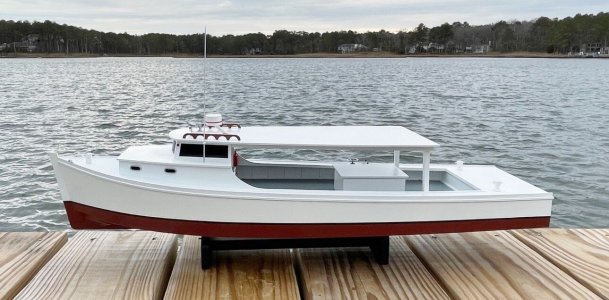
Annie Buck Chesapeake deadrise oyster / crab working boat Build Log

7. Annie Buck Build Log

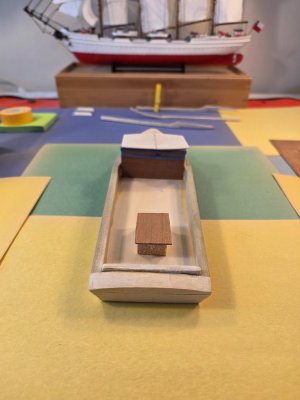
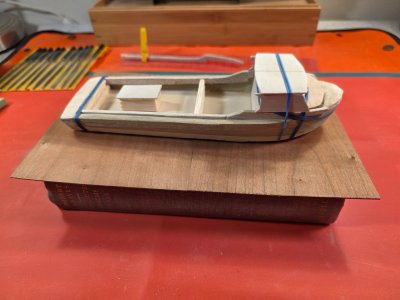
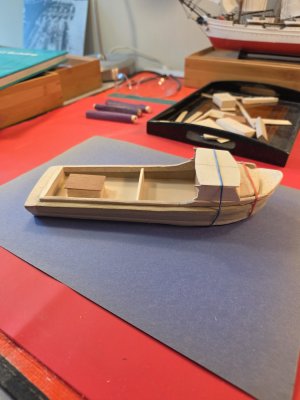
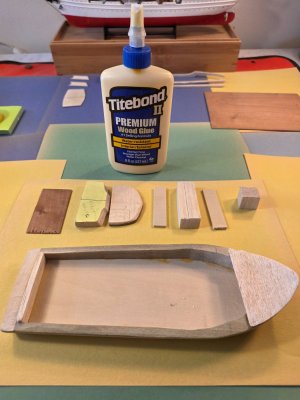
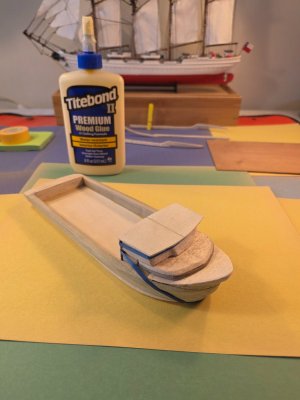
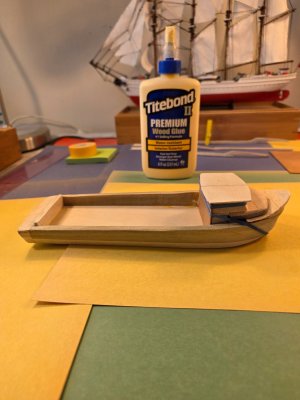
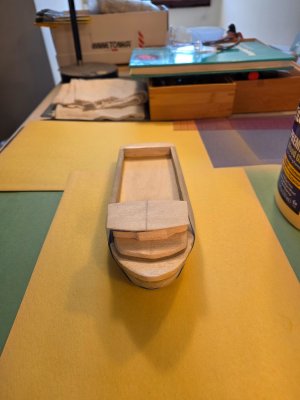
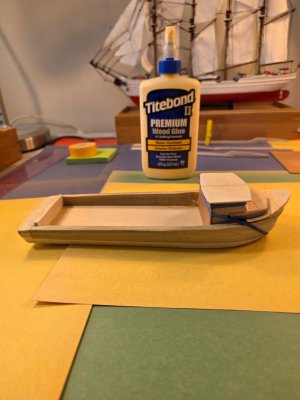
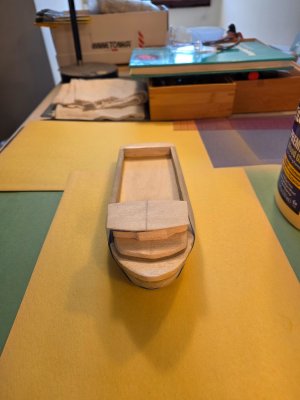
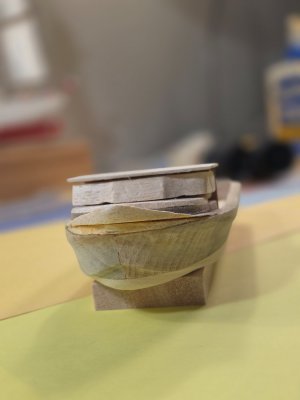
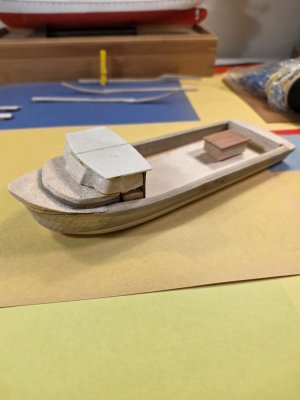
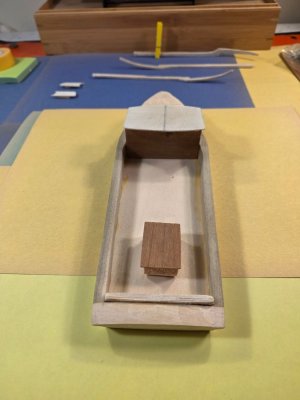
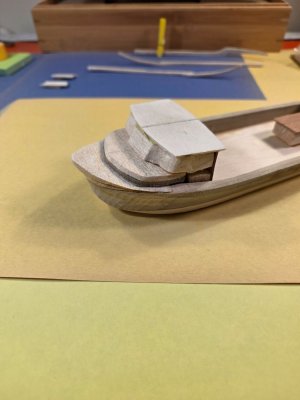
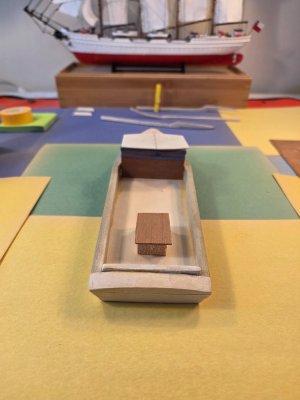
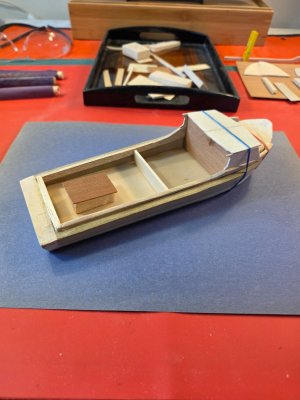
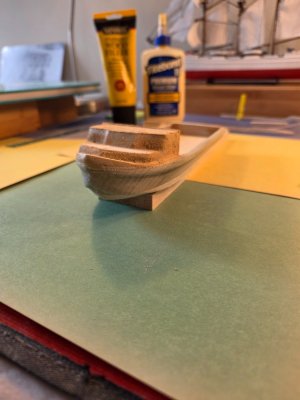
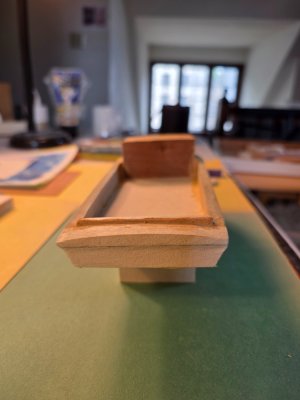
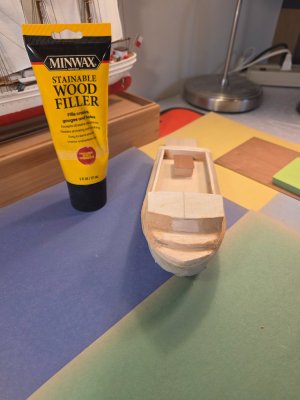
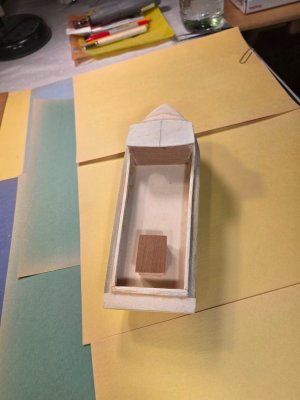
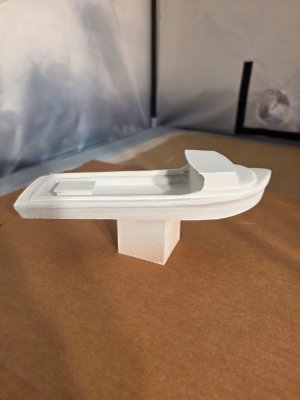
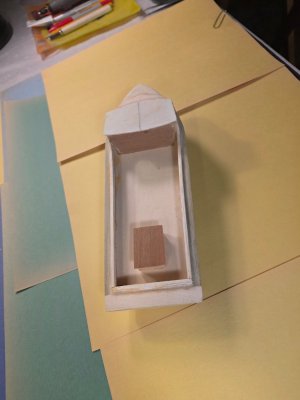
Today's tasks: Fairing the hull, final dry fitting and gluing Pilot House and Cabin, re-doing engine block.

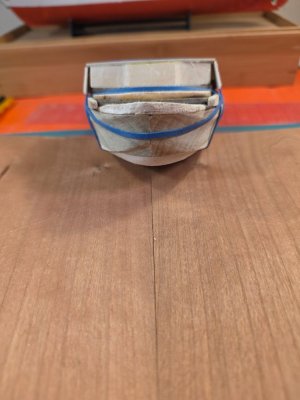
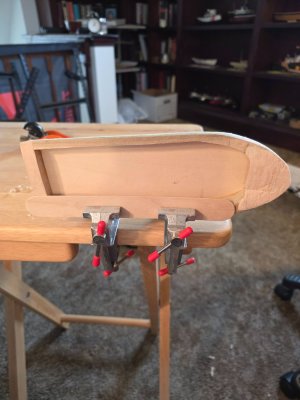
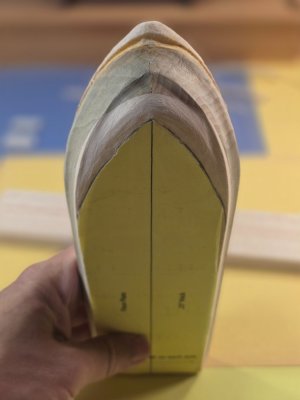
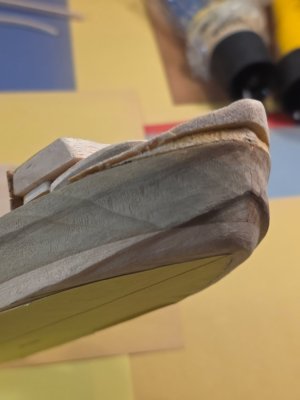
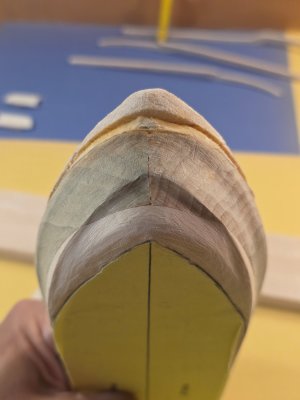
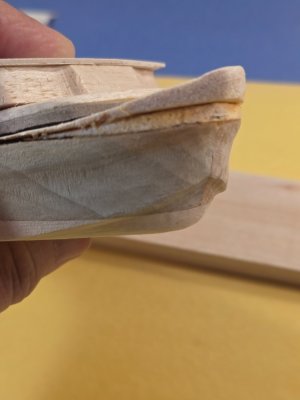
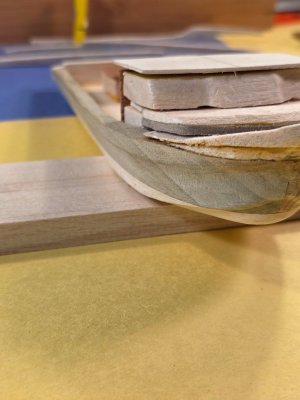
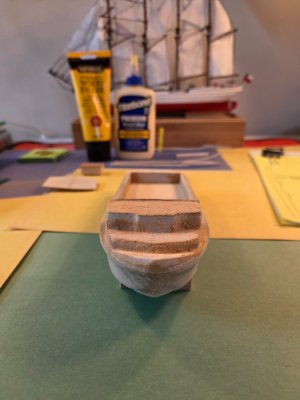
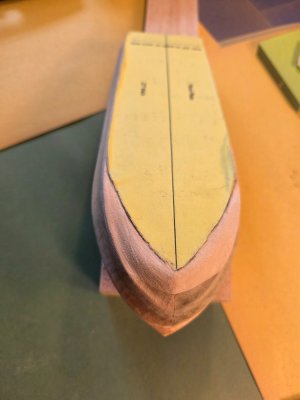
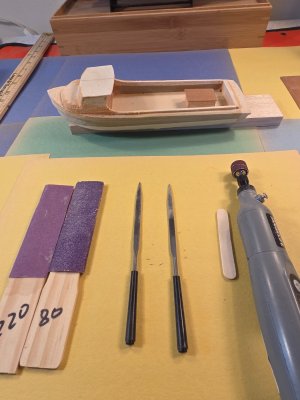
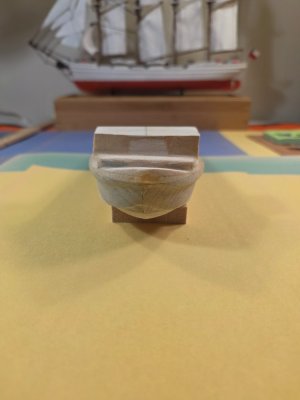
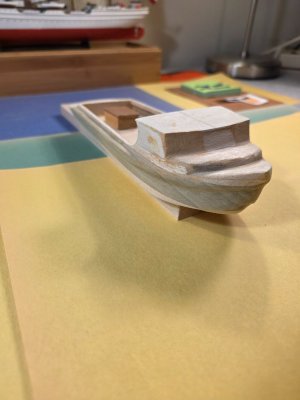
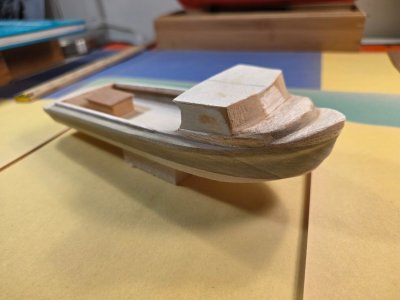
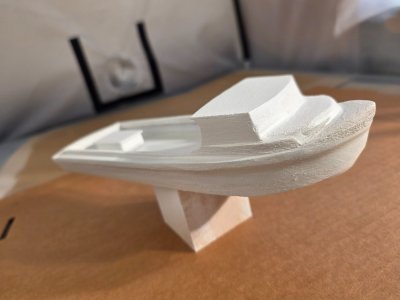
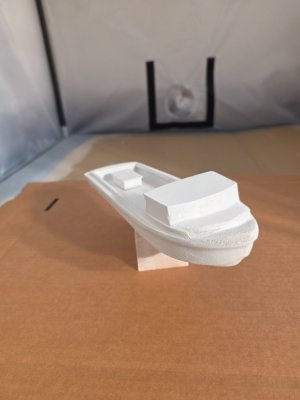
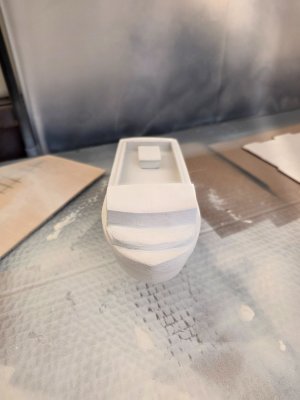
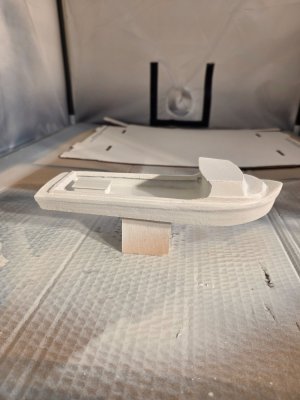
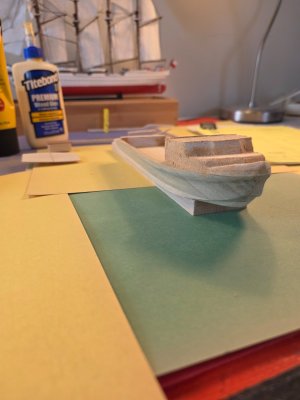
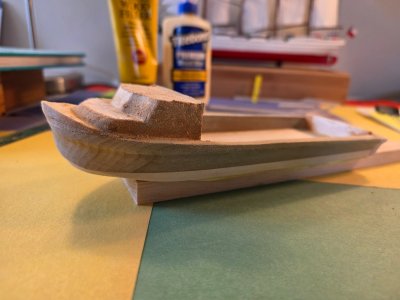
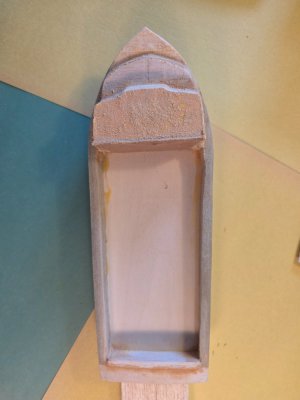
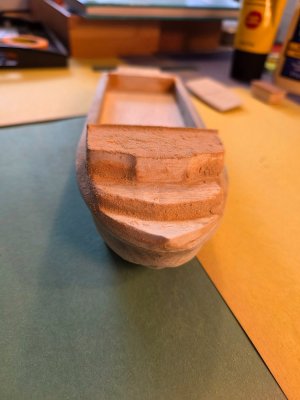
Progress pictures from the last couple of bench sessions. Spent alot of time shaping the hull following the 4 component hull lines:
(1) chine line rising at the bow from waterline to flare line,
(2) flare line with concave sides, from chine to sheer line,
(3) the sheer line from transom to bow, and
(4) bow line from false stem to tumblehome.

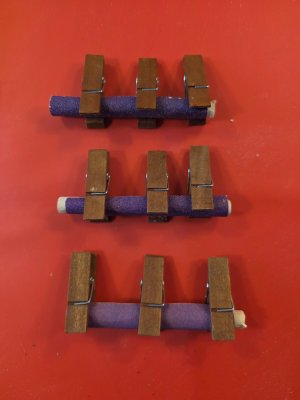
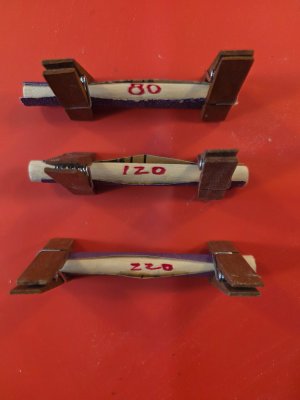
Shaping done mostly with home-made dowel/sandpaper jigs in 80, 120 and 220 grit.

Started using some cherry sheet stock for the top of the engine box and the back wall of the pilot house. It's the only 1mm sheet stock I have.

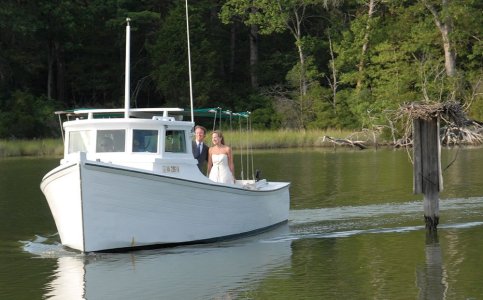
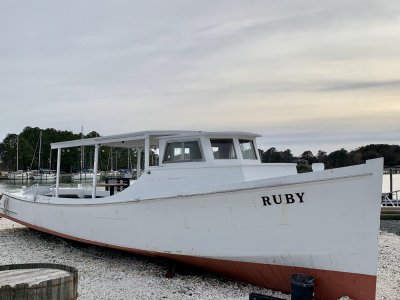
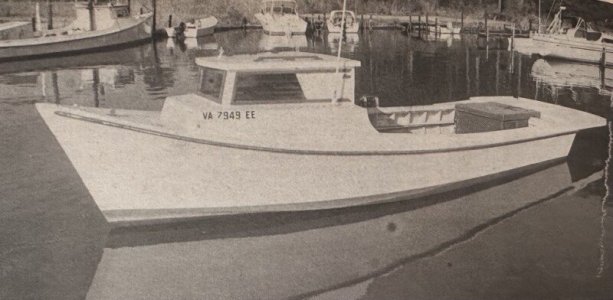
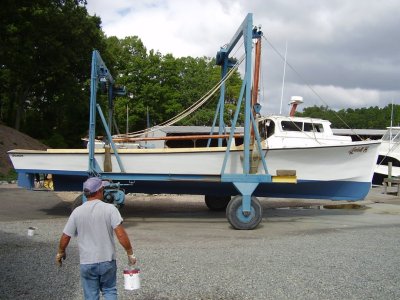
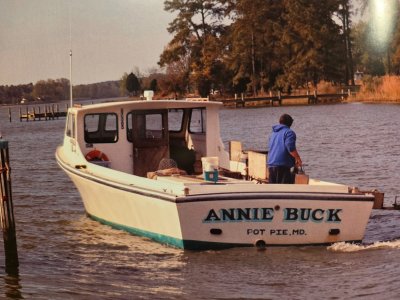
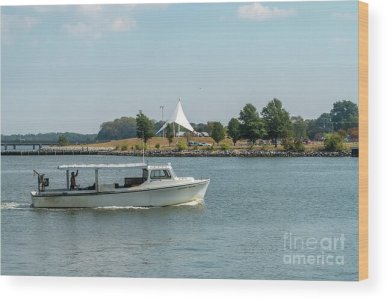
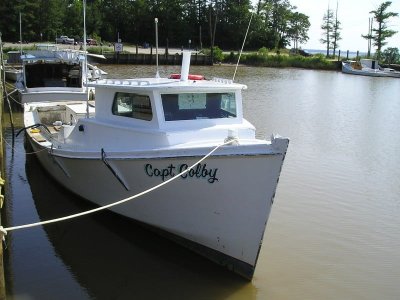
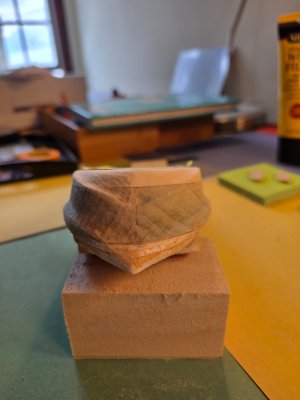
Showing pics of some real Chesapeake Bay deadrise oyster/crab working boats. The flare in the port and starboard sides has to be concave and the vertical angle of the bow is severe (over 60 degrees) in these type of boats. I added another layer of balsa at the bow to increase the verticality of the bow, which ultimately (after much sanding) will join both sides into a false stem.

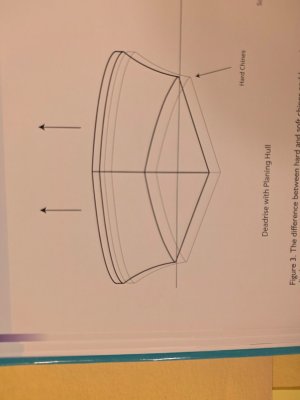
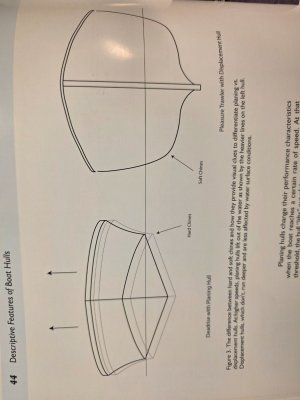
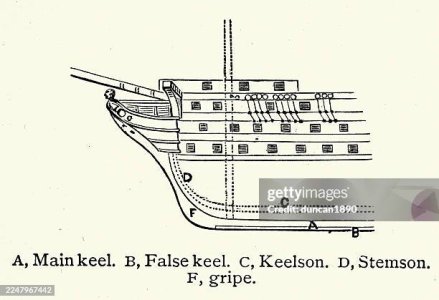
I learned alot about the difference between "planing" hulls and "displacement" hulls. The Annie Buck has a planing hull because the chine and flared sides effectively lift the boat slightly above water by forcing water down along the line of propulsion -- as opposed to displacement hulls like a ship of the line or tall sailing ship which effectively pushes water outward from the hull for stability from the line of the keel.

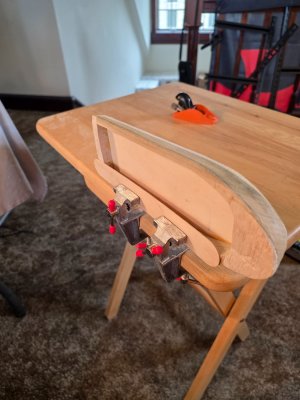
After fairing the sides of the hull from the sheer line to the chine line, I planed the toprails to get the sheer line as close to smooth as possible. This pine stock that I am using for the hull is pretty grainy and accepts the planer well. The trick is that the grain of the transom is cross-ways (perpendicular) to the grain on the hull sides. So using the planer I had to pull up as the plane approached the transom. I separately used my sandpaper jigs to also sand a flare into the transom cross-wise from the line of the hull.

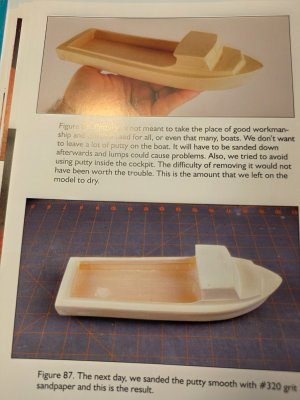
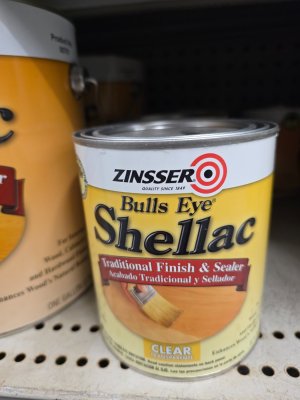
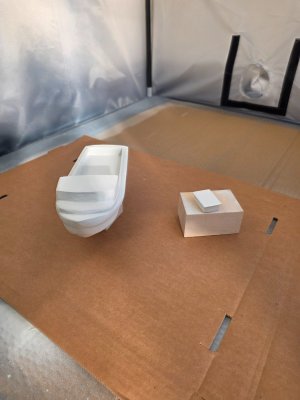
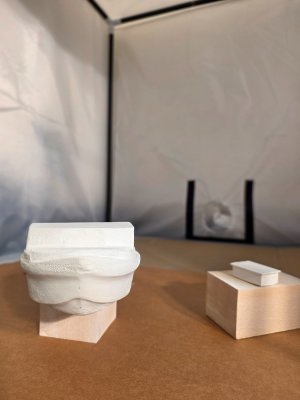
The front of the vessel will dry overnight, then tomorrow will be spent filling the sides of the pilot house with wood putty (homemade or store-bought), fixing a couple of divots in the inner wales and prepping everything for pre-staining / pre-painting with shellac. After the shellac dries, I will use the window decals as templates for stenciling on the window outlines and painting the windows. For the rear door of the pilot house, I will probably fabricate the door out of the 1mm cherry stock I have on hand.
1000018346.jpg


1000018354.jpg

1000018355.jpg

1000018356.jpg

1000018357.jpg

1000018358.jpg

1000018359.jpg

20260511_165755.jpg

20260512_145646.jpg

1000018400.jpg

1000018401.jpg

1000018497.jpg

1000018499.jpg

1000018500.jpg

1000018413.jpg

1000018418.jpg

1000018506.jpg

1000018508.jpg

1000018509.jpg

1000018511.jpg

1000018513.jpg

1000018351.jpg

1000018511.jpg

1000018353.jpg

1000018513.jpg
 
Last edited:
8. Annie Buck build log

Question for SoS members:

"To chine or not to chine, that is the question."

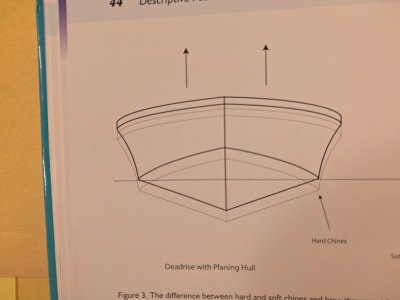
I learned something interesting about hulls today, that is, for some hulls the chine operates to make the lower hull more hydro-dynamic. Having a "second flare" below the bottom chine line results in a second convex flare leading down to the keel. This shape lifts the boat out of the water with less hull area, aka a planar hull, so it is more efficient at higher speed for crab boats.

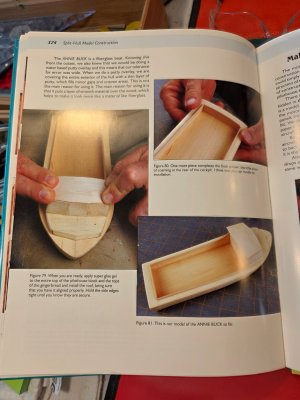
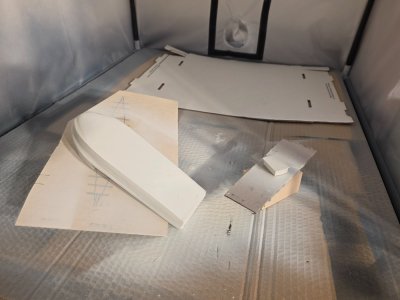
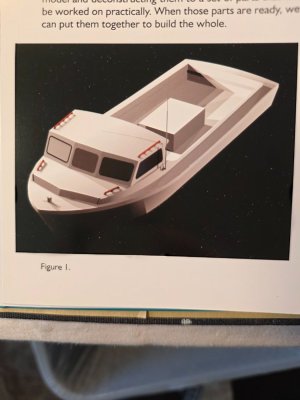
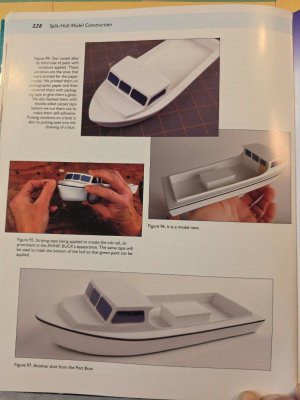
This build of the Annie Buck has an odd feature...instead of having a full taper of the center line of the hull plate (this is a waterline model), the bottom hull as designed is more rounded, like a displacement style hull. The alternative paper model that you can build in this book "Fundamentals of Model Boat Building" has a rounded hull at the bottom of the bow which, if completed would lower the model by about 2 more inches. Much more like a tall ship of the line or a cargo freighter. Rounded hulls are more characteristic of an oyster working boat. As shown in the pictures, the bottom of the wood build ends with a rounded hull at the waterline.

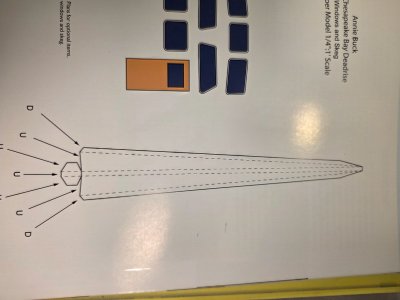
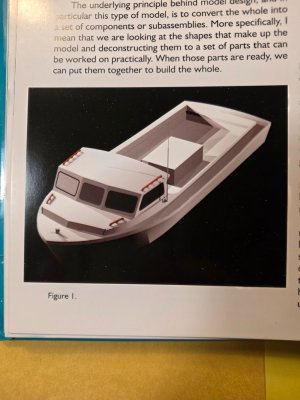
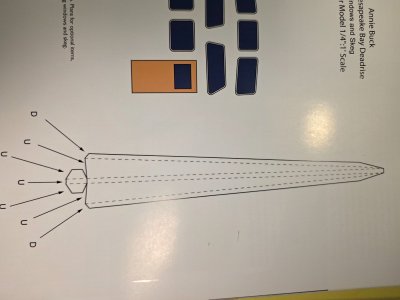
The book also has a second, easier, paper model of the Annie Buck, but does not have the dynamic flares or chines as in the wooden build hull. So if you wanted to replicate the paper model in the wooden build you would need to add a SKEG below the water line.

What is a Skeg? I have the design for the paper model skeg in the pictures. It's a triangular spike that runs from below the bow to below the stern.

Having the Skeg below the waterline makes sense if you are an oyster boat because they operate closer to shore. The crabbing boats need to travel further from shore to crab so they need hulls that are efficient at the higher speeds, which is more characteristic of a sea going vessel.

So if I were to make this a full-hull model instead of a waterline model, it would either have a thin hull at the keel (with a second flare down to the keel from the lower chine line), or a skeg appended to a rounded hull below the bottom chine line.

I chose to keep this build as planned, with the rounded hull at the waterline and an imaginary Skeg below the waterline. Choices, choices!

20260512_211034.jpg

20260512_210926.jpg

20260512_210906.jpg

20260512_210547.jpg

20260512_210040.jpg

20260512_210018.jpg

20260512_210014.jpg

20260512_205932.jpg

20260512_205918.jpg

20260512_205757.jpg

20260512_205533.jpg

20260512_205555.jpg

20260512_205523.jpg

20260512_145646.jpg

20260512_142735.jpg
 
Last edited:
tumblehome.jpg

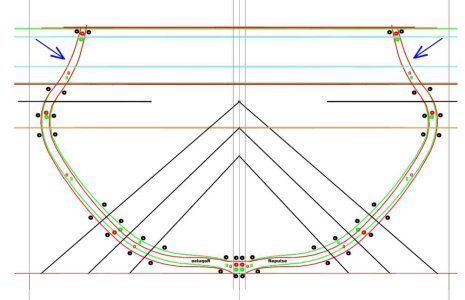
This is the midship forward cross section of the French La Bellone 32 1757 captured by the English added to the fleet and renamed Repulse .
The blue arrows point to the tumblehome. The French were much better at it.
 
View attachment 602554

This is the midship forward cross section of the French La Bellone 32 1757 captured by the English added to the fleet and renamed Repulse .
The blue arrows point to the tumblehome. The French were much better at it.
Thanks Dean. I got the flare of the Annie Buck side hull walls confused with the tumblehome, or indented area of the bulkheads towards the top decks. See pic.

Here is a link to a log where simple sandpaper jigs were made with PVC pipes to sand in the tumblehome, similar to the sandpaper jigs I made to sand in the hull flare. I'll correct my original post.

Thread 'A simple homemade bulkhead sander/shaper' https://shipsofscale.com/sosforums/threads/a-simple-homemade-bulkhead-sander-shaper.18825/

20260512_210922.jpg

20260511_165655.jpg
 
9. Annie Buck build log

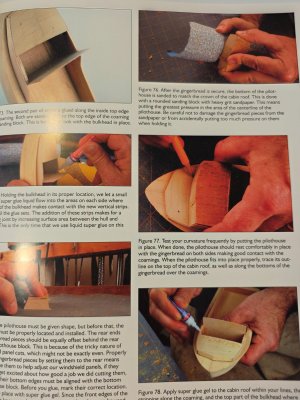
Final assembly and gluing of the cabin, pilot house, side coamings, and roof. Will do a final fairing then apply one or two coats of shellac. Then final painting and attachment/painting of pilot house windows. I used Minwax Wood Filler to fill holes, cracks and seams.

Looking forward to putting this build on the shelf. I learned quite a few things, like the difference between planing hulls and displacement hulls, why boats have chines and flared hulls, and hopefully a new approach to painting with a shellac base coat.

My next build will be a paper cardstock build of a 17th Century Dutch pinnace or fluyt from Ab & Emiel Hoving's great book "17th Century Dutch Ship Models in Paper." Then a half-hull model of the 19th century yacht "Shadow" from Model Boat Store design plans.

20260513_130319.jpg

20260513_130329.jpg

20260513_130337.jpg

20260513_130351.jpg

20260513_130401.jpg

20260513_130422.jpg

20260513_130535.jpg

20260513_130540.jpg

20260513_130635.jpg

20260513_180457.jpg

20260513_180621.jpg

20260513_212905.jpg

20260513_213224.jpg

20260513_213756.jpg

20260513_213825.jpg
 
The old furniture finishing books had the first coat of shellac be a 1:1 dilution with thinner. I use a piece of a worn out white T-shirt to apply.
A curved Kelly is a good handle for the rag..
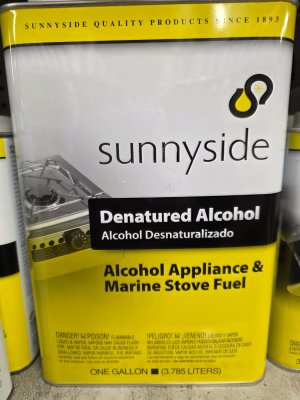
Thanks Dean. Google says to thin the shellac with 90+ percent denatured alcohol that is ethanol based rather than methanol based. A product called Everclear was also mentioned. Do you use something similar?
 
Last edited:
10. Annie Buck build log

Coming down the home stretch with the Annie Buck Chesapeake Bay deadrise oyster/crab working boat.

1 coat of diluted shellac, 50% thinned with denatured alcohol 90% proof

2 coats of shellac, 100%

First coat of semi-gloss white acrylic paint

Waited 2-3 hours between applications. I will let dry overnight. Then sand everything down and apply 2 or 3 more coats of white paint. Will add the black trim line across the top wales once I can get to the hobby store.They have great trims in different colors and sizes for sandbox racers. Im going with a .75 mm black trim line.

The engine box does not look good painted in balsa wood. Too rough looking on the non-grain sides. I may just redo the engine box for a 3rd time in pine wood with cherry wood top board.

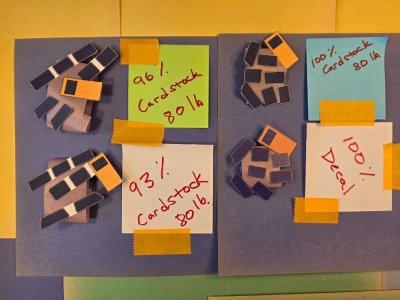
Also, trying different sizes of pilot house windows, in decal transfer paper and 80% card stock. I worked the pilot house with alot of sanding, so the windows at 100% were slightly big. I printed out the windows on 80 pound card stock in 100%, 96% and 93% size to see tomorrow which ones I will use in the final build.

20260514_152343.jpg

20260513_213827.jpg

20260514_102308.jpg

20260514_102250.jpg

20260514_152505.jpg

20260514_152453.jpg

20260514_152411.jpg

20260514_152402.jpg

20260514_152248.jpg

20260514_152310.jpg

20260514_152213.jpg

20260514_152053.jpg

20260514_111502.jpg

20260514_111438.jpg

20260514_111434.jpg

20260514_111401.jpg
 
Last edited:
Google says to thin the shellac with 90+ percent denatured alcohol that is ethanol based rather than methanol based. A product called Everclear was also mentioned.
There are 4 alcohols with a short enough carbon chain to be useful as shellac thinner.
Methanol - 1 carbon - 100% is possible - in Grampa's time it was shellac thinner. Drink it or inhale a significant amount and there is a problem. The human liver metabolizes it to formaldehyde and the next oxidation step is formic acid. One kills everything and the other can dissolve glass. Evaporates quickly.
1-Propanol - 3 carbons - straight chain - probably 100% possible it does not seem to be readily available.
2-Propanol - 3 carbons - branched chain - 100% possible - Isopropyl alcohol - Theoretically it evaporates more slowly than ethanol - I think - practically - no difference worth consideration.
Ethanol - 2 carbons - only 95% is really possible. Ethanol forms a non-covalent bond with water - an azeotrope - ~ 95%-5%. Simple distillation will not yield anything more pure than 95% ethanol. It can be distilled from benzene or some similarly noxious method and produce 100% ethanol. But - as soon as 100% ethanol is exposed to Terra's atmosphere - this ethanol "pulls" water vapor in it until it gets to the 95% that is its equilibrium point. So - buying 100% ethanol is a waste of money.
Everclear and Pharmco grain is liquor / ABC store ethanol -- it is 95% / 190 proof - fratboy -purple passion stuff - Federal tax is $25/gal
Denatured alcohol / ethanol is 95% plus a poison to make it not drinkable- usually an emmetic - for Shellac thinner - it is transparant. It is $24/ gal.
I do not see the 5% water as being the same as applying actual water to wood. The azeotrope bond probably has it being more "interested" in staying with the ethanol than swelling wood.

Bottom line - use ethanol based shellac thinner / denatured- if you are going to use shellac a lot - buy a gallon- for the best price break.
 
There are 4 alcohols with a short enough carbon chain to be useful as shellac thinner.
Methanol - 1 carbon - 100% is possible - in Grampa's time it was shellac thinner. Drink it or inhale a significant amount and there is a problem. The human liver metabolizes it to formaldehyde and the next oxidation step is formic acid. One kills everything and the other can dissolve glass. Evaporates quickly.
1-Propanol - 3 carbons - straight chain - probably 100% possible it does not seem to be readily available.
2-Propanol - 3 carbons - branched chain - 100% possible - Theoretically it evaporates more slowly than ethanol - I think - practically - no difference worth consideration.
Ethanol - 2 carbons - only 95% is really possible. Ethanol forms a non-covalent bond with water - an azeotrope - ~ 95%-5%. Simple distillation will not yield anything more pure than 95% ethanol. It can be distilled from benzene or some similarly noxious method and produce 100% ethanol. But - as soon as 100% ethanol is exposed to Terra's atmosphere - this ethanol "pulls" water vapor in it until it gets to the 95% that is its equilibrium point. So - buying 100% ethanol is a waste of money.
Everclear and Pharmco grain is liquor / ABC store ethanol -- it is 95% / 190 proof - fratboy -purple passion stuff - Federal tax is $25/gal
Denatured alcohol / ethanol is 95% plus a poison to make it not drinkable- usually an emmetic - for Shellac thinner - it is transparant. It is $24/ gal.
I do not see the 5% water as being the same as applying actual water to wood. The azeotrope bond probably has it being more "interested" in staying with the ethanol than swelling wood.

Bottom line - use ethanol based shellac thinner / denatured- if you are going to use shellac a lot - buy a gallon- for the best price break.
Good information, thanks Dean. We'll, I've been holding off learning to do airbrush painting until my 10th build or so. Maybe now is the time if I'm going to make an investment in a good filtration mask and an air exhaust painting box.

Any advice on how I should pick out an air filtration mask? I do not know thing 1 about bad things to inhale. My wife thinks I'll get early onset dementia from using super glue!
 
Masks - lots of choices - I have tried 3 - including a 3-M N-95 -
I most want to avoid the micro wood dust that escapes my Dust Deputy cyclone and Rigid 16 gal filter.
Organic chemical gases require an activated charcoal filter. For dust it is a physical barrier - for charcoal - it is a bond that saturates- changing filters can get expensive - I am not spray painting a car so a war gas type charcoal filter is not necessary.

If I wish to use a bonding agent with poor shear strength I use Duco - nitrocellulose - acetone - which does not scare me -nail polish
I treat CA as an impractical poison - I am not in that much of a hurry that instant grab is something that I want. The couple of times that I tried it - under fad propaganda influence and before I understood what it is - the damned stuff polymerized in the bottle before I could get a second use.

I use
Titebond II for wood to wood.
Duco to get patterns on Sandeply
TrueTest rubber cement for timber patterns of frame stock
Epoxy for metal to wood -
belt and suspenders where I can
I tried and do not like Franklin liquid hide glue - too wet - no grab - I think Old Brown - which is also liquid but has to be applied when close to hot 135 - 145 degrees F - and is still wet - both are hide glue plus urea.
I now have a Lee Valley hot pot and hide glue flakes - in vac sealed Mason jars - and distilled water - to try when I gather up the courage.

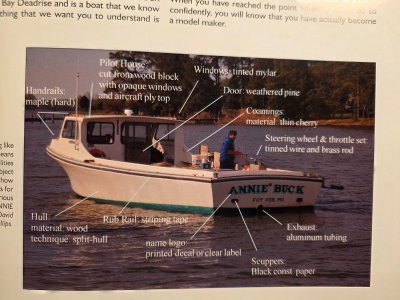
Looking at your build - if it was my build -- I would use Hard Maple for the deck and rail and box. The edges will be sharp and crisp with this species of wood. I would use thin Hard Maple and build the pilot house as it was actually built. Or at least use square posts at the interior corners. I would cut out the windows - frame them?. For glazing I would use clear cellophane - candy wrapping at Amazon. It is essentially wood so PVA should bond it. If I did not wish to furnish the house interior - and I would not - I would use black construction paper off set behind in the interior.

Speaking in Lt. Orr's voice: you should really consider using tubed artist oils - only a few basic colors are needed - any color between can be mixed using a color wheel guide and this should be documented for a repeat. It will out last you in tubes if capped. The smaller size tubes will be enough to last forever. It is the same pigment or even finer grind of them that is sold in tiny premixed jars. Except that the jars also have the polymerizing bonding agent mixed with the pigment and solvent. After a year it goes solid in the jar. It has not really "dried". It has polymerized. It ain't never gonna dissolve again. It is now a different "chemical". A chemical that will not dissolve in anything you want to go near. It can be brushed, ragged, or sprayed. Organic oil based paint has a better flat finish and CAN be made glossy if you are mishiguene enough to want that.
 
Jaager - May I ask what types of wood you use for hull planking, frames / bulkheads, and deck.planking? Also, any recommendations for wood stock that presents well when used in making half-hull models and their mounting boards?
I promised a reply so here it is.

I am going going for gloves off - solo opinion - far from orthodox or popular - certainly not about model competition - or admission to some imaginary club - rather - this is something to play off of while formulating your own view :

Frames -- My scale is 1:60 that is one of the larger scales. Framing requires a significant volume of wood -depending on the vessel. That is 10-20 BF. It is not financially practical to use exotic imported wood.
I use domestic species. For display I use two species - Hard Maple and Black Cherry.
I would also consider Birch and Beech. Both are close to Hard Maple but there are confusing species involved, some better than others - almost never specified beyond Birch or Beech. My local hardwood lumberyards do not stock either on a reliable basis.
I bought some Granadillo 8x4 S4S on sale. Enough for about two large hulls. - Really dark - really hard - saving it for something special. Afraid it might kill the edge of my Lenox bimetal blade.
For hidden framing - I originally used 2x4 Pine - Pine - not Fir - not Spruce - Pine - sap free - Actual Eastern White Pine is probably worth any extra cost. Now I prefer Yellow Poplar - Tulip Poplar. It really reacts well to a quality steel sharp chisel edge - quality planer edge.
While on the subject - paying for quality chisels and planes - is worth the extra cost. The joy of having an edge that does not fight you is worth what it costs.

Hull planking - wide open - anything with high Janka hardness - straight grain - no visible pores - tight grain - fine texture. Since the volume is not close to that necessary for framing the price is less of a factor.
I have bitten on about half a dozen WoodCraft sales for wood that met the above standards and looked good. I have learned that for wood - I might not get more than one shot at it. Those species on sale usually means that it is inventory clearance and they do not intend to restock. What I want is dull and boring grain. This is usually the exact opposite of what full size project woodworker are after.
One that looks really good is Tiete Rosewood/Sirari/Patagonian Cherry -an elegant pinkish color. Cannot find any more - unless I buy a truckload or want thin already grooved and finished flooring.
I got some Katalox for maybe wales - not absolute black - much less hassle than African Ebony which is being loved to extinction - actually - I am counting on black aniline dye to work on a lot of species. Actual Ebony is a pretentious affectation.
I have Yellowheart, Goiabao, Araracanga, Tatajuba, I have not tried any of it. I do not regret purchasing any of it.

One purchase that I do very much regret is AYC - Alaskan Yellow Cedar - which is not a Cedar, rather a Cypress. It is too soft. It looks like gooey plastic up close. It takes low contrast grain way too far. It is junk.

Basswood is too soft. It takes too much effort to get a smooth surface. No crisp edges. It is used for everything in many kits and should not be used for anything.

Pear - European Pear - is about 25% better than Black Cherry. If it is the cost of a domestic wood it is the better choice. It is not worth paying import costs . For Europeans - Black Cherry is not worth import costs.

Buxus - actual Boxwood - is for carving and delicate parts. It is too rare and too expensive for anything else.
Pretend Boxwood - Castelo - West Indian Box - work well for framing at 1:96 scale and the even more miniature scales. For larger scales it is expensive overkill. The hardness and lack of visible grain is not necessary.

Bulkheads - NEVER - My contempt and loathing for PoB is as math absolute as my brain can formulate. Coming from scratch, I see many ways to fix problems with kit PoB mfg deficiencies. Most problems are an easy fix if you are your own sawmill. It is just wood after all. Unless it pure synthetic plastic junk like MDF. If a kit is MDF and AYC - no matter how close it is to plans - is a cheat. You may as well go back to Styrene kits.
While Styrene is excellent at simulating iron and steel - for wood: not so much.

Deck planking - Hard Maple - bowling alley - gym floors - before they started painting the damn things hideous colors. Birch tongue depressors - Maybe even Yellow Poplar sapwood if picked carefully.
European and American yellow Holly - which is now absurdly expensive. Never white marquetry Holly. No wood that can be used for deck planking is or was that white.
Holystoning a deck is a flat stone and sand. It just sands a deck. It takes back to fresh sawn. It does no bleach wood. And most neglected and sun bleached wood used for decking turns silver grey.

Half-hull back ground. If painted - anything. Natural grain - an alcohol base aniline dye - can get you to blue or green or red or yellow and still show a grain with depth. A stain makes everything muddy. If you want visibility and character and possible distraction from the primary subject Ambrosia Maple or even dyed Ambrosia Maple. Long ago I bought a few boards of Sassafras from an independent cabinet maker. It has a distinctive wavy grain. It looks like a train of ocean waves. Appropriate for a model display base - if blue or green or blue green or whatever this ugly blue green the Atlantic outside my window is. As something vertical?
Or a species that I hate because I got fooled because what Underhill meant by Sycamore - which is close to Hard Maple - is not what is Sycamore in North America. Ours is buttonwood - same color as Maple about as hard - stinks when cut - fibers roll - crisp edges near impossible - busy grain - now sold as "Lacewood".

About Hard Maple: The grain an be simple straight indistinct. It can also be " figured pieces such as birdseye, curl, or quilt and are likely to be much more expensive." You can get any of this from the same Maple plank. It depends on the plane cut relative to the growth rings. I use a stylized framing. A long curved futtock goes from clear to figured as the grain orientation to the surface changes. "You pays your money, takes your chances, and accepts what comes."

Dean
 
Last edited:
Back
Top