• SUBSCRIBE TO SHIPS IN SCALE TODAY!

    The beloved Ships in Scale Magazine is back and charting a new course for 2026!
    Discover new skills, new techniques, and new inspirations in every issue.

    NOTE THAT OUR NEXT ISSUE WILL BE MARCH/APRIL 2026
  • Win a Free Custom Engraved Brass Coin!!!
    As a way to introduce our brass coins to the community, we will raffle off a free coin during the month of August. Follow link ABOVE for instructions for entering.

Muscongus Bay Lobster Smack by MBerg - Model Shipways - 1:24

Down with an illness this week, working from home has opened up bench time but energy is low and extended sitting has been rough; progress is slower than it looks.

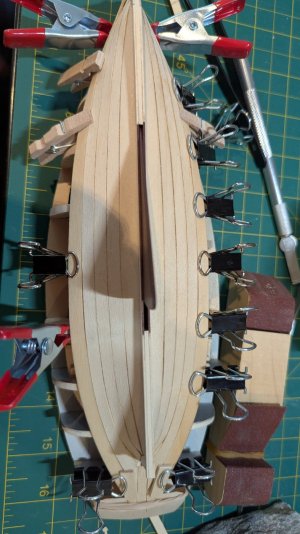
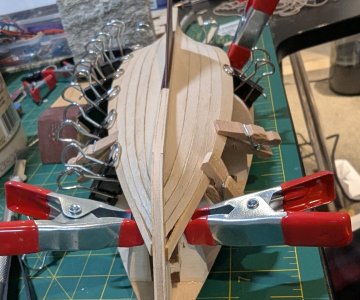
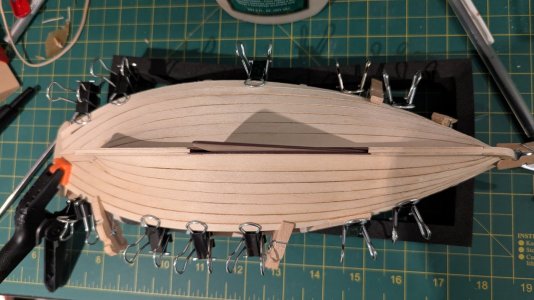
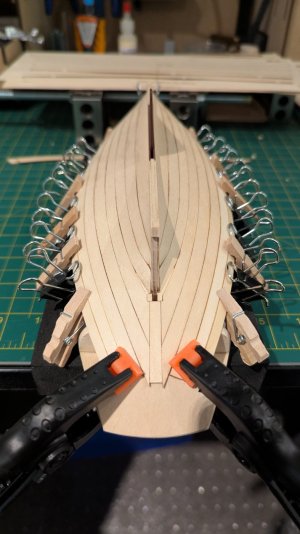
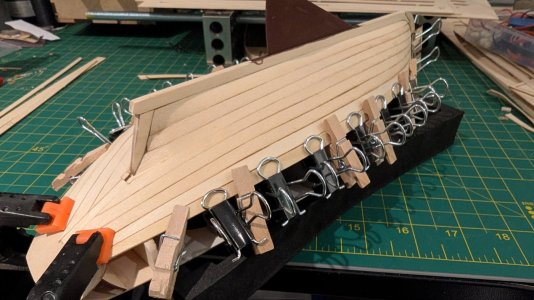
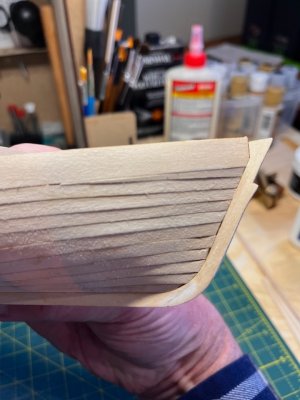
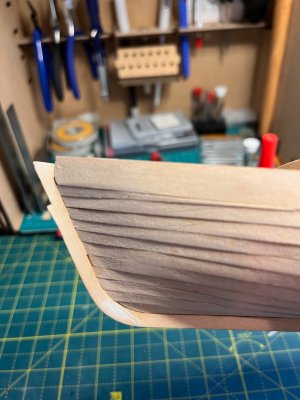
Planking continues. Around strake six I noticed the plank creep on the port side was running slightly less than starboard. Rather than compensate by adding on the next port strake, I sanded the starboard plank down. The sheer is going to run short of the deck regardless, and an added strake at the end is already looking inevitable. The kit-supplied planks need resizing to follow the tick marks accurately, and I can see I've been running short of them consistently as every other build log I've seen.

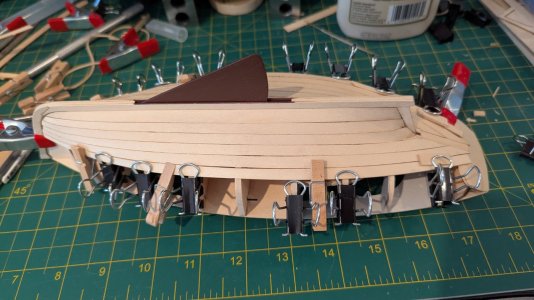
After strake six, I pulled all the remaining port side planks, including the sheer and lined them up. Sure enough, the sheer comes just barely shy of the false deck; maybe flush with it at best. That's not enough margin with deck planking still to come, which will add a small amount of height. Not enough to risk it.

Current plan is to leave a deliberate gap and continue placing strake seven and the remaining strakes on their tick marks, then add an additional strake when the time is right; likely before strake nine goes on. My gut says it would be best to do before strake 9. The lower strakes are just creeping into view from inside the cockpit now, so any new strake added sooner benefits from being hidden under the floor. The higher it goes, the more exposed the work becomes. It also doesn't help that the hull right now still has some curve to it; it will be easier to work a new strake into a flatter section, (though hull space is running thin) just playing it by ear.

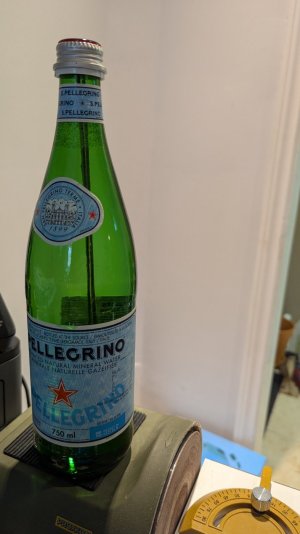
As of tonight, both seventh strakes are clamped, wet-formed, and ready for glue in the morning. Found that a Pellegrino bottle works perfectly for soaking the planks before forming. Fill it with the hottest tap water available, drop the plank in for five minutes with the cap on, and it's ready to bend and clamp. A lot of ground covered this week despite everything.

I'm also debating if I should add a newly made strake right on top of the previous, or leave a gap between a pair of strakes (say 8 & 9) that I can fill in later. I'm open to any suggestions on that subject.

PXL_20260510_172502918.MP.jpg

PXL_20260510_172537007.jpg

PXL_20260511_182746149.MP.jpg

PXL_20260512_133532636.jpg

PXL_20260514_005652434.MP.jpg

PXL_20260515_002232544.MP.jpg

PXL_20260515_002254686.MP.jpg
 
Nice work! In all honesty, if it currently looks like the sheer strake will be at least flush with the deck, that may be enough, as you'll be sanding/cutting the top of the sheer strake flush with the deck anyway in order to plank the deck.
 
Hmmm.... I see what you're saying - I think. I don't know why I was thinking of it this way, but I was picturing having to plank the deck before adding the sheer and then butting the sheer up against it and trimming it flush. But instead, the deck planks would sit on top of the sheer, yes?

It may still be a bit risky as it was a very loose dry-fit to see where the sheer would fall which doesn't leave much room for error and I only checked amidships. I think I will need to recheck and get a better gauge on this after strake 8 or so.
 
It continues to look great. I added my fillers between plank 9 and the shear strake, because to me that seemed to be the easiest pale in terms of bending. I also only needed to add "stealers," not full strakes. I glued the sheer strake so it sat flush or just above the top of the deck, and then filled the gaps.
Starboard bow stealer.jpeg

Port bow steaker.jpeg

Straboard stern stealer.jpeg

Of course, once you've sanded and filled, it really doesn't matter where you put the extra plank, assuming you're painting the hull. Place them wherever is easist.
 
Hmmm.... I see what you're saying - I think. I don't know why I was thinking of it this way, but I was picturing having to plank the deck before adding the sheer and then butting the sheer up against it and trimming it flush. But instead, the deck planks would sit on top of the sheer, yes?
I would plank the deck first, and then make sure the sheer was at least flush with it
 
Appreciate the comments. I see you didn't have to add too much, if that's all I end up needing it's likely the way to go.
 
I agree that it's probably best to double-check once you get closer. As for the decking, every boat is different, but in general there's a plank (covering board, if I'm remembering correctly) around the perimeter of the deck extending over the hull planking. That way, there isn't a gap there for water on the deck to work its way into the hull and damage the hull planking from within. That said, whether you want to do that or not is up to you, the toe rail pretty much covers all of that anyway so it's not really visible which way you do it. If that makes sense.

Edit: a picture speaks a thousand words. The deck and covering boards on my earlier Lancha Chilota build.
20250214_223706(1).jpg
 
Last edited:
in general there's a plank (covering board, if I'm remembering correctly) around the perimeter of the deck extending over the hull planking.
Yeah, I opted for simplicity and will likely just plank straight across. Though this looks nice and part of my wants to do it, I feel it will mostly be covered by toe rails do you think?

Happy Victoria Day weekend and the official start to Canadian summer. Hopefully we don't get any more snow!

A short Story of Indecision

The closer I got to the sheer, the more I questioned how to resolve the planking issues. After adding the sixth strake it became obvious the current spiling wasn’t meant for that part of the hull. I narrowed it down to three reasonable options:

  1. Continue planking all the way, adding the sheer at the appropriate height and then backfilling any gaps between 9th and sheer with stealers.
  2. Continue planking all the way and remaking a larger sheer.
  3. Leave a gap in the planking and backfill with a half strake instead of stealers.
Adding a strake felt like the right approach, but the most difficult one. After one suggestion and rewatching part of Hillbilly Modelers video, I was looking at adding stealers, though what I liked least about that approach was the way the spiled planks were bowing and buckling as I was forcing them into an area of the hull they weren't meant to be. Another suggested approach (#2) would work and I was considering cutting a strip and edge gluing it to the existing sheer to make it thicker since I don't have a lot of sheet to cut such thick and long pieces from. However, if needed to soak and bend the plank that's likely not a good approach, it also doesn't solve my poorly spiled plank issue.

After some back and forth, I put the build on hold and went to relax. I’m still a bit cloudy‑headed from being sick all week. As I was about to go to bed I suddenly had a wave of motivation, so I soaked the eighth planks and started dry fitting again. Once I got a good read, I started forming and clamping the eight plank, and I was having the same issue as before. I would close one gap and it would bow out at another spot. After messing around for a while I once again tried fitting it along the tick marks of where plank eight should be. I pulled out my 'nails' and attached it to the hull since the room for clamps is running out. Since the planks transition from curving down toward the hull to curving up and away from the hull, this is where this plank is meant to sit and it laid perfectly. This put me right back into indecision mode so I nailed on both sides the same and left it overnight to look at with fresh eyes in the morning.

PXL_20260516_130343085.MP.jpg


After a brief conversation this morning, it was suggested that I could start with the sheer and work my way back and then filled whatever is left. This is a variation of option 3 above and something that also crossed my mind last night, I liked the idea, and using the sheer as a guide gives me more confidence than floating the eight strake somewhere along the hull hoping the planks above and below will also fit well.

It may not be the easiest or most conventional approach with this kit, but I believe it follows some construction methods on others. As long as I don't glue anything down I don't have to commit. I pulled the eighth strake off, released the last sheer and ran a few dryfit trials. At this point, I ended up cutting back the bow of the false deck that protrudes over the rabbet and added a piece of scrap to raise the front keel to be level with the false deck.

PXL_20260516_182315565.MP.jpg


I then soaked the sheers and nailed them on.

PXL_20260516_191645083.MP.jpg


So I will glue this on a bit later today or this evening and continue with the 9th strake, 8th and finally whatever is left to fill in. I'm hoping I'm not creating extra problems for myself, but worst case I'm sure I'll be sanding and filling in no time. I'm excited to get this part of the build behind me and move on to other areas.
 
Good evening,

I was planning to be further along before posting an update, but between a polypectomy (thankfully on the other side of yet another one), endless property maintenance, DIY septic troubleshooting (not my most enjoyable pastime), and the usual work emergencies, I haven’t had much time this past week. I figured I’d bring everything up to speed so everyone knows I’m still alive — and so I can keep my offline notes cleaned up.

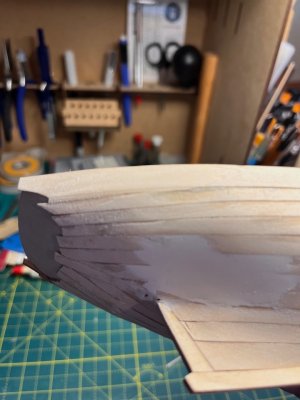
I carried on with planking as planned. Once I reached the final gap, I tried shaping a piece from the leftover sheet skeletons, but every attempt either fell just off the edge or had etching running through it. I ended up taking a strip of basswood and cutting it in half to make two planks. Because of the location, they were relatively straight, so shaping them from strip stock worked out.

My first attempt was to place tape over the gap and trace it. Between the fine tip Sharpie intermittently not marking the tape and slipping on and off the plank edges, the result wasn’t great. I transferred it anyway and cut the first plank. For the second, I changed tactics: I tick marked the top and bottom edges at each bulkhead, removed the tape, and connected the dots with a straightedge. Much steadier line, much easier cut, and a better rough plank.

Once I had rough templates, I marked them port and starboard and spent a few evenings dry fitting and sanding. Eventually they fit so nicely I barely needed glue then I wet formed them (which probably caused more issues than not).

PXL_20260520_000305959.MP.jpg


PXL_20260523_004948054.MP.jpg


Unfortunately, after wet bending they swelled more than expected and stayed slightly expanded. I should’ve sanded the edges a bit more before gluing. I’ve also been using slightly diluted white glue between planks, which probably caused a bit more swelling. 'No turning back now - only one option - force them in!'

It wasn’t actually very dramatic. They still fit well, though you can see some slight protrusion mainly in the bow.

PXL_20260523_160421136.MP.jpg


PXL_20260523_160430882.MP.jpg


PXL_20260523_160509734.MP.jpg


PXL_20260523_160454040.MP.jpg


And that’s it - I planked my first POB! I feel like I learned a ton during this step. There’s definitely room for improvement and more advanced techniques, but the end result is about as good as I could’ve hoped for.

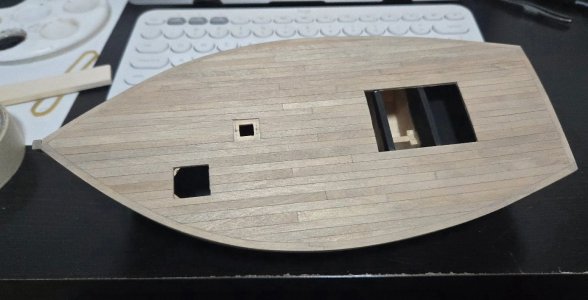
To take a break from the hull, I shifted to the topsides. I carved down the sheer, which was sticking up quite high due to the method I used, and started tracing deck lines to get a sense of the plank widths I want. I may do something intentional around the hatches. I also added the trim where the forward cockpit wall meets the deck (not shown in the photos).

Finally, I tackled the inboard side of the hull planks visible from the cockpit. I went back and forth on repainting the cockpit white or combination of white/grey, but for a working boat that would show dirt and blood instantly. In the end, I kept the grey and also decided to try a diluted brown wash to add depth and tone things down so the cockpit planks fade into the background.

I almost stole some of my wife’s artist paints, but rummaged through my stash first and found some old Testors acrylic washes from Michaels. Olive green (nope), teak (nope), basswood (nope), and mahogany (this could work). They were separated badly, which is probably why they were a on clearance from $10 to $3 each, but after shaking the mahogany it came back to life perfectly. I must've bought these 2-3 years ago, so I'm glad I finally used one!

I started applying it, and felt it blended well, though slightly blotchy and amplified some glue marks I needed to clean up. After dry fitting the seats and coaming, the planks fade nicely into the background while still looking natural.

PXL_20260525_224830427.MP.jpg


PXL_20260525_003049233.MP.jpg


The hull is sitting around with a coating of filler waiting to be sanded which is not an appropriate activity in my modeling area so I'll need to Head outside to sand with the black flies.

Thanks for checking in.

-Matt
 
Back
Top