Good evening,
I was planning to be further along before posting an update, but between a polypectomy (thankfully on the other side of yet another one), endless property maintenance, DIY septic troubleshooting (not my most enjoyable pastime), and the usual work emergencies, I haven’t had much time this past week. I figured I’d bring everything up to speed so everyone knows I’m still alive — and so I can keep my offline notes cleaned up.
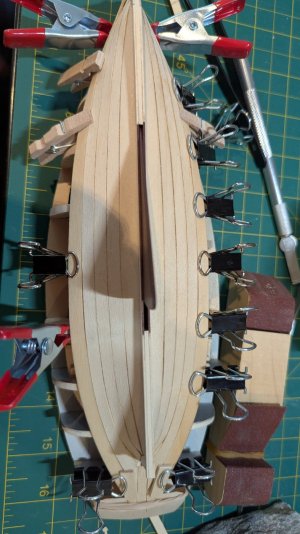
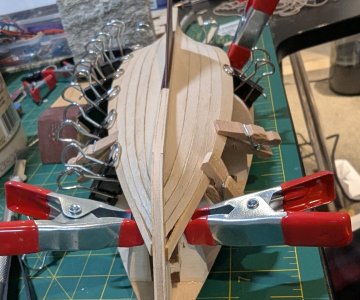
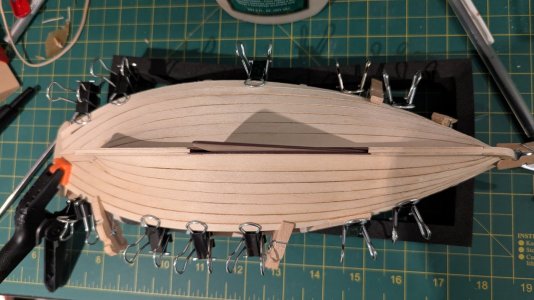
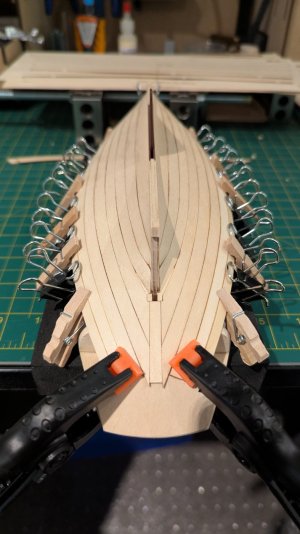
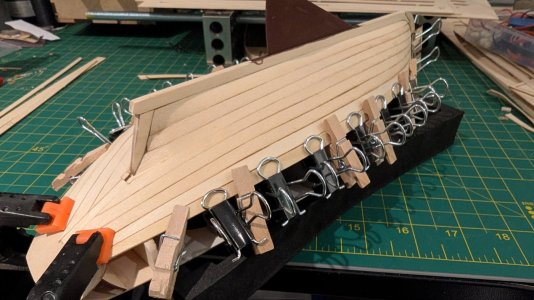
I carried on with planking as planned. Once I reached the final gap, I tried shaping a piece from the leftover sheet skeletons, but every attempt either fell just off the edge or had etching running through it. I ended up taking a strip of basswood and cutting it in half to make two planks. Because of the location, they were relatively straight, so shaping them from strip stock worked out.
My first attempt was to place tape over the gap and trace it. Between the fine tip Sharpie intermittently not marking the tape and slipping on and off the plank edges, the result wasn’t great. I transferred it anyway and cut the first plank. For the second, I changed tactics: I tick marked the top and bottom edges at each bulkhead, removed the tape, and connected the dots with a straightedge. Much steadier line, much easier cut, and a better rough plank.
Once I had rough templates, I marked them port and starboard and spent a few evenings dry fitting and sanding. Eventually they fit so nicely I barely needed glue then I wet formed them (which probably caused more issues than not).
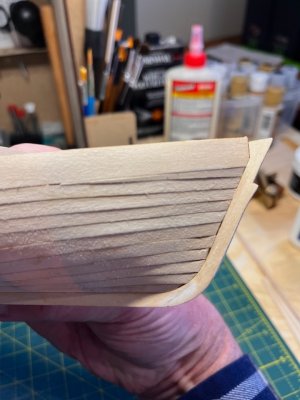
Unfortunately, after wet bending they swelled more than expected and stayed slightly expanded. I should’ve sanded the edges a bit more before gluing. I’ve also been using slightly diluted white glue between planks, which probably caused a bit more swelling.
'No turning back now - only one option - force them in!'
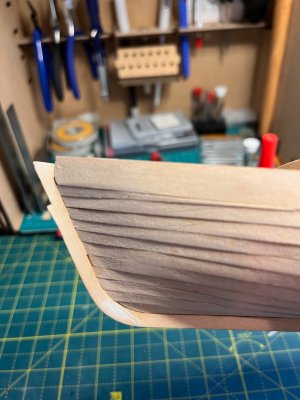
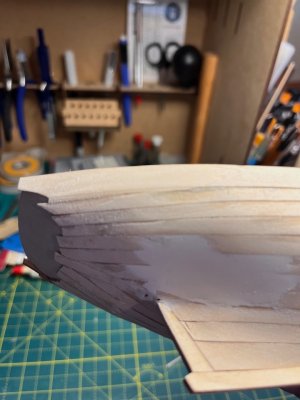
It wasn’t actually very dramatic. They still fit well, though you can see some slight protrusion mainly in the bow.
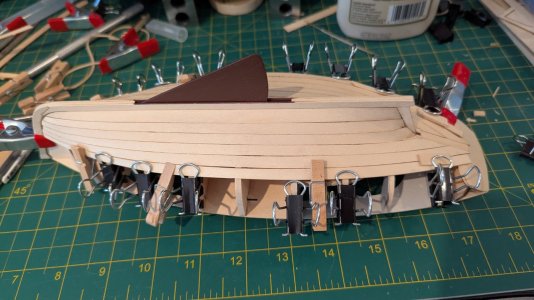
And that’s it - I planked my first POB! I feel like I learned a ton during this step. There’s definitely room for improvement and more advanced techniques, but the end result is about as good as I could’ve hoped for.
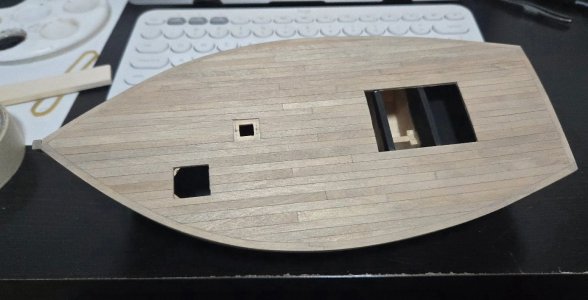
To take a break from the hull, I shifted to the topsides. I carved down the sheer, which was sticking up quite high due to the method I used, and started tracing deck lines to get a sense of the plank widths I want. I may do something intentional around the hatches. I also added the trim where the forward cockpit wall meets the deck (not shown in the photos).
Finally, I tackled the inboard side of the hull planks visible from the cockpit. I went back and forth on repainting the cockpit white or combination of white/grey, but for a working boat that would show dirt and blood instantly. In the end, I kept the grey and also decided to try a diluted brown wash to add depth and tone things down so the cockpit planks fade into the background.
I almost stole some of my wife’s artist paints, but rummaged through my stash first and found some old Testors acrylic washes from Michaels. Olive green (nope), teak (nope), basswood (nope), and mahogany (this could work). They were separated badly, which is probably why they were a on clearance from $10 to $3 each, but after shaking the mahogany it came back to life perfectly. I must've bought these 2-3 years ago, so I'm glad I finally used one!
I started applying it, and felt it blended well, though slightly blotchy and amplified some glue marks I needed to clean up. After dry fitting the seats and coaming, the planks fade nicely into the background while still looking natural.
The hull is sitting around with a coating of filler waiting to be sanded which is not an appropriate activity in my modeling area so I'll need to Head outside to sand with the black flies.
Thanks for checking in.
-Matt