
• SUBSCRIBE TO SHIPS IN SCALE TODAY!

    The beloved Ships in Scale Magazine is back and charting a new course for 2026!
    Discover new skills, new techniques, and new inspirations in every issue.

    NOTE THAT OUR NEXT ISSUE WILL BE MARCH/APRIL 2026
  • Win a Free Custom Engraved Brass Coin!!!
    As a way to introduce our brass coins to the community, we will raffle off a free coin during the month of August. Follow link ABOVE for instructions for entering.

His Majesty's Ship Fowey (44) 1744 by AllanKP69

I have a Foredom flexshaft. StewMac has an accessory that is a plunge router.
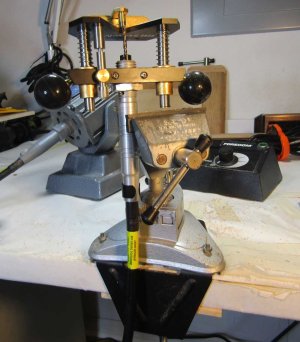
Foredom shaping table.jpg

Upside down it is a shaper. No fence - just roller - which not as fool proof - the cutter is 1/4" twist drill bit with 22.5 degree tip angle
The tool allows the bit to be angled. It was quick to cut the rabbet and if there was a fence I may have been happy with what it did.
The 45 degree wedge - shallow - that a chisel can work off of for the angle change that comes with a garboard going from near horizontal at the deadflat to almost vertical at the ends.
If there is an actual garboard instead of open framing - the angle of the meeting is hidden so it can be faked.
There is a TEMU mini router table so does AliExpress - Ali also has a Dremel version
The TEMU table is Al so drilling bolt holes is easy. The mount for a Foredom HP is a Wolf wax trimmer - it also allows rotation of cutter angle.

Foredom + StewMac is serious money
Foredom + Wolf is serious money
AliExpress + Dremel is $100 if you have the correct Dremel already - it is elementary school when compared to grad school for the other two - but this is not an assembly line doing it over and over thing either.

 
I also created a short series of consecutive scrapers to refine the dynamic profile. Inefficient but satisfying.
THANK YOU VERY MUCH for your input. I truly appreciate it! But now that you opened the door a crack I am trying to push all the way in and ask if you have photos and can describe how you made your scrapers.
nless you are going to leave a portion of the hull unplanked - the rabbet needs to be more functional that perfect.
You are right. The hull will have a portion unplanked midships as requested by the folks receiving the finished model. but the garboard and probably one or two more strakes of planking adjacent to the garboard will be complete so the rabbet will be covered. For this log, I figured if I need to make it, I may as well show it. Hopfully alternative ideas like you have wrote will get posted as the build progresses.

Allan
 
THANK YOU VERY MUCH for your input. I truly appreciate it! But now that you opened the door a crack I am trying to push all the way in and ask if you have photos and can describe how you made your scrapers.

You are right. The hull will have a portion unplanked midships as requested by the folks receiving the finished model. but the garboard and probably one or two more strakes of planking adjacent to the garboard will be complete so the rabbet will be covered. For this log, I figured if I need to make it, I may as well show it. Hopfully alternative ideas like you have wrote will get posted as the build progresses.

Allan
Hi Allen, I did use the word created but instead I should have used the word used. I didn't make anything fancy - I just used what I had on hand to scrape the preliminary chisel-cut rabbet into the shape I needed (and to make it smooth). I used box cutter blades, various XActo blades, the edge of a cabinet scraper that I angled on a disc sander, I have about 20 single-edge razor blades that I have taken a cut-off wheel to in order to create all manner of shapes... Again, nothing sophisticated or special.

Here's a build you might look at: https://shipsofscale.com/sosforums/...-plan-by-jean-boudriot-myself.3009/post-65966
 
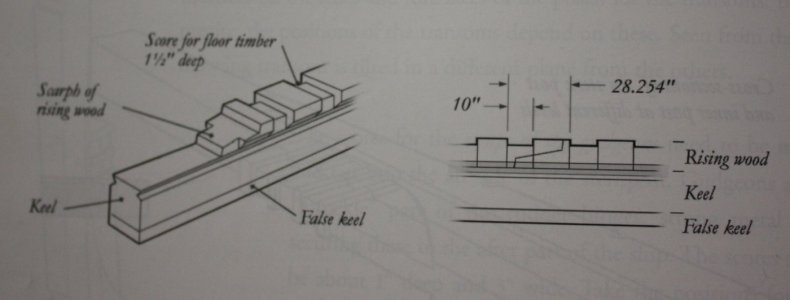
To score or not to score??? I have the keel assembled and ready to add the false keel, stern post, inner post and rising wood. Ships typically had a score on the top and sides of about 1.5" in the rising wood (hog) that sat on top of the keel for the floor timbers. Antscherl comments that this will be imperceptible on the finished model in Volume I of The Fully Framed Model. I am curious to know what others would do. I am good to add them in midships where there will be full framing and forgetting about it fore and aft where there will be alternating frames that will be completed planked over.
Allan

Example by David Antscherl in Volume I of TFFM page 44 for a Swan Class vessel.
1781709048885.jpeg
 
To score or not to score??? I have the keel assembled and ready to add the false keel, stern post, inner post and rising wood. Ships typically had a score on the top and sides of about 1.5" in the rising wood (hog) that sat on top of the keel for the floor timbers. Antscherl comments that this will be imperceptible on the finished model in Volume I of The Fully Framed Model. I am curious to know what others would do. I am good to add them in midships where there will be full framing and forgetting about it fore and aft where there will be alternating frames that will be completed planked over.
Allan

Example by David Antscherl in Volume I of TFFM page 44 for a Swan Class vessel.
View attachment 612758


Having similar thoughts with my Granado design project. It seems that milling them out would be a 'neater' result but gives less flexibility for errors!
 
Thanks Richard,
Milling them is definitely a good way to go. No matter the method it needs to be done spot on regarding location on the keel and square or the frames will be askew. Choices, choices....
Allan
 
Hi Allan,
I cut the notches. It makes it in my opinion much easier to place the parallel frames. I used the technique by my Fly, Alert and Hoy project. You will find fotos of all rising woods on SoS
 
Last edited:
Allan,
When I look at the Antscherl illustration and compare it to the design plan, I cannot reconcile the two.
The following is my interpretation - not statements of hard fact:
The top of the rabbet is the bottom of the floor.
The bottom of the cross chock or half floor or long arm of futtock 1 - depending on the style then current.

The "score" in the rising wood (I have been calling it "deadwood going all the way") falls short of the top of the rabbet.
The only way that the floor bottom edge will meet the top of the rabbet is if there is a corresponding score in the floor..
Some French anatomy illustrations show a complex multipart assembly here.
This is all too hidden and too small for me to even consider replicating. A cross section model maybe.

I use styled framing. Floor = F1. no space in the sequence.
My spaces are totally within F1.
Navy Board style the spaces alternate between floor and F1.
In either style the timbers all side scarph. There are no opennings, so all frames are locked in place before they reach the keel level.
You will be doing a stylized framing also. Very close to actual, but more regular. The actual ship framing would have had chocks between the frame timbers that would side scarph and also lock the frames together before the top of the keel level.
I am not sure about the 1719 Est. era - there was also a 1" or 2" chock at every bolt that tied a bend into a single unit for most of the 18thC. or 19thC. The air gap was necessary because the 15" sided timbers were far from being seasoned.

My hull does not need a keel or top timber jig. The keel-stem - deadwood aft - sternpost go on last just as with a carved hull.
BUT - IF I did build on the keel, I would not cut notches. Too many opportunities for error. I would glue a scab on top of the keel.
You will have floor width + F1 width + space. The deadwood/short scab would be F1 + space. Glued on deadwood pieces is easier to fix. Isopropanol if PVA or hot ethanol if hide glue.

My answer to your "to score or not to score" question is "No" - "Never"
 
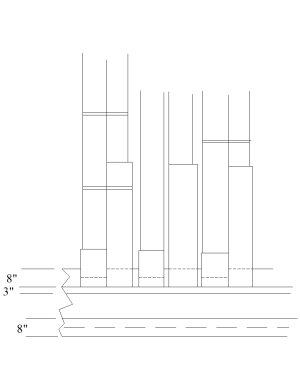
Thanks Dean/ I am not sure what you are describing. :( Can you make a drawing? For example what is a side scarph? I know hook and butt and other types but cannot picture a side scarph. A dozen or so frames will be set up as below. Note that the false keel on the contemporary drawing is 8 inches thick. From what I found, this may have been a double layer as it is twice as thick as any scantlings I found in the Establishment, or, the draftsman made a mistake. I found this to be quite different but lacking more information also based on contemporary sources I will likely go with the original drawing. I THINK I got this right what with the ghost lines and such, but my mind is in a fog so there might be mistakes in the sketch below. I did not show the filler/spacer pieces between the frames in this sketch.
Allan

1781780752740.jpeg
 
I do not draw so good.

I read that the original definition of a scarph was the side overlap.
The first use was probably F1 actually touching the side of the floor and the side of F2 to turn an end grain to end grain butt joint into two layer plywood.

(I did reading about early hull assembly methods - shell first - the hybrid transition - the frame first - seeking historical justification and precedence for my framing method and found that scarph first mentioned there.)

The scarphs within two parts of a strake - the Z of your keel - the top and butt or anchor stock of a wale - kinda hijacked the original definition of what a scarph is - so I call it a "side scarph" i.e. overlapping reenforcement.

In your pic above -the left part is a bend. Floor and F1 are touching. F1 and F2 are touching.
The two sets of parallel horizontal lines - they are a bolt joining F1 to F2 and F2 to F3?

In the actual vessel I am proposing that there was a piece of Pine 1" thick between F1 and F2 and between F2 and F3. It may have been 6"x6" but the bolt would go thru the middle of it. The name for it is chock. I think every bolt had one.

I also propose that the single filling frame beside the bend also had bolts or trunnels attaching it to the bend and that there was a chock that was the thickness of the space in the way of it. The floater frame did not actually float unsupported..
It sure would make rotating a frame assembly from flat on the ground to perpendicular a lot less prone to breaking at the timber butts. 50% heavier but that is less trouble than dealing with something that is flimsy?

OK - I looked again - either the floater frames on either side of a bend was chock attached - making the rotation a four frame operation or the two floaters were chock attached and they were functionally a bend during assembly?

For a model - air spaces and chocks are not very pretty to look at - Our wood is already seasoned and will not be exposed to water - so no practical reason to include them. For a museum model I would leave them off. For a demo model for a young gentlemen - future officer engineering or NA classroom demo model - I would include them.

this may have been a double layer as it is twice as thick as any scantlings
I vote that it was double and not a mistake. They knew the sandy bottom lots of sandbars nature of the southern North American shore line - a cheap sacrifice and easy to replace.

The 3" pair of horizontal lines are the rabbet?
The dashed line across the floor - in the 8" zone =?
The dashed line across F1 at a higher level - in the 8" zone =?

I would just sit the bend on top of the keel rabbet. No score.
The solid horizontal line in the space would define a piece of deadwood. If I had to have a notch on top of the keel, I would just glue all of those pieces to the top of the keel before I slud the bends and frames into place.

Lazy me - I would probably forget the whole notch/deadwood/ rising wood thing altogether and just drill a vertical hole for a pin or Bamboo dowel thru the floor and the keel and have done with it. The keelson will hide the top and if you hold off fitting it -the false keel will hide the bottom. A Dritz stainless steel quilters pin is #70 push fit - easy to obtain - strong - and I will be long long gone before it would rust - if SS even rusts.

You do know that the single floater frames and F3<F1 and F2<floor will be a royal pain the keep track of?
Temp spacers are a big help. Double stick tape (Scotch) will hold the spacers but first give the wood a coating of shellac.
The narrow spacers can be poster board. It need not be wood when it is thin.
 
Back
Top